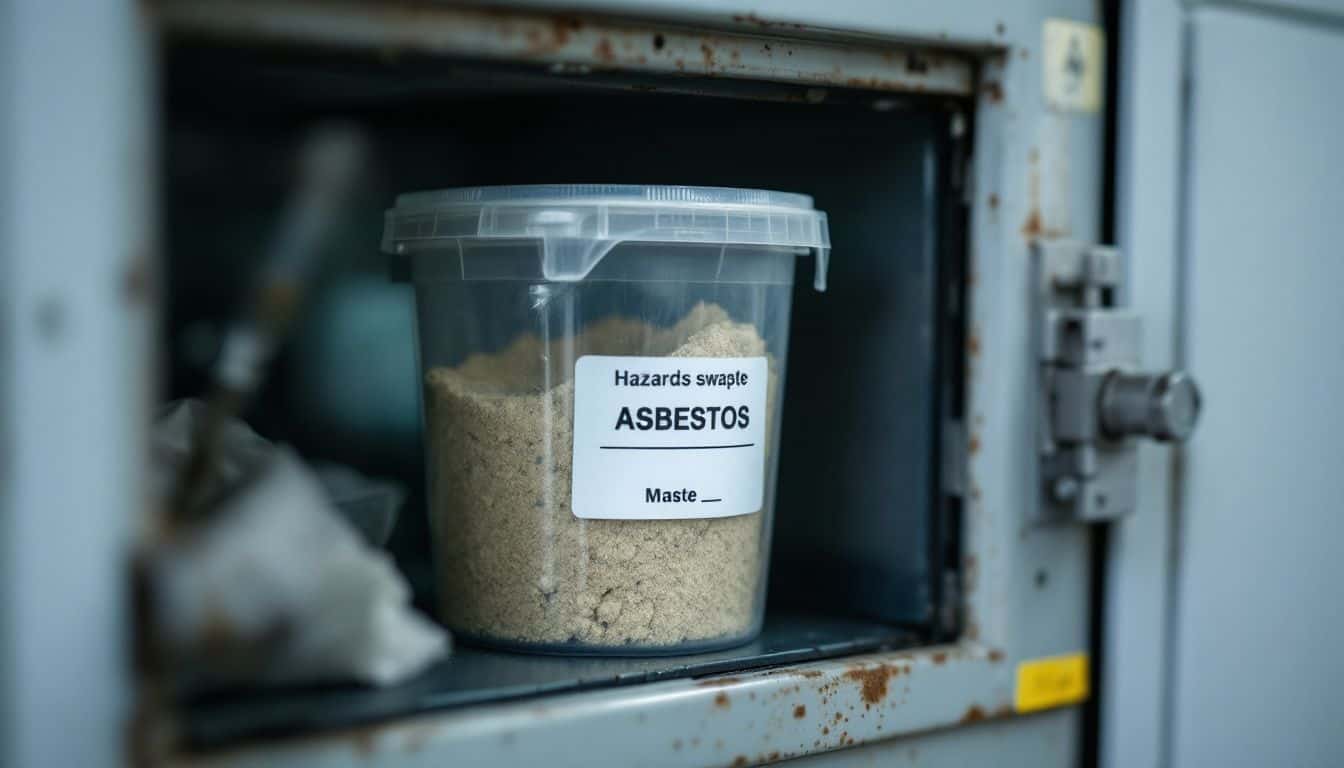
Why Asbestos Sampling Bags Matter More Than You Might Think
When a surveyor takes a sample from a suspected asbestos-containing material, what happens next is just as critical as the sample itself. The way that material is collected, contained, and transported determines whether fibres stay locked away — or become a serious health hazard. Asbestos sampling bags are the first line of defence in that process, and getting their use right is non-negotiable under UK law.
This isn’t just about ticking a compliance box. Mesothelioma, asbestosis, and asbestos-related lung cancer are all caused by inhaling fibres invisible to the naked eye. A poorly sealed sample bag, an unlabelled container, or the wrong packaging method can undo every other precaution taken on site.
What Are Asbestos Sampling Bags and Why Are They Specialised?
Asbestos sampling bags are not ordinary zip-lock bags or general-purpose hazardous waste containers. They are purpose-built receptacles designed specifically to contain asbestos fibres without any risk of release during handling, storage, or laboratory transit.
Proper asbestos sampling bags are typically made from heavy-duty polythene and feature secure, airtight seals. They are pre-labelled with asbestos hazard warnings and often colour-coded to meet waste classification requirements. The bags used during a survey must be robust enough to withstand handling without tearing, and they must be compatible with the double-wrapping protocol required under HSE guidance.
What Makes a Bag Suitable for Asbestos Samples?
- Heavy-gauge polythene construction — typically at least 250 microns for outer bags
- Airtight resealable closure or heat-seal capability
- Pre-printed asbestos hazard warning labels
- Sufficient size to accommodate the sample without forcing the seal
- Compatibility with a secondary outer bag for double-wrapping
- Clear space for handwritten identification details including location, date, and sample reference
Using substandard bags — even briefly — creates a genuine contamination risk and puts both the handler and anyone else in the vicinity in danger. Purpose-made asbestos sampling bags are not optional; they are a fundamental requirement of safe and legally compliant sampling.
The Correct Protocol for Using Asbestos Sampling Bags on Site
The protocol for collecting and bagging asbestos samples follows HSE guidance, particularly HSG264, which governs asbestos surveys. Every step matters, and shortcuts are not acceptable.
Step 1 — Prepare the Area and PPE Before Sampling
Before any material is disturbed, the surveyor must be wearing appropriate personal protective equipment. This includes a correctly fitted FFP3 respirator, disposable Type 5 coveralls, nitrile gloves, and overshoes. The sampling area should be isolated where possible to limit the spread of fibres.
Have your asbestos sampling bags open and ready before you begin. You should never be fumbling with packaging after the material has been disturbed — every second the sample is exposed is a second fibres can become airborne.
Step 2 — Collect the Sample Using Wet Methods
Wetting the material before sampling is standard practice. A fine water mist applied to the surface suppresses fibre release significantly. Use a sharp, clean implement — typically a knife or chisel — to remove a small but representative portion of the material.
A sample of around 1–2 cm² is usually sufficient for laboratory analysis. Avoid aggressive cutting or breaking that creates dust. Slow, deliberate movements with wet suppression are the correct approach — the goal is a clean sample with minimal fibre disturbance.
Step 3 — Place the Sample Directly into the Inner Sampling Bag
The sample goes straight into the inner asbestos sampling bag — no delays, no placing it on a surface first. Seal the inner bag immediately and firmly. If the bag uses a zip-lock mechanism, run your fingers along the seal twice to confirm it is fully closed.
Wipe the outside of the inner bag with a damp cloth to remove any surface contamination before placing it into the outer bag. This step is often skipped under time pressure, but it matters.
Step 4 — Double-Wrap the Sample
Double-wrapping is a requirement, not a recommendation. The sealed inner bag goes into a second, larger asbestos sampling bag. This outer bag is then sealed in the same manner. This two-layer system ensures that even if the inner seal is compromised during transit, the fibres remain contained.
Label the outer bag clearly with:
- The word ASBESTOS prominently displayed
- Sample reference number
- Location within the building — floor, room, and material type
- Date of sampling
- Name of the surveyor or company
- Destination laboratory details
Step 5 — Clean Up and Decontaminate
Once the sample is bagged, the immediate area must be cleaned using a Type H vacuum cleaner. Standard vacuums are not suitable — they can redistribute fibres rather than capture them. Any disposable materials used during sampling, including wipes and PPE, should be treated as asbestos waste and bagged separately.
The surveyor should remove PPE carefully, rolling coveralls inward to contain any surface contamination, and dispose of them in a dedicated asbestos waste bag — never in general waste.
Legal Requirements Governing Asbestos Sample Handling in the UK
The Control of Asbestos Regulations sets the legal framework for all asbestos-related activities in the UK, including the sampling process. These regulations place a duty on employers and those in control of premises to manage asbestos safely — which includes ensuring that any sampling activity is carried out by competent individuals using appropriate materials and methods.
HSG264, the HSE’s guidance document for asbestos surveys, provides detailed practical guidance on how surveys should be conducted, including the collection and handling of samples. Surveyors working under this guidance are expected to follow documented procedures covering every stage from site preparation through to laboratory submission.
Who Can Legally Take Asbestos Samples?
Sampling during a management or refurbishment and demolition survey must be carried out by a surveyor who holds the appropriate competency. In practice, this means surveyors working for companies accredited by the United Kingdom Accreditation Service (UKAS) to ISO 17020. This accreditation demonstrates that the organisation’s sampling and inspection procedures meet a recognised standard.
Unaccredited sampling — even if the individual is experienced — does not provide the legal assurance required for compliance purposes. If you are commissioning an asbestos survey, always verify that the company holds current UKAS accreditation before work begins.
Notifiable Non-Licensed Work and Sampling Obligations
Some lower-risk asbestos work falls under the category of Notifiable Non-Licensed Work (NNLW). Even in these cases, strict protocols apply. Workers must be trained, the work must be notified to the relevant enforcing authority, and health surveillance records must be maintained.
The sampling and containment requirements do not become less stringent simply because the work does not require a full licence. Asbestos sampling bags must still meet the required standard, and the full double-wrapping and labelling protocol still applies.
Transporting Asbestos Samples to the Laboratory
Once bagged and labelled, samples need to reach an accredited laboratory for analysis. The transport of asbestos samples is subject to regulations governing the carriage of dangerous goods. In practical terms, this means samples must be placed inside a rigid outer container — typically a sealed plastic box or a purpose-built sample transit case — in addition to the double-wrapped bags.
The rigid container provides protection against physical damage during transit that could compromise the bag seals. It also provides an additional layer of containment in the event of an accident. The container itself should be labelled to indicate its contents.
Laboratories accredited by UKAS to ISO 17025 are the appropriate destination for asbestos samples. They use polarised light microscopy (PLM) or transmission electron microscopy (TEM) to identify the type and concentration of asbestos fibres present. The results form the basis of the asbestos register and management plan — documents that are legally required for most non-domestic premises.
Asbestos Waste Classification and Disposal After Sampling
Asbestos waste — including used sampling bags, PPE, and any other contaminated materials — is classified as hazardous waste in the UK. It cannot be placed in general waste streams under any circumstances.
Friable vs Non-Friable Asbestos Waste
The classification of asbestos waste as friable or non-friable affects how it is handled and disposed of. Friable asbestos — such as pipe lagging, sprayed coatings, and loose insulation — can release fibres very easily when disturbed. It requires the most stringent containment and is always treated as high-risk waste.
Non-friable asbestos, such as asbestos cement sheets or floor tiles, is less likely to release fibres when intact. However, once it has been cut, drilled, or disturbed during sampling, it must still be treated as hazardous waste and disposed of accordingly.
Approved Disposal Routes for Asbestos Waste
Asbestos waste from sampling must go to a licensed hazardous waste disposal facility. The waste must be accompanied by a consignment note — a legal document that records the transfer of hazardous waste from the producer to the carrier and then to the disposal facility. This creates an auditable chain of custody.
Never dispose of asbestos sampling waste in skips, general bins, or unlicensed facilities. The penalties for improper asbestos waste disposal are severe, and the environmental and public health consequences can be significant. If you are unsure about disposal routes, the Environment Agency (in England) or Natural Resources Wales can provide guidance on licensed facilities in your area.
For larger projects, understanding the full scope of asbestos removal requirements — from containment through to licensed disposal — is essential for any property owner or facilities manager overseeing significant works.
Common Mistakes When Using Asbestos Sampling Bags
Even experienced operatives can fall into habits that compromise the integrity of the sampling process. These are the errors that come up most frequently — and the ones most likely to create compliance problems or health risks.
- Using single-layer bags only. Double-wrapping is mandatory. A single bag, however robust, does not meet the required standard.
- Inadequate labelling. A bag marked only with “asbestos” is not sufficient. Full identification details must be included on every outer bag.
- Sealing bags away from the sample area. Bags should be sealed as close to the sample as possible, then moved away from the work area immediately.
- Storing samples loose in a vehicle. Samples must be in a rigid outer container during transport — not loose in a bag or on a seat.
- Disposing of PPE in general waste. Contaminated coveralls, gloves, and masks are asbestos waste and must be bagged and disposed of as such.
- Using non-specialist bags. Standard zip-lock bags or food-grade polythene are not appropriate. Purpose-made asbestos sampling bags are required.
- Skipping the wipe-down of the inner bag. Surface contamination on the outside of the inner bag can transfer to the outer bag and to hands during handling.
When Sampling Becomes Part of a Larger Survey or Demolition Project
Asbestos sampling bags play a role in every type of asbestos survey — from routine management surveys through to full refurbishment and demolition surveys. The sampling protocols described above apply across all survey types, but the scope and intensity of sampling varies significantly depending on the purpose of the survey.
A demolition survey requires the most thorough sampling approach. Every part of the structure that will be disturbed must be assessed, and sampling must be intrusive enough to identify all asbestos-containing materials before demolition work begins. The number of samples taken — and therefore the volume of asbestos sampling bags required — can be substantial on larger sites.
Surveyors working on demolition projects must be particularly rigorous about sample identification and chain of custody documentation, because the results directly inform the asbestos management plan that demolition contractors are legally required to follow.
Asbestos Surveys Across the UK — Regional Considerations
The protocols for asbestos sampling bags and sample handling are consistent across England, Scotland, Wales, and Northern Ireland — the regulations apply nationwide. However, the volume and type of asbestos survey work varies significantly by region, reflecting differences in building stock, industrial heritage, and development activity.
In London, the density of older commercial and residential buildings means that asbestos survey demand is consistently high. Properties ranging from Victorian terraces to 1970s office blocks regularly require thorough sampling. Our team conducting an asbestos survey London follows the same rigorous sampling protocols regardless of the property type or age.
In the North West, industrial heritage means that older factories, warehouses, and public buildings frequently contain significant quantities of asbestos-containing materials. Our surveyors undertaking an asbestos survey Manchester are well versed in the types of materials — pipe lagging, sprayed coatings, and insulating board — most commonly encountered in that region’s building stock.
In the Midlands, the mix of Victorian-era industrial buildings and post-war commercial premises creates a similarly complex picture. An asbestos survey Birmingham often involves sampling a wide range of material types, and the correct use of asbestos sampling bags throughout that process is just as critical as anywhere else in the country.
Frequently Asked Questions
What are asbestos sampling bags made from?
Asbestos sampling bags are made from heavy-duty polythene, typically with a gauge of at least 250 microns for outer bags. They feature airtight seals — either resealable zip-lock closures or heat-seal mechanisms — and are pre-printed with asbestos hazard warning labels. Standard polythene bags, food-grade zip-lock bags, or general waste sacks are not suitable substitutes.
Is double-wrapping in asbestos sampling bags a legal requirement?
Yes. Double-wrapping is required under HSE guidance, specifically HSG264, which governs asbestos surveys in the UK. The inner bag contains the sample directly; the outer bag provides a secondary layer of containment. Both bags must be sealed and the outer bag must be fully labelled before the sample is moved from the sampling area.
Can I transport asbestos samples in just the double-wrapped bags?
No. In addition to the double-wrapped asbestos sampling bags, samples must be placed inside a rigid outer container — such as a sealed plastic box or a purpose-built transit case — for transport. This protects the bag seals from physical damage during transit and provides an additional containment layer. Transporting samples loose in a vehicle does not meet the requirements for the carriage of dangerous goods.
Who is permitted to take asbestos samples in the UK?
Asbestos samples taken as part of a survey must be collected by a competent surveyor working for a company accredited by the United Kingdom Accreditation Service (UKAS) to ISO 17020. Unaccredited sampling does not provide the legal assurance required for compliance purposes. Always verify UKAS accreditation before commissioning any asbestos survey or sampling work.
How should asbestos sampling waste — including used bags and PPE — be disposed of?
All waste generated during asbestos sampling, including used asbestos sampling bags, PPE, wipes, and any other contaminated materials, is classified as hazardous waste under UK law. It must be disposed of at a licensed hazardous waste facility and must be accompanied by a consignment note. It cannot be placed in general waste, skips, or unlicensed facilities under any circumstances.
Get Expert Asbestos Sampling and Survey Support from Supernova
Supernova Asbestos Surveys has completed over 50,000 surveys nationwide, working with property managers, facilities teams, local authorities, and private clients across the UK. Every survey we carry out follows HSE guidance and UKAS-accredited procedures — including the correct use of asbestos sampling bags at every stage of the process.
Whether you need a management survey, a refurbishment and demolition survey, or specialist advice on asbestos sampling and waste disposal, our team is ready to help. Call us on 020 4586 0680 or visit asbestos-surveys.org.uk to find out more or request a quote.