One missing asbestos register can turn routine maintenance into a costly, dangerous mistake. If contractors drill into a wall, lift ceiling tiles, or open a riser without accurate asbestos information, the result can be exposure, work stoppages, enforcement action, and a serious compliance problem for the dutyholder.
For any non-domestic premises that may contain asbestos, the asbestos register is one of the most important documents you hold. It sits at the centre of asbestos management under the Control of Asbestos Regulations, and it needs to be accurate, accessible, and kept up to date.
If you manage an office, warehouse, school, industrial unit, retail site, or the common parts of a residential block, you need to know what an asbestos register is, what it should contain, and how to maintain it properly. Done well, it protects contractors, occupants, and your organisation. Done badly, it leaves gaps that can quickly become liabilities.
What is an asbestos register?
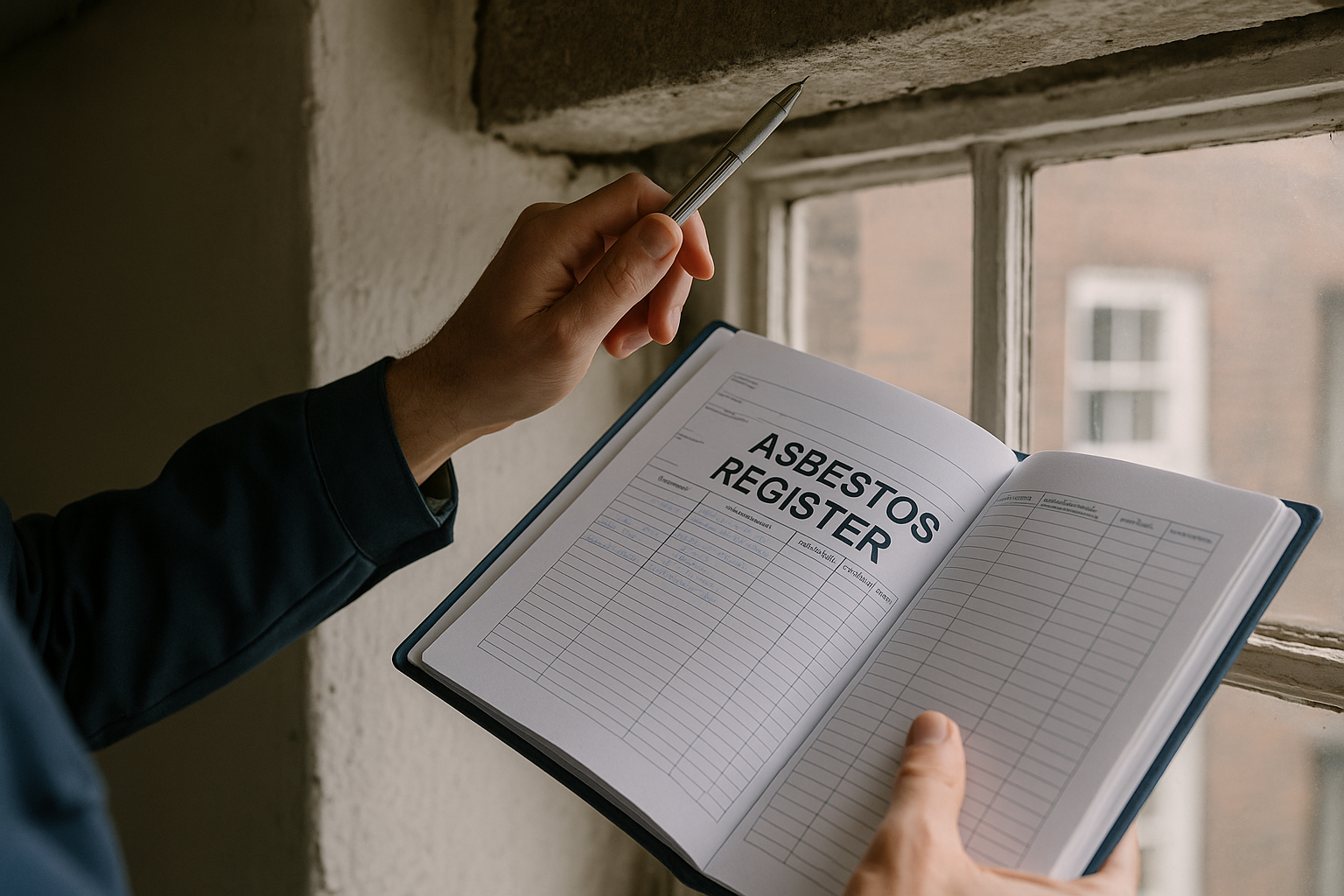
An asbestos register is a written record of asbestos-containing materials, or presumed asbestos-containing materials, within a building. It identifies where those materials are, what they are, what condition they are in, and the risk they present if disturbed.
It is usually created following an asbestos survey and forms part of the wider asbestos management plan. The register is not just a list. It is a working document used to inform maintenance, repairs, contractor control, and day-to-day safety decisions.
In practical terms, your asbestos register should help someone answer a simple question before work begins: is there asbestos here, and what do I need to do about it?
Why an asbestos register matters in non-domestic buildings
Asbestos is still present in many UK buildings, particularly those built or refurbished before asbestos use was fully prohibited. It may be found in insulation board, pipe lagging, textured coatings, floor tiles, cement products, sprayed coatings, ceiling panels, and many other materials.
If those materials remain in good condition and are not disturbed, they can often be managed in place. The problem starts when nobody knows they are there, or when the information held is vague, outdated, or inaccessible.
A proper asbestos register helps you:
- identify asbestos-containing materials before work starts
- reduce the risk of accidental disturbance
- brief contractors and maintenance teams properly
- prioritise repairs, encapsulation, or removal
- demonstrate compliance with the Control of Asbestos Regulations
- show HSE inspectors that asbestos risks are being managed
For property managers, facilities teams, landlords, and managing agents, this is not paperwork for its own sake. It is a practical control measure that supports safe occupation and maintenance of the building.
Who is responsible for the asbestos register?
Responsibility usually sits with the dutyholder. Under the Control of Asbestos Regulations, the dutyholder is the person or organisation responsible for maintenance and repair of non-domestic premises, or the person with control over that part of the premises.
That may be:
- the building owner
- a landlord
- a tenant, depending on lease terms
- a managing agent acting on behalf of the owner or landlord
- a facilities management team with delegated responsibilities
In multi-occupied buildings, duties can be shared. Common areas in residential blocks, such as plant rooms, stairwells, corridors, service risers, and lift motor rooms, are also covered.
The key point is simple: if you control maintenance or repair, you may also carry responsibility for ensuring the asbestos register exists and is maintained. If lease terms or management arrangements are unclear, get that clarified early. Confusion over responsibility does not remove the legal duty.
What the dutyholder must do
The dutyholder should make sure reasonable steps are taken to find out if asbestos is present, assess the risk, and keep records up to date. They also need to make sure information from the asbestos register is provided to anyone liable to disturb asbestos.
That means the register must not sit forgotten in a file. It should be part of your contractor control process, permit systems, and planned maintenance procedures.
What should an asbestos register include?
HSE guidance, including HSG264, sets out the standard expected from asbestos surveys and the records that follow from them. A useful asbestos register should be detailed enough for someone on site to understand exactly what is present and where.
1. Precise location of each material
Descriptions need to be specific. “Ceiling panel in warehouse” is not enough. A good entry should identify the building, floor, room, element, and where helpful, the position within that room.
For example:
- asbestos insulation board to soffit within first-floor electrical riser, north core
- textured coating to ceiling in ground-floor office 3
- asbestos cement flue on external elevation above loading bay
Floor plans, photographs, and reference numbers make the asbestos register much easier to use.
2. Product type and asbestos type where known
The register should record the material or product identified, such as asbestos insulation board, cement sheet, floor tile, lagging, or sprayed coating. Where sampling and analysis have been carried out, it should also note the asbestos type identified.
If no sample has been taken, the material may be recorded as a presumed asbestos-containing material. That is acceptable where appropriate, but it must be clearly marked as presumed rather than confirmed.
3. Condition of the material
Condition is central to risk. A sealed and undamaged material in a locked service area presents a different issue from damaged debris in a frequently accessed plant room.
The asbestos register should record whether the material is:
- in good condition
- showing minor damage or surface wear
- poor, friable, or deteriorating
- sealed, painted, or encapsulated
- exposed or vulnerable to impact
Condition assessments should be clear enough to support management decisions and future re-inspections.
4. Material and priority risk information
The register should include the risk information arising from the survey. This often reflects both the material assessment and the likelihood of disturbance in normal occupation or maintenance.
That helps you decide what needs urgent action, what can be managed in place, and where contractor controls need to be tighter.
5. Recommended action
An asbestos register should not stop at identification. It should say what needs to happen next. Common recommendations include:
- leave in place and monitor
- label where appropriate
- repair minor damage
- encapsulate to protect the surface
- restrict access
- arrange removal by a competent contractor
- carry out further inspection or sampling
These actions should feed directly into the asbestos management plan.
6. Survey details
You should be able to see who carried out the survey, when it was completed, and what areas were inspected. Any limitations are especially important. If certain rooms, voids, or service areas were not accessed, the asbestos register should make that clear.
That avoids a common mistake: assuming “not inspected” means “asbestos not present”. It does not.
How an asbestos register is created
The asbestos register is normally produced from the findings of a professional asbestos survey. The right survey depends on what is happening at the property.

Management survey
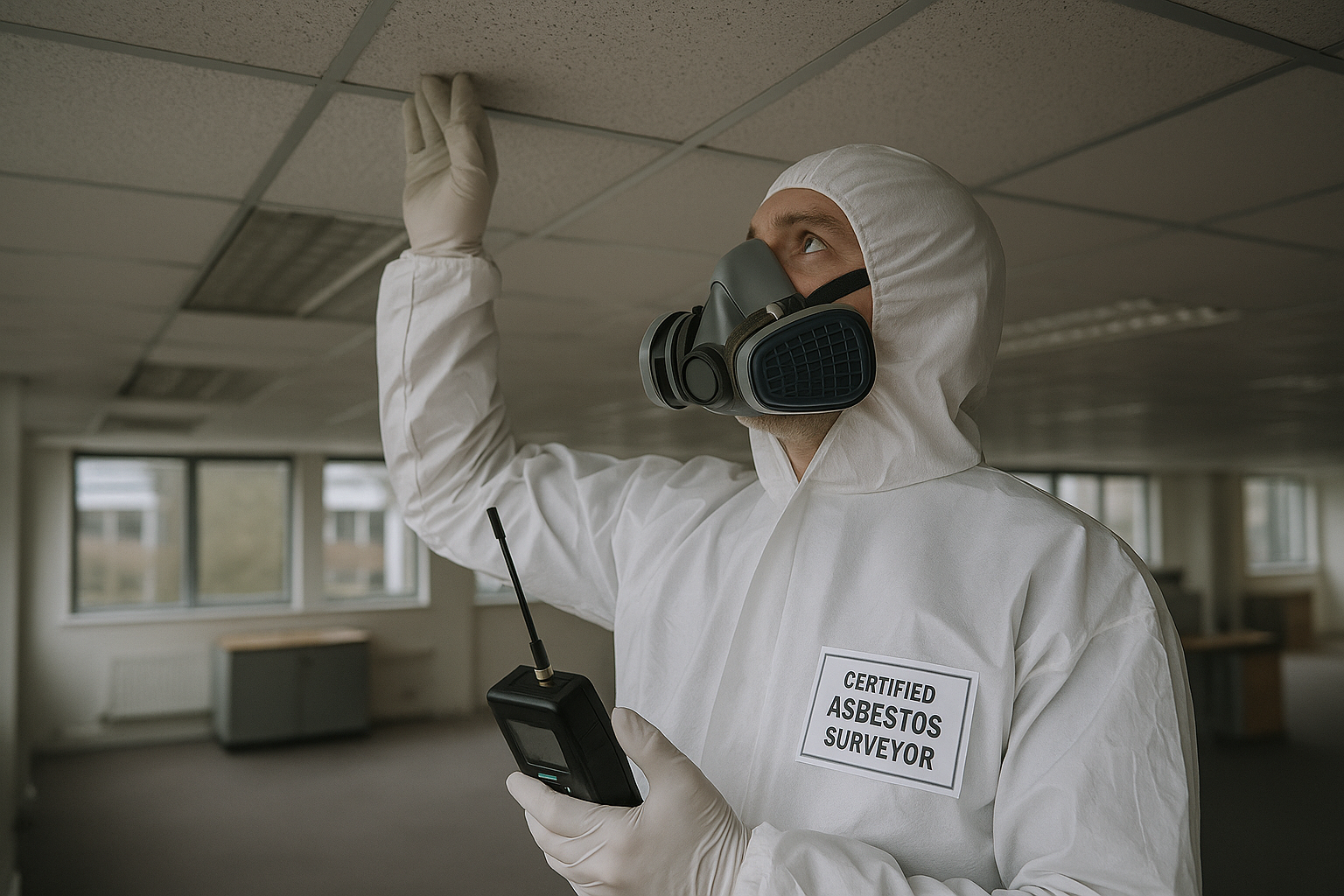
For occupied buildings in normal use, the starting point is usually a management survey. This is designed to locate, as far as reasonably practicable, asbestos-containing materials that could be disturbed during routine occupation, maintenance, or installation work.
It is generally non-intrusive or only lightly intrusive, depending on access and the building layout. The information gathered is then used to create or update the asbestos register for ongoing management.
Refurbishment survey
If you are planning renovation, strip-out, reconfiguration, or major upgrades, you will usually need a refurbishment survey. This is more intrusive because it must identify asbestos in the areas affected by the planned works.
It does not replace the asbestos register for the whole building, but its findings must be reflected in your records. If new asbestos-containing materials are identified, or if presumed materials are confirmed through sampling, your register should be updated before works proceed.
Demolition survey
Where a structure is due for full or partial demolition, a demolition survey is required. This is the most intrusive survey type and aims to locate all asbestos-containing materials, so they can be dealt with before demolition starts.
Again, the findings affect the asbestos register and wider project planning. Demolition should never proceed on assumptions.
How to keep an asbestos register up to date
An asbestos register is not a one-off document. It needs regular review and updating, because buildings change, materials deteriorate, and new information becomes available.
This is where many organisations fall short. They commission a survey, file the report away, and assume the job is done. It is not.
When to update the asbestos register
Your asbestos register should be reviewed and updated when:
- known asbestos-containing materials are re-inspected
- their condition changes
- maintenance work affects the area
- refurbishment reveals additional materials
- sampling confirms or disproves presumed asbestos
- encapsulation, repair, or removal has been completed
- areas previously inaccessible become accessible and are surveyed
If the building has had years of reactive maintenance, tenant alterations, or undocumented changes, a review of the existing asbestos register is often sensible. Older registers can contain vague room descriptions, outdated layouts, or references to materials that have since been removed.
Re-inspections
Known or presumed asbestos-containing materials should be re-inspected at suitable intervals. The exact frequency depends on the material, its condition, its location, and the likelihood of disturbance.
Annual re-inspection is common for many premises, but higher-risk materials or busy environments may justify more frequent checks. Lower-risk materials in stable, secure areas may support a different schedule if that decision is properly reasoned and recorded.
Each re-inspection should confirm:
- whether the material is still present
- whether its condition has changed
- whether the risk of disturbance has altered
- whether the existing management action remains suitable
If anything has changed, the asbestos register should be amended straight away.
After works are completed
Any building work, however small, should trigger a review of the asbestos register if it affected an area with known or presumed asbestos. If asbestos has been removed, repaired, enclosed, or made inaccessible, the record should reflect that.
This is especially important after fit-outs, M&E upgrades, partition changes, and service installations. Those are the jobs most likely to expose gaps between what the register says and what is actually on site.
Who needs access to the asbestos register?
The asbestos register must be available to anyone who may disturb asbestos in the course of their work. That includes internal teams and external contractors.
As a minimum, consider access for:
- maintenance engineers
- electricians, plumbers, and HVAC contractors
- IT and cabling installers
- fire alarm and security engineers
- cleaning and facilities teams working in service areas
- project managers planning intrusive works
- emergency responders where relevant
Access does not always mean handing over the full report to every visitor. It means making sure the relevant information is provided before work starts, in a format they can understand and use.
Practical ways to manage access
Good practice includes:
- keeping the asbestos register in a central digital system or controlled site file
- checking it during contractor induction and permit-to-work processes
- highlighting affected rooms and building elements on plans
- briefing contractors on presumed asbestos as well as confirmed findings
- making sure site staff know how to find the latest version
If your process relies on one person remembering to email a PDF every time work is booked, it is fragile. Build the asbestos register into your normal maintenance workflow.
Common asbestos register mistakes to avoid
Even where a register exists, it is not always good enough. The most common failures are practical rather than technical.
Using an out-of-date register
Old room numbers, missing tenant fit-outs, and removed materials still listed as present can all undermine the value of the document. Review the register whenever the building changes.
Assuming inaccessible areas are asbestos-free
If an area was not accessed, that should be clearly recorded. Arrange follow-up inspection when access becomes possible. Do not let “no information” become “no risk” by default.
Failing to brief contractors
Having an asbestos register is not enough if nobody checks it before work starts. Build a mandatory review step into maintenance planning and permits.
Not recording presumed asbestos properly
Presumed asbestos-containing materials need to be managed just as carefully until proven otherwise. Make sure they are clearly identified in the register and communicated to anyone working nearby.
Separating the register from the management plan
The asbestos register tells you what is there. The management plan sets out how it will be controlled. If those two documents do not align, action points can be missed.
What happens if you do not have an asbestos register?
If you are responsible for a non-domestic building and there is no suitable asbestos register in place, you may be in breach of the Control of Asbestos Regulations. The HSE can require improvements, stop unsafe work, or take enforcement action where dutyholders fail to manage asbestos risk properly.
The legal issue is only part of the problem. Operationally, the absence of an asbestos register can lead to:
- work delays while emergency surveys are arranged
- contractors refusing to proceed
- unexpected project costs
- contamination incidents after accidental disturbance
- tenant complaints and reputational damage
- difficulties during property transactions and compliance audits
For industrial settings in particular, where plant rooms, ducts, service runs, roof sheets, and older insulation materials are common, the risk of accidental disturbance can be higher if records are poor.
Practical steps to improve your asbestos register today
If you are not confident your asbestos register is current and usable, start with a simple review.
- Check the survey date. If it is old, or the building has changed since it was produced, it may need updating.
- Review limitations. Look for areas marked inaccessible, not inspected, or presumed.
- Compare the register to the building. Make sure room names, layouts, and tenancy arrangements still match reality.
- Check re-inspection records. Confirm known materials have been revisited at suitable intervals.
- Test your contractor process. Ask how an engineer booked for tomorrow would access asbestos information before starting work.
- Plan the right survey. Use a management survey for ongoing occupation, and the correct intrusive survey before refurbishment or demolition.
If you operate across multiple sites, standardise your approach. A consistent asbestos register format, regular review cycle, and clear contractor briefing process will make compliance far easier to manage.
Local support for asbestos surveys and registers
If your property portfolio spans different regions, local survey support can speed up inspections and reporting. Supernova provides survey services across the country, including asbestos survey London, asbestos survey Manchester, and asbestos survey Birmingham.
That means you can arrange the right survey type quickly, whether you need to establish an asbestos register for a newly acquired building, update records after tenant changes, or prepare for intrusive works.
Frequently Asked Questions
Is an asbestos register a legal requirement?
For non-domestic premises where asbestos is present or likely to be present, the duty to manage under the Control of Asbestos Regulations means you need an accurate record of asbestos-containing materials or presumed materials. In practice, that record is your asbestos register, and it is a core part of compliance.
Does every building need an asbestos register?
Not every building automatically needs one, but many non-domestic buildings do, particularly older premises where asbestos may still be present. The duty applies to non-domestic properties and the common parts of residential blocks. If asbestos is present or presumed present, it should be recorded and managed.
How often should an asbestos register be updated?
It should be updated whenever there is new information, such as re-inspection findings, changes in condition, sampling results, removal works, or refurbishment activity. Periodic review is essential, and many buildings require regular re-inspections of known materials.
Can I create an asbestos register without a survey?
Not reliably. An asbestos register should be based on competent inspection and, where appropriate, sampling and analysis. Without a survey, you are likely to miss materials, misdescribe risks, or fail to identify inaccessible areas that need further attention.
What is the difference between an asbestos register and an asbestos management plan?
The asbestos register records what asbestos-containing materials are present, where they are, and what condition they are in. The asbestos management plan explains how those materials will be controlled, monitored, communicated, and reviewed over time. You need both working together.
If you need a new asbestos register, an update to an existing one, or the right survey before works begin, Supernova Asbestos Surveys can help. We provide management, refurbishment, and demolition surveys nationwide. Call 020 4586 0680 or visit asbestos-surveys.org.uk to arrange expert support.