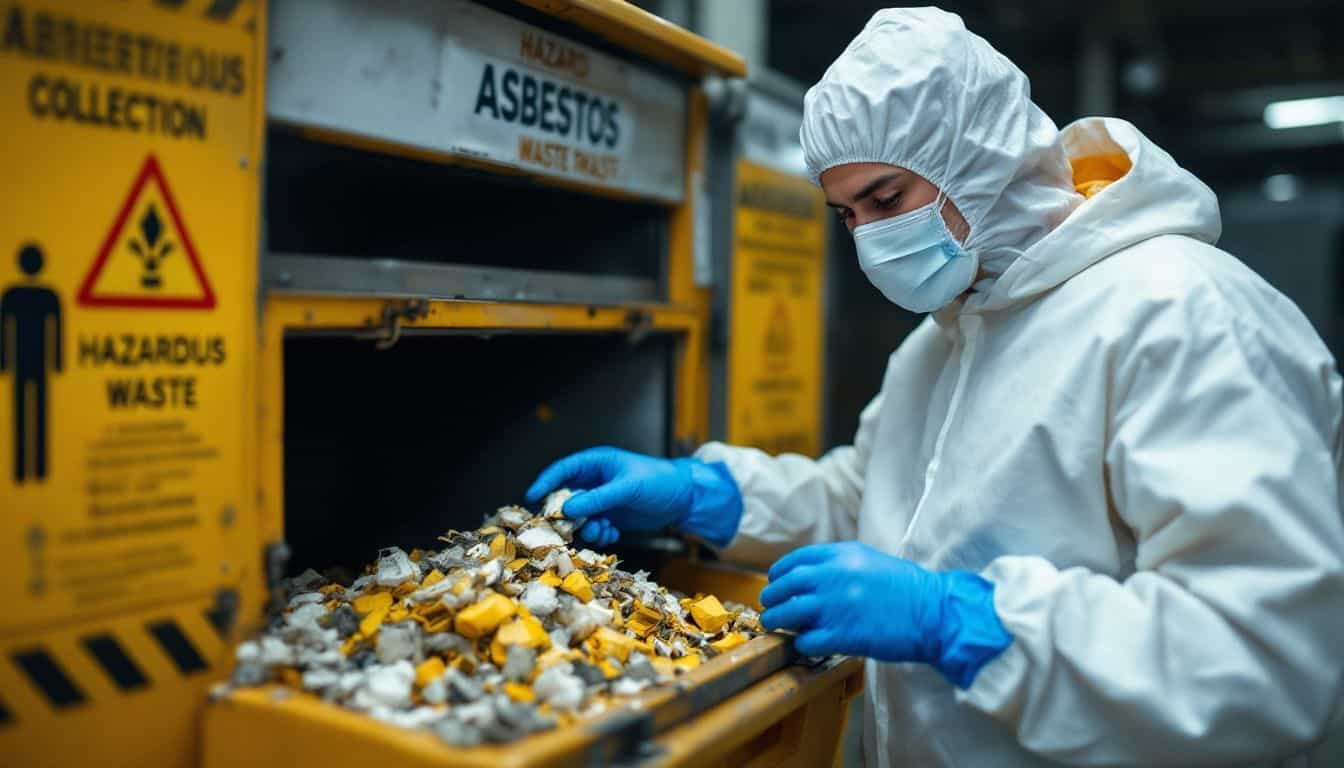
Asbestos Waste Disposal: Why Regular Bins Are Never an Option
Asbestos waste disposal is one of the most tightly regulated activities in the UK — and for good reason. Get it wrong and you’re not just risking a hefty fine; you’re potentially endangering everyone who comes into contact with that waste, from the refuse collector who unknowingly handles it to the people living near an illegal dumping site.
If you’ve recently had asbestos-containing materials (ACMs) identified in a property, or you’re managing a refurbishment or demolition project, understanding exactly how to handle asbestos waste is non-negotiable. The legal framework is strict, the penalties are severe, and the health consequences of getting it wrong can be devastating and irreversible.
Why Asbestos Waste Cannot Go in Regular Bins
Asbestos is classified as hazardous waste by the Environment Agency. That classification alone means it cannot be placed in standard household or commercial waste bins — full stop.
The danger lies in the fibres. When asbestos-containing materials are disturbed, microscopic fibres become airborne and can be inhaled. These fibres lodge permanently in lung tissue and can cause mesothelioma, asbestosis, and lung cancer — conditions that can take decades to develop but remain incurable.
A bin lorry compacting asbestos waste, or a skip being tipped at a general waste facility, creates exactly the kind of disturbance that releases those fibres into the air. There is no safe level of asbestos fibre exposure. That is why the law treats asbestos waste differently from almost every other type of waste, and why anyone responsible for a property containing ACMs must understand the correct procedures before any work begins.
The Two Types of Asbestos Waste You Need to Know
Not all asbestos waste behaves the same way, and understanding the distinction affects how you handle, package, and ultimately dispose of it.
Friable Asbestos
Friable asbestos refers to materials that can be crumbled or broken apart by hand pressure when dry. Loose insulation, pipe lagging, and sprayed coatings are common examples. Because these materials release fibres so readily, they represent the highest risk category and require the most stringent handling procedures.
Only licensed asbestos contractors should handle friable asbestos. Workers must wear appropriate respiratory protective equipment (RPE) and personal protective equipment (PPE), and the work area must be properly enclosed and decontaminated. HEPA-filtered vacuum equipment is required throughout the process.
Non-Friable Asbestos
Non-friable asbestos is found in more solid, bonded materials — asbestos cement sheets, floor tiles, and certain roofing products. These materials are less likely to release fibres when left undisturbed, but once they are cut, drilled, broken, or removed, they become a significant hazard.
Non-friable asbestos waste still requires specialist disposal. It cannot be placed in general skips or standard waste containers. The fact that it is less immediately dangerous than friable asbestos does not exempt it from hazardous waste regulations — the same legal obligations apply.
The Legal Framework Governing Asbestos Waste Disposal in the UK
Several pieces of legislation work together to govern how asbestos waste must be managed. Knowing which rules apply — and who enforces them — is essential for anyone responsible for a property containing asbestos.
The Control of Asbestos Regulations
The Control of Asbestos Regulations set out the core duties around managing and working with asbestos, including the requirements for licensed removal work. Any work classified as notifiable non-licensed work (NNLW) or licensed asbestos work must follow specific procedures, and the waste generated from that work must be handled in accordance with the regulations at every stage — from removal through to final disposal.
The Environmental Protection Act and Hazardous Waste Regulations
The Environmental Protection Act imposes a duty of care on anyone who produces, carries, or disposes of waste. For asbestos, this means ensuring the waste is properly described, packaged, and transferred only to authorised parties. The Hazardous Waste Regulations add further requirements around consignment notes and record-keeping, creating a documented chain of custody that must be maintained throughout.
The Environment Agency, SEPA, and Natural Resources Wales
In England, the Environment Agency oversees compliance with hazardous waste rules. In Scotland, that role falls to the Scottish Environment Protection Agency (SEPA). In Wales, Natural Resources Wales takes on the equivalent function. All three bodies have enforcement powers and can prosecute for illegal disposal — and they do.
Step-by-Step: How Asbestos Waste Disposal Should Work
Proper asbestos waste disposal follows a clear sequence. Cutting corners at any stage creates both legal and health risks that can have long-lasting consequences for individuals, businesses, and the wider public.
Step 1 — Get an Asbestos Survey Before Anything Else
Before any removal or disposal can take place, you need to know exactly what you’re dealing with. A management survey will identify the location, type, and condition of ACMs in a building that remains in use, while a demolition survey is required before any major refurbishment or demolition work begins. Both provide the information needed to plan safe removal and disposal.
Without a survey, you cannot know what type of asbestos you are dealing with, which directly affects how the waste must be handled and disposed of. Skipping this step is not just risky — in many circumstances, it is unlawful.
Step 2 — Use a Licensed Contractor for Removal
For licensable asbestos work — which includes most friable asbestos removal — you must use a contractor licensed by the HSE. Our asbestos removal service ensures all work is carried out by qualified professionals who understand both the removal and the waste disposal obligations that come with the job. Engaging the right contractor from the outset removes much of the compliance burden from the property owner or manager.
Step 3 — Package the Waste Correctly
All asbestos waste must be double-bagged in heavy-duty polythene bags that are clearly labelled with asbestos hazard warnings. The bags must be sealed and then placed in a second outer bag or rigid container. Different waste types have specific packaging requirements:
- Asbestos insulation and loose materials: Double-bag in sealed, labelled polythene sacks; keep damp where possible to reduce fibre release during handling.
- Asbestos cement sheets and roofing materials: Wrap carefully in heavy polythene sheeting, seal with tape, and label clearly before placing in a designated asbestos skip or container.
- Asbestos pipes: Double-bag each section individually; seal tightly and label with the type of asbestos if known.
- Contaminated soil: Place in sealed, leak-proof containers; label to indicate asbestos contamination and transport only to an approved facility.
- Asbestos-contaminated PPE and vacuum filters: Treat as asbestos waste; bag, seal, and label before disposal at a licensed site.
Step 4 — Use a Licensed Waste Carrier
Asbestos waste can only be transported by a carrier registered with the Environment Agency or the relevant devolved authority. Always ask for evidence of a valid waste carrier licence before allowing anyone to remove asbestos waste from your site. Using an unlicensed carrier makes you liable under the duty of care provisions — ignorance is not a defence.
Step 5 — Complete the Hazardous Waste Consignment Note
Every movement of hazardous asbestos waste requires a consignment note. This document records the type and quantity of waste, the producer, the carrier, and the receiving facility. All parties must sign the note, and copies must be retained for a minimum of three years. This paperwork trail is not optional — it is a legal requirement, and failure to maintain it can result in prosecution even where the physical disposal was carried out correctly.
Step 6 — Dispose of Waste at a Licensed Site Only
Asbestos waste must be taken to a facility that holds an environmental permit specifically authorising it to accept asbestos. These are specialist licensed landfill sites or transfer stations with procedures in place to ensure the waste is buried or contained in a way that prevents fibre release. Sending asbestos waste to a standard waste facility — even if that facility accepts other types of hazardous waste — is not compliant.
What Counts as an Asbestos-Only Skip — and When Do You Need One?
Standard skips placed on driveways or building sites are not suitable for asbestos waste. An asbestos-only skip is a sealed, lockable container specifically designated for ACM waste. It must be clearly labelled and transported by a licensed carrier.
For larger projects, your licensed contractor will arrange an asbestos skip as part of the overall removal process. For smaller quantities — such as a few sheets of asbestos cement — you may be able to arrange a dedicated collection through a licensed hazardous waste contractor rather than hiring a full skip.
Never mix asbestos waste with general construction or demolition waste. Doing so contaminates the entire skip load and creates a far more expensive and complex disposal problem than if the materials had been separated from the outset.
Prohibited Practices: What You Must Never Do
The following actions are illegal and can result in serious criminal penalties. None of these are grey areas — each constitutes an offence under UK environmental and health and safety legislation:
- Placing asbestos in household or commercial waste bins
- Disposing of asbestos in a general skip
- Fly-tipping asbestos in public areas, fields, or unauthorised land
- Burying asbestos on private land without an environmental permit
- Transporting asbestos waste in an unmarked or unlicensed vehicle
- Accepting asbestos waste at a facility not licensed to receive it
- Mixing asbestos waste with general waste to avoid disposal costs
These prohibitions apply equally to individuals, sole traders, and large organisations. The scale of the operation does not reduce the legal obligation.
Penalties for Illegal Asbestos Waste Disposal
The penalties for improper asbestos waste disposal reflect how seriously the law treats this issue. In a magistrates’ court, fines can reach £20,000 per offence. Cases referred to the Crown Court carry the potential for unlimited fines, and custodial sentences of up to two years are possible for the most serious breaches.
Beyond criminal penalties, businesses and individuals can face civil liability if improper disposal causes harm to third parties. Reputational damage and the cost of remediation — cleaning up an illegal dump site, for example — can far exceed any initial saving made by cutting corners on disposal costs.
The Environment Agency actively investigates illegal asbestos disposal and prosecutions do result in convictions. This is not a theoretical risk.
What Homeowners and Tradespeople Need to Know About Small Quantities
If you are a homeowner who has discovered a small amount of asbestos-containing material — a few roof tiles, a section of floor covering — you may be wondering whether the same rules apply. The short answer is yes.
Some local authorities operate household hazardous waste collection schemes that accept small quantities of bonded asbestos from domestic properties. Contact your local council to find out whether this service is available in your area and what quantity limits apply. Do not assume the service exists — check first, and do not attempt to dispose of the material through any other channel while you wait.
Tradespeople working in domestic properties who encounter asbestos must treat it as hazardous waste regardless of quantity. A plumber who removes a small section of asbestos pipe lagging cannot simply bag it and put it in the van with general building waste. The same rules apply: licensed carrier, consignment note, licensed disposal site. There are no exemptions based on the size of the job.
HSE Guidance and Where to Find It
The HSE publishes detailed guidance on asbestos waste management, including HSG264, which covers asbestos surveying, and the Approved Code of Practice (ACoP) L143, which covers work with asbestos. These documents are freely available on the HSE website and provide authoritative guidance on both the practical and legal requirements for anyone working with or managing ACMs.
The Environment Agency also publishes technical guidance on the classification and disposal of asbestos waste. If you are unsure whether a specific material requires hazardous waste treatment, the Environment Agency’s guidance documents are the right starting point — not online forums or informal advice from contractors who may not be fully up to date with current requirements.
Choosing the Right Professionals for Asbestos Waste Disposal
The safest and most straightforward approach to asbestos waste disposal is to engage professionals who handle the entire process — from survey through to disposal — as a managed service. This removes the risk of inadvertent non-compliance and ensures you have the documentation to demonstrate your duty of care has been met.
When selecting a contractor, check the following:
- Does the contractor hold a current HSE asbestos removal licence (for licensable work)?
- Are they registered as a licensed waste carrier with the Environment Agency?
- Do they have experience with the specific type of asbestos waste you need to dispose of?
- Will they provide you with copies of all consignment notes and disposal documentation?
- Can they evidence their procedures for packaging, labelling, and transporting ACMs?
If a contractor cannot answer these questions clearly and confidently, look elsewhere. The documentation they provide is your proof that your duty of care obligations have been fulfilled — without it, you remain exposed to liability.
Supernova Asbestos Surveys operates across the UK, providing surveys, removal, and waste disposal services that meet all regulatory requirements. Whether you need an asbestos survey in London, an asbestos survey in Manchester, or an asbestos survey in Birmingham, our teams are on hand to help you manage the full process from identification through to compliant disposal.
Frequently Asked Questions
Can I put asbestos in my household bin or a general skip?
No. Asbestos is classified as hazardous waste and cannot be placed in household bins, general commercial bins, or standard skips. Doing so is a criminal offence under UK environmental legislation. Asbestos waste must be packaged correctly, transported by a licensed carrier, and taken to a facility specifically permitted to accept it.
Do I need a licensed contractor to remove and dispose of all types of asbestos?
For most work involving friable asbestos — such as pipe lagging, loose insulation, or sprayed coatings — a contractor licensed by the HSE is legally required. Some lower-risk work involving bonded asbestos materials may qualify as notifiable non-licensed work (NNLW) and can be carried out by a trained but unlicensed operative, though the waste disposal obligations remain the same regardless of the type of work. If you are unsure which category applies, seek professional advice before starting any work.
What paperwork is required when disposing of asbestos waste?
Every movement of asbestos waste must be accompanied by a hazardous waste consignment note. This document identifies the waste type and quantity, the producer, the carrier, and the receiving disposal facility. All parties must sign it, and copies must be kept for a minimum of three years. Failing to complete or retain consignment notes is a legal offence, even if the physical disposal was carried out correctly.
Can homeowners dispose of small amounts of asbestos themselves?
Homeowners are not permitted to dispose of asbestos through general waste channels, but some local authorities do operate household hazardous waste collection schemes that accept small quantities of bonded asbestos from domestic properties. You should contact your local council to check whether this service is available in your area and what restrictions apply. For anything beyond the smallest quantities, engaging a licensed professional is strongly advisable.
How do I find a licensed asbestos waste carrier?
You can search the Environment Agency’s public register of licensed waste carriers to verify that a contractor is authorised to transport asbestos waste. Always request evidence of a valid licence before allowing any waste to leave your site. Using an unlicensed carrier means you remain in breach of your duty of care obligations, regardless of what the carrier does with the waste afterwards.
Get Expert Help With Asbestos Waste Disposal
Supernova Asbestos Surveys has completed over 50,000 surveys across the UK and provides a fully managed service covering identification, removal, and compliant asbestos waste disposal. Our licensed professionals handle every stage of the process, giving you the documentation and peace of mind that your duty of care obligations have been met.
Call us on 020 4586 0680 or visit asbestos-surveys.org.uk to arrange a survey or discuss your asbestos waste disposal requirements with our team.