One torn sack is all it takes to turn a controlled job into a contamination problem. If asbestos waste is being handled on your site, the right asbestos disposal bag is not an optional extra. It is a basic control measure that helps contain fibres, protect people nearby and keep your organisation on the right side of UK asbestos and waste rules.
Disposal does not begin when the waste reaches a tip. It starts the moment asbestos is disturbed, removed or cleaned up. That means choosing the correct asbestos disposal bag, sealing it properly, storing it securely and making sure the waste goes to an authorised facility under the right arrangements.
Why the right asbestos disposal bag matters
Asbestos becomes dangerous when fibres are released and inhaled. Materials can look solid enough, but once they are snapped, drilled, broken, cut or otherwise disturbed, fibres may spread quickly.
A suitable asbestos disposal bag is designed to contain hazardous waste during handling, storage and transport. It helps reduce the chance of leaks, tears and cross-contamination in vehicles, communal areas, plant rooms, service yards and waste holding points.
Using ordinary bin liners, rubble sacks or unmarked packaging is not acceptable for asbestos waste. Packaging must be suitable for hazardous material handling and used in line with the Control of Asbestos Regulations, HSE guidance and wider waste requirements.
What an asbestos disposal bag is used for
An asbestos disposal bag is generally used for smaller quantities of asbestos waste and contaminated disposable items. It is not a one-size-fits-all solution, and it should never be used as an excuse to break larger asbestos items into smaller pieces just to make them fit.
Waste that may go into an asbestos disposal bag
- Small pieces of asbestos cement
- Dust and debris from controlled cleaning
- Contaminated wipes and rags
- Disposable coveralls
- Used gloves
- Selected disposable respiratory filters where appropriate
- Small fragments from confirmed asbestos-containing materials
Waste that usually needs wrapping instead
- Full asbestos cement sheets
- Large boards or panels
- Long pipe sections
- Bulky items likely to puncture a bag
- Any item that cannot be bagged without breaking it up
Larger waste often needs to be double-wrapped in heavy-duty polythene sheeting and sealed correctly. Trying to force oversized waste into an asbestos disposal bag often causes the very damage you are trying to avoid.
Which UK rules apply to asbestos disposal
Asbestos disposal sits within several overlapping duties. The legal framework starts with the Control of Asbestos Regulations. Identification and assessment are supported by HSG264 where surveying is concerned, and the HSE provides practical guidance on handling asbestos materials and waste.
The first question is not always disposal. It is whether the material has been properly identified, whether it should remain in place and be managed, or whether removal is necessary. Once waste is created, it must be treated appropriately as hazardous waste and handled so fibres cannot escape.
Key compliance points to remember
- Asbestos waste must be packaged so fibres are contained
- Packaging must be clearly labelled as asbestos waste
- Waste must be taken only to an authorised facility that accepts it
- Transport arrangements must be lawful and suitable
- Anyone doing the work must be competent for the task
- Higher-risk materials may require a licensed contractor
If there is any doubt about what the material is, stop work and get it checked. On occupied sites, that usually means arranging sampling or a survey before maintenance continues. If you are managing premises in the capital, booking an asbestos survey London service is a sensible first step before contractors start opening up ceilings, risers or service voids.
How to use an asbestos disposal bag correctly
Using an asbestos disposal bag properly is about process as much as packaging. The way waste is handled before it reaches the bag has a direct effect on fibre release.
1. Wear suitable PPE and RPE
Anyone handling asbestos waste should have the right protective equipment for the task. That may include disposable coveralls, gloves and suitable respiratory protective equipment.
Contaminated clothing and disposable items should not be taken through clean areas. Where disposable PPE has been used during the work, it will often need to go into the asbestos disposal bag afterwards.
2. Keep waste damp where appropriate
Where HSE guidance allows, dampening asbestos waste can help reduce dust release. The aim is controlled dampening, not soaking the material until liquid leaks from the packaging.
Do not sweep with a dry brush and do not use a standard vacuum cleaner. If cleaning is needed, use methods and equipment suitable for asbestos work.
3. Fill the asbestos disposal bag carefully
Place waste in gently. Do not drop sharp fragments from height, and do not overfill the asbestos disposal bag.
Heavy loads and jagged edges can split the bag during lifting or transport. If the waste is awkward, use more bags or switch to wrapping where appropriate.
4. Seal and double-bag
Asbestos waste is commonly double-bagged. The first asbestos disposal bag is sealed, then placed inside a second bag and sealed again.
This gives extra protection if the outer packaging is damaged. For larger items, double-wrapping in polythene sheeting may be the safer approach.
5. Label the package clearly
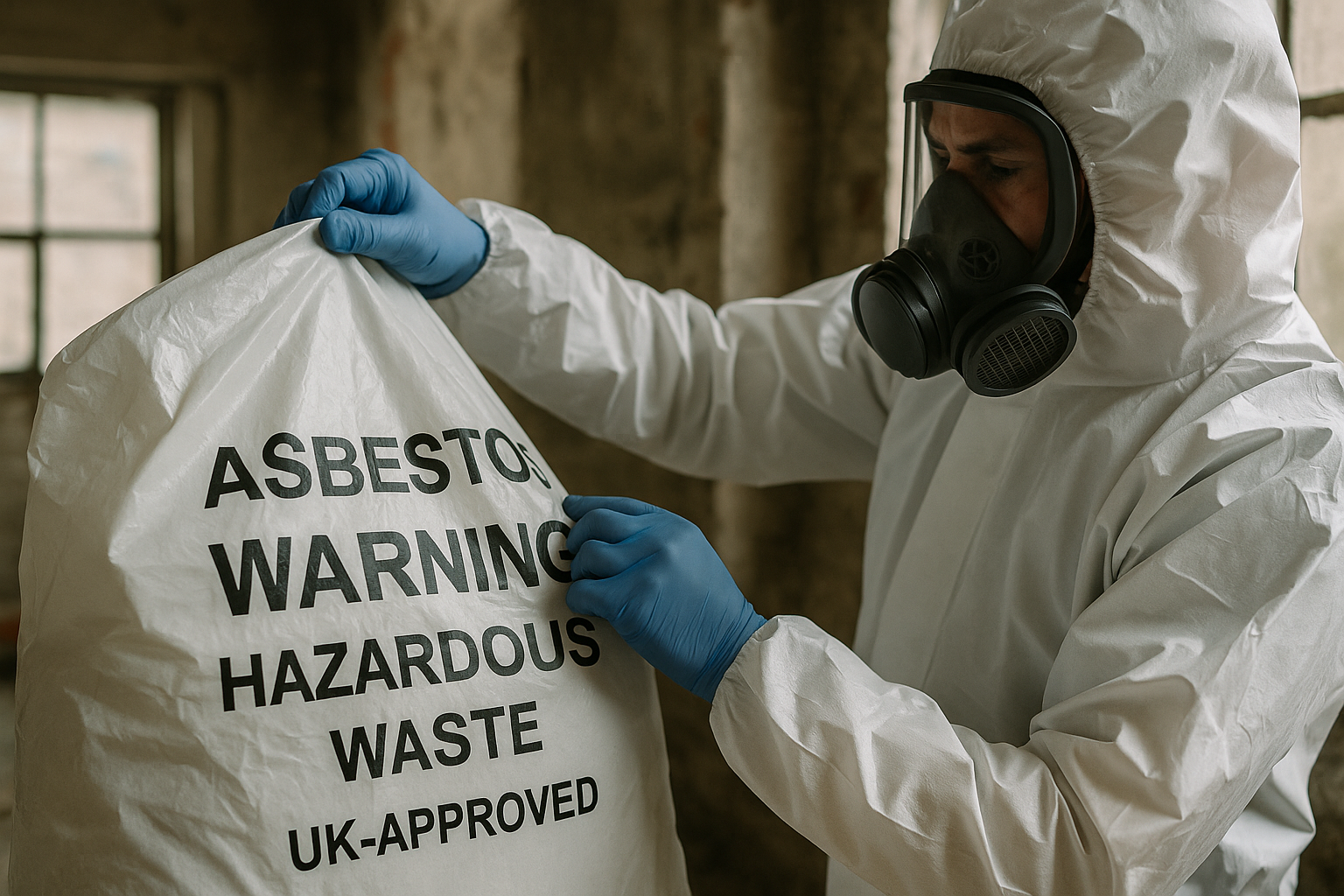
Every asbestos disposal bag should be clearly marked with asbestos hazard warnings. Anyone handling the package should be able to identify the risk immediately.
Unmarked asbestos waste creates obvious compliance and safety problems. It should never be mixed with general rubbish, demolition arisings or ordinary builders’ waste.
What type of asbestos waste can be bagged
Not all asbestos-containing materials behave in the same way. The correct packaging depends on the material type, its condition and how likely it is to release fibres.
Lower-risk waste that may be suitable for bagging
- Small offcuts of asbestos cement
- Minor debris from controlled work
- Contaminated disposable PPE
- Cleaning materials used during the task
- Small amounts of confirmed textured coating debris
Higher-risk waste that needs specialist handling
- Asbestos insulating board
- Pipe lagging
- Loose insulation
- Sprayed coatings
- Damaged friable debris
Higher-risk asbestos materials are not a routine bagging job. They may require licensed work, enclosures, controlled cleaning and formal clearance procedures. Where removal is needed, using a professional asbestos removal service is the safest option for damaged, friable or legally restricted materials.
Common mistakes people make with an asbestos disposal bag
Most failures come from treating asbestos waste like ordinary building debris. That is when contamination spreads and paperwork problems follow.
Using the wrong type of bag
A household refuse sack is not an asbestos disposal bag. It may tear too easily, lacks the correct warning information and does not show that the contents are hazardous.
Overfilling the bag
If the bag is too heavy or packed with sharp fragments, it may split when lifted. Keep each asbestos disposal bag manageable and use more than one if needed.
Breaking larger items to make them fit
This is a common error with asbestos cement sheets and boards. Breaking them up creates more edges, more dust and more risk.
If the item is too large for an asbestos disposal bag, wrap it instead. Do not reduce it in size just for convenience.
Leaving waste unsecured on site
Sealed asbestos waste should be stored in a secure area until collection or transport. It should not be left in public access areas, open skips, shared compounds or anywhere it can be tampered with.
Mixing asbestos with other waste
General construction waste should be kept separate. Once mixed, more material may be treated as contaminated, which increases disposal costs and site disruption.
Taking it to the wrong facility
Not every waste site accepts asbestos. Always check in advance that the destination is authorised to receive the type of asbestos waste you have.
Transporting asbestos waste safely
Once waste has been sealed in an asbestos disposal bag or wrapped package, transport becomes the next risk point. The fact that it is bagged does not mean the job is finished.
Waste must remain secure throughout the journey. Packaging should be protected from puncture, crushing, movement and weather exposure.
Practical transport checks
- Make sure every asbestos disposal bag is fully sealed
- Keep bags upright where possible
- Do not crush bags under tools, rubble or equipment
- Keep asbestos waste separate from clean materials
- Use a suitable vehicle space that prevents movement and damage
- Confirm the disposal site’s acceptance arrangements before travel
Transport duties can become more involved depending on the type and quantity of asbestos and who is carrying it. If you are coordinating works across multiple properties, it is often more efficient to use a competent contractor who already understands the disposal chain and documentation.
For property portfolios in the North West, arranging an asbestos survey Manchester appointment before maintenance starts can prevent accidental disturbance and avoid creating unmanaged asbestos waste in the first place.
Where asbestos waste can be taken
An asbestos disposal bag does not make asbestos suitable for ordinary disposal. The waste still has to go to a facility authorised to accept it.
Some local authority arrangements accept limited domestic asbestos waste, but this varies by area. There may be booking requirements, quantity limits and strict packaging rules. Commercial waste follows its own obligations and should never be treated as if it were ordinary household waste.
Check these points before you travel
- Does the site accept asbestos at all?
- Does it accept only bonded asbestos, or other types as well?
- What packaging standard does it require?
- Do you need to book in advance?
- Are there quantity restrictions?
- What paperwork must accompany the load?
Turning up without checking is a frequent mistake. If the site refuses the load, you are left with hazardous waste still in your vehicle and a compliance problem to solve.
Documentation and record keeping
Safe disposal is not only about the physical asbestos disposal bag. You should also be able to show that the waste was identified, handled, moved and disposed of correctly.
For businesses, landlords, managing agents and contractors, clear records matter. They support legal compliance, internal auditing and future maintenance planning.
Useful records to keep
- Survey reports and sampling results
- Material and priority assessments where relevant
- Risk assessments and method statements
- Waste consignment documentation where required
- Carrier and disposal site details
- Photographs of packaging and labelling where helpful
- Updates to the asbestos register or management plan
If asbestos has been identified in a non-domestic building, the duty to manage does not disappear because one item has been removed. The wider asbestos risk across the premises still needs to be reviewed and recorded properly.
For sites across the Midlands, booking an asbestos survey Birmingham service can help update records before refurbishment, maintenance or tenant alterations begin.
When you should not handle asbestos waste yourself
Understanding what an asbestos disposal bag is for does not automatically mean you should be the person using one. In many situations, the safest decision is to stop and bring in a specialist.
Get professional advice if:
- You do not know whether the material contains asbestos
- The material is damaged, dusty or friable
- The waste comes from insulation board, lagging or sprayed coating
- The area is occupied or hard to isolate
- You are dealing with commercial premises
- You do not have the right PPE, RPE or packaging
- You are not sure where the waste can legally go
Property managers often run into asbestos during routine jobs such as boiler replacement, roof repairs, ceiling access, electrical works and refurbishments. The safest move is usually to identify the material first, then decide whether it should be managed in place or removed by a competent contractor.
Practical advice for property managers and dutyholders
If you manage buildings, the best disposal plan is the one you never need to improvise. Most asbestos waste problems begin with poor planning rather than bad intentions.
Before any work starts
- Check whether an up-to-date asbestos survey is already available
- Review the asbestos register for the area affected
- Make sure contractors have the relevant information before starting
- Stop intrusive work if suspect materials are found
- Arrange sampling or a survey instead of guessing
If asbestos waste is created
- Isolate the area if needed
- Prevent others from walking through contamination
- Use the correct asbestos disposal bag or wrapping method
- Store waste securely pending collection or transport
- Keep disposal paperwork with the job record
That practical discipline matters just as much as the bag itself. A properly used asbestos disposal bag is one part of a wider control process, not a shortcut around it.
Choosing the safest route for disposal
If the waste is limited, low-risk and already properly identified, correct packaging and authorised disposal may be straightforward. If the material is damaged, friable, extensive or uncertain, the right answer is usually to stop and escalate.
A good rule is simple: if you are relying on guesswork at any stage, you are already taking too much risk. Survey first, assess properly and only proceed when the method of handling, packaging and disposal is clear.
Need help with asbestos identification, surveys or removal? Supernova Asbestos Surveys supports property owners, landlords and managers across the UK with expert advice, asbestos surveys and specialist project support. Call 020 4586 0680 or visit asbestos-surveys.org.uk to arrange the right service for your property.
Frequently Asked Questions
Can I use a normal rubble sack instead of an asbestos disposal bag?
No. A normal rubble sack is not suitable for asbestos waste. An asbestos disposal bag should be fit for hazardous waste packaging, clearly labelled and used as part of the correct containment process.
Can all asbestos materials go in an asbestos disposal bag?
No. Smaller pieces of lower-risk waste may be bagged, but larger items such as full asbestos cement sheets usually need wrapping. Friable materials such as lagging or asbestos insulating board may require licensed handling and should not be treated as a simple bagging task.
Do I need to double-bag asbestos waste?
In many cases, yes. Double-bagging provides an extra layer of protection if the outer package is damaged. Larger items that cannot be bagged are often double-wrapped in suitable polythene instead.
Can I take asbestos waste to my local tip?
Only if that site is authorised to accept it and you meet its packaging and booking requirements. Many facilities do not accept asbestos, and domestic and commercial arrangements are not the same.
When should I call a specialist instead of handling asbestos waste myself?
Call a specialist if the material is unknown, damaged, friable, extensive or located in an occupied area. You should also get professional help if you are dealing with commercial premises or do not have the right equipment, packaging or disposal route.