
One missing document can unravel an otherwise sensible asbestos strategy. An asbestos management plan is the document that turns survey findings into day-to-day control measures, helps protect occupants and contractors, and shows that the duty to manage asbestos is being taken seriously under the Control of Asbestos Regulations.
A survey on its own is not enough. If your team cannot quickly confirm where asbestos-containing materials are, what condition they are in, who needs to know about them, and what happens before maintenance starts, the risk is still there.
For property managers, estates teams, landlords and duty holders, the challenge is usually practical rather than theoretical. Information sits in different folders, older records are not updated, contractors arrive on site without the right briefing, and nobody is fully sure what the HSE would expect to see if asked for evidence.
A working asbestos management plan pulls all of that into one usable system. It should be clear, current and easy to follow, not a document that only appears when there is an audit or an incident.
Why an asbestos management plan matters
The duty to manage asbestos applies to those responsible for maintenance and repair in non-domestic premises, and in the common parts of some domestic buildings. If asbestos is present or presumed to be present, you need more than a survey report saved on a server.
An asbestos management plan should explain what asbestos is in the building, where it is located, what condition it is in, how likely it is to be disturbed, and what controls are in place. It should also show who is responsible for reviews, inspections, contractor communication and emergency action.
Done properly, an asbestos management plan helps you:
- prevent accidental disturbance during maintenance and minor works
- brief contractors before they start work
- prioritise budgets towards the highest risks
- schedule re-inspections and reviews
- record responsibilities clearly
- demonstrate compliance if the HSE asks for evidence
The bigger risk is not paperwork. It is someone drilling, cutting, sanding or removing a material without realising asbestos is present. A practical plan reduces that risk because it turns information into action.
Start with reliable asbestos information
A strong asbestos management plan depends on reliable information. If the survey data is weak, out of date or incomplete, the plan built on it will be weak as well.
HSE guidance is clear on the sequence: identify asbestos-containing materials, assess the risk, prepare a written plan, act on it, and keep it under review. HSG264 remains central because it sets out how asbestos survey information should be gathered, presented and used.
Use the right survey for the building and the work
For occupied premises, the starting point is often a professional management survey. This is designed to locate, as far as reasonably practicable, accessible asbestos-containing materials that could be disturbed during normal occupation, routine maintenance or foreseeable installation work.
Where major intrusive works are planned, a management survey is not enough. Before strip-out or structural alteration, you will usually need a demolition survey so hidden asbestos can be identified in areas that are not accessed during routine inspection.
Confirm suspect materials before work starts
If there is uncertainty about a material, arrange professional asbestos testing before anyone disturbs it. Assumptions are where avoidable exposure often begins.
Where a sample needs laboratory confirmation, proper sample analysis gives you evidence to support the decisions in your asbestos management plan. That is especially useful where records are incomplete or materials look similar to non-asbestos products.
If you are arranging checks for a single suspect item or need fast support for a site issue, you can also review options for asbestos testing to confirm what you are dealing with before maintenance proceeds.
What an asbestos management plan should contain
An effective asbestos management plan should be easy for a site manager to use and robust enough to stand up to scrutiny. The exact layout can vary, but the content should reflect HSE guidance, your survey information and the way the building is actually used.

At minimum, your asbestos management plan should include:
- duty holder details, including names, roles and contact information
- building details such as address, occupancy, use and restricted areas
- an asbestos register listing identified or presumed asbestos-containing materials
- material condition information showing what is stable, sealed, damaged or deteriorating
- risk and priority assessments showing where action is most urgent
- control measures for each item, such as monitoring, labelling, encapsulation or restricted access
- responsibilities for inspections, contractor briefings, record keeping and emergency response
- training arrangements for anyone who may disturb the building fabric
- procedures for accidental damage or suspected disturbance
- review dates and re-inspection schedules
The asbestos register and the asbestos management plan should work together. In practice, that means your plan should link directly to the register and be updated whenever inspections, maintenance, repairs or incidents change the picture.
How to create an asbestos management plan step by step
Many duty holders have survey findings and a spreadsheet register, then assume they have done enough. They have not. The asbestos management plan is the part that turns information into a working system.
A practical way to build one is to follow a clear sequence.
- Gather the current information. Pull together the latest survey reports, asbestos register, site plans, sample results, previous inspection records and any records of repair or removal.
- Confirm who the duty holder is. In multi-occupied premises or managed estates, responsibilities must be agreed and recorded clearly.
- List each known or presumed ACM. Record location, product type, accessibility, condition and any existing controls.
- Assess the risk and priority. Consider both the material risk and the likelihood of disturbance during normal use, maintenance or contractor activity.
- Decide the control measure for each item. This may be leave and monitor, repair, encapsulate, label, restrict access or arrange removal.
- Set out contractor controls. Explain how contractors receive asbestos information, who signs them in, and what checks happen before intrusive work starts.
- Add emergency arrangements. Include area isolation, reporting lines, access control, sampling arrangements and follow-up actions.
- Assign actions and deadlines. Every action should have a named owner and a realistic timescale.
- Schedule re-inspections and reviews. Monitoring is part of the plan, not something to think about later.
If your plan does not identify who is doing what and by when, it is only background reading. A useful asbestos management plan should help staff make the right decision on a normal working day, not only during an audit.
Practical site controls that make the plan work
Many asbestos plans fail for a simple reason: they describe the asbestos but do not explain how exposure will be prevented. Your controls need to be specific to the building and practical for the people using it.
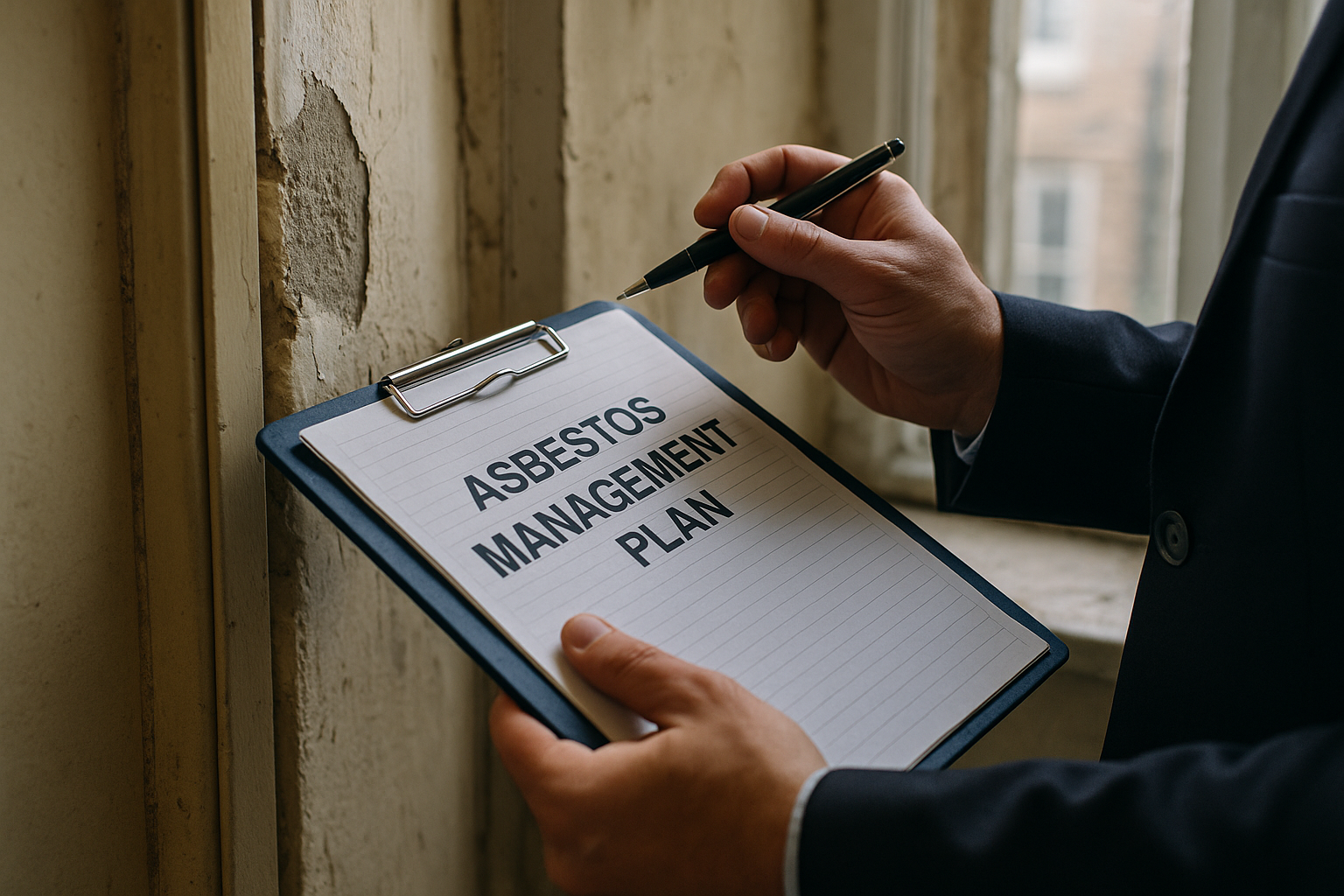
Useful controls often include:
- marking or labelling asbestos-containing materials where appropriate
- restricting access to higher-risk areas such as plant rooms, risers and service voids
- using permit-to-work checks before intrusive tasks
- sharing the asbestos register with contractors before work starts
- briefing maintenance teams on local asbestos risks
- stopping work immediately if suspect materials are uncovered
- recording who has seen the asbestos information and when
- checking nearby ACMs after maintenance in adjoining areas
These controls should be written into the asbestos management plan, not left to verbal instruction. If a contractor arrives on site, there should be no doubt about where the information is, who provides it, and what happens if unexpected materials are found.
Training and communication
People cannot follow a plan they do not know exists. Anyone who may disturb the building fabric, supervise works, approve permits or manage contractors should understand the asbestos arrangements for that site.
That does not mean everyone needs the same level of training. It does mean the right people need the right information in a format they can use.
As a minimum, make sure:
- site managers know where the asbestos register is kept
- contractors are briefed before starting work
- maintenance teams know when to stop and ask for advice
- any changes to asbestos records are communicated promptly
- emergency contacts are easy to find
How to prioritise actions in an asbestos management plan
Not every asbestos-containing material needs to be removed. In many buildings, the safest option is to leave asbestos in place and manage it properly. The key is to identify which items need urgent action and which can be monitored safely.
Prioritisation should consider both the material itself and the way the area is used. A damaged board in a busy service corridor will usually rank above a sealed cement sheet in a locked external store.
Ask these questions when prioritising:
- Is the material damaged, friable or deteriorating?
- Is it in an area where people regularly work or pass through?
- Could routine maintenance disturb it?
- Is it hidden above ceilings, inside risers or in plant areas where contractors may need access?
- Has the use of the area changed since the last inspection?
- Would accidental damage create a realistic chance of fibre release?
Your asbestos management plan should make these distinctions obvious. That helps direct budgets and attention to the areas of greatest risk rather than spreading resources too thinly.
Typical action categories
- Immediate action: damaged or high-risk materials with a strong likelihood of disturbance
- Short-term remedial action: items needing sealing, repair, labelling or restricted access
- Planned monitoring: lower-risk materials in good condition that are unlikely to be disturbed
- Further investigation: areas with limited access or materials that could not be confirmed
Where repair is not suitable, licensed or non-licensed asbestos removal may be the right next step, depending on the material and the risk. The decision should be based on condition, location, planned works and the likelihood of disturbance.
Monitoring and reviewing the asbestos management plan
An asbestos management plan becomes unreliable quickly if nobody owns the updates. Buildings change. Tenants change. Maintenance programmes change. Even where asbestos-containing materials stay in place, the risk around them may not.
Monitoring means more than checking a diary once a year. You need a routine for verifying that ACMs remain in the same condition and that site controls are still being followed.
Useful monitoring steps include:
- planned visual re-inspections of known asbestos-containing materials
- checks after maintenance work in nearby areas
- reviews of contractor compliance and permit systems
- updates after changes in occupancy, access or building use
- recording any damage, remedial work or removal
- confirming that labels, barriers and access restrictions remain in place
If a material is damaged or newly exposed, the asbestos management plan should trigger immediate action. That may include isolating the area, arranging sampling, updating the register and deciding whether remedial work or removal is needed.
When to update the plan
Review the asbestos management plan regularly and also whenever something significant changes. A review should confirm that the register, risk ratings, controls and responsibilities still reflect reality.
Update the plan:
- after a scheduled re-inspection
- after accidental damage or suspected disturbance
- after refurbishment, installation or maintenance work near known ACMs
- when new asbestos-containing materials are identified
- when occupancy patterns or building use change
- when the duty holder, managing agent or responsible person changes
Keep your records aligned. If an ACM has been removed, the register and the asbestos management plan should show that clearly. If it has been repaired or encapsulated, record what was done, by whom, and when it should be checked again.
Common mistakes that weaken an asbestos management plan
Most problems are not caused by the absence of paperwork. They happen because the plan is out of date, hard to access or disconnected from real maintenance activity.
Common mistakes include:
- relying on an old survey without checking whether the building has changed
- keeping the asbestos register in a place contractors cannot access
- failing to assign named responsibilities
- not linking permit-to-work systems to asbestos information
- assuming low-risk materials never need re-inspection
- forgetting to update records after removal, repair or damage
- using a generic template that does not reflect the building
- treating the plan as a one-off exercise rather than a live document
A good test is simple: if a contractor asked to see the asbestos information right now, would your team be able to provide clear, current records within minutes? If not, your asbestos management plan probably needs work.
Which properties need an asbestos management plan?
The duty is not limited to one sector. If you manage non-domestic premises, or common parts where the duty to manage applies, an asbestos management plan may be needed wherever asbestos is present or presumed to be present.
Common settings include:
- schools, colleges and universities
- offices and business parks
- shops, retail units and shopping centres
- warehouses, factories and industrial estates
- healthcare buildings, clinics and surgeries
- hotels, leisure facilities and hospitality venues
- local authority buildings and community premises
- housing associations and common parts of residential blocks
The practical risks vary by property type. A school may need tight controls around holiday works. A warehouse may need stronger controls in service areas and loading zones. A healthcare site may need careful planning so maintenance can proceed safely without disrupting essential operations.
That is why a generic document rarely works well. Your asbestos management plan should reflect how the building is used, who enters it, and what maintenance activities are likely.
Local support for surveys and asbestos planning
If your records are incomplete, the first step is usually to get the right survey information in place. For managed portfolios and multi-site estates, consistent reporting makes it much easier to build and maintain a reliable asbestos management plan.
Supernova supports clients across the country, including those needing an asbestos survey London service for city offices, mixed-use buildings and large estates.
We also help duty holders who need an asbestos survey Manchester for commercial, industrial and public-sector properties.
For clients in the Midlands, our asbestos survey Birmingham service supports property managers, landlords and organisations that need clear, usable asbestos information.
Frequently Asked Questions
Who is responsible for an asbestos management plan?
The duty holder is responsible. In practice, that is the person or organisation with responsibility for maintenance and repair, or control of the premises. In multi-occupied buildings, responsibilities should be agreed clearly and recorded in writing.
Is an asbestos survey the same as an asbestos management plan?
No. A survey identifies asbestos-containing materials and provides information about location, extent and condition. An asbestos management plan uses that information to set out control measures, responsibilities, review arrangements and actions needed to prevent disturbance.
How often should an asbestos management plan be reviewed?
It should be reviewed regularly and whenever significant changes occur, such as re-inspections, maintenance near ACMs, accidental damage, changes in occupancy or changes in the duty holder. The right frequency depends on the building and the level of risk.
Does every asbestos-containing material need to be removed?
No. Many ACMs can be left in place safely if they are in good condition and unlikely to be disturbed. The asbestos management plan should explain which materials are being monitored, which need remedial action, and which require removal.
What happens if asbestos is damaged unexpectedly?
Work should stop immediately, the area should be isolated, and access should be controlled. The incident should be reported through the site procedure, and competent advice should be sought so the material can be assessed, sampled if necessary, and the register and asbestos management plan updated.
If you need help building or updating an asbestos management plan, Supernova Asbestos Surveys can help with surveys, testing, registers and practical compliance support nationwide. Call 020 4586 0680 or visit asbestos-surveys.org.uk to arrange expert advice.