
One missing update can turn a routine repair into an asbestos incident. A well-built asbestos management plan is what prevents that. It gives duty holders, property managers and facilities teams a working system for controlling asbestos risk, protecting occupants and contractors, and showing that they are meeting their duties under the Control of Asbestos Regulations.
The problem is rarely the idea of the plan. It is the execution. Too many sites have an asbestos register tucked away in a folder, a survey no one can find, and contractors arriving on site without clear information. That is where avoidable disturbance happens.
A practical asbestos management plan is not a one-off document. It should be used on site, reviewed regularly and updated when the building changes, materials deteriorate, or works are planned. If it is not helping people make safer decisions day to day, it is already underperforming.
What an asbestos management plan actually does
An asbestos management plan is the written plan for managing the risk from asbestos in non-domestic premises. It should sit alongside the asbestos register and explain how asbestos-containing materials, or presumed asbestos-containing materials, will be identified, communicated, monitored and controlled.
In simple terms, the plan should answer a few essential questions:
- What asbestos-containing materials are present, or presumed to be present?
- Where are they located?
- What condition are they in?
- How likely are they to be disturbed?
- What controls are already in place?
- What action is needed next, and who is responsible?
HSE guidance is clear that the duty to manage is ongoing. That means an asbestos management plan must be monitored, reviewed and revised when circumstances change. If your premises were built before 2000, asbestos should be presumed present unless there is strong evidence to show otherwise, and that presumption should be reflected in the plan.
Who needs an asbestos management plan
The duty usually falls on whoever has responsibility for maintenance and repair in non-domestic premises. That may be a landlord, employer, managing agent, freeholder, facilities manager or another duty holder with contractual control over the building.
The legal duty is broad, but the way an asbestos management plan works in practice will vary from one site to another. A school, for example, has very different occupancy patterns and vulnerabilities from a warehouse or plant room environment. The plan must reflect how the building is actually used, not just what type of building it is.
Industries where asbestos management is essential
Competitor content often lists industries because the duty to manage applies across a wide range of premises. That matters in real life too. Different industries have different maintenance patterns, contractor access issues and exposure risks.
- Schools, colleges and universities
- Hospitals, surgeries, clinics and care environments
- Offices and mixed-use commercial buildings
- Retail units, shopping centres and hospitality venues
- Factories, workshops and industrial sites
- Warehouses and logistics facilities
- Local authority estates and civic buildings
- Hotels, leisure venues and entertainment premises
- Communal areas of residential buildings under non-domestic control
Each of these industries needs a site-specific asbestos management plan. Generic templates often miss the practical details that actually control risk, such as who signs off contractor access, how plant spaces are managed, or how temporary works are checked before they start.
Start with the right survey information
A strong asbestos management plan starts with reliable information. HSE guidance and HSG264 set the framework, but the plan is only as good as the survey evidence underneath it. If the survey is outdated, incomplete or not suited to the building use, the plan will always be weak.

For occupied premises, the usual starting point is an management survey. This is designed to locate, as far as reasonably practicable, the presence and extent of asbestos-containing materials that could be disturbed during normal occupation, routine maintenance or foreseeable installation work.
If major refurbishment, strip-out or demolition is planned, the requirement changes. In that situation, a demolition survey is usually needed so hidden asbestos can be identified before intrusive works begin.
That distinction is critical. A management survey supports the asbestos management plan for normal occupation. It does not replace the need for a more intrusive survey where refurbishment or demolition is proposed.
Search HSE.GOV.UK and use it properly
Many duty holders begin by using Search HSE.GOV.UK to find guidance on the duty to manage, asbestos registers, risk assessment and training. That is sensible, but the guidance only becomes useful when it is applied to the actual building, survey findings and day-to-day maintenance arrangements.
Use HSE guidance to sense-check your system, not to copy and paste generic wording into an asbestos management plan. If your plan does not match the real building, it will not help the people working in it.
What your plan should contain
An effective asbestos management plan should be clear, site-specific and easy to use. It should help site teams, managers and contractors make safe decisions quickly.
At a minimum, your plan should contain the following sections.
1. Premises details
Record the building name, address, use, occupancy type and a short site description. If the estate includes multiple blocks, identify each one clearly and define the boundaries of the plan.
Include any features that affect risk, such as vulnerable occupants, frequent contractor access, service risers, roof voids, plant areas or inaccessible spaces.
2. Duty holder and responsible persons
Name the duty holder and anyone with day-to-day responsibility for implementing the asbestos management plan. Include job titles, contact details and escalation routes.
If responsibility is shared between landlord, tenant and managing agent, say so plainly. Vague responsibility is one of the most common reasons asbestos controls fail in practice.
3. The asbestos register
The register is the backbone of the asbestos management plan. It should list known or presumed asbestos-containing materials with enough detail for people to act safely.
- Location
- Product type
- Extent or quantity
- Asbestos type where known
- Material condition
- Surface treatment or sealing
- Accessibility
- Photographs or marked-up plans where useful
- Inaccessible or presumed asbestos areas
If an area could not be inspected, record that clearly. Do not leave gaps. Manage that area as presumed asbestos until proper assessment is possible.
4. Material and priority assessments
A useful asbestos management plan explains not just what is present, but how risky it is. That means considering both the material itself and the likelihood of disturbance.
Material assessment looks at factors such as product type, friability, damage and surface treatment. Priority assessment looks at occupancy, maintenance activity, accessibility and the chance of accidental disturbance.
5. Control measures
Your plan should explain how exposure will be prevented. Controls need to be practical enough for maintenance teams and contractors to follow on site.
- Labelling or signage where appropriate
- Restricted access arrangements
- Permit-to-work systems
- Contractor briefing and induction procedures
- Method statements for work near asbestos-containing materials
- Encapsulation or sealing
- Routine condition inspections
- Emergency arrangements for accidental damage
If controls exist only on paper, they are not controls. Check that the people using the building understand them and can access the information quickly.
6. Action plan
This is where many documents fall short. The asbestos management plan should not stop at recording risk. It needs a practical action list that shows what must be done, who will do it and by when.
Actions may include reinspection, repair, encapsulation, access restrictions, further sampling, improved contractor communication or removal by a competent contractor where necessary.
7. Monitoring and review arrangements
HSG264 supports periodic reinspection of known or presumed asbestos-containing materials, with intervals based on condition and risk. Many sites use annual reinspection for stable materials, but more frequent checks may be needed where damage or disturbance is more likely.
The review process for the asbestos management plan should also be defined. That may include scheduled reviews, post-incident reviews and updates after maintenance, occupancy changes or newly identified materials.
8. Training and communication records
Anyone who may disturb asbestos during their work needs suitable information, instruction and training. The asbestos management plan should record how staff, contractors and visiting trades are informed.
Keep evidence of inductions, briefings and awareness arrangements. If there is an incident and no communication record, the plan will be difficult to defend.
6. Write your asbestos management plan and monitor it
This stage is where survey findings become a live control system. Writing the asbestos management plan is not about copying text from guidance. It is about turning survey data into clear actions that fit the building, the maintenance regime and the people using the site.
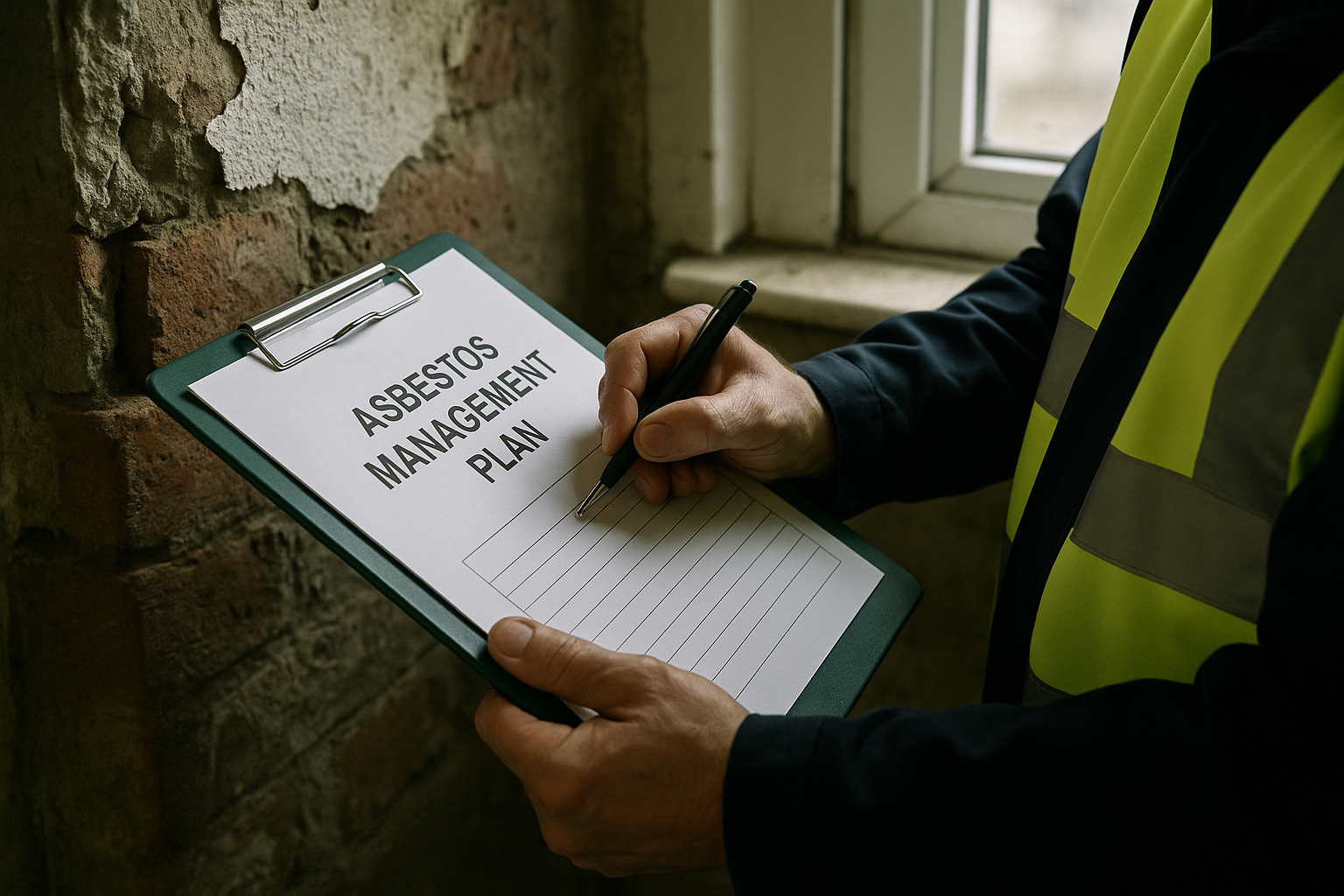
A practical sequence usually looks like this:
- Review the survey and confirm the scope of the premises.
- Build or update the asbestos register.
- Record inaccessible areas and presumed asbestos.
- Assess risk using material and priority factors.
- Decide the management approach for each item.
- Assign timescales and named responsibilities.
- Put communication and contractor controls in place.
- Monitor material condition and review the plan regularly.
Monitoring is what keeps an asbestos management plan useful. If a ceiling void is opened, a panel is damaged, a room changes use or maintenance access increases, the plan should change as well.
Store the latest version where people can actually find it. Site managers, maintenance teams and authorised contractors should be able to access the current asbestos management plan quickly. If the only copy is buried in an old email chain, the system is weak before work even starts.
Prioritising your actions
Not every asbestos-containing material needs the same response. A good asbestos management plan helps you prioritise action based on risk, not alarm.
Asbestos in good condition and unlikely to be disturbed can often remain in place safely. Damaged materials in busy or frequently accessed areas usually need much faster intervention.
High-priority actions
These generally involve damaged, friable or exposed materials, or items in areas where disturbance is likely. Examples include broken asbestos insulating board near access routes, damaged lagging or debris in service spaces used by contractors.
- Immediate isolation of the area
- Urgent assessment by a competent asbestos professional
- Temporary sealing where appropriate
- Arranging licensed or non-licensed remedial work as required
- Immediate update of the register and asbestos management plan
Medium-priority actions
These often involve materials that are currently stable but showing wear, minor damage or increased potential for disturbance. They may not need urgent removal, but they do need a defined response.
That response could include more frequent inspections, minor repair, encapsulation or tighter access controls.
Low-priority actions
These usually involve materials in good condition, in sealed or low-traffic areas, with little chance of disturbance. They still need to remain on the register and within the asbestos management plan.
Low priority does not mean no action. It means controlled management, clear communication and review when building use changes.
Practical factors to use when prioritising
- Condition of the material
- Likelihood of disturbance
- Type of work carried out nearby
- Occupancy levels and vulnerability of users
- Ease of access to the material
- Whether refurbishment is planned
- Whether the material can be safely managed in place
Your asbestos management plan should record why decisions were made. If you choose to monitor rather than remove, the reasoning should be clear and defensible.
Keep your asbestos management plan up to date
An asbestos management plan is only useful if it reflects current conditions. Buildings change constantly. Rooms are repurposed, contractors open hidden areas, materials age and maintenance patterns shift.
If the plan is not updated, people may rely on information that is no longer accurate. That is how routine works become incidents.
When the plan should be reviewed
Review and update the asbestos management plan when:
- Reinspection identifies a change in material condition
- Maintenance or repair work affects a known asbestos area
- There is accidental damage or an asbestos incident
- The building layout or room use changes
- Occupancy patterns change significantly
- Further survey work identifies new materials or inaccessible areas
- Responsibility for the premises changes hands
Version control matters. Date each revision, record what changed and make sure superseded copies are removed from circulation. Old plans can create just as much risk as no plan at all.
How to keep updates practical
Use a simple review routine. Tie asbestos checks into planned maintenance, contractor control procedures and estate inspections.
For example:
- Check the register before issuing permits for intrusive work
- Review asbestos information after any damage report
- Update plans after reinspection visits
- Confirm contractor sign-off before works start
- Brief new site managers as part of handover
That way, the asbestos management plan stays part of operations rather than becoming a forgotten compliance document.
Related content, topics and products: what duty holders should actually focus on
Competitor pages often include headings such as related content, topics and products. On their own, those labels do not manage risk. What matters is knowing which supporting documents and services your site genuinely needs.
Related content that supports your plan
Useful related content usually includes your asbestos survey, asbestos register, reinspection records, contractor procedures, training records, permits to work and emergency arrangements. These documents should support the asbestos management plan, not contradict it.
If your survey says one thing and your register says another, resolve that immediately. Conflicting records create confusion at the worst possible moment.
Topics that should sit alongside asbestos management
Asbestos control does not operate in isolation. The most effective sites connect the asbestos management plan with wider health and safety management topics, such as:
- Planned preventative maintenance
- Contractor control
- Fire stopping and building fabric works
- Permit-to-work systems
- Refurbishment planning
- Incident reporting
- Training and competence checks
That joined-up approach helps prevent asbestos information from being missed when urgent works are arranged.
Products and materials that commonly feature in plans
When people see the word products in competitor content, they often mean asbestos-containing products that may be present in the building. Your asbestos management plan should identify relevant materials clearly, such as:
- Asbestos insulating board
- Pipe lagging
- Sprayed coatings
- Textured coatings where asbestos is present
- Cement sheets and roof panels
- Floor tiles and bitumen adhesive
- Gaskets, rope seals and insulation products
- Soffits, panels and service duct materials
Knowing the product type helps you judge condition, likely fibre release and the right management approach.
Contractor control and communication on live sites
One of the biggest tests of an asbestos management plan is what happens when contractors arrive. If they cannot access the right information before starting work, the plan is not doing its job.
Before any intrusive work begins, contractors should know:
- Whether asbestos is known or presumed in the work area
- Where the latest register and plans can be accessed
- What restrictions apply
- Whether further survey work is required
- Who to contact if suspect materials are found
Do not rely on verbal handovers alone. Use sign-in procedures, permit controls and written acknowledgements where appropriate.
When a management plan is not enough
A common mistake is assuming the existing asbestos management plan covers all future works. It does not. If works become intrusive, hidden materials may be disturbed and a more targeted survey may be required before the job proceeds.
This is especially relevant on estates with frequent churn, fit-outs or service upgrades. If there is any doubt, pause and check the survey scope before work starts.
Local support for multi-site property portfolios
For organisations managing more than one building, consistency matters. A central standard is useful, but each site still needs its own accurate asbestos management plan, register and review process.
If you manage property in the capital, arranging an asbestos survey London service can help keep surveys and management information aligned with the realities of busy commercial buildings. For regional estates, support is also available through an asbestos survey Manchester team and an asbestos survey Birmingham service.
The key is not just getting a survey done. It is making sure the findings are translated into a usable asbestos management plan for each site.
Common mistakes that weaken an asbestos management plan
Most failures are not caused by one dramatic error. They come from small gaps that build up over time.
- Using an out-of-date survey
- Failing to record presumed asbestos in inaccessible areas
- Not assigning named responsibility for actions
- Keeping the plan where contractors cannot access it
- Not linking asbestos controls to permit-to-work systems
- Forgetting to review the plan after damage or building changes
- Assuming low-risk materials need no monitoring
- Using a template that does not reflect the real site
If any of these sound familiar, the fix is usually straightforward: review the evidence, update the register, assign actions and make the asbestos management plan easier to use on site.
Footer links and document access: the overlooked practical detail
Some competitor pages include footer links to related resources, topics and services. On your own site or internal portal, that idea is useful if it helps people reach the current survey, register, emergency procedure and contact details quickly.
Good footer links or document shortcuts might include:
- The current asbestos register
- The latest survey report
- Emergency damage procedure
- Contractor induction information
- Permit-to-work forms
- Named duty holder contact details
Keep access simple. If staff or contractors have to search through multiple folders to find the latest asbestos management plan, delays and mistakes become much more likely.
When to get expert help
If your records are inconsistent, your building use has changed, or you are unsure whether the existing survey still supports your asbestos management plan, get specialist advice before works continue. This is especially sensible where there are multiple buildings, shared responsibilities or regular contractor attendance.
Expert input is also valuable when you need to prioritise remedial works across an estate. A clear risk-based approach helps you direct budget to the areas that need attention first, rather than reacting to the loudest concern.
Frequently Asked Questions
Who is responsible for an asbestos management plan?
The responsible person is usually the duty holder for the premises. That may be a landlord, employer, managing agent, freeholder or another party with responsibility for maintenance and repair. Where responsibilities are shared, the asbestos management plan should state clearly who does what.
How often should an asbestos management plan be reviewed?
The asbestos management plan should be reviewed regularly and whenever circumstances change. That includes reinspection findings, damage, maintenance works, changes in occupancy, layout changes or newly identified asbestos-containing materials. Review intervals should reflect the condition and risk profile of the materials on site.
What is the difference between an asbestos register and an asbestos management plan?
The asbestos register records where known or presumed asbestos-containing materials are located and describes their condition. The asbestos management plan explains how those materials will be controlled, communicated, monitored and reviewed. In short, the register records the information and the plan sets out what you will do with it.
Can asbestos be left in place?
Yes, if it is in good condition and unlikely to be disturbed, asbestos can often be managed safely in place. The asbestos management plan should explain the reasons for that decision, set out control measures and specify how the material will be monitored over time.
Do I need a new survey before refurbishment works?
Often, yes. A management survey supports normal occupation and routine maintenance, but it is not usually sufficient for intrusive refurbishment or demolition works. Before those works start, a more intrusive survey may be needed to identify hidden asbestos and protect workers properly.
If you need help building, reviewing or updating an asbestos management plan, Supernova Asbestos Surveys can help. We provide asbestos surveys, registers and practical advice for duty holders across the UK. Call 020 4586 0680 or visit asbestos-surveys.org.uk to arrange support.