
One outdated asbestos management plan can turn a routine maintenance task into a dangerous mistake, a contractor exposure incident and a clear compliance failure. If you manage a non-domestic building, or the common parts of a residential block, your plan needs to work in the real world: on site, under pressure and before anyone drills, strips out or opens a ceiling void.
The duty to manage asbestos sits within the Control of Asbestos Regulations and is supported by HSE guidance and HSG264. In practice, that means identifying asbestos or presumed asbestos-containing materials, assessing the risk, recording decisions, controlling access and keeping the asbestos management plan under review as the building changes.
Why an asbestos management plan matters
An asbestos management plan is not just a document for an audit file. It is the working system that tells staff, contractors, tenants and managing agents what is in the building, what condition it is in and what must happen before work starts.
Without a usable plan, ordinary jobs become risky very quickly. Replacing lights, opening risers, lifting floor finishes, accessing plant rooms or altering partitions can all disturb asbestos-containing materials if the information is missing, unclear or out of date.
A good plan helps you:
- Prevent accidental disturbance of asbestos-containing materials
- Show that the duty to manage is being handled properly
- Brief contractors before they begin work
- Prioritise monitoring, repair, encapsulation or removal
- Keep a clear audit trail of decisions and actions
- Reduce delays when maintenance or refurbishment is proposed
For property managers, the real value is control. Instead of relying on assumptions, you can make decisions based on survey evidence, risk assessment and a clear process that people can actually follow.
Who needs an asbestos management plan?
The need for an asbestos management plan is not limited to one sector. It applies wherever there is a duty to manage asbestos in non-domestic premises, and in the common parts of domestic buildings such as blocks of flats.
That often includes:
- Offices and multi-let commercial buildings
- Schools, colleges and universities
- Hospitals, clinics, surgeries and care settings
- Retail units, shopping parades and supermarkets
- Warehouses, depots, factories and workshops
- Hotels, pubs, restaurants and leisure venues
- Council buildings, libraries and community sites
- Communal stairwells, corridors, plant rooms and service cupboards in residential blocks
The legal duty usually falls on the person or organisation with responsibility for maintenance or repair. That may be the owner, landlord, managing agent, employer, tenant or a combination of parties under a lease or contract.
If responsibility is shared, the split needs to be recorded clearly. One of the most common causes of failure is assuming somebody else is dealing with asbestos information when nobody actually is.
Start with the right survey information
You cannot write a reliable asbestos management plan on guesswork. The plan is only as good as the information behind it.
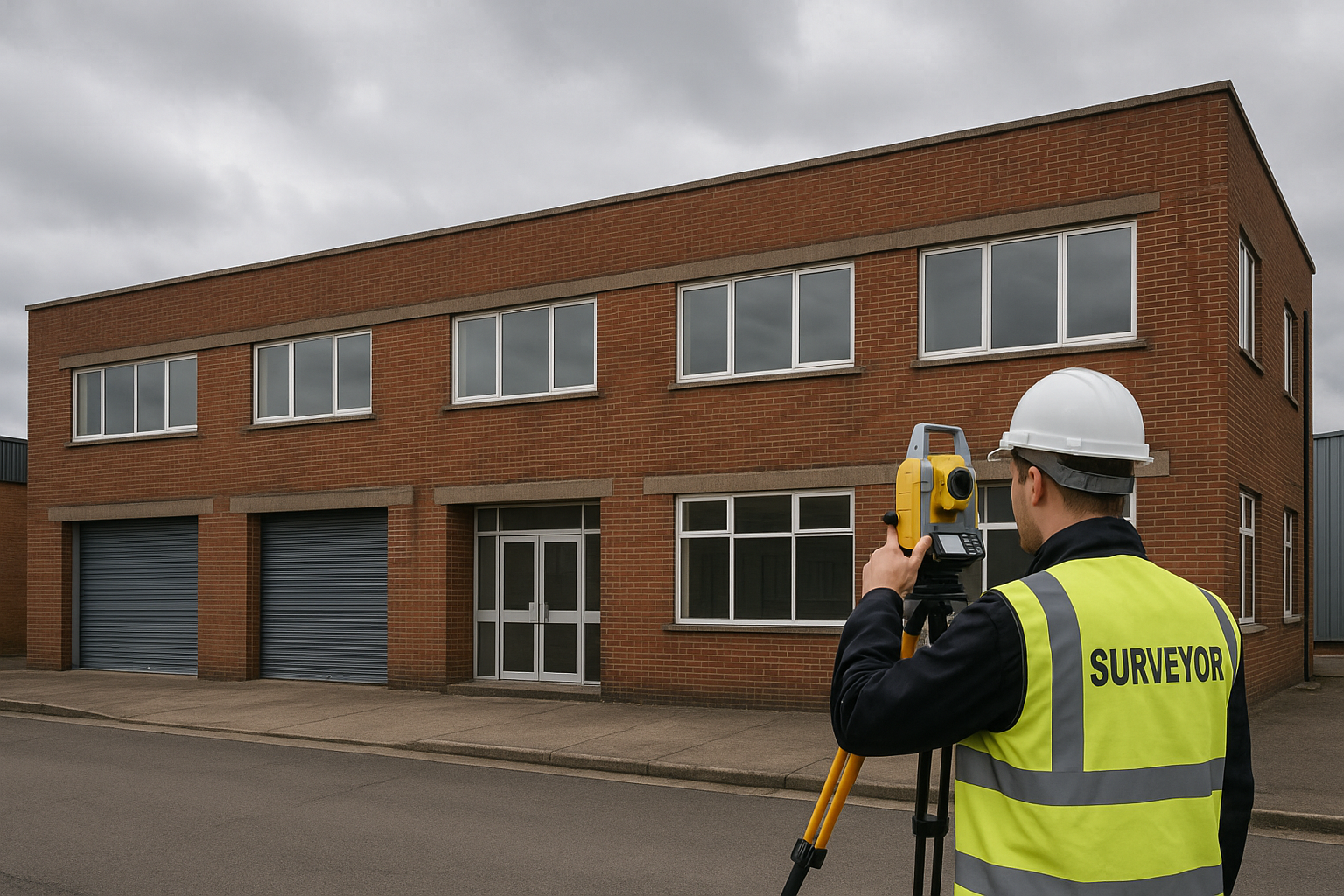
For occupied premises, the usual starting point is a management survey. This is designed to locate, as far as reasonably practicable, asbestos-containing materials that could be disturbed during normal occupation, routine maintenance or foreseeable installation work.
If intrusive works are planned, that is a different situation. Before major alterations, strip-out or structural changes, you will usually need a refurbishment survey.
If a building, or part of it, is due to be taken down, a demolition survey is required before demolition starts. This survey is fully intrusive because hidden asbestos must be identified before the structure is disturbed.
Where a suspect material needs laboratory confirmation, professional sample analysis removes uncertainty. That evidence can then be used to update the register and strengthen the asbestos management plan.
What to gather before a survey
Surveyors can work more effectively when relevant building information is available in advance. It will not replace the inspection, but it can reduce gaps and help target higher-risk areas.
- Previous asbestos surveys and registers
- Building plans and layout drawings
- Maintenance records and repair logs
- Refurbishment history
- Information on roof voids, risers and locked rooms
- Records of known removals, repairs or encapsulation
If access is restricted, deal with that early. A plan based on incomplete access needs clear follow-up actions, otherwise presumed asbestos can easily become forgotten asbestos.
What an asbestos management plan should contain
An effective asbestos management plan should be site-specific, practical and easy to use. HSE guidance does not expect vague statements. It expects a clear record of what is present, what the risks are and how those risks will be controlled.
At a minimum, your plan should include:
- The name of the duty holder and any delegated responsible persons
- The address and scope of the premises covered
- An asbestos register showing known or presumed asbestos-containing materials
- The location, extent and condition of each item
- Material and priority risk assessments
- Control measures for each material
- Actions required, with priorities and timescales
- Arrangements for informing staff, tenants and contractors
- Emergency procedures if materials are damaged
- Reinspection and review dates
- Records of completed works, removals, repairs and updates
The register and the asbestos management plan do different jobs. The register records what is there. The plan records what you are doing about it.
Define the duty holder properly
Responsibility needs to be explicit. Your plan should state:
- Who holds the legal duty
- Who maintains the asbestos register
- Who approves contractor access
- Who arranges reinspections
- Who responds to damage or incidents
- Who authorises updates to the plan
If those roles are unclear, the plan will fail when a real decision is needed.
Step-by-step: creating an asbestos management plan
Putting an asbestos management plan together is more straightforward when you break it into practical stages.
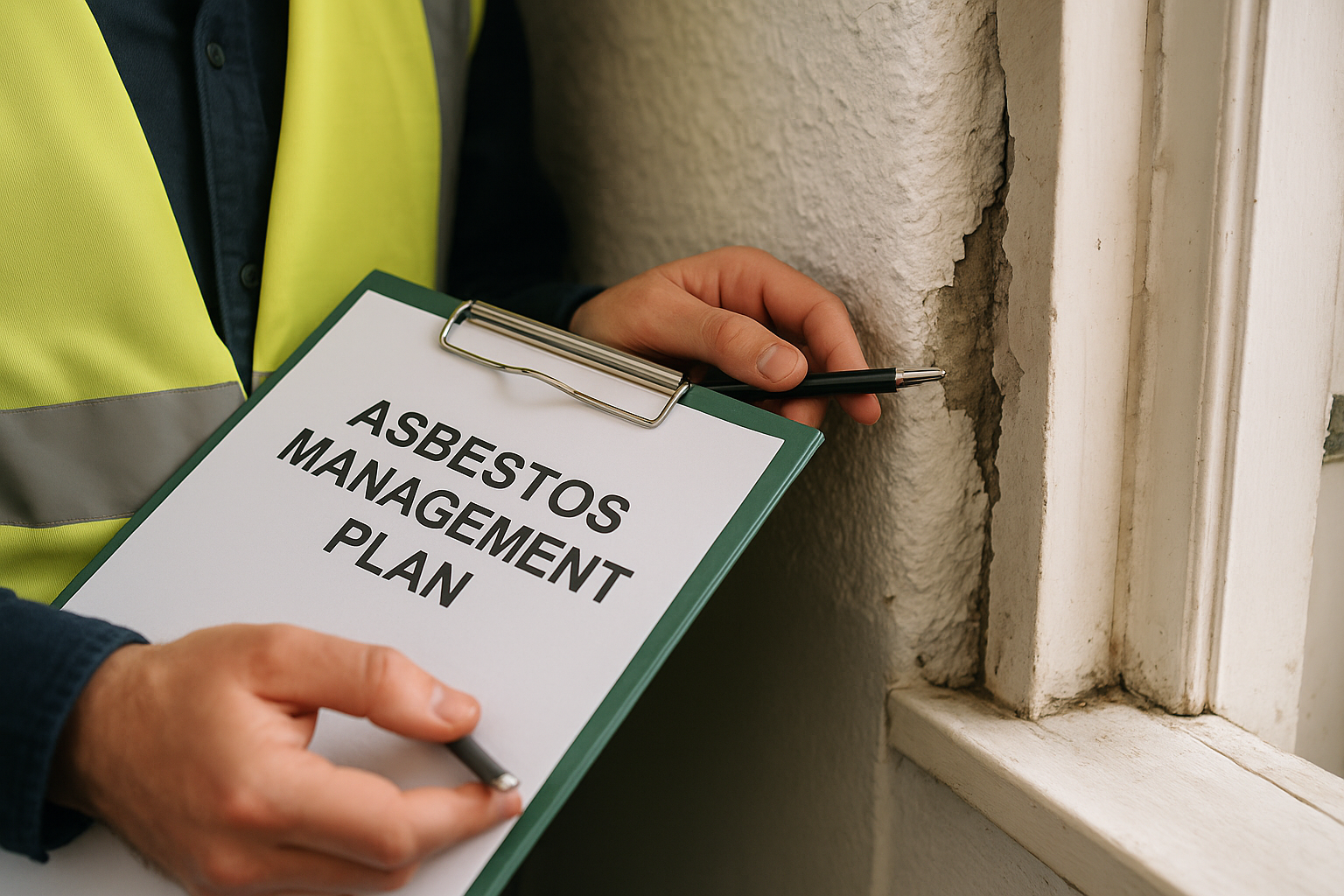
1. Identify asbestos or presumed asbestos
Start with current survey information and any confirmed test results. If materials cannot be accessed or there is insufficient evidence, they should be presumed to contain asbestos until proven otherwise.
2. Build or update the asbestos register
Record where materials are, what they are, their condition and any surface treatment or protection. Make sure locations are clear enough for somebody unfamiliar with the building to find them.
3. Assess the risk
Look beyond the material itself. A low-damage material in a locked plant area may present less day-to-day risk than a more accessible product in a busy circulation route.
Consider:
- Condition of the material
- Likelihood of disturbance
- Accessibility
- Occupancy and foot traffic
- Maintenance activity nearby
- Planned works
4. Decide the control measures
Not every asbestos-containing material needs removal. In many cases, leaving the material in place and monitoring it is the safest and most proportionate option.
Typical control measures include:
- Leave and monitor
- Label and protect
- Repair or encapsulate
- Restrict access
- Remove where condition or planned works make retention unsuitable
5. Set actions, priorities and deadlines
Every action in the asbestos management plan should have an owner and a timescale. Without that, the plan becomes a list of good intentions rather than a management tool.
6. Communicate the information
Anyone liable to disturb asbestos-containing materials must have the right information before work starts. That includes contractors, maintenance teams, engineers and sometimes cleaning or security staff depending on the area involved.
7. Review and update regularly
A static asbestos management plan is not enough. If materials deteriorate, access changes, tenants move, or works take place, the plan must be updated to reflect current conditions.
How to prioritise actions in an asbestos management plan
A sound asbestos management plan prioritises action based on risk, not fear. Removal is not automatically the first choice, and doing nothing without evidence is rarely defensible.
Higher-priority situations often include:
- Damaged asbestos insulation board in occupied areas
- Debris in service risers accessed by contractors
- Pipe lagging in poor condition
- Materials likely to be disturbed during planned works
- Repeated impact damage in loading or storage areas
Lower-priority situations may include:
- Asbestos cement sheets in good condition and rarely disturbed
- Sealed floor tiles beneath intact finishes
- Textured coatings in sound condition where no intrusive work is planned
For each item, record why the chosen action is appropriate. If you decide to monitor rather than remove, the reason should be clear and supported by condition and likelihood of disturbance.
Practical action categories
- Monitor in place when the material is stable and unlikely to be disturbed.
- Protect or label where people need a clear warning or the surface needs added protection.
- Repair or encapsulate where damage can be controlled safely in situ.
- Remove where condition, access needs or upcoming works make retention unsuitable.
Communicating the plan to staff and contractors
An asbestos management plan only works if the right people use it. Too many compliance problems happen because information sits in a folder while contractors are working from assumptions.
Make communication part of your normal site process. Do not wait until a problem is discovered mid-job.
Before any work starts
- Check whether the work is intrusive
- Review the asbestos register for the relevant area
- Brief contractors on known or presumed asbestos-containing materials
- Use permits or sign-off procedures for higher-risk tasks
- Stop the job if survey information is missing or unsuitable for the scope of works
This is especially important in older buildings where hidden voids, risers, ceiling spaces and service ducts may contain materials not obvious from a visual inspection alone.
If you manage multiple sites, consistency matters. The same contractor should not receive excellent asbestos information at one building and almost none at another.
Monitoring, reinspections and keeping the plan up to date
An asbestos management plan should change when the building changes. One of the most common failings across portfolios is relying on a plan written for a building that has since been altered, re-let, repaired or partly refurbished.
Monitoring should be built into normal facilities management routines rather than left to memory. Useful measures include:
- Scheduled reinspections of known or presumed asbestos-containing materials
- Pre-work checks before maintenance and contractor access
- Permit systems for intrusive tasks
- Records of damage, repairs and removals
- Review of previously inaccessible areas when access becomes available
- Version control for register and plan updates
Update the plan whenever:
- A reinspection shows deterioration
- Materials are damaged
- Repair, encapsulation or removal work is completed
- New areas are accessed or surveyed
- The building layout changes
- Occupancy or use changes significantly
- Refurbishment or demolition works are planned
Each update should be dated internally for document control, but your legal references should remain aligned with the current Control of Asbestos Regulations, HSE guidance and HSG264 rather than relying on outdated wording copied from old templates.
Emergency arrangements for accidental disturbance
If asbestos-containing material is accidentally disturbed, people need a simple response they can follow immediately. This section of the asbestos management plan should be easy to find and easy to understand.
- Stop work immediately.
- Keep people out of the affected area.
- Prevent further disturbance.
- Report the incident to the responsible manager.
- Arrange assessment by a competent asbestos professional.
- Do not restart work until the area is confirmed safe.
Do not improvise with cleaning or sweeping. Disturbance can spread debris and fibres further. A planned response is always safer than a rushed reaction.
Common mistakes that weaken an asbestos management plan
Most poor outcomes come from ordinary management failures rather than unusual events. Watch out for these common problems:
- Using an old survey that no longer reflects the building
- Confusing a management survey with a refurbishment or demolition requirement
- Failing to record inaccessible areas properly
- Not sharing asbestos information before contractor work starts
- Leaving actions without owners or deadlines
- Assuming asbestos must always be removed
- Failing to update the plan after repairs, removals or layout changes
If your plan is hard to navigate, too vague to use on site or disconnected from the register, it needs work. A usable document beats a polished one every time.
Managing asbestos across different locations
If you oversee buildings in more than one city, consistency is essential. Site-specific detail matters, but the core process should stay the same: survey, register, risk assess, control, communicate and review.
Supernova supports duty holders nationwide, including those needing an asbestos survey London, an asbestos survey Manchester or an asbestos survey Birmingham. If your portfolio spans several regions, standardising how asbestos information is gathered and updated will make your asbestos management plan far easier to maintain.
Practical checklist for a workable asbestos management plan
If you want to sense-check your current arrangements, use this quick checklist:
- Do you have a current survey suitable for the building and the planned works?
- Is your asbestos register easy to access and easy to understand?
- Are known and presumed materials clearly identified?
- Have risks been assessed based on condition and likelihood of disturbance?
- Are control measures specific to each item?
- Do actions have owners and deadlines?
- Are contractors briefed before work begins?
- Are reinspections scheduled and recorded?
- Is there an emergency procedure for accidental disturbance?
- Has the plan been updated after recent changes to the building?
If the answer to several of these is no, your asbestos management plan may not be doing the job it needs to do.
Get expert help with your asbestos management plan
If your survey information is outdated, your register is incomplete or you are planning works that could disturb hidden materials, now is the time to act. Supernova Asbestos Surveys has completed more than 50,000 surveys nationwide and can help with management surveys, refurbishment surveys, demolition surveys and sample analysis to support a clear, usable asbestos management plan.
Call 020 4586 0680 or visit asbestos-surveys.org.uk to arrange the right service for your building.
Frequently Asked Questions
Who is responsible for an asbestos management plan?
The responsible party is usually the duty holder: the person or organisation with responsibility for maintenance or repair of the premises. Depending on the building, that could be the owner, landlord, tenant, managing agent or employer. If responsibility is shared, the split should be recorded clearly.
Does every building need an asbestos management plan?
No, but many non-domestic buildings and the common parts of residential buildings do. If asbestos is present or presumed to be present and the duty to manage applies, a written asbestos management plan is normally expected as part of proper control.
How often should an asbestos management plan be reviewed?
It should be reviewed regularly and updated whenever there is a material change. That includes deterioration, damage, repair, removal, new survey information, changes in occupancy or planned refurbishment works.
Is a survey enough on its own?
No. A survey identifies asbestos-containing materials or presumed materials, but the asbestos management plan sets out how the risk will be controlled, who is responsible, how information will be shared and when the materials will be reinspected.
Does asbestos always need to be removed?
No. Many asbestos-containing materials can remain in place if they are in good condition and unlikely to be disturbed. The right action depends on the type of material, its condition, location and the likelihood of disturbance.