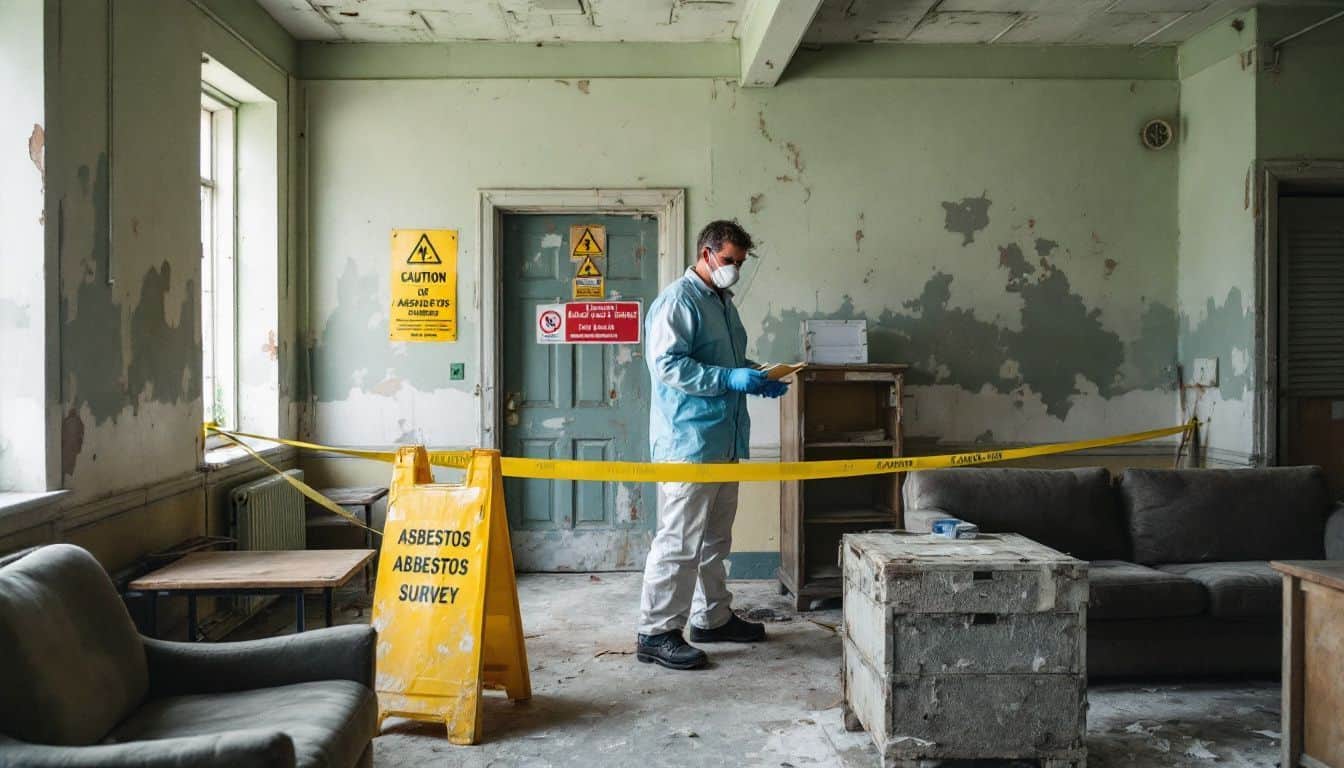
Before You Lift a Single Floorboard: Why a Pre Renovation Hazmat Survey Is Non-Negotiable
Renovating an older building is exciting — until you realise the walls, floors, or ceiling tiles might be hiding something far more dangerous than dated décor. A pre renovation hazmat survey is the critical first step that separates a safe, legally compliant refurbishment from one that puts workers, occupants, and owners at serious risk.
Asbestos was used extensively in UK construction until its full ban in 1999. Any building built or refurbished before that date could contain asbestos-containing materials (ACMs) in dozens of locations. Disturb them without knowing, and you risk releasing fibres that cause mesothelioma, asbestosis, and lung cancer — conditions that can take decades to develop and have no cure.
This post walks through everything a robust renovation plan must include when asbestos is a potential concern — from the surveys you are legally required to commission, through to safe removal, waste disposal, and ongoing management.
What Is a Pre Renovation Hazmat Survey?
A pre renovation hazmat survey — formally known in the UK as a refurbishment and demolition (R&D) survey — is a fully intrusive inspection carried out before any structural, mechanical, or cosmetic renovation work begins. Its purpose is to locate and identify every ACM in the areas that will be disturbed during the project.
Unlike a management survey, which assesses materials in their current condition for ongoing monitoring purposes, an R&D survey goes considerably deeper. Surveyors will access voids, break into cavities, and take bulk samples for laboratory analysis. Nothing is assumed to be safe — everything is investigated.
The survey produces a detailed report listing:
- The location of every ACM found
- The type of asbestos identified (chrysotile, amosite, crocidolite, etc.)
- The condition and extent of each material
- A risk assessment for each ACM
- Recommendations for removal, encapsulation, or management
This report then forms the foundation of your entire renovation plan. Without it, you are working blind — and potentially breaking the law.
Legal Requirements: What the Regulations Actually Say
The Control of Asbestos Regulations place a clear legal duty on anyone commissioning or managing renovation work on a building that may contain asbestos. The regulations require that a refurbishment survey is completed before any work that will disturb the building fabric begins. This is not optional guidance — it is a legal obligation.
Failure to comply can result in prohibition notices, unlimited fines, and prosecution. The HSE takes a firm line on this, particularly where workers have been exposed to asbestos as a result of inadequate pre-work surveys.
Who Is Responsible?
The dutyholder — typically the building owner, employer, or person in control of the premises — carries the primary legal responsibility. Under the Construction (Design and Management) Regulations, principal designers and principal contractors also have duties to ensure pre-construction hazard information is gathered and shared before work starts.
If you are commissioning a renovation project, you must provide your contractor with the results of any asbestos survey before they begin. Handing over a building without that information is a serious breach of your legal duties.
Who Can Carry Out the Survey?
Pre renovation hazmat surveys must be carried out by a competent surveyor. The HSE’s guidance document HSG264 sets out the standard that surveyors must meet. UKAS-accredited surveying bodies provide the highest level of assurance, and reputable surveying companies will hold the relevant accreditations and carry professional indemnity insurance.
Never commission a survey from a contractor who is also tendering for the removal work — the potential for conflict of interest is significant and undermines the integrity of the whole process.
Where Is Asbestos Typically Found in Older Buildings?
One of the most common mistakes property owners make is assuming asbestos is only found in obvious places like lagging around pipes. In reality, ACMs can appear almost anywhere in a building constructed or refurbished before 1999.
Common locations include:
- Ceiling tiles and textured coatings such as Artex
- Floor tiles and the adhesive beneath them
- Pipe and boiler insulation
- Roof sheeting and rainwater goods
- Partition walls and internal panels
- Fire doors and fire-resistant boards
- Soffit boards and external cladding
- Insulation board in electrical cupboards and service risers
- Bitumen felt on flat roofs
- Gaskets and rope seals in heating systems
A pre renovation hazmat survey will systematically check all of these locations — and more — within the areas to be refurbished. If the entire building is being renovated, the survey must cover the entire building.
Developing Your Asbestos Management Plan
Once the survey is complete, the findings must be incorporated into a formal asbestos management plan. This document is the operational backbone of your renovation project — it tells everyone involved where the hazards are, how they are to be managed, and what the responsibilities of each party are.
What the Plan Must Include
A well-constructed asbestos management plan will contain:
- An up-to-date asbestos register — listing all ACMs by location, type, condition, and risk rating
- A clear decision for each ACM — remove, encapsulate, or manage in place
- Removal sequencing — which ACMs must be dealt with before other trades can begin work
- Contractor requirements — specifying whether licensed or non-licensed removal contractors are required
- Emergency procedures — what happens if ACMs are discovered unexpectedly during work
- Waste disposal arrangements — how asbestos waste will be packaged, labelled, transported, and disposed of at a licensed facility
- Communication plan — how asbestos information is shared with all contractors, subcontractors, and workers on site
The plan must be accessible to all relevant parties throughout the project. It is a live document — if additional ACMs are found during the works, it must be updated immediately.
Keeping the Asbestos Register Updated
The asbestos register is not a document you create once and file away. Every time an ACM is removed, encapsulated, or found to have changed condition, the register must be updated.
This is especially important for buildings that will remain in use after renovation — the register forms part of the ongoing duty to manage asbestos for future occupants and maintenance workers.
Safe Asbestos Removal: What the Process Involves
For many renovation projects, removal of ACMs is the only practical option. Encapsulation may be suitable where materials are in good condition and will not be disturbed, but for most structural renovation work, the ACMs in the affected areas must come out before other trades begin.
Licensed vs Non-Licensed Removal
Not all asbestos removal requires a licensed contractor — but much of it does. The Control of Asbestos Regulations distinguish between licensed, notifiable non-licensed, and non-licensed work based on the type of asbestos, its condition, and the level of disturbance involved.
High-risk materials such as sprayed coatings, lagging, and asbestos insulating board (AIB) must always be removed by a contractor holding a licence from the HSE. Lower-risk materials such as asbestos cement sheeting in good condition may be removable under non-licensed conditions, but this still requires appropriate training, controls, and notification procedures.
If you are in any doubt, treat the work as licensable. The consequences of getting this wrong are too serious to risk. For larger or more complex projects, a demolition survey may be required alongside the standard refurbishment survey to ensure full compliance before the project begins.
Control Measures During Removal
Safe asbestos removal requires a series of engineering and procedural controls to prevent fibre release and protect workers and building occupants. These typically include:
- Erecting a sealed enclosure around the work area
- Using negative pressure units (NPUs) with HEPA filtration to maintain controlled airflow
- Wet suppression methods to reduce dust generation
- Full personal protective equipment (PPE) for all workers, including disposable coveralls and appropriate respiratory protective equipment (RPE)
- Air monitoring throughout the removal process
- Clearance air testing by an independent analyst before the enclosure is dismantled
No area should be signed off for re-occupation or for other trades to enter until a four-stage clearance procedure has been completed and a certificate of reoccupation has been issued by an independent analyst. Cutting corners at this stage puts everyone at risk.
Asbestos Waste Disposal
Asbestos waste is classified as hazardous waste and must be handled accordingly. All waste must be double-bagged in appropriate asbestos waste sacks, clearly labelled, and transported by a registered waste carrier to a licensed disposal facility.
A waste transfer note must be completed and retained for a minimum of three years. Do not allow asbestos waste to be mixed with general construction waste — this is both illegal and extremely dangerous. Reputable contractors offering asbestos removal will handle all waste documentation as a matter of course.
Protecting Workers: Training and Communication
Every worker on a renovation site where asbestos has been identified — or where its presence cannot be ruled out — must receive appropriate asbestos awareness training. This applies not just to the removal contractors, but to all trades: electricians, plumbers, plasterers, carpenters, and anyone else working in the building.
Asbestos awareness training covers:
- What asbestos is and why it is dangerous
- Where it is likely to be found
- What to do if asbestos is suspected or discovered unexpectedly
- How to avoid disturbing ACMs
- Emergency procedures
This training is not a substitute for the specialist training required by removal operatives — it is a baseline level of knowledge that every worker on site must have.
The survey results must also be shared with all contractors bidding for or undertaking work on the project. Withholding this information is not only dangerous — it is a breach of your legal duties under CDM.
What Happens If Asbestos Is Found Unexpectedly During Renovation?
Even with a thorough pre renovation hazmat survey, it is possible to encounter unexpected ACMs during the works — particularly in areas that were not accessible at the time of the survey, or where materials were concealed behind later additions to the building.
If this happens, work in the affected area must stop immediately. The area should be cordoned off, access restricted, and the asbestos management plan updated. A further survey or sampling exercise will be needed before work can resume.
This is not a reason to avoid thorough surveying in the first place — quite the opposite. The more thorough your pre renovation hazmat survey, the less likely you are to encounter unexpected discoveries mid-project, with all the programme delays and additional costs that brings. Treating the survey as an inconvenience rather than an investment is a false economy.
Planning Your Renovation Around the Survey Findings
A pre renovation hazmat survey does not just satisfy a legal requirement — it actively shapes how your project is sequenced and resourced. Once you know exactly what ACMs are present and where, you can plan your programme with confidence.
Consider the following when building your renovation timeline:
- Commission the survey early — before finalising your contractor appointments or programme. The survey findings may affect the scope of works and the specialist contractors you need to engage.
- Allow time for removal — licensed asbestos removal takes time. Enclosures need to be erected, work completed safely, and clearance testing passed before other trades can enter. Build this into your programme realistically.
- Sequence removal correctly — ACMs that are in areas where other trades will work must be removed and cleared before those trades begin. Overlapping these activities is not an option.
- Budget for the unexpected — even with a thorough survey, contingency should be built in for additional ACMs discovered during the works. A contingency of 10–15% on your asbestos removal budget is prudent.
- Update your documentation throughout — keep the asbestos register and management plan current at every stage of the project.
Projects that integrate the survey findings into their planning from the outset run more smoothly, encounter fewer delays, and are far less likely to result in regulatory intervention or worker exposure incidents.
Renovation Projects Across the UK: Getting the Right Survey
Supernova Asbestos Surveys operates nationwide, with experienced surveyors covering major cities and regions across England, Scotland, and Wales. Whether you are managing a renovation project in the capital or further afield, we can provide the pre renovation hazmat survey you need to proceed safely and legally.
If you are based in the capital, our asbestos survey London service covers all central and Greater London areas, with fast turnaround times and fully accredited surveyors.
For projects in the North West, our asbestos survey Manchester team covers the city and surrounding areas, including Salford, Stockport, and beyond.
In the Midlands, our asbestos survey Birmingham service provides the same high standard of surveying across Birmingham, the Black Country, and the wider West Midlands region.
With over 50,000 surveys completed nationwide, Supernova has the experience, accreditations, and regional coverage to support renovation projects of any scale. Call us on 020 4586 0680 or visit asbestos-surveys.org.uk to discuss your requirements and get a quote.
Frequently Asked Questions
What is the difference between a management survey and a pre renovation hazmat survey?
A management survey is designed to locate and assess ACMs that are present in a building during normal occupation — it focuses on materials in their current condition and informs an ongoing management plan. A pre renovation hazmat survey (formally an R&D survey) is fully intrusive and is required specifically before refurbishment or demolition work begins. It goes much further, accessing voids and cavities to ensure every ACM that could be disturbed by the planned works is identified before work starts.
Do I need a pre renovation hazmat survey for a small domestic renovation?
If the property was built or refurbished before 1999 and you are planning work that will disturb the building fabric — such as removing walls, replacing flooring, or stripping out a kitchen or bathroom — then a survey is strongly advisable and, in many circumstances, legally required. Even in domestic settings, the duty to manage asbestos and the obligations under the Control of Asbestos Regulations apply where work is being carried out by tradespeople. Do not assume a small job carries no risk.
How long does a pre renovation hazmat survey take?
The duration depends on the size and complexity of the building and the scope of the planned works. A survey covering a single floor of a commercial building might be completed in a day; a full survey of a large industrial or institutional building could take several days. Your surveying company will advise on timescales when you request a quote. Laboratory analysis of bulk samples typically adds a few working days before the final report is issued.
What happens if asbestos is found during my renovation?
Work in the affected area must stop immediately. The area should be cordoned off and access restricted to prevent further disturbance. Your asbestos management plan should set out the emergency procedures to follow. A further survey or sampling exercise will be required, and — depending on the material — a licensed removal contractor may need to be engaged before work can resume. This is exactly why a thorough pre renovation hazmat survey is so valuable: the more you know before work starts, the less likely you are to face costly and disruptive mid-project discoveries.
How do I find a competent surveyor for a pre renovation hazmat survey?
Look for a surveying company that holds UKAS accreditation and whose surveyors meet the competency standards set out in HSG264. The company should carry professional indemnity insurance and should not have any involvement in the asbestos removal work — the surveyor and the removal contractor must be independent of each other. Supernova Asbestos Surveys meets all of these criteria and has completed over 50,000 surveys across the UK. Contact us on 020 4586 0680 or visit asbestos-surveys.org.uk to arrange your survey.