Asbestos in School Buildings: Warning Signs, Legal Duties and What to Do Next
Thousands of school buildings across the UK were constructed during the decades when asbestos was the go-to material for insulation, fire protection and acoustic dampening. That means asbestos in school buildings is not a historical footnote — it is an active, ongoing responsibility for headteachers, governors, facilities managers and local authorities right now.
Knowing what to look for, where to look, and what the law requires of you is not optional. It could be the difference between a safe learning environment and a serious health crisis.
Why Asbestos in School Buildings Is Still Such a Pressing Issue
Asbestos use in UK construction peaked between the 1950s and 1980s, and schools built during this period are extremely likely to contain asbestos-containing materials (ACMs). The ban on all asbestos types was not fully enforced until 1999, which means buildings constructed right up to the turn of the millennium may also harbour ACMs.
The Health and Safety Executive (HSE) has consistently highlighted that school buildings are among the most asbestos-affected public structures in the country. This is partly due to the sheer number of schools built during the post-war construction boom, and partly because asbestos was heavily favoured for its low cost and practical properties.
When ACMs are in good condition and left undisturbed, they do not necessarily pose an immediate risk. The danger arises when materials degrade, are damaged during maintenance work, or are disturbed by building refurbishment — all common occurrences in ageing school estates.
How to Tell If Your School Building May Contain Asbestos
The Age of the Building
The single most reliable indicator is construction date. If your school was built before 2000, the likelihood of ACMs being present is significant. Buildings dating from the 1960s and 1970s — a period of rapid expansion in UK school construction — are particularly high-risk.
Check the original building records, planning documentation or any existing asbestos register. If no records exist, that is itself a warning sign that a formal survey has never been carried out.
Construction Materials and Building Style
Certain building types and materials are strongly associated with asbestos use. CLASP (Consortium of Local Authorities Special Programme) school buildings, which were widely used across England and Wales from the late 1950s onwards, are known to contain significant quantities of asbestos insulating board (AIB).
Other construction types to be aware of include:
- Prefabricated or modular buildings from the 1960s–1980s
- Flat-roofed structures with asbestos cement sheeting
- Buildings with suspended ceiling systems installed before the 1990s
- Structures with visible pipe lagging or boiler insulation
Where Asbestos Is Most Commonly Found in Schools
Asbestos does not announce itself. It is often hidden behind wall panels, above ceiling tiles or wrapped around pipework. Understanding the most common locations helps duty holders prioritise their inspections and make informed decisions about where to focus attention first.
Insulation and Lagging
Pipe lagging and boiler insulation are among the most frequently identified ACMs in school buildings. Asbestos was applied as thermal insulation around heating pipes, boilers and hot water systems throughout the mid-twentieth century. Over time, this lagging can crack, crumble and shed fibres — particularly in plant rooms and service corridors that receive heavy foot traffic from maintenance staff.
Asbestos insulating board (AIB) was also used extensively in wall panels, partitions, door panels and ceiling linings. AIB is a particularly hazardous material because it releases fibres relatively easily when disturbed.
Ceiling Tiles and Suspended Ceilings
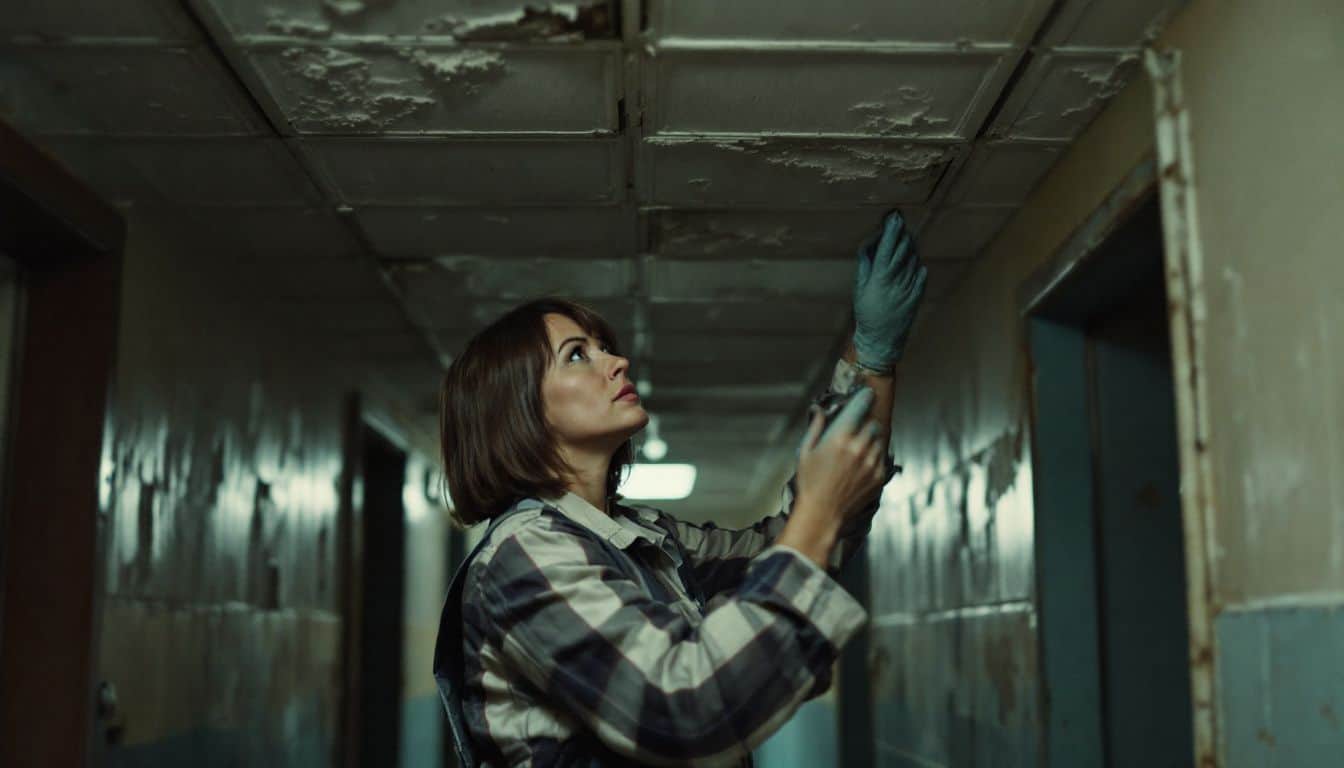
Many older school classrooms, corridors and sports halls were fitted with ceiling tiles containing AIB or asbestos cement. These tiles may look unremarkable — often plain white or textured — but can release fibres when broken, drilled or lifted during routine maintenance.
Suspended ceiling systems also create a hidden void above the tiles where asbestos debris can accumulate over decades. Any work involving access to ceiling voids must be preceded by appropriate asbestos testing to confirm whether the materials above are safe to work near.
Floor Coverings
Vinyl floor tiles installed before the 1980s frequently contained chrysotile (white asbestos) as a binding agent. These tiles are often found in corridors, changing rooms and older classroom blocks. While intact floor tiles pose a lower risk, sanding, cutting or lifting them without proper precautions can release significant quantities of asbestos dust.
The adhesive used to bond floor tiles to the substrate — known as black mastic — can also contain asbestos and must be treated with equal caution.
Heating Systems and Boiler Rooms
School boiler rooms are one of the highest-risk areas for asbestos exposure. Sprayed asbestos coatings were applied directly to structural steelwork, boiler casings and ductwork as both fireproofing and insulation. These spray coatings are classed as the most hazardous form of ACM because the fibres are loosely bound and become airborne very easily.
Any school with an original boiler room that has not been professionally surveyed should treat this space as a high-priority area for investigation.
Textured Coatings and Decorative Finishes
Artex and similar textured coatings applied to ceilings and walls before the mid-1980s often contained chrysotile asbestos. These coatings are widespread in older school buildings and are frequently disturbed during redecoration work. Sanding or scraping textured coatings without prior testing is a common — and serious — mistake.
Physical Warning Signs That Asbestos May Be Deteriorating
Even where an asbestos register exists, materials can deteriorate between formal inspections. Staff and caretakers should be trained to recognise the physical warning signs that ACMs may be releasing fibres.
Damaged or Crumbling Insulation
Insulation lagging that appears cracked, crumbling or flaking is a clear red flag. This type of deterioration is common in older plant rooms and around heating pipes that have been subjected to years of thermal cycling. Any damaged lagging should be treated as a potential asbestos hazard until confirmed otherwise.
Do not attempt to repair or remove damaged insulation without first arranging a professional assessment. Even a brief disturbance can release a significant quantity of fibres into the air.
Broken or Damaged Ceiling and Wall Panels
Cracked, broken or missing ceiling tiles and wall panels in older buildings should raise immediate concern. AIB panels that have been chipped, drilled or broken during maintenance work are particularly hazardous.
If you notice damage to panels in an older building and cannot confirm the material is asbestos-free, restrict access to the area and seek professional advice without delay.
Visible Dust Near Suspected ACMs
Fine white or grey dust accumulating around ceiling tiles, pipe lagging or wall panels may indicate that ACMs are actively shedding fibres. This is an urgent warning sign that should not be ignored or cleaned up without specialist guidance.
Visible dust from suspected asbestos-containing materials should prompt immediate restriction of the area and professional asbestos testing to determine whether airborne fibres are present at hazardous levels.
Deterioration Following Maintenance Work
Unplanned or poorly managed maintenance work is one of the most common triggers for asbestos fibre release in school buildings. If maintenance has recently been carried out in an area containing suspected ACMs — drilling, cutting, plastering or pipework — this should be flagged immediately and air monitoring considered.
Legal Requirements for Managing Asbestos in Schools
The legal framework for managing asbestos in school buildings is clear and non-negotiable. Schools are not exempt from the Control of Asbestos Regulations — they are subject to the same duties as any other non-domestic premises.
The Duty to Manage
Regulation 4 of the Control of Asbestos Regulations places a legal duty on those responsible for non-domestic premises to manage asbestos. In schools, this duty typically falls on the governing body, the academy trust, or the local authority — depending on the type of school.
The duty holder must:
- Take reasonable steps to identify whether ACMs are present
- Assess the condition and risk posed by any ACMs found
- Prepare and implement a written asbestos management plan
- Monitor the condition of ACMs at regular intervals
- Provide information about ACM locations to anyone who may disturb them
Failure to comply with these duties is a criminal offence. The HSE has the power to issue improvement notices, prohibition notices and prosecute duty holders where these obligations are not met.
HSG264 and the Requirement for a Survey
HSE guidance document HSG264 sets out the requirements for asbestos surveys in non-domestic buildings. For schools, a management survey is the minimum baseline requirement. This survey identifies the location, extent and condition of ACMs that could be disturbed during normal occupancy and routine maintenance.
Where refurbishment or demolition work is planned, a more intrusive refurbishment survey is required before any work begins. This applies even if a management survey has already been completed — the two survey types serve different purposes and one does not replace the other.
If a building is being taken down entirely, a demolition survey must be completed before any structural work commences. This is the most intrusive survey type and ensures every ACM is identified before workers are put at risk.
The Asbestos Management Plan
Every school with confirmed or suspected ACMs must have a written asbestos management plan. This document should set out:
- The location and condition of all known ACMs
- The risk assessment for each ACM
- The actions required to manage each material safely
- The schedule for regular monitoring inspections
- Emergency procedures in the event of accidental disturbance
- Named individuals responsible for each aspect of management
The plan must be kept up to date and made available to all contractors and maintenance staff before they begin any work on the premises. A plan that sits in a filing cabinet and is never shared with those who need it offers no real protection.
What to Do If You Suspect Asbestos Is Present or Has Been Disturbed
Immediate Actions for School Administrators
If you suspect asbestos has been disturbed, or if you identify damaged ACMs, act immediately. Speed is not optional here — the longer a potentially contaminated area remains accessible, the greater the risk of further exposure.
- Restrict access to the affected area — do not allow staff, pupils or contractors into the space
- Do not attempt to clean up any visible dust or debris yourself
- Contact a UKAS-accredited asbestos surveyor to carry out an assessment
- Notify the relevant duty holder (governing body, local authority or trust)
- Document everything — photographs, location, time and circumstances
- Inform staff and, where appropriate, parents of the situation and the steps being taken
When to Commission a Professional Survey
If your school does not have an up-to-date asbestos register, or if you cannot confirm the status of materials in a specific area, commission a survey before any maintenance, refurbishment or building work begins. This is not a discretionary step — it is a legal requirement under the Control of Asbestos Regulations.
Supernova Asbestos Surveys provides management surveys and refurbishment surveys for schools across the UK. Whether you need an asbestos survey London schools and academies can rely on, an asbestos survey Manchester facilities managers trust, or an asbestos survey Birmingham duty holders book with confidence — our UKAS-accredited surveyors are available nationwide.
Asbestos Removal in Schools
Not all ACMs need to be removed. In many cases, materials in good condition are best managed in place under a robust monitoring programme. Removal introduces its own risks and should only be undertaken when the risk assessment clearly supports it.
However, where materials are severely damaged, where refurbishment is planned, or where the risk assessment concludes that removal is the safest option, asbestos removal must be carried out by a contractor licensed by the HSE. Certain types of ACM — including AIB, sprayed coatings and most pipe lagging — can only be legally removed by a licensed contractor. Attempting to remove these materials without the appropriate licence is a serious criminal offence.
Before any removal work begins, ensure the contractor has sight of the asbestos survey report and the management plan. They should also produce a written plan of work outlining exactly how the removal will be conducted safely.
Training and Awareness for School Staff
Legal compliance does not begin and end with a survey. Everyone who works in or around a school building — from teaching staff to caretakers and contractors — should have a basic awareness of asbestos: what it is, where it might be found, and what to do if they suspect it has been disturbed.
Duty holders are legally required under the Control of Asbestos Regulations to share information about ACM locations with anyone who might disturb them. This means contractors must be briefed before starting any work, and maintenance staff must know which areas require particular caution.
Short asbestos awareness training sessions are widely available and represent a modest investment against the potential cost — human and financial — of an unmanaged asbestos incident in a school environment.
Frequently Asked Questions
How do I know if my school building contains asbestos?
The most reliable way to confirm whether asbestos is present is to commission a professional asbestos management survey carried out by a UKAS-accredited surveyor. If your school was built before 2000 and has no existing asbestos register, you should assume ACMs may be present until a survey confirms otherwise. Building age, construction style and the absence of records are all strong indicators that a survey is overdue.
Is it illegal to have asbestos in a school?
No — having asbestos in a building is not itself illegal. What the law requires is that it is properly managed. Under the Control of Asbestos Regulations, duty holders must identify ACMs, assess their condition, produce a written management plan and monitor materials regularly. Failure to do this is a criminal offence, regardless of whether anyone is actually harmed.
What should I do if asbestos is accidentally disturbed in a school?
Act immediately. Restrict access to the affected area, do not attempt to clean up dust or debris yourself, and contact a UKAS-accredited asbestos surveyor without delay. Notify the duty holder, document the incident thoroughly, and consider whether air monitoring is required to assess fibre levels. Do not reopen the area until a professional has confirmed it is safe to do so.
Do all school buildings need an asbestos survey?
Any school building that was built or refurbished before 2000 and does not have a confirmed, up-to-date asbestos register should be surveyed. HSE guidance under HSG264 makes clear that a management survey is the minimum requirement for occupied premises. If refurbishment or demolition is planned, a more intrusive survey type is required before work begins.
Who is responsible for managing asbestos in a school?
The legal duty to manage asbestos falls on the person or organisation that has responsibility for maintaining the building. In practice, this is typically the governing body for maintained schools, the academy trust for academies and free schools, or the local authority where it retains responsibility for the estate. The duty is set out in Regulation 4 of the Control of Asbestos Regulations and cannot be delegated away — though day-to-day management tasks can be assigned to a named individual.
Supernova Asbestos Surveys has completed over 50,000 surveys across the UK and works with schools, academies, local authorities and multi-academy trusts to ensure their asbestos obligations are met fully and efficiently. If your school does not have an up-to-date asbestos register, or if you have concerns about materials in your building, call us today on 020 4586 0680 or visit asbestos-surveys.org.uk to arrange a survey.