
When a school asbestos file is clear, current and easy to use, routine maintenance is safer, contractors can work with confidence, and the dutyholder can show they are managing risk properly. When asbestos reports are vague, outdated or missing key details, the opposite happens: decisions are delayed, work is disrupted, and the chances of accidental disturbance go up.
That is why schools need more than a simple list of suspect materials. Good asbestos reports give you a practical record of what was inspected, what was found, how serious the risk is, and what needs to happen next. For headteachers, estates teams, academy trusts and local authorities, that report is the working foundation of asbestos management across the site.
Why asbestos reports matter so much in schools
Many school buildings still contain asbestos-containing materials, particularly where parts of the estate were built or refurbished before asbestos use was banned. These materials may be hidden in ceiling voids, service risers, floor tiles, pipe insulation, wall panels, textured coatings and roofing products.
If those materials remain undisturbed and in good condition, they can often be managed safely. The problem starts when no one knows they are there, when their condition has changed, or when building work begins without the right information.
Under the Control of Asbestos Regulations, the dutyholder for non-domestic premises must take reasonable steps to find out whether asbestos is present, assess the risk, and manage that risk. In a school, that duty usually sits with the employer, academy trust, governing body, local authority or another organisation with control over maintenance and repair.
Accurate asbestos reports help schools to:
- identify where asbestos-containing materials are located
- understand the condition of those materials
- plan maintenance without disturbing asbestos
- brief contractors before any work starts
- prioritise repair, encapsulation or removal
- maintain an up-to-date asbestos register and management plan
- demonstrate compliance with HSE guidance and HSG264
Without reliable asbestos reports, a school cannot make informed decisions about day-to-day occupation, minor works or larger projects.
Which surveys produce asbestos reports?
Not all asbestos reports are created for the same purpose. The type of survey determines how intrusive the inspection is, what areas are accessed, and how the findings should be used.
Management survey
A management survey is the standard survey for an occupied school building. Its purpose is to locate, as far as reasonably practicable, any asbestos-containing materials that could be damaged or disturbed during normal occupation, routine maintenance or foreseeable minor works.
This survey is usually non-intrusive or only slightly intrusive. It focuses on accessible areas and visible materials. The resulting asbestos reports support the asbestos register and management plan used during normal building occupation.
Refurbishment and demolition survey
Where planned works will disturb the fabric of the building, a management survey is not enough. Before major refurbishment, structural alteration or full demolition, a more intrusive survey is required. For project-specific intrusive inspections, a demolition survey is used to identify asbestos in the areas affected before work begins.
This type of survey may involve opening up floors, walls, ceilings, ducts and voids. The area is often taken out of normal use while the inspection takes place. The asbestos reports produced from this work are essential before contractors start stripping out or demolishing any part of the premises.
What information should asbestos reports include?
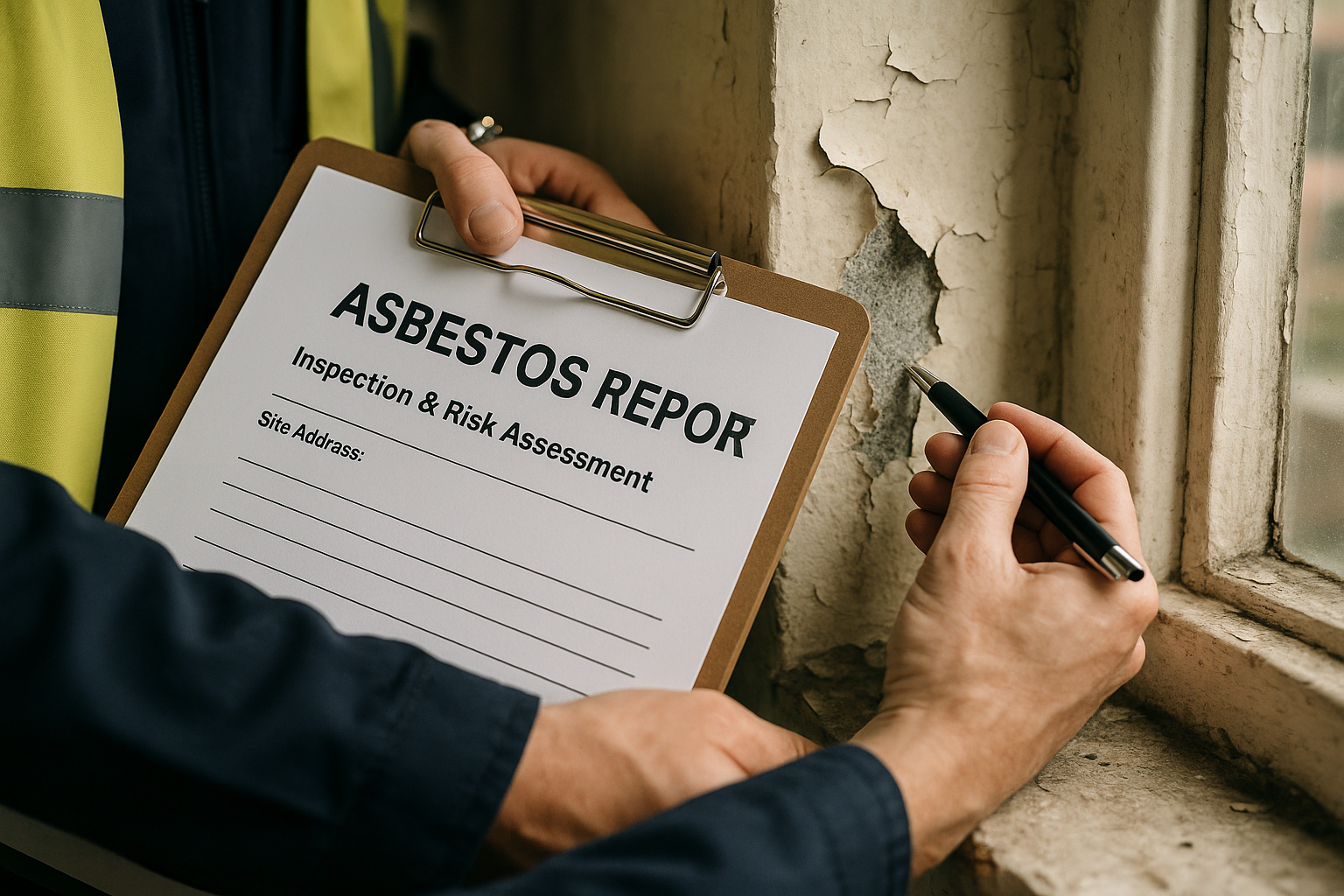
HSG264 sets out what a suitable asbestos survey report should contain. In practice, schools should expect asbestos reports to be detailed enough for a competent person to understand exactly what was inspected, what was found, and what action is required.
1. Property and survey details
The report should identify the school site clearly. That includes the building name, address, survey date, the type of survey completed, and the areas included or excluded.
This matters because asbestos reports are only reliable within their stated scope. If a boiler room, roof void or locked storeroom was not accessed, that limitation needs to be recorded so the school does not assume the area is asbestos-free.
2. Executive summary
A useful summary helps the dutyholder understand the main findings quickly. It should highlight whether asbestos was identified, whether any urgent action is needed, and whether further inspection is recommended.
For busy school estates teams, this section often becomes the starting point for immediate decisions.
3. Presumed and confirmed asbestos-containing materials
The core of asbestos reports is the material schedule. Each asbestos-containing material, or presumed asbestos-containing material where sampling was not carried out, should be listed clearly.
The entry should normally include:
- the room or area
- the exact location within that room
- the product type, such as insulating board, cement sheet or floor tile
- the asbestos type if confirmed by analysis
- whether the material was sampled, presumed or strongly presumed
- the extent or quantity of the material
Descriptions should be precise. “Panel above suspended ceiling in science prep room” is useful. “Boarding in corridor” is not.
4. Location plans and annotated drawings
Good asbestos reports do not rely on text alone. They include marked-up plans, sketches or photographs showing where asbestos-containing materials are located.
This is one of the most practical parts of the report. A contractor, caretaker or project manager should be able to cross-check the written schedule against a floor plan and identify the material before any work starts.
5. Material assessment and condition
The report should assess the condition of each item. That means noting whether the material is sealed, damaged, exposed, deteriorating or otherwise vulnerable to disturbance.
Many asbestos reports also include a material assessment score. This usually reflects factors such as:
- product type
- extent of damage
- surface treatment
- asbestos type
This helps indicate how readily fibres could be released if the material is disturbed.
6. Risk-based recommendations
Schools need recommendations they can act on. For each item, asbestos reports should explain what is needed next.
Typical recommendations include:
- leave in place and monitor
- repair minor damage
- encapsulate or seal
- label the material or area
- restrict access
- arrange removal before planned works
- undertake further inspection if access was limited
Where removal is needed, the report should make clear that the work must be planned and carried out by competent specialists. If you need licensed or non-licensed remedial work arranged, professional asbestos removal should always be based on the survey findings and the nature of the material involved.
7. Photographs
Photographs are not just helpful extras. In many school buildings, they make the report far easier to use. A clear image of a ceiling tile, riser panel or pipe elbow can prevent confusion later.
Photos should be labelled so they correspond with the material schedule and plans.
8. Sample and laboratory information
Where samples were taken, asbestos reports should record the sample reference numbers and analysis results. The report should also confirm that testing was completed by a competent laboratory in line with recognised standards.
Where a full survey is not required and only a suspect material needs testing, standalone sample analysis can be useful for targeted checks. That said, isolated testing is not a replacement for a suitable survey where the duty to manage applies.
9. Surveyor details and limitations
The report should identify who carried out the survey and the organisation responsible. It should also explain any limitations, such as inaccessible areas, fixed finishes that could not be disturbed, or parts of the site excluded from the instruction.
This protects the school from making assumptions based on incomplete information. One of the most common problems with older asbestos reports is that exclusions are buried in the small print and then forgotten.
How asbestos reports feed into the asbestos register and management plan
Asbestos reports are not meant to sit in a folder untouched. Their findings should be transferred into the school’s live asbestos register and used to shape the asbestos management plan.
The asbestos register
The register is the day-to-day working record of known or presumed asbestos-containing materials in the building. It should reflect the latest survey information and be updated when materials are removed, repaired, encapsulated or re-inspected.
For schools, the register needs to be accessible to anyone who may disturb the fabric of the building. That includes maintenance staff, visiting engineers, IT installers, fire alarm contractors and builders.
The management plan
The management plan explains how the school controls the risk from asbestos over time. It should cover responsibilities, communication, re-inspection arrangements, emergency procedures and planned actions for each item identified in the asbestos reports.
A practical management plan will usually include:
- named persons responsible for asbestos management
- how contractors are briefed before work starts
- how staff report damage to ceilings, panels or service areas
- how often re-inspections are arranged
- what happens if asbestos is accidentally disturbed
- how records are updated following remedial work
If the report identifies damaged materials but the management plan does not assign actions and timescales, the paperwork is not doing its job.
What makes asbestos reports useful in real school settings?
The best asbestos reports are technically sound, but they are also easy to use. In schools, that practical side matters just as much as the survey detail.
A report becomes far more valuable when it helps people on site make quick, safe decisions.
Clear room references
Schools often rename rooms over time. A report that refers only to old plans can create confusion. Room numbers, block names and plain-English descriptions should all line up.
Simple action wording
“Monitor” is not enough on its own. Better asbestos reports explain what that means in practice, such as visual checks during routine inspections and formal re-inspection at suitable intervals.
Useful for contractors
Before any contractor drills, cuts, lifts, strips or accesses concealed spaces, they need the right asbestos information. Reports should make it easy to identify affected areas and avoid unsafe assumptions.
Easy to update
School estates change constantly. A classroom may be refurbished, a boiler replaced, or damaged panels removed during holidays. Asbestos reports should be structured so updates can be integrated into the wider asbestos record without confusion.
Common problems found in poor asbestos reports
Not every report gives a school what it needs. Some documents meet the bare minimum on paper but are difficult to use in practice.
Watch for these warning signs:
- no clear plans showing asbestos locations
- vague material descriptions
- missing sample references or unclear analysis results
- no explanation of inaccessible areas
- outdated room names or building references
- recommendations that are too generic to act on
- no obvious link to the asbestos register or management plan
If any of those issues appear, it is worth reviewing whether the survey information is still suitable and sufficient for the school’s current needs.
Practical advice for schools reviewing asbestos reports
If you are responsible for a school site, do not wait until a project starts to check the paperwork. Review asbestos reports while there is still time to fix gaps.
Use this checklist:
- Confirm the survey type. Make sure the report matches the intended use of the building or project.
- Check the scope. Look for excluded areas, locked rooms, roof spaces and service voids.
- Review the plans. Ensure asbestos locations are marked clearly and match the written schedule.
- Check recommendations. Every identified item should have a practical management action.
- Compare with the register. The live asbestos register should reflect the latest report.
- Plan re-inspections. Known asbestos-containing materials need regular review to confirm their condition has not changed.
- Brief contractors properly. Make asbestos information part of every permit-to-work or pre-start process.
Where schools operate across multiple sites, consistency matters. Using one experienced provider can make records easier to compare and manage across the estate.
Do schools in different cities need different asbestos reports?
The legal duty is the same, but local building stock can vary a lot. Victorian schools, post-war system-built blocks, and later extensions all present different asbestos risks. That is why survey experience with education buildings is so useful.
If your estate includes properties in the capital, a specialist asbestos survey London service can help with complex and heavily altered buildings. For schools in the north-west, an asbestos survey Manchester can support both single-site and multi-site requirements. And for education premises across the Midlands, an asbestos survey Birmingham service offers the same standard of reporting and compliance support.
Wherever the school is based, the report should still align with the Control of Asbestos Regulations, HSG264 and current HSE guidance.
When should asbestos reports be updated?
Asbestos reports are not always one-and-done documents. They may need updating when the building changes, when access improves, or when the condition of a known material deteriorates.
Typical triggers for review include:
- planned refurbishment or demolition works
- discovery of previously inaccessible areas
- damage to known or presumed asbestos-containing materials
- changes to room use that increase the likelihood of disturbance
- completion of removal or encapsulation works
- significant time passing since the last inspection
Where asbestos remains in place, periodic re-inspection is a key part of the duty to manage. The report findings should continue to reflect the actual condition on site.
Choosing a surveyor for school asbestos reports
Schools should look for competence, clear reporting and experience with occupied education settings. The cheapest document is rarely the most useful one if it creates uncertainty later.
Ask practical questions before appointing a surveyor:
- Will the report include annotated plans and photographs?
- How are inaccessible areas recorded?
- How are recommendations prioritised?
- Can the findings be integrated easily into the asbestos register?
- Is sampling and analysis handled through competent, recognised processes?
- Does the team understand how schools operate during term time and holidays?
A good surveyor will explain the difference between survey types, define the scope clearly, and produce asbestos reports that are usable by both compliance teams and site staff.
Frequently Asked Questions
What is the difference between an asbestos survey and an asbestos report?
The survey is the inspection process carried out on site. The report is the written record of that inspection, including findings, sample results, risk information, plans, photographs and recommendations. Schools need both the physical survey work and clear asbestos reports to manage risk properly.
Do all schools need asbestos reports?
Any school responsible for non-domestic premises must manage asbestos risk under the Control of Asbestos Regulations. If asbestos may be present, the dutyholder must have suitable information about its location and condition. In practice, that means having appropriate asbestos reports and keeping the asbestos register and management plan up to date.
How often should school asbestos reports be reviewed?
The report itself does not always need to be replaced on a fixed timetable, but known asbestos-containing materials should be re-inspected at suitable intervals and the records updated when conditions change. If refurbishment or demolition is planned, a more intrusive survey and new report will usually be required for the affected area.
Can a school rely on old asbestos reports?
Only if they are still relevant, accurate and suitable for the current building layout and use. Old asbestos reports often contain outdated room references, incomplete access information or findings that no longer reflect the site. If there is doubt, review the records before any work proceeds.
What should a school do if an asbestos report recommends removal?
The school should assess the recommendation in the context of the material’s condition, location and any planned works. Removal should be arranged through competent specialists, with the scope based on the survey findings and the applicable legal requirements. The asbestos register and management plan should then be updated once the work is complete.
If you need clear, compliant asbestos reports for a school, Supernova Asbestos Surveys can help with management surveys, refurbishment and demolition surveys, sampling, and follow-on support across the UK. Call 020 4586 0680 or visit asbestos-surveys.org.uk to book a survey or discuss the right service for your site.