
Ignore asbestos for long enough and a straightforward maintenance job can become a legal, financial and safety problem very quickly. If you are responsible for a workplace, school, shop, warehouse, rental portfolio or the shared parts of a residential block, the asbestos survey legal requirement is not a technical side issue. It sits right at the centre of your duty to manage risk.
For most non-domestic premises in the UK, the law expects dutyholders to take reasonable steps to find asbestos-containing materials, assess their condition, and prevent anyone from disturbing them without proper controls. That normally means arranging the right survey at the right time, keeping records current, and making sure contractors are given clear asbestos information before work starts.
What does the asbestos survey legal requirement actually mean?
The phrase asbestos survey legal requirement is usually shorthand for the duties created by the Control of Asbestos Regulations. In practice, if you are the person or organisation responsible for maintenance or repair in non-domestic premises, you need to know whether asbestos is present, where it is, what condition it is in, and how the risk will be controlled.
The law does not say you can simply commission one survey and forget about it. It requires active management. HSE guidance and HSG264 set out how asbestos surveys should be planned, carried out and reported, so if you are relying on survey information to support compliance, it needs to be suitable for the building and the work involved.
That means you should be able to show:
- What asbestos information you already hold
- What areas have been surveyed
- What materials have been identified or presumed
- How the risk has been assessed
- What actions are in place to prevent disturbance
- Who has access to the asbestos register and management plan
If those basics are missing, your compliance position is weak even before any incident happens.
Which buildings fall under the asbestos survey legal requirement?
The asbestos survey legal requirement applies mainly to non-domestic premises and the common parts of domestic buildings. That covers far more properties than many owners and managing agents first assume.
Typical examples include:
- Offices and business parks
- Shops, restaurants, pubs and hotels
- Factories, depots and warehouses
- Schools, colleges and universities
- Hospitals, surgeries and care settings
- Churches, village halls and public buildings
- Communal corridors, stairwells, risers, plant rooms and roofs in blocks of flats
If a property was built or refurbished before 2000, it should be treated as potentially containing asbestos unless there is reliable evidence showing otherwise. Age alone does not prove asbestos is there, but it is a clear reason to investigate properly.
Inside a private home, the duty to manage does not apply in the same way as it does in non-domestic premises. Even so, asbestos still has to be considered before refurbishment or demolition works in older domestic properties. Tradespeople, occupants and neighbours can all be put at risk if hidden asbestos is disturbed.
Who is responsible for meeting the asbestos survey legal requirement?
The person with the legal duty is known as the dutyholder. This is usually the person or organisation with responsibility for maintenance or repair, although responsibility can also sit with anyone who has control over part of the premises.
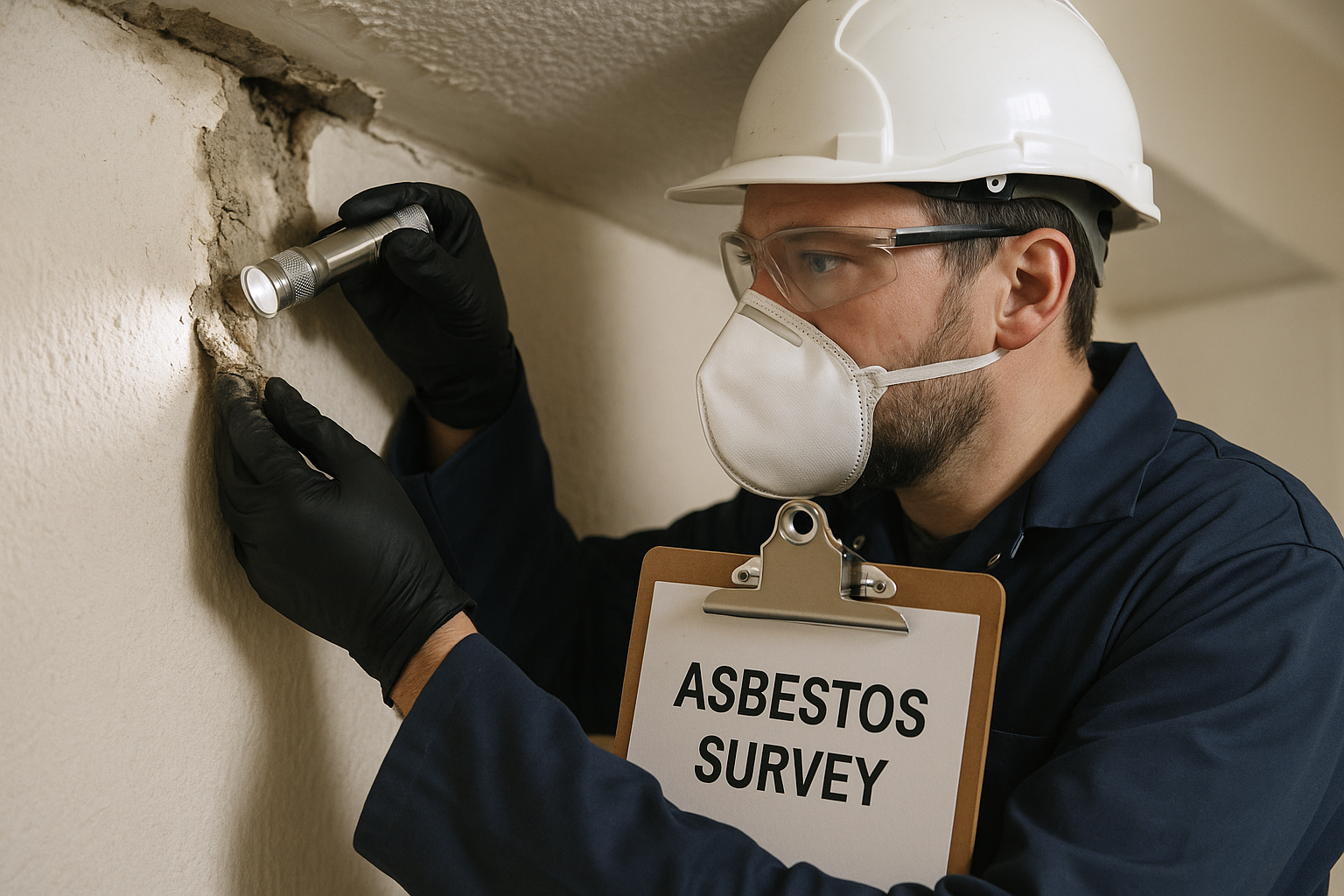
Depending on the property and the lease structure, the dutyholder may be:
- The building owner or freeholder
- A landlord
- A managing agent
- A facilities management company
- An employer in control of the workplace
- A leaseholder with repairing obligations
In multi-let buildings, responsibility is often shared. That is where confusion creeps in. If nobody has clearly agreed who commissions surveys, who updates the asbestos register and who briefs contractors, gaps appear very quickly.
A practical step is to review leases, service agreements and maintenance contracts now. Make sure asbestos responsibilities are written down, named, and easy to follow. If there are shared areas, confirm who controls them and who is expected to act.
When is an asbestos survey legally required?
The answer depends on what is happening in the building. The asbestos survey legal requirement is not limited to one survey type or one stage in a property’s life. Different situations trigger different duties.
During normal occupation and routine maintenance
If you manage a non-domestic building, you need enough information to comply with the duty to manage asbestos. In most cases, that means arranging a management survey so accessible asbestos-containing materials can be located and assessed.
This survey supports day-to-day occupation, planned maintenance and routine works. It helps you create an asbestos register and decide whether materials should be monitored, repaired, encapsulated or removed.
Before refurbishment works
If works will disturb the fabric of the building, a management survey is not enough. Before strip-out, rewiring, HVAC upgrades, kitchen replacements, ceiling works, structural alterations or major maintenance, you will usually need a refurbishment survey.
This type of survey is intrusive by design. It is intended to identify asbestos hidden behind walls, above ceilings, within risers, under floors and inside service voids that the planned works could disturb.
Before demolition
If a building, or part of one, is due to be demolished, a demolition survey is required. This is the most intrusive survey type and is used to locate asbestos-containing materials throughout the structure so they can be dealt with safely before demolition starts.
No demolition contractor should be expected to proceed without this information. Hidden asbestos can lead to exposure, contamination, delays and enforcement action.
After asbestos has already been identified
Once asbestos-containing materials are known or presumed to be present, they need to be monitored. That is where a re-inspection survey becomes useful.
Re-inspections check whether materials remain in the same condition, whether risk ratings still make sense, and whether the management plan reflects what is actually on site. Many dutyholders review annually, but the correct interval depends on the material, its condition and the likelihood of disturbance.
Choosing the right survey type matters
One of the most common mistakes is using the wrong survey for the job. The asbestos survey legal requirement is not satisfied by having just any asbestos report on file. The survey must match the building use and the planned work.

Management survey
A management survey is designed for occupied premises where normal activities continue. Its purpose is to locate, as far as reasonably practicable, the presence and extent of suspect asbestos-containing materials that could be disturbed during normal occupation, routine maintenance or foreseeable installation work.
It is not a substitute for a refurbishment or demolition survey.
Refurbishment survey
A refurbishment survey is required before work that breaks into the building fabric. It is intrusive within the area of the proposed works and can involve destructive inspection. If the project affects only one part of the building, the survey can be targeted to that area, but the scope must be accurate.
Demolition survey
A demolition survey is required before demolition of the whole building or a defined part of it. It aims to identify all asbestos-containing materials, including those in concealed or difficult-to-access areas. Because it is highly intrusive, the area is usually vacant at the time of survey.
Re-inspection survey
A re-inspection survey reviews materials that have already been identified or presumed. It updates condition information and helps you decide whether your current controls are still suitable. If materials have deteriorated, your management plan must be updated.
What the law expects dutyholders to do
Meeting the asbestos survey legal requirement involves more than booking a surveyor. Dutyholders need a structured, documented approach to asbestos management.
As a minimum, you should be able to do the following:
- Review existing asbestos information for the property
- Commission the correct survey where information is missing or unsuitable
- Presume materials contain asbestos where there is uncertainty
- Assess the risk based on condition and likelihood of disturbance
- Maintain an asbestos register
- Prepare a written asbestos management plan
- Inform contractors, staff and anyone else who may disturb asbestos
- Review and update records when conditions or building use change
If you cannot produce these records when asked, it becomes very difficult to demonstrate compliance. That applies even if no one has yet been exposed.
What should an asbestos survey report include?
A useful report should do more than list sample results. It should give you clear information you can act on. HSG264 sets the benchmark for what a suitable survey report should contain.
A good asbestos survey report will usually include:
- The survey scope and purpose
- The areas accessed and any limitations
- Details of areas not accessed
- Descriptions of suspect materials
- Photographs and plans where appropriate
- Material assessments and condition notes
- Laboratory results for samples taken
- Recommendations for management, re-inspection or removal
If the report is vague, does not reflect the actual work scope, or leaves major gaps unexplained, challenge it straight away. A poor survey can create false confidence, which is often more dangerous than knowing information is incomplete.
Do you need asbestos sample testing as well?
In many cases, yes. Surveyors often take representative samples of suspect materials so they can be analysed by a suitable laboratory. Where sampling is not possible, materials may need to be presumed to contain asbestos until there is evidence to the contrary.
If you already have a suspect material and need laboratory confirmation, professional sample analysis can help establish whether asbestos fibres are present. That said, a single lab result is not a replacement for a building survey where legal duties apply.
A survey provides context, location data, condition assessment and management advice. A standalone sample result only tells you what was in the piece tested.
How often should asbestos information be reviewed?
There is no single review period that applies to every building and every material. What matters is that your asbestos information remains current and your risk assessment still reflects reality.
As a practical approach:
- Review the asbestos register regularly
- Re-inspect known materials at suitable intervals
- Check asbestos information before any maintenance or project work
- Update records after damage, removal, encapsulation or changes in use
- Make sure contractors are always working from the latest information
Annual review is common practice, but high-traffic areas, vulnerable materials and locations with frequent contractor access may need more frequent checks. Set diary reminders and assign responsibility to a named person rather than relying on memory.
Common mistakes that lead to non-compliance
Most asbestos problems do not happen because the law is unclear. They happen because routine controls were missed. Property managers can reduce risk quickly by avoiding a few recurring mistakes.
- Relying on an old survey that no longer reflects the building layout or condition
- Using a management survey before intrusive refurbishment works
- Failing to tell contractors where asbestos is located
- Ignoring the common parts of residential buildings
- Assuming previous works removed all asbestos
- Leaving inaccessible areas unaddressed with no presumption recorded
- Commissioning a survey that does not match the actual work scope
- Filing the report away and taking no further action
A simple control measure is to build asbestos checks into every maintenance and project planning process. Before any work is approved, ask: what asbestos information do we have, is it current, and is it suitable for this task?
Practical steps for property managers and dutyholders
If you are trying to get on top of asbestos compliance across one site or a whole portfolio, keep the process simple and repeatable. The asbestos survey legal requirement becomes much easier to manage when it is built into ordinary property procedures.
- Identify older buildings. Flag any property built or refurbished before 2000 for asbestos review.
- Gather existing documents. Collect previous surveys, registers, removal records and plans.
- Check suitability. Ask whether the existing information is current and relevant to the intended work.
- Commission the right survey. Match the survey type to occupation, maintenance, refurbishment or demolition.
- Create a live register. Make sure asbestos information is easy for the right people to access.
- Brief contractors. Share relevant asbestos information before they arrive on site.
- Review regularly. Update records after inspections, works or changes in condition.
If you manage sites in the capital, arranging an asbestos survey London service can help keep projects moving while meeting your legal duties. The same applies to regional portfolios where local support matters, whether you need an asbestos survey Manchester appointment or an asbestos survey Birmingham visit.
What happens if you ignore the asbestos survey legal requirement?
Ignoring the asbestos survey legal requirement can lead to far more than paperwork problems. If asbestos is disturbed unexpectedly, you may face work stoppages, emergency clean-up costs, contractor claims, tenant complaints and scrutiny from enforcing authorities.
There is also the human risk. Asbestos is dangerous when fibres are released and inhaled. That is why the regulations focus so heavily on identifying materials before they are disturbed and keeping reliable information available to anyone who may work on the building.
From a property management point of view, non-compliance usually shows up in one of three ways:
- A contractor starts work without seeing the asbestos register
- Refurbishment begins based on an unsuitable survey
- Known asbestos is left on site with no effective review or management plan
Each of those failures is preventable with the right planning.
Why competent surveying matters
Not all asbestos information is equally useful. A survey only helps you if it is accurate, clearly scoped and carried out by a competent organisation that understands the building, the regulations and the intended works.
When instructing a survey, be clear about:
- The building type and use
- Whether the property is occupied
- The exact area of planned works
- The level of access available
- The timescale for the project
- Any previous asbestos information already held
The clearer your brief, the more reliable the result. If you are unsure which survey type you need, ask before booking. Getting that decision right at the start is cheaper than correcting it after contractors have been delayed.
Frequently Asked Questions
Is an asbestos survey a legal requirement for every workplace?
Not every workplace automatically needs the same type of survey, but dutyholders in non-domestic premises must manage asbestos risk under the Control of Asbestos Regulations. In practice, that usually means having suitable asbestos survey information for the building and the work being carried out.
Do I need an asbestos survey before refurbishment?
Yes, if the refurbishment will disturb the building fabric, a refurbishment survey is normally required. A management survey is not designed to identify hidden asbestos in areas affected by intrusive works.
How often should asbestos be re-inspected?
There is no single fixed interval for every building. Re-inspection should take place at suitable intervals based on the type of material, its condition and the likelihood of disturbance. Many dutyholders review annually, but some situations need more frequent checks.
Can I rely on an old asbestos survey?
Only if it is still relevant, accurate and suitable for the current building layout and planned work. If the property has changed, areas were not accessed, or intrusive works are now planned, an older report may no longer be enough.
Is sample testing enough on its own?
No. Sample testing can confirm whether a material contains asbestos, but it does not replace a survey where legal duties apply. A survey provides location details, condition assessment, risk information and recommendations for management.
If you need clear advice on the asbestos survey legal requirement, Supernova Asbestos Surveys can help. We provide management, refurbishment, demolition and re-inspection surveys across the UK, with practical reporting that helps dutyholders act quickly. Call 020 4586 0680 or visit asbestos-surveys.org.uk to book a survey or discuss your property.