Office Asbestos Surveys: Every Area That Must Be Covered
If your office building was constructed or refurbished before 2000, asbestos-containing materials (ACMs) are very likely present somewhere on the premises. Office asbestos surveys are not a box-ticking exercise — they are a legal requirement under the Control of Asbestos Regulations, and the scope of those surveys matters enormously.
A survey that misses areas is not a compliant survey. It is a liability. The question is not simply whether asbestos exists in your building — it is where it is hiding, what condition it is in, and what needs to happen next.
Why the Scope of Office Asbestos Surveys Determines Their Value
Asbestos was used extensively in UK construction right up until its full ban in 1999. It appeared in hundreds of building products — insulation boards, floor tiles, ceiling tiles, pipe lagging, textured coatings, roofing sheets, and more. In many office buildings, ACMs are present in areas that are rarely visited or easily overlooked.
A survey that only checks the main office floor or the most accessible areas is not fit for purpose. Under the Control of Asbestos Regulations, dutyholders must take reasonable steps to determine whether ACMs are present in all non-domestic premises. That means a systematic, building-wide inspection — not a selective walkthrough.
The HSE’s guidance document HSG264 sets out exactly how asbestos surveys should be planned and conducted. Surveyors are expected to follow this methodology, and dutyholders are expected to commission surveys that meet it.
If you are based in the capital and need a qualified team, our asbestos survey London service covers the full range of survey types across all commercial property.
General Office Spaces, Corridors, and Communal Areas
The everyday working environment is often where ACMs are most likely to be disturbed — and therefore most likely to pose a risk. Surveyors should inspect ceiling tiles, partition walls, floor coverings, and any textured coatings on ceilings or walls.
Artex is a well-known example of a textured coating that frequently contained asbestos, and it was applied widely in offices built and refurbished during the 1970s and 1980s. Corridors and communal areas deserve the same level of attention as individual offices.
Fire doors in older buildings frequently contain asbestos infill panels. Skirting boards and decorative mouldings may also be ACMs, particularly where they date from the mid-twentieth century. These are the spaces your staff occupy every day — if ACMs in these areas are in poor condition or at risk of disturbance, that needs to be identified and managed promptly.
Storage Rooms, Plant Rooms, and Maintenance Areas
These are among the highest-risk areas in any office building, precisely because they are accessed less frequently and ACMs can deteriorate unnoticed for years. Plant rooms and maintenance spaces often contain older pipe insulation, boiler insulation, and gaskets — all common sources of asbestos.
Storage rooms, particularly in older buildings, can contain residual materials from previous fit-outs or building works. Basements and sub-floor voids fall into the same category — they are easy to skip during a survey, but they must be included in a complete inspection.
If your maintenance team regularly accesses these areas without knowing whether ACMs are present, that is a serious and unacceptable risk. A thorough office asbestos survey will always include these spaces.
Heating, Ventilation, and Mechanical Systems
Asbestos was widely used in thermal insulation for heating systems throughout the twentieth century. Pipe lagging, boiler insulation, and duct insulation are all potential ACMs that need careful assessment during office asbestos surveys.
Ventilation systems present a particular concern. If fibrous insulation is present inside or around ductwork and it is in poor condition, it can circulate fibres through the entire building. A thorough survey should examine all accessible ductwork, air handling units, and associated plant.
Do not assume that because a heating system has been partially updated the insulation has been replaced. In many older office buildings, original lagging remains in place around sections of pipework that were not touched during refurbishment works.
Roof Spaces, Ceiling Voids, and False Ceilings
Roof voids and ceiling voids are frequently overlooked — but they are exactly the kind of space where ACMs accumulate undisturbed. Asbestos insulation boards, pipe insulation, and even loose-fill asbestos have been found in roof spaces of buildings constructed between the 1950s and 1980s.
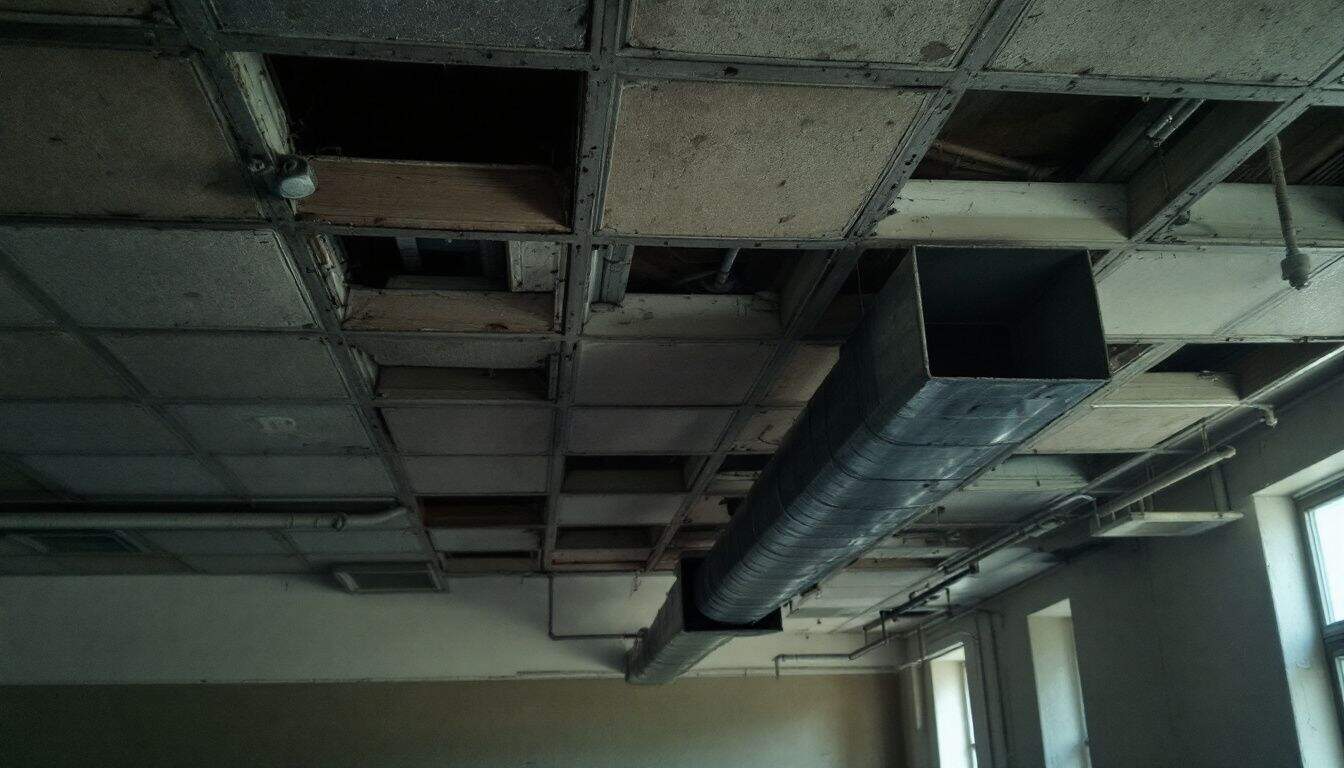
False ceiling voids — the space above suspended ceilings — should always be inspected. This is a common route for services including electrical conduit, pipework, and ducting, all of which may be insulated with ACMs. Contractors working above suspended ceilings are at particular risk if this area has not been surveyed.
A management survey should cover all accessible voids. Where voids are not accessible without breaking into the building fabric, a refurbishment survey will be required before any work is carried out in those areas.
Stairwells, Fire Escape Routes, and Lift Shafts
Stairwells were frequently treated with fire-resistant materials, some of which contained asbestos. Sprayed asbestos coatings used as fireproofing are among the most hazardous forms of ACM when disturbed — and they were commonly applied in exactly these kinds of areas.
Lift shafts in older office buildings may contain asbestos rope seals, insulation boards, and fireproofing materials. These should always be assessed before any work begins in those areas.
Fire escape routes are particularly important to survey thoroughly. In the event of an emergency, the last thing you want is for evacuating staff or emergency services to disturb deteriorating ACMs in a stairwell.
Service Ducts, Access Hatches, and Hidden Voids
Any area accessible via an access hatch needs to be opened and inspected. Service ducts — particularly in older office buildings — often contain pipe lagging and electrical insulation that includes asbestos.
These areas are sometimes neglected during maintenance, which means ACMs can deteriorate significantly before anyone notices. A surveyor who does not open access hatches or inspect service ducts is not conducting a compliant survey.
Make sure you commission a firm that takes a genuinely thorough approach to the survey scope. Cutting corners here is not just poor practice — it puts people at risk.
External Areas and Building Fabric
Many dutyholders assume office asbestos surveys only cover interiors. In fact, external building fabric is a significant area of concern, particularly in commercial buildings from the 1960s through to the 1990s.
- Roofing sheets: Asbestos cement was one of the most common roofing materials used in commercial buildings. Weathered or damaged sheets can shed fibres, creating risk for anyone working on or near the roof.
- Soffits and fascias: Asbestos cement was widely used in external soffits, particularly on buildings from the 1960s and 1970s.
- Gutters and downpipes: Asbestos cement guttering was standard on many commercial properties. It may look intact but can be brittle and prone to crumbling.
- Cladding panels: External wall cladding on flat-roofed commercial buildings may contain asbestos, particularly where it was installed before the mid-1980s.
External ACMs that are weathered or damaged can shed fibres, creating risk for anyone working nearby. They must be included in your survey scope — do not allow a surveyor to omit them.
Types of Office Asbestos Survey — Which One Do You Need?
Management Surveys
A management survey is the standard survey for occupied office premises. Its purpose is to locate, as far as reasonably practicable, ACMs in all areas likely to be disturbed during normal occupation — including routine maintenance.
This type of survey uses a combination of visual inspection and limited sampling to identify ACMs, assess their condition, and estimate the risk they pose. The output is an asbestos register and a management plan — both of which are legal requirements for non-domestic premises.
Management surveys are not designed to be fully intrusive. They will not involve breaking into the building fabric. For areas that cannot be accessed without structural interference, a different survey type is required.
Refurbishment Surveys
Before any significant building work begins — whether that is a partial office refurbishment, a fit-out, or structural alterations — a refurbishment survey is required. This is a far more intrusive process.
Surveyors will access voids, break into the building fabric, and inspect areas that would not normally be disturbed during day-to-day occupation. All ACMs in the area of work must be identified before contractors start. This is a legal requirement, not a best practice recommendation.
Failing to commission a refurbishment survey before building work is one of the most common ways workers are inadvertently exposed to asbestos — and it is a serious regulatory breach.
Demolition Surveys
Where a building or part of a building is to be demolished, a demolition survey is required. This is the most intrusive type of survey — the entire structure must be inspected before demolition work begins, including areas that are not normally accessible. HSG264 sets out the full requirements for this type of survey.
Re-inspection Surveys
Once ACMs have been identified and recorded in your asbestos register, they need to be monitored regularly to check their condition has not deteriorated. A re-inspection survey revisits known ACMs, assesses whether their condition has changed, and updates your register accordingly.
Re-inspections are typically carried out annually, though higher-risk materials may require more frequent assessment. This is an ongoing obligation, not a one-off task.
Sampling and Laboratory Analysis
Where a surveyor suspects a material may contain asbestos, samples should be taken and sent to a UKAS-accredited laboratory for analysis. This is the only reliable way to confirm whether a material is an ACM.
Key points on sampling during office asbestos surveys:
- Samples must be taken carefully to minimise fibre release during collection.
- Laboratories used for sample analysis must hold UKAS accreditation for asbestos testing.
- All sample locations should be clearly documented and cross-referenced in the survey report.
- Where sampling is not possible due to access or risk, materials should be presumed to contain asbestos and managed accordingly.
If you want to test a specific material without commissioning a full survey, our asbestos testing kit allows you to collect a sample safely and have it analysed by an accredited laboratory. This is a practical option when a contractor or maintenance operative has identified a suspect material and needs a quick answer before proceeding.
For more information on our laboratory and field services, visit our dedicated asbestos testing page.
Your Asbestos Register and Management Plan
The output of a management survey is not just a report — it is the foundation of your ongoing asbestos management obligations. Every dutyholder in a non-domestic building must maintain an asbestos register and an asbestos management plan.
Your asbestos register should record:
- The location of every known or presumed ACM
- The type of asbestos, where confirmed by analysis
- The condition of each ACM and its risk rating
- The date of last inspection
- Any remedial action taken or planned
The register must be kept up to date. It should be reviewed and updated after any building work, after a re-inspection survey, or whenever there is a change that might affect known ACMs. Reviewing it annually as a minimum is sound practice.
Critically, the register must be made available to anyone who might disturb ACMs — including contractors, maintenance staff, and emergency services. Keeping it filed away where no one can access it defeats the purpose entirely.
What Happens If Areas Are Missed?
An incomplete survey creates a false sense of security. If a dutyholder believes their building has been fully assessed but areas were skipped, they may unknowingly allow work to proceed in locations where ACMs are present and undocumented.
The consequences can be severe. Workers or contractors disturbing unidentified ACMs face direct exposure to asbestos fibres. The dutyholder faces potential prosecution under the Control of Asbestos Regulations, and the HSE takes enforcement action seriously in cases involving inadequate asbestos management.
Beyond the legal risk, there is the human cost. Asbestos-related diseases — including mesothelioma and asbestos-related lung cancer — are caused by inhaling fibres that are invisible to the naked eye. A missed area on a survey can have consequences that take decades to manifest but are irreversible when they do.
Choosing the Right Surveying Company
Not all asbestos surveys are equal. The quality of an office asbestos survey depends heavily on the competence of the surveyor, the methodology they follow, and the thoroughness with which they approach the scope.
When selecting a surveying company, look for the following:
- UKAS accreditation or P402-qualified surveyors: Surveyors should hold the relevant qualifications under the British Occupational Hygiene Society (BOHS) scheme or equivalent.
- Clear methodology aligned with HSG264: The company should be able to explain how they plan and conduct surveys in line with HSE guidance.
- Transparent reporting: Survey reports should be detailed, clearly structured, and include photographs, sample results, and condition assessments.
- Full scope coverage: Confirm that the survey will cover all areas — including plant rooms, voids, external fabric, and any areas accessed via hatches.
- Ongoing support: A good surveying company will help you understand your management obligations, not just hand over a report and disappear.
Our management survey service is conducted by qualified professionals following HSG264 methodology. We cover every area of your building — nothing is skipped, nothing is presumed without evidence.
Frequently Asked Questions
Do I legally need an office asbestos survey?
Yes. Under the Control of Asbestos Regulations, dutyholders of non-domestic premises — which includes office buildings — have a legal duty to manage asbestos. This requires taking reasonable steps to identify whether ACMs are present, which means commissioning a suitable survey. If your building was built or refurbished before 2000, a survey is not optional.
What type of asbestos survey does my office need?
For an occupied office building, a management survey is the standard starting point. If you are planning refurbishment or fit-out works, you will need a refurbishment survey covering the areas to be disturbed. If full demolition is planned, a demolition survey is required. Your surveying company can advise on the right type based on your specific circumstances.
How often should office asbestos surveys be updated?
Your asbestos register should be reviewed annually as a minimum. Known ACMs should be re-inspected regularly — typically once a year — to check their condition has not deteriorated. A re-inspection survey is used for this purpose. If building works are carried out, the register must be updated to reflect any changes.
Can I collect asbestos samples myself?
You can use a testing kit to collect a sample from a suspect material and have it analysed by a UKAS-accredited laboratory. However, this should only be done where it is safe to do so and where the material is not likely to release fibres during sampling. For a full building assessment, always commission a qualified surveyor rather than attempting to sample multiple materials yourself.
What areas are most commonly missed in office asbestos surveys?
The areas most frequently overlooked include plant rooms, roof voids, ceiling voids above suspended ceilings, service ducts, lift shafts, and external building fabric such as roofing sheets and soffits. A competent surveyor following HSG264 guidance should inspect all of these areas as standard. If a surveyor proposes to exclude any of them without a clear and documented reason, that is a red flag.
Supernova Asbestos Surveys has completed over 50,000 surveys across the UK, working with office landlords, facilities managers, and property owners to ensure their buildings are fully assessed and legally compliant. Whether you need a management survey, a pre-refurbishment inspection, or ongoing re-inspection support, our qualified team is ready to help.
Call us on 020 4586 0680 or visit asbestos-surveys.org.uk to book your survey or discuss your requirements with our team.