
One missed ceiling tile, one unrecorded leak, one contractor drilling into the wrong panel — that is often how asbestos incidents start. An annual asbestos inspection gives duty holders a practical way to keep asbestos records accurate, spot changes early and show they are actively managing risk rather than relying on an old survey that no longer reflects the building.
If you manage a workplace, school, surgery, warehouse, shop, block or mixed-use premises built before 2000, asbestos management is not a box-ticking exercise. Under the Control of Asbestos Regulations, supported by HSE guidance and HSG264, asbestos-containing materials left in place must be monitored and reviewed at suitable intervals.
For many properties, an annual asbestos inspection is a sensible benchmark. But the right interval is always based on risk, condition and likelihood of disturbance, not a calendar date applied blindly across every material in the building.
Why an annual asbestos inspection matters
An annual asbestos inspection is widely used because many asbestos registers are reviewed every 6 to 12 months. That approach works well for a lot of occupied buildings, especially where asbestos-containing materials are stable and there is no major change in use.
What matters most is not the phrase itself but the purpose behind it. A proper inspection checks whether known or presumed asbestos-containing materials have changed, whether existing controls still work and whether your management plan still matches what is happening on site.
- It helps identify damage, wear or deterioration early
- It keeps the asbestos register current
- It supports safer maintenance and contractor control
- It helps duty holders demonstrate active compliance
- It reduces the chance of accidental disturbance during routine works
That last point is often where problems arise. A report from years ago may still list asbestos correctly, but if the area has been altered, damaged or used differently since then, the information may no longer be reliable enough for day-to-day management.
The purpose of an asbestos survey
An asbestos survey gives you the baseline information needed to manage asbestos safely. It identifies suspected or confirmed asbestos-containing materials, records their location and condition, and supports decisions on monitoring, repair, encapsulation or removal.
Without a reliable survey, your asbestos register is little more than guesswork. That creates immediate problems when maintenance is planned, contractors attend site or building use changes.
What a survey should help you do
- Identify the location, extent and condition of asbestos-containing materials
- Assess the likelihood of disturbance during normal occupation or maintenance
- Decide whether materials should be monitored, repaired, sealed or removed
- Create or update an asbestos register
- Set suitable re-inspection intervals for materials left in situ
A survey is not just a report for a file. It is the working foundation of your asbestos management plan, and every annual asbestos inspection depends on that foundation being sound.
Which survey do you need before an annual asbestos inspection?
If asbestos information is missing, limited or out of date, the first step is to arrange the correct survey. The right survey depends on how the building is used and whether any work is planned.
For occupied premises, the usual starting point is a management survey. This is designed to locate asbestos that could be disturbed during normal occupation, routine maintenance or minor works.
If intrusive works are planned, you will usually need a refurbishment survey before the project starts. If the building is coming down, a demolition survey is required so asbestos can be identified before demolition proceeds.
Where asbestos has already been identified and remains in place, a re-inspection survey is often the most practical way to carry out an annual asbestos inspection and keep records up to date.
Management survey
A management survey is the standard survey for non-domestic premises in normal occupation. It aims to identify asbestos-containing materials that could be damaged or disturbed during day-to-day use, light maintenance or installation work.
If your building has never had one, or the existing report no longer matches the layout, use or condition of the premises, arranging a new survey should be a priority before relying on any annual asbestos inspection process.
How often should an annual asbestos inspection take place?
The name suggests once a year, but the correct interval should be risk-based. HSE guidance supports periodic re-inspection where asbestos-containing materials remain in situ, and the timing should reflect the material type, its condition and the chance of disturbance.
When annual may be suitable
- Materials are in good condition
- They are sealed, protected or encapsulated
- They are in low-traffic or low-access areas
- There is little chance of accidental disturbance
- No leaks, impacts or maintenance issues have been reported
When more frequent checks may be needed
- Materials are damaged, worn or deteriorating
- The area has regular contractor or maintenance access
- The material is friable or easier to disturb
- The use of the building has changed
- There has been water ingress, impact damage, fire or unauthorised work
A useful annual asbestos inspection is not a quick walk-through. It should compare current condition against previous findings, confirm labels and controls remain in place and record any actions needed.
In some buildings, different materials may need different review periods. Pipe insulation in a busy plant room may justify more frequent checks than asbestos cement sheets in a locked external store. One blanket interval across the whole site is rarely the best approach.
What happens during an annual asbestos inspection?
A structured annual asbestos inspection should follow the asbestos register item by item. The aim is to verify whether each known or presumed asbestos-containing material is still in the same condition and whether the original management decision remains suitable.
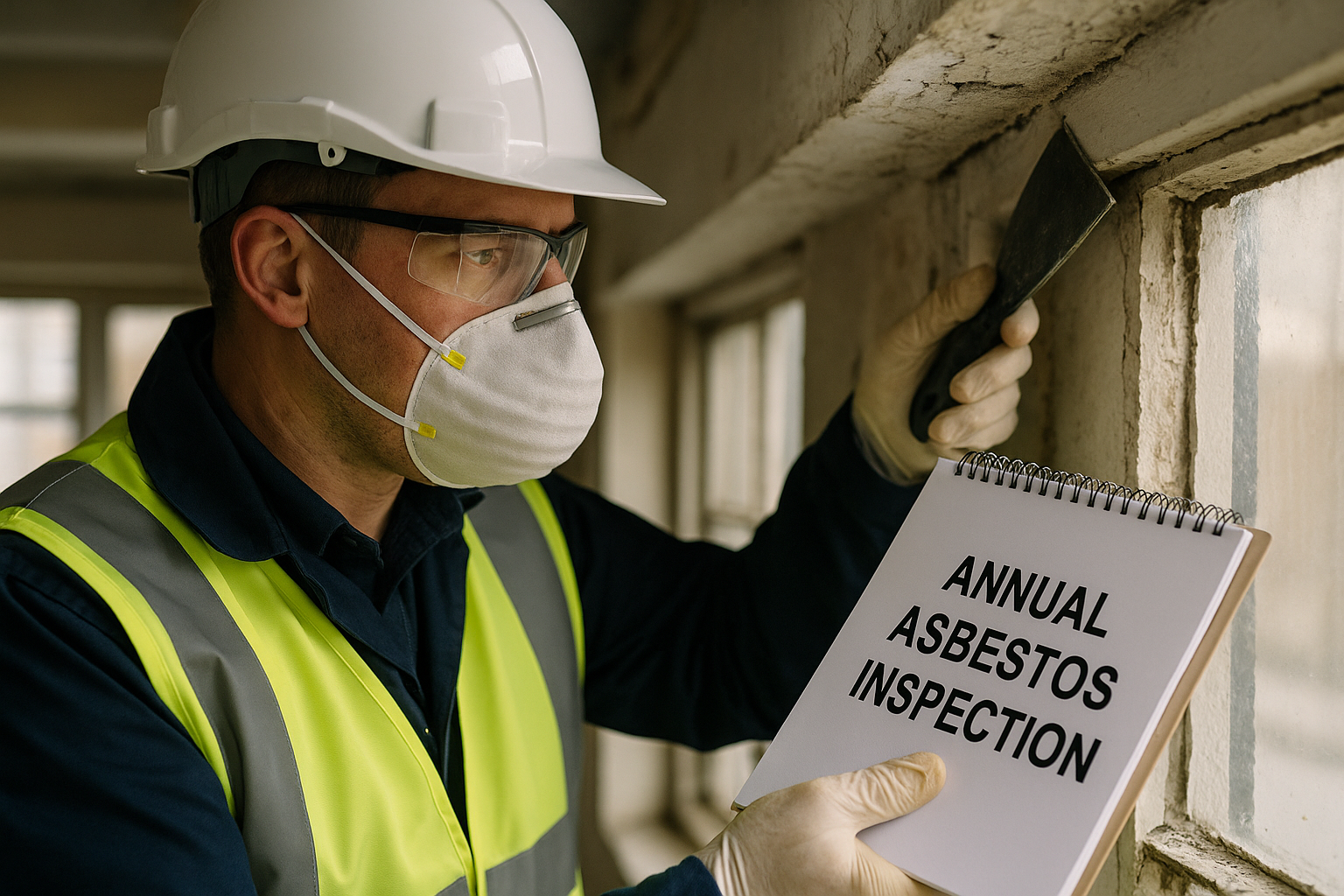
- Review the existing survey report, asbestos register and management plan
- Visit each accessible asbestos location on site
- Check condition, surface damage, sealing and signs of disturbance
- Confirm labels, access controls and local procedures are still in place
- Record any changes in use, occupancy or maintenance activity
- Update the register and management plan where required
- Set the next review date based on current risk
If the inspection identifies damage or uncertainty, further action may be needed straight away. That could mean repair, encapsulation, restricted access, sampling, removal planning or a revised inspection interval.
Good inspections are evidence-led. Notes should be clear, photographs should match locations and any change in condition should be recorded in a way that maintenance teams and contractors can understand quickly.
What duty holders should check during an annual asbestos inspection
If you are responsible for asbestos management, do not treat the inspection as something only the surveyor needs to understand. You should know what is being checked and what decisions may follow.
Condition of the material
Look for cracks, chips, abrasion, delamination, exposed edges, broken seals or debris nearby. Even minor changes can affect the risk rating if the material is in an area with regular access.
Likelihood of disturbance
Ask whether people, tools, stock or maintenance activity now come closer to the material than before. A panel in fair condition may still become higher risk if the area is now used more heavily.
Controls already in place
Check that warning labels remain visible, access restrictions are still practical and staff know what the controls mean. A control measure only works if people on site actually follow it.
Changes to the building
Refits, partition moves, service upgrades and occupancy changes can all affect asbestos risk. An annual asbestos inspection should account for what has changed since the previous review, not simply repeat old wording.
Industries and property types where asbestos inspections are critical
Asbestos duties apply across a wide range of sectors. The exact risk profile changes from one property to another, but the need for accurate surveys and regular review does not disappear because a site appears quiet or low use.
- Commercial offices where ceiling voids, risers, plant rooms and service ducts may contain asbestos materials
- Education including schools, colleges and training buildings with long occupancy periods and frequent maintenance
- Healthcare such as surgeries, clinics and older hospital buildings where services are often upgraded
- Retail units and shopping premises with repeated fit-outs and signage works
- Industrial sites with vibration, plant maintenance and higher wear
- Warehousing and logistics buildings with asbestos cement roofs, wall panels and service areas
- Hospitality and leisure where refurbishment is common
- Public sector estates with mixed building ages and varied maintenance demands
A factory with regular engineering works may need closer monitoring than a low-occupancy storage unit, even if both contain similar materials. The re-inspection interval should always reflect real site conditions.
If you manage property portfolios across major cities, local support can make scheduling easier. Supernova can assist with an asbestos survey London booking, an asbestos survey Manchester appointment or an asbestos survey Birmingham service.
Sampling and analysis of asbestos materials
Not every suspect material can be identified reliably by eye. Sampling and analysis are used where confirmation is needed, especially when the material type affects the management decision.
Samples should be taken by a competent person using suitable controls. They are then analysed by an accredited laboratory to confirm whether asbestos is present and, where relevant, what type has been identified.
Why sampling matters
- It confirms whether a suspect material actually contains asbestos
- It prevents unnecessary removal of non-asbestos materials
- It supports accurate risk assessment and register updates
- It improves decisions around repair, encapsulation or removal
Sampling is not a DIY task. Disturbing a suspect material without the right controls can release fibres and create avoidable exposure.
Where sampling is not possible during a survey, materials may be presumed to contain asbestos until proven otherwise. That presumption should still be recorded clearly in the report and management plan, and it should be reviewed during the next annual asbestos inspection.
Selecting a competent surveyor for an annual asbestos inspection
The quality of your annual asbestos inspection depends heavily on who carries it out. A poor surveyor can miss materials, misjudge condition or give you a report that looks polished but is weak in practice.
When appointing a surveyor, focus on evidence of competence rather than price alone. HSE guidance and HSG264 set the standard for how asbestos surveys should be planned, undertaken and reported.
What to look for
- UKAS accreditation for asbestos surveying and relevant analytical work
- Appropriate qualifications and training for the surveyor carrying out the work
- Experience in your property type, whether education, healthcare, industrial, retail or commercial
- A clear scope of work showing what areas and activities are covered
- Reports aligned with HSG264 and suitable for day-to-day management use
Questions to ask before appointing
- What type of survey do you recommend for this building and why?
- Will sampling be included where required?
- How will inaccessible areas be recorded?
- What format will the asbestos register be provided in?
- Can you support ongoing re-inspection scheduling?
A competent surveyor should be able to explain the process in plain English. If the recommendation is vague or the survey type does not match the planned work, stop and ask more questions.
Checking the accuracy of the survey report
Receiving the report is not the end of the job. Checking its accuracy is a key part of asbestos management because a weak report can leave gaps that affect contractors, maintenance teams and your legal position.
Read the report alongside your own site knowledge. Compare it against the building layout, plant areas, risers, voids and maintenance history.
What a good report should include
- A clear description of the survey scope
- Any exclusions or inaccessible areas
- The location and extent of identified or presumed asbestos-containing materials
- Material and priority assessments where applicable
- Photographs and clear location references
- Sampling results where samples were taken
- Recommendations for management, further action and re-inspection
Red flags to watch for
- Large areas marked inaccessible without explanation
- Vague location details such as “various areas”
- No clear distinction between sampled and presumed materials
- Condition ratings that do not match what you can see on site
- No practical guidance on next steps
If something does not look right, challenge it. Ask for clarification, amendments or a return visit where necessary.
An annual asbestos inspection only works if the underlying records are trustworthy. If the original survey is weak, the inspection process becomes weaker with it.
Building an effective annual asbestos inspection process
A reliable annual asbestos inspection process is built around the asbestos register, not treated as a separate exercise. Each review should confirm whether materials remain in the same condition, whether controls are still suitable and whether the management plan needs updating.
Practical steps for duty holders
- Start with sound baseline information. If the existing survey is weak or outdated, replace it before relying on historic records.
- Review each asbestos item by risk. Do not apply one blanket inspection interval across the whole site if different materials present different risks.
- Schedule inspections in advance. Put review dates into your compliance calendar and assign responsibility to a named person.
- Brief staff and contractors. Anyone working near asbestos needs access to the relevant information before work starts.
- Update records immediately. If condition changes, amend the register and management plan straight away.
- Trigger extra inspections after incidents. Water ingress, impact damage, unauthorised works and fire should all prompt a review.
This is where many organisations fall short. They have a survey, but no live process around it. The report sits in a folder, the register is not updated and the next inspection is only remembered when a contractor asks for asbestos information.
A better approach is to link the annual asbestos inspection to wider property management routines. Tie it into planned preventive maintenance, contractor induction, project approval and compliance audits so asbestos information stays active rather than forgotten.
Common mistakes that undermine asbestos management
Most asbestos failures are not caused by the material suddenly changing on its own. They happen because information is outdated, controls are unclear or the wrong type of survey was used for the work taking place.
- Assuming an old survey is still accurate without checking changes on site
- Using a management survey where intrusive refurbishment works are planned
- Failing to review presumed asbestos-containing materials
- Not sharing the asbestos register with contractors before work starts
- Ignoring minor damage because the material looked stable last year
- Leaving inaccessible areas unresolved for long periods
- Treating the annual review as paperwork rather than a physical inspection
If any of these issues sound familiar, act before the next maintenance job begins. A short delay to review records is far better than dealing with accidental disturbance, emergency clean-up and disrupted operations.
When an annual asbestos inspection is not enough on its own
An annual asbestos inspection is a key part of asbestos management, but it is not a substitute for the right survey at the right time. If you are planning intrusive works, changing building use or uncovering previously hidden areas, you may need more than a routine re-inspection.
For example, opening walls, replacing services, stripping ceilings or reconfiguring occupied space can all disturb materials that were never accessed during a management survey. In those cases, a refurbishment survey is usually required before work starts.
The same principle applies after incidents. If there has been flooding, fire, impact damage or unauthorised drilling, a standard annual check may not be enough. You may need urgent assessment, sampling or remedial action to make the area safe and restore confidence in the register.
Practical advice for keeping asbestos records usable
The best asbestos records are simple enough to use under pressure. If a contractor arrives to fix a leak, your team should be able to identify the relevant area, check the register and understand the controls within minutes.
- Keep the latest survey and register in an accessible digital format
- Use clear location references that match how the site is actually described
- Make sure room names, floor plans and plant areas are current
- Record inaccessible areas clearly and plan how they will be addressed
- Review asbestos information whenever layouts or services change
- Train key staff to understand the difference between survey types and re-inspection needs
Small practical improvements make a big difference. A well-organised register supports a more effective annual asbestos inspection and reduces the chance of bad decisions during urgent maintenance.
Frequently Asked Questions
Is an annual asbestos inspection a legal requirement?
There is no universal rule that every building must be inspected exactly once a year. The legal duty is to manage asbestos properly under the Control of Asbestos Regulations, using suitable monitoring and review intervals based on risk, condition and likelihood of disturbance. For many premises, an annual asbestos inspection is a sensible and defensible routine.
What is the difference between an asbestos survey and an annual asbestos inspection?
An asbestos survey establishes what asbestos-containing materials are present, where they are and what condition they are in. An annual asbestos inspection, often carried out as a re-inspection, reviews known or presumed materials left in place to check whether their condition or risk has changed.
Who should carry out an annual asbestos inspection?
It should be carried out by a competent person. In many cases, duty holders use a specialist asbestos surveying company so the inspection is consistent, properly recorded and aligned with HSG264 and HSE guidance.
What happens if asbestos is damaged during an inspection?
If damage is identified, access to the area may need to be restricted immediately. The next steps could include assessment, repair, encapsulation, sampling or arranging licensed removal, depending on the material and the level of risk.
Do I need a new survey if I already have an asbestos register?
Not always, but you do need to know whether the register is still reliable. If the building has changed, areas were previously inaccessible, intrusive works are planned or the original report is poor, a new survey may be necessary before relying on the register for ongoing management.
If you need a dependable annual asbestos inspection, a new survey or support reviewing your asbestos register, Supernova Asbestos Surveys can help. We provide UKAS-accredited surveying services nationwide, with practical advice that fits real buildings and real maintenance pressures. Call 020 4586 0680 or visit asbestos-surveys.org.uk to arrange the right service for your property.