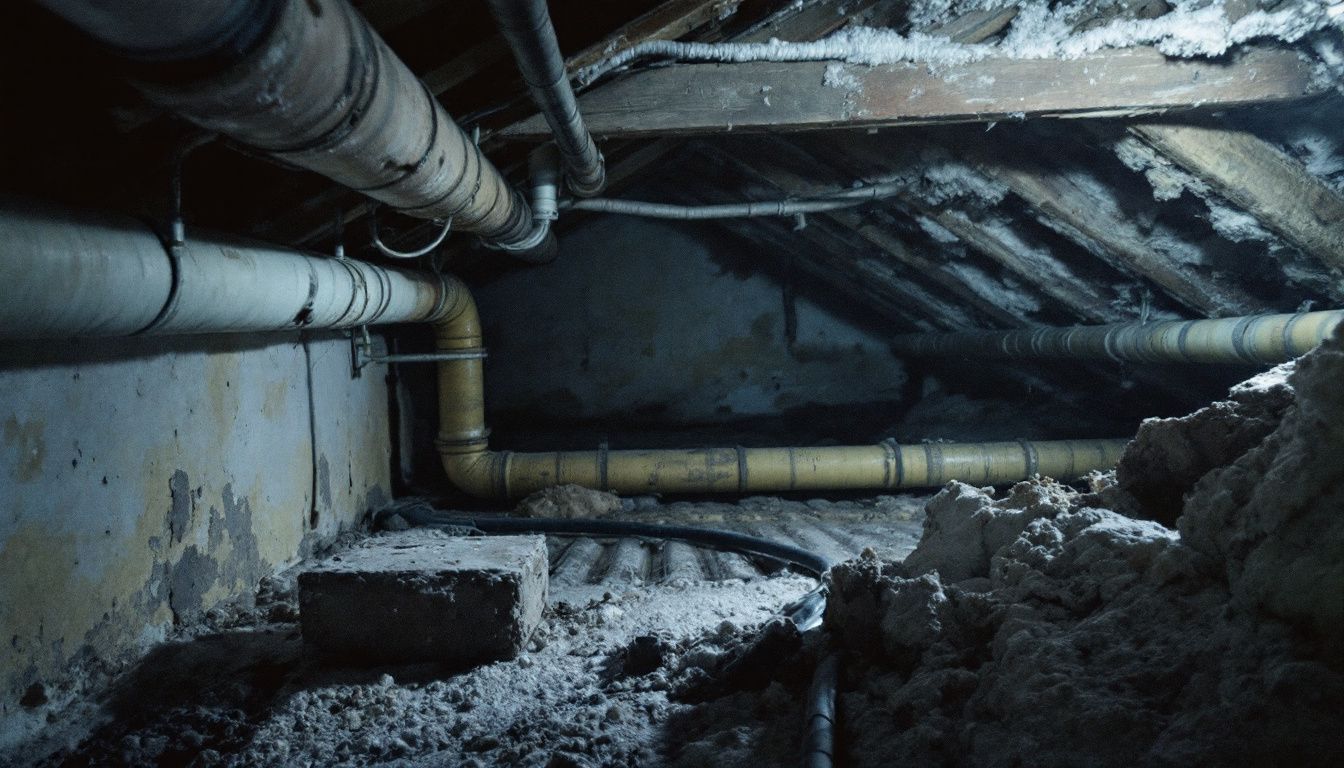
Asbestos Should Not Be Found in Buildings Built After the Ban — But That Rule Is Not as Simple as It Sounds
Asbestos should not be found in buildings built after the UK ban came into effect. That much is straightforward. But in practice, build date alone is one of the least reliable indicators of asbestos risk, and property managers, landlords, and contractors who rely on it are regularly caught out.
Retained materials from earlier phases, outbuildings that pre-date the main structure, older plant and equipment, and incomplete removal records all create situations where asbestos turns up where it is not expected. The only way to manage that risk properly is to verify the position, not assume it.
When Asbestos May Still Be Present: A Practical Overview
Asbestos was used extensively across UK construction because it was cheap, durable, fire resistant, and thermally insulating. It appeared in everything from pipe lagging and ceiling tiles to roofing sheets, floor adhesives, fire protection coatings, and gaskets.
While asbestos should not be found in buildings built after the ban, the picture is more complicated than a simple cut-off date suggests. Here is a practical breakdown:
- Buildings constructed after the ban: Asbestos should not normally be present, but exceptions exist — particularly where older outbuildings, retained plant, or reused materials are involved
- Buildings constructed in the years immediately before the ban: Some asbestos-containing products may still be in place, particularly those that were not yet prohibited at the time
- Older buildings: The likelihood of asbestos-containing materials (ACMs) is significantly higher, especially in commercial, industrial, education, and public sector premises
If there is any doubt about a building’s asbestos status, treat it as a compliance issue rather than a guessing exercise. Under the Control of Asbestos Regulations, dutyholders are required to take reasonable steps to establish whether asbestos is present and to manage any risk it poses.
Why Asbestos Is Dangerous
Asbestos becomes dangerous when its fibres are released into the air and breathed in. The fibres are invisible to the naked eye and can remain airborne long enough to be inhaled by anyone in the vicinity — not just the person doing the work.
The main health conditions associated with asbestos exposure include:
- Mesothelioma — a cancer of the lining of the lungs or abdomen
- Asbestos-related lung cancer
- Asbestosis — scarring of the lung tissue
- Pleural thickening and other pleural diseases
These conditions typically develop years or decades after exposure, which means the consequences of disturbing asbestos today may not become apparent for a long time. That delay is part of what makes asbestos risk easy to underestimate.
Disturbance does not require demolition. Drilling into a panel, sanding a textured coating, lifting old floor tiles, cutting through an insulating board partition, or breaking cement sheets can all release fibres. Some materials are more friable than others — pipe lagging, sprayed coatings, and asbestos insulating board carry a higher release risk than asbestos cement — but no suspect material should be handled without proper controls in place.
Pregnancy and Asbestos Exposure
Pregnancy does not create a unique asbestos-related disease, but that does not make exposure acceptable. No pregnant worker, occupant, or contractor should be placed in a situation where asbestos fibres may be disturbed or released.
If work is under way in an occupied building and asbestos is suspected, stop the task immediately, restrict access to the area, and arrange professional advice before proceeding. The priority is preventing inhalation for everyone present — including any unborn child.
Where Asbestos Was Used in Buildings and Equipment
Understanding the typical locations of ACMs helps identify risk areas before work begins. Asbestos was selected for its fire resistance, thermal insulation, acoustic properties, and longevity, which is why it appears across such a wide range of building products and materials.
Common Building Materials Containing Asbestos
- Asbestos insulating board in partitions, soffits, ceiling tiles, service ducts, and risers
- Pipe and boiler lagging in plant rooms and heating systems
- Sprayed coatings applied to structural steelwork for fire protection
- Textured coatings on ceilings and walls
- Vinyl floor tiles and bitumen-based adhesives
- Asbestos cement sheets, gutters, flues, water tanks, and garage roofs
- Roofing felt, rope seals, and gaskets
Older Equipment and Machinery
Asbestos was not limited to the structural fabric of buildings. Older machinery, electrical switchgear, storage heaters, fire doors, lift components, boiler seals, and industrial plant may also contain asbestos. This is a particular concern on sites where the building itself is relatively modern but the equipment inside it is much older.
Warehouses, factories, schools, hospitals, and plant-heavy commercial sites often have this combination. The building may post-date the ban, but the machinery or service equipment may not. That is precisely the kind of scenario where assuming asbestos should not be found in buildings built after the ban leads to problems.
Property Types and Sectors Where Asbestos Appears Most Often
Any older non-domestic building can contain ACMs, but some sectors see it more frequently because of how those buildings were originally designed, built, and maintained.
- Education: Schools, colleges, and campus buildings often have service ducts, ceiling voids, and older boiler systems with legacy insulation
- Healthcare: Hospitals, clinics, and surgeries frequently have plant rooms and pipework with asbestos insulation installed during earlier building phases
- Industrial: Factories, workshops, and warehouses commonly feature asbestos cement cladding, machinery insulation, and gaskets
- Commercial: Offices, retail units, and mixed-use buildings may have asbestos ceiling tiles, partition systems, and riser ducts
- Residential blocks: Communal areas, service cupboards, roof spaces, and garages are all areas where ACMs may be present
- Agricultural sites: Barns, sheds, and outbuildings with asbestos cement roofs and wall sheets remain common
If you manage multiple sites, the age and use of each building should shape your asbestos management strategy. Premises with frequent maintenance access, contractor traffic, or planned alterations need particularly close attention.
Check Existing Records Before Doing Anything Else
Before anyone opens a ceiling void, strips out a partition, or starts any maintenance work, check what information already exists. This is often the quickest way to avoid accidental disturbance and is also a legal requirement under the duty to manage.
Start by gathering the following:
- Any previous asbestos survey reports for the building
- The asbestos register, if one has been maintained
- Maintenance records and refurbishment history
- Building plans and service drawings
- Information from facilities staff, caretakers, and long-term contractors
Plans and drawings can help identify probable asbestos locations — risers, boiler rooms, service ducts, roof voids, plant enclosures, and partition walls. Existing reports may show where asbestos has previously been removed, encapsulated, or left in place under a management plan.
If records are missing, outdated, or incomplete, do not treat that as evidence the building is asbestos-free. Incomplete records usually mean the information needs updating, not that there is nothing to find.
For occupied premises, a professional management survey is usually the right starting point. It identifies ACMs that could be disturbed during normal occupation and routine maintenance, and forms the basis of a compliant asbestos register.
Inspect the Building Properly
Desktop checks and record reviews are useful, but they are only part of the picture. A physical inspection is needed to identify suspect materials, assess their condition, and understand the likelihood of disturbance.
A thorough inspection should consider:
- The age and construction type of the building
- Areas with heat, fire protection, or insulation requirements
- Past alterations, patch repairs, and changes of use
- Access points, service routes, and concealed voids
- The condition of any suspect materials already visible
Visual identification alone is never sufficient to confirm asbestos. Many non-asbestos products look almost identical to ACMs. Where confirmation is needed, sampling and laboratory analysis are required — and that work must be carried out by a competent person using the correct procedures.
Choosing the Right Survey Type
The type of survey required depends on what the building is being used for and what work is planned.
For planned intrusive works, a refurbishment survey is required in the affected area before the project begins. This involves more intrusive inspection techniques to identify all ACMs that could be disturbed during the works.
If a structure is to be demolished entirely, a demolition survey must be completed before demolition proceeds. This is a more extensive exercise that aims to locate all ACMs throughout the building, including those in areas that would not normally be accessible.
For buildings where an asbestos register already exists, a periodic re-inspection survey is needed to keep that information current. ACM condition can change over time, and records that are not reviewed regularly become unreliable.
Condition Matters as Much as Presence
Not every ACM requires immediate removal. If asbestos is in good condition, properly sealed, and unlikely to be disturbed during normal use, management in situ may be the appropriate course of action. That decision should be based on a formal risk assessment, taking into account the material type, its condition, its location, and the realistic likelihood of disturbance.
HSE guidance and HSG264 set the standard for how asbestos surveys should be conducted and reported. Any survey you commission should comply with those standards, and the resulting report should be clear, accurate, and usable by the people who need to act on it.
Using Photographs and Diagrams to Support Asbestos Management
A written report is essential, but photographs and marked-up floor plans make asbestos information far more practical to use on site. They help maintenance teams, contractors, and property managers identify exactly where ACMs are located and what they look like before any work begins.
A well-structured asbestos register should include:
- Clear photographs of each identified or presumed ACM
- Marked-up floor plans showing precise locations
- Room references and access notes
- Material condition assessments
- Recommendations for management, reinspection, or removal
This is especially important in larger buildings, multi-occupancy premises, and estates where verbal descriptions alone are not sufficient to prevent mistakes.
What to Do If You Come Across a Suspect Material
If a suspect material is uncovered during work, stop immediately. Do not drill it, cut it, break it, sweep it, or vacuum it with standard equipment. Take the following steps straight away:
- Stop the work
- Keep all people away from the area
- Prevent any further disturbance to the material
- Report it to the responsible person or dutyholder
- Arrange professional assessment or sampling before proceeding
Where a material needs to be formally identified, arrange asbestos testing through a competent provider. If you need a low-disturbance sampling option for a straightforward situation, a postal testing kit can help — but the sample must still be taken carefully and only where it is safe to do so.
Where ACMs are damaged, deteriorating, or in the path of planned works, licensed or non-licensed removal may be required depending on the material and the task involved. Any removal should be properly planned with the right controls in place and carried out by competent specialists. If removal is needed, arrange professional asbestos removal rather than leaving contractors to make assumptions on site.
Practical Guidance for Dutyholders, Landlords, and Property Managers
If you are responsible for a non-domestic building, or for the common parts of a residential building, the duty to manage asbestos applies to you. The most reliable way to stay compliant is to make asbestos information part of your standard property management process — not something that only gets addressed when a problem arises.
Use this checklist as a starting point:
- Identify which buildings in your portfolio may contain asbestos
- Gather all existing surveys, plans, and maintenance records
- Commission the correct survey type where information is missing or works are planned
- Maintain an up-to-date asbestos register for each premises
- Share asbestos information with contractors before any work starts
- Review ACM condition on a regular basis
- Update records after removals, repairs, or new findings
If you manage sites across different parts of the country, local surveying support can simplify access and response times. Supernova provides services including asbestos survey London support and asbestos survey Manchester coverage for clients who need reliable surveying across busy property portfolios.
Where sampling alone is needed to confirm whether a suspect material contains asbestos before decisions are made, you can also arrange independent asbestos testing as a standalone service.
The Bottom Line on Build Date and Asbestos Risk
The rule that asbestos should not be found in buildings built after the ban is a useful starting point, but it is not a substitute for proper verification. Mixed-age structures, retained plant and equipment, incomplete removal records, and older outbuildings all create situations where asbestos turns up in buildings that appear to post-date the ban.
Assumptions are what lead to disturbed ACMs, project delays, enforcement action, and avoidable health risk. A professional survey, carried out to the correct standard, removes the guesswork and gives you the information you need to manage your obligations properly.
Supernova Asbestos Surveys carries out management, refurbishment, demolition, re-inspection, testing, and removal coordination services across the UK. With over 50,000 surveys completed nationwide, we have the experience to handle straightforward and complex sites alike. Call us on 020 4586 0680 or visit asbestos-surveys.org.uk to arrange the right survey for your property.
Frequently Asked Questions
Does a building constructed after the ban definitely contain no asbestos?
Not necessarily. While asbestos should not be found in buildings built after the ban, exceptions exist. Older outbuildings, retained plant and equipment, reused materials, and incomplete removal records can all mean asbestos is present even in a building that appears to post-date the ban. If there is any uncertainty, the correct approach is to commission a professional survey rather than assume the building is clear.
Can I identify asbestos by looking at it?
No. Many asbestos-containing materials look virtually identical to non-asbestos products. A visual inspection can identify suspect materials and help assess the likelihood of asbestos being present, but only sampling and laboratory analysis can confirm whether a material actually contains asbestos fibres.
What type of survey do I need before refurbishment works?
You need a refurbishment survey covering the area where works are planned. This is a more intrusive survey than a standard management survey and is designed to locate all ACMs that could be disturbed during the refurbishment. It must be completed before the works begin, not during or after.
Who is responsible for managing asbestos in a building?
Under the Control of Asbestos Regulations, the duty to manage asbestos falls on the dutyholder — typically the owner, employer, or person responsible for maintaining the building. In leased premises, responsibility may be shared between landlord and tenant depending on the terms of the lease. If you are unsure who holds the duty, take professional advice rather than leaving the question unresolved.
How often should an asbestos register be reviewed?
There is no single fixed interval, but HSE guidance recommends that ACM condition is reviewed regularly — typically at least annually for materials in accessible locations, and more frequently where condition is deteriorating or disturbance is more likely. A re-inspection survey carried out by a competent surveyor is the standard way to keep your register current and defensible.