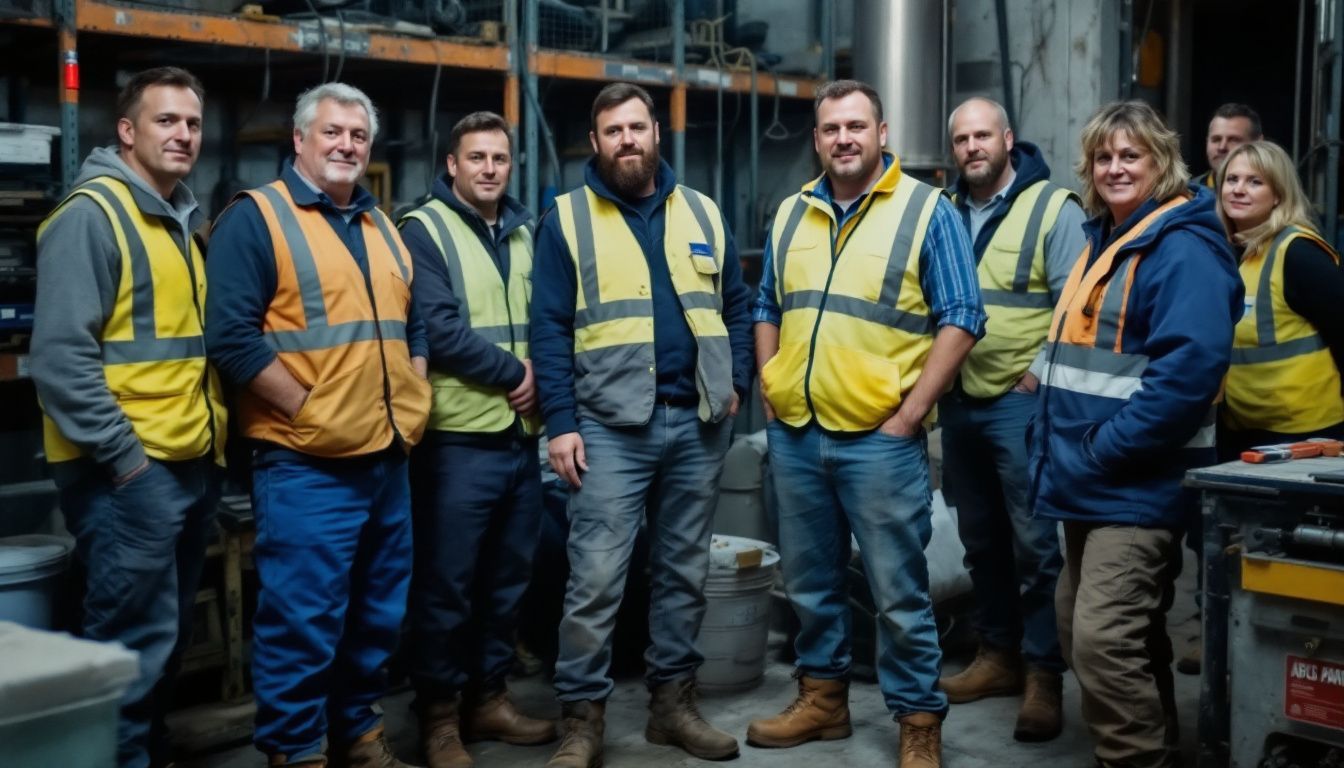
Asbestos Awareness Training: What It Actually Changes in UK Workplaces
Asbestos remains the single biggest cause of work-related deaths in the UK. Despite being banned from use in construction since 1999, it still lurks inside millions of buildings — offices, schools, hospitals, rental properties — and presents a very real danger to anyone who disturbs it without knowing what they’re dealing with.
Understanding what impact asbestos awareness training can have on handling asbestos in the UK is not an abstract question. It has direct consequences for whether workers go home healthy or spend their later years battling a preventable, terminal illness.
Asbestos awareness training isn’t a box-ticking exercise. Done properly, it fundamentally changes how workers think, act, and make decisions on site — and in many situations, it’s a legal requirement.
Why Asbestos Awareness Still Matters Today
You might assume that because asbestos was banned decades ago, the risk has largely passed. The opposite is true. Asbestos-containing materials (ACMs) were used extensively in UK construction throughout the 20th century, and millions of buildings still contain them in some form.
The danger isn’t asbestos sitting undisturbed behind a wall. It’s what happens when someone drills, cuts, sands, or otherwise disturbs it without realising it’s there. That’s when microscopic fibres become airborne, get inhaled, and begin causing irreversible damage to lung tissue.
The diseases caused by asbestos exposure — mesothelioma, asbestosis, lung cancer, pleural thickening — can take decades to develop. By the time symptoms appear, it’s often too late for effective treatment. Prevention, and the training that enables it, is everything.
Who Needs Asbestos Awareness Training?
Under the Control of Asbestos Regulations, employers are legally required to ensure that workers who may encounter asbestos during their normal duties receive appropriate training. This applies broadly across a wide range of trades and industries.
Trades Most at Risk
- Electricians and plumbers working in older buildings
- Carpenters, joiners, and general builders
- Plasterers and decorators
- Roofers and cladding contractors
- Heating and ventilation engineers
- Demolition and refurbishment workers
- Facilities managers and maintenance staff
But it’s not just tradespeople on the tools. Supervisors, site managers, architects, and office-based facilities teams all benefit from understanding the basics — because decisions made at planning and management level can inadvertently put workers at risk.
Duty Holders and Property Managers
If you manage or own a non-domestic building constructed before 2000, you are likely a duty holder under the Control of Asbestos Regulations. You have a legal obligation to manage any asbestos in your premises.
Awareness training helps you understand what that obligation actually looks like in practice — and what happens if you fail to meet it. Duty holders who have never received any asbestos awareness training often don’t realise they’re already in breach of their legal duties. Training closes that gap before it becomes a costly enforcement issue.
What Does Asbestos Awareness Training Cover?
Good asbestos awareness training goes well beyond a generic health and safety briefing. It equips people with specific knowledge they can apply in real-world situations — not just theoretical understanding that evaporates the moment they leave the room.
Identifying Asbestos-Containing Materials
One of the biggest challenges with asbestos is that it’s not always obvious. It was mixed into hundreds of different products — insulation boards, floor tiles, ceiling tiles, textured coatings such as Artex, roofing felt, pipe lagging, and more.
Training helps workers recognise where ACMs are commonly found and understand which materials should be treated with caution until confirmed safe. Workers learn about the three main types of asbestos used in construction — white (chrysotile), blue (crocidolite), and brown (amosite) — and understand that all three are hazardous.
The common assumption that only blue or brown asbestos poses a serious risk is one of the most dangerous misconceptions in the industry. Awareness training directly challenges and corrects that assumption.
Understanding the Health Risks
It’s not enough to tell workers that asbestos is dangerous. Training should explain precisely why — how fibres behave when airborne, why the body struggles to expel them, and what diseases can result from exposure. Understanding the mechanism of harm encourages workers to take the risk seriously rather than dismissing it as something that happens to other people.
Crucially, training must convey the latency period — the fact that symptoms may not emerge for 20 to 40 years after exposure. This is one reason the risk is so often underestimated: there’s no immediate consequence to reinforce the danger. A worker who breathes in asbestos fibres on a Tuesday morning feels absolutely fine on Wednesday. That disconnect is dangerous, and good training addresses it head-on.
Safe Working Practices and Emergency Procedures
Workers need to know exactly what to do if they encounter a material they suspect contains asbestos. That means stopping work immediately, not disturbing the material further, reporting it to a supervisor, and following the correct procedures before any work resumes.
Training covers the appropriate use of personal protective equipment (PPE) — including the correct grade of respiratory protective equipment (RPE) — as well as decontamination procedures and waste disposal requirements. Workers learn what they can legally do themselves and when a licensed contractor must be brought in.
Legal Duties and the Three Categories of Work
The Control of Asbestos Regulations sets out three categories of asbestos work, each with different requirements:
- Licensable work — high-risk activities that can only be carried out by a contractor licensed by the Health and Safety Executive (HSE). This includes most asbestos removal work involving high-risk materials.
- Notifiable non-licensed work (NNLW) — lower-risk work that doesn’t require a licence but must be notified to the relevant enforcing authority, and requires specific training, health surveillance, and record-keeping.
- Non-licensed work — the lowest-risk category, where minimal disturbance of low-risk materials occurs. Awareness training is still required.
Understanding these categories helps both workers and managers make the right call on site — rather than either ignoring a genuine risk or unnecessarily halting work that could safely proceed with appropriate precautions.
The Different Levels of Asbestos Training
Not everyone needs the same level of training. The Control of Asbestos Regulations specifies that training must be appropriate to the nature of the work and the level of risk involved. Getting this calibration right matters — under-training leaves workers exposed, whilst over-specifying training wastes resources and credibility.
Asbestos Awareness Training (Category A)
This is the baseline level, designed for workers who may inadvertently come into contact with asbestos as part of their normal work but are not expected to carry out any work on ACMs. It covers identification, health risks, and what to do if you suspect you’ve found asbestos.
This level is widely required across the construction, maintenance, and facilities management sectors. If you employ people who work in buildings built before 2000, the question is rarely whether they need this training — it’s whether they’ve already received it.
Non-Licensed Work Training (Category B)
This training is for workers who carry out non-licensed or notifiable non-licensed asbestos work. It builds on awareness training with more detailed guidance on safe working methods, RPE selection and use, decontamination, and waste handling.
It must be refreshed periodically to remain valid. A lapsed certificate is not a minor administrative oversight — it’s a gap in legal compliance that leaves both the worker and the employer exposed.
Licensed Work Training (Category C)
The most advanced level — required for workers employed by HSE-licensed asbestos removal contractors. This covers all aspects of licensed asbestos work, including detailed risk assessment, enclosure construction, air monitoring, and emergency procedures.
This isn’t a one-day course; it reflects the full complexity and risk of licensed removal operations. Workers operating at this level are handling some of the most hazardous materials in any UK workplace.
The Real-World Impact of Asbestos Awareness Training on Handling Asbestos in the UK
When asbestos awareness training is delivered properly and embedded into a workplace’s safety culture, the effects are tangible — not just in compliance terms, but in the day-to-day behaviour of people on site.
Fewer Accidental Disturbances
The most immediate benefit is a reduction in accidental disturbances. Workers who know what to look for are far less likely to unknowingly drill into asbestos insulation board or sand down a floor containing asbestos vinyl tiles.
That reduction in accidental exposure directly reduces the risk of future disease — not in some abstract way, but in real terms for real people working in real buildings across the UK every day.
Faster and More Appropriate Incident Response
When workers do encounter suspected ACMs, training ensures they respond correctly — stopping work, containing the area, and escalating appropriately. Without training, workers may continue working through an exposure incident without realising the danger, or they may overcorrect and create unnecessary disruption.
Both outcomes are costly. Trained workers make better decisions faster, and that speed matters when fibres are already in the air.
A Stronger Safety Culture Across the Organisation
Training builds a culture where asbestos risk is taken seriously at all levels — from apprentices to site managers to senior leadership. When everyone understands the stakes, safety behaviours become the norm rather than the exception.
Regular toolbox talks and refresher training keep that culture alive. Knowledge fades, complacency sets in, and new workers arrive without the same grounding as established staff. Refresher training is not optional — it’s how you maintain the gains you’ve already made.
Legal Protection for Employers
Employers who fail to provide adequate asbestos training face significant legal exposure. HSE enforcement action, improvement notices, prohibition notices, and prosecution are all possibilities — as are civil claims from workers who go on to develop asbestos-related disease.
Documented, appropriate training provides evidence of due diligence and is a key component of any defensible safety management system. If something goes wrong, the absence of training records is a serious liability.
Does Asbestos Awareness Training Actually Save Lives?
Yes — and the logic is straightforward. Asbestos-related diseases are entirely preventable. They result from exposure. Exposure is reduced when people know how to avoid it. Training is how people learn to avoid it.
The UK’s asbestos death toll reflects decades of past exposure — workers who handled ACMs routinely, often without any protective equipment, often without even knowing what they were being put at risk from. The goal now is to ensure that today’s workforce does not become the next generation of statistics.
That requires a consistent, high-quality approach to training — not a one-off online module that gets clicked through in 20 minutes and forgotten. It requires training that’s relevant, practical, regularly refreshed, and backed up by genuine management commitment to taking asbestos seriously as an ongoing risk.
The Role of Asbestos Surveys in Supporting Training
Training tells workers what asbestos looks like and how to respond if they find it. But an asbestos survey tells you exactly where it is in your building — which materials contain it, what condition they’re in, and what risk they pose right now.
These two things work together. A trained workforce without an up-to-date asbestos register is still operating with incomplete information. An asbestos register without a trained workforce is a document that nobody knows how to act on.
If you manage a property in London, an asbestos survey London from a qualified surveyor will identify ACMs and produce a management plan you can actually use. The same applies across the country — whether you need an asbestos survey Manchester for a commercial premises in the North West, or an asbestos survey Birmingham for a pre-2000 industrial or office building in the Midlands.
HSE guidance — including HSG264, the definitive reference document for asbestos surveying — makes clear that managing asbestos effectively requires both knowledge of where it is and a workforce capable of responding appropriately when they encounter it.
Practical Steps for Employers Right Now
If you’re responsible for managing asbestos risk in your organisation, here’s where to start:
- Audit your current training records. Who has been trained? At what level? When does it expire? If you don’t have clear answers to these questions, that’s the first problem to solve.
- Identify which workers need which level of training. Not everyone needs Category C. But anyone who works in a building constructed before 2000 almost certainly needs at least Category A.
- Commission an asbestos management survey if you don’t already have an up-to-date asbestos register for your premises. Training works best when it’s backed by accurate information about where ACMs are located.
- Establish a refresher training schedule. Training isn’t a one-time event. Build refresher dates into your safety management calendar and treat lapsed certificates as a compliance issue, not an admin task.
- Integrate asbestos awareness into induction. Every new worker who will spend time in a pre-2000 building should receive asbestos awareness training before they start work — not weeks later when it’s convenient.
- Keep records. Document who received what training, when, and from whom. In the event of an HSE inspection or a civil claim, those records are your first line of defence.
Common Misconceptions That Training Corrects
Awareness training is most valuable when it directly challenges the assumptions that put workers at risk. Some of the most persistent and dangerous misconceptions include:
- “I’d be able to tell if something contained asbestos.” You wouldn’t. ACMs look like ordinary building materials. Without testing or a survey, visual identification is unreliable.
- “White asbestos is safe.” It isn’t. Chrysotile (white asbestos) is still a Group 1 carcinogen and was used in the vast majority of ACMs found in UK buildings.
- “The building was renovated recently, so it’s fine.” Renovation doesn’t guarantee removal. ACMs are often left in place during refurbishment if they’re in good condition and not being disturbed.
- “I only disturbed it briefly — it won’t affect me.” There is no known safe level of asbestos exposure. Even brief, low-level exposure carries some degree of risk.
- “Asbestos is an old problem — it doesn’t affect modern workers.” The average age of a mesothelioma diagnosis in the UK is in the late 70s, reflecting past exposure. But workers disturbing ACMs today are creating future cases.
Each of these misconceptions is correctable through well-delivered training. Each one, left uncorrected, is a potential pathway to a future diagnosis.
Frequently Asked Questions
Is asbestos awareness training a legal requirement in the UK?
Yes, under the Control of Asbestos Regulations, employers must ensure that workers who may come into contact with asbestos during their normal work receive appropriate training. The level of training required depends on the nature of the work and the degree of risk involved. Failure to provide adequate training is a breach of legal duty and can result in HSE enforcement action.
How often does asbestos awareness training need to be refreshed?
The Control of Asbestos Regulations require that training is kept up to date. For Category B (non-licensed work) training, annual refreshers are typically required. Category A awareness training should also be refreshed regularly — most safety professionals recommend every one to two years, and whenever a worker’s role changes in a way that affects their asbestos exposure risk.
What impact can asbestos awareness training have on handling asbestos in the UK on a day-to-day basis?
The practical impact is significant. Trained workers are more likely to recognise potential ACMs before disturbing them, respond correctly when they suspect they’ve found asbestos, use appropriate PPE and RPE, and escalate incidents through the right channels. Over time, this reduces accidental exposures, improves incident response, and builds a safety culture that treats asbestos as the serious ongoing risk it is — rather than a historical problem that’s already been dealt with.
Do office workers and managers need asbestos awareness training?
If they work in or manage a building constructed before 2000, then yes — awareness training is strongly advisable and may be a legal requirement depending on their role. Duty holders and facilities managers in particular need to understand their obligations under the Control of Asbestos Regulations. Poor decisions made at management level — such as commissioning refurbishment work without first checking for ACMs — can put workers at serious risk.
What’s the difference between asbestos awareness training and an asbestos survey?
They serve different but complementary purposes. Asbestos awareness training equips workers with the knowledge to recognise, avoid, and respond to asbestos risks. An asbestos survey — carried out by a qualified surveyor — identifies exactly where ACMs are located in a specific building, their condition, and the risk they present. Both are essential components of effective asbestos management. Training without survey data leaves workers acting on incomplete information; survey data without trained workers is a document that nobody knows how to act on.
Speak to Supernova Asbestos Surveys
Supernova Asbestos Surveys has completed over 50,000 surveys across the UK, helping property managers, employers, and duty holders understand exactly what they’re dealing with — and what to do about it.
Whether you need a management survey to underpin your asbestos training programme, a refurbishment survey before planned works, or expert advice on your legal obligations as a duty holder, our team is ready to help.
Call us on 020 4586 0680 or visit asbestos-surveys.org.uk to book a survey or speak to one of our qualified surveyors. Don’t wait until a worker disturbs something they shouldn’t — get the information you need to manage asbestos safely and legally, starting today.