How Is Asbestos Disposed of in the UK? The Full Legal Process
Asbestos disposal is not something you figure out as you go. Get it wrong and you are not just risking serious harm to health — you are committing a criminal offence. Whether you manage a commercial property, own a building due for refurbishment, or have just had asbestos-containing materials (ACMs) identified on your site, understanding exactly how asbestos is disposed of in the UK is both a legal and practical necessity.
This post walks you through the entire process — from identifying what you have got, through licensed removal, to legally compliant disposal at an approved site. Every step matters, and none of them can be skipped.
Before Disposal: Identifying Asbestos in Your Building
You cannot safely remove or dispose of what you have not properly identified. Before any removal or disposal work takes place, a professional asbestos survey must be carried out. For non-domestic premises, this is not just good practice — it is a legal requirement under the Control of Asbestos Regulations.
Knowing exactly what ACMs are present, where they are, and what condition they are in shapes every decision that follows — including who can remove them, how the work must be controlled, and how the resulting waste must be handled and documented.
Which Survey Do You Need?
The right survey depends on what you are planning to do with the building. The three main survey types are:
- Management survey — The standard survey for occupied, non-domestic premises. It locates ACMs that could be disturbed during normal occupancy and routine maintenance, and is required under the duty to manage asbestos.
- Refurbishment survey — Required before any refurbishment work begins. More intrusive than a management survey, it accesses areas that will be disturbed during the planned works.
- Demolition survey — The most thorough survey type, required before any demolition. Every accessible part of the structure is inspected and sampled to ensure nothing is missed.
Any building constructed before 2000 must be treated as potentially containing asbestos until a survey proves otherwise. Once known ACMs are recorded, a re-inspection survey should be carried out at regular intervals to monitor their condition — because the condition of an ACM directly affects how urgently it needs to be removed and how it must be handled during disposal.
How Asbestos Is Detected and Confirmed
Surveyors carry out detailed visual inspections to identify suspect materials. Textured coatings, pipe lagging, ceiling tiles, corrugated roofing panels, and floor tiles are all common locations where asbestos has historically been used.
Where materials are suspect, samples are taken and sent to an accredited laboratory for analysis. The main analytical techniques used in UK laboratories include:
- Polarised light microscopy (PLM) — The standard method for bulk sample analysis; identifies asbestos fibre type and confirms whether asbestos is present
- Phase contrast microscopy (PCM) — Used primarily for air monitoring; counts fibres but cannot distinguish asbestos from non-asbestos fibres
- Transmission electron microscopy (TEM) — A high-resolution technique used when greater precision is required, particularly for fine fibre identification
If you suspect asbestos in your property and need a quick answer, Supernova’s asbestos testing kit allows you to collect a sample safely at home or on-site. The sample is then sent for professional sample analysis at an accredited laboratory, with results returned promptly. For a full site assessment, our asbestos testing service covers everything from initial inspection through to confirmed laboratory results.
Licensed vs Non-Licensed Removal: Why the Distinction Matters
Not all asbestos removal work carries the same legal requirements — and the category of work directly affects how the waste must be handled, documented, and disposed of. The Control of Asbestos Regulations divides asbestos work into three distinct categories.
Licensed Work
This covers the highest-risk removal tasks and must only be carried out by a contractor holding a licence issued by the Health and Safety Executive (HSE). Licensed work includes:
- Removal of asbestos insulation, including pipe and boiler lagging
- Removal of asbestos insulating board (AIB)
- Removal of sprayed asbestos coatings
- Any work where asbestos is friable or in poor condition
Licensed contractors must notify the HSE at least 14 days before work commences, maintain health surveillance records for workers for a minimum of 40 years, and conduct detailed air monitoring throughout the project.
Notifiable Non-Licensed Work (NNLW)
Some lower-risk tasks do not require a licence but must still be notified to the relevant enforcing authority before work begins. Workers must undergo health surveillance and records must be maintained. This category typically covers short-duration work with ACMs that are in reasonable condition.
Non-Licensed Work
The lowest-risk category — typically involving intact, non-friable materials such as asbestos cement sheeting, textured coatings in good condition, or asbestos-reinforced floor tiles. No licence or notification is required, but work must still be carried out safely by trained individuals using appropriate controls.
A professional survey report will make clear which category applies to your situation. A reputable asbestos removal contractor will always explain your obligations before any work begins.
The Asbestos Removal Process: Step by Step
For licensed removal work, the process is tightly controlled from start to finish. Here is what a professionally managed project looks like in practice.
1. Pre-Work Planning and Risk Assessment
Before any work begins, the licensed contractor prepares a detailed plan of work. This covers the risk assessment, method statement, PPE and RPE specification, air monitoring strategy, decontamination arrangements, and emergency procedures. Nothing is left to improvisation.
2. Enclosure and Containment
The work area is sealed off using heavy-duty polythene sheeting, creating a controlled enclosure. All gaps, vents, and openings are sealed. The enclosure is maintained under negative air pressure using a negative pressure unit (NPU) fitted with HEPA filtration — ensuring any airborne fibres are drawn inward rather than escaping into the surrounding building.
3. Decontamination Facilities
A three-stage decontamination unit (DCU) is set up adjacent to the enclosure. It comprises a dirty end where contaminated PPE and tools are removed, a shower area, and a clean end where fresh PPE is donned. No one enters or exits the enclosure without passing through this system.
4. Personal Protective Equipment
Workers must wear appropriate RPE and PPE throughout. For licensed work, this typically includes a full-face powered air-purifying respirator (PAPR) or half-mask with P3 filters, disposable Type 5 coveralls, and disposable gloves and boot covers.
5. Wet Methods During Removal
ACMs are wetted prior to and during removal to suppress fibre release. Specialist wetting agents may be used to improve penetration into dense materials. High-speed power tools are avoided wherever possible to minimise mechanical disturbance of the material.
6. Continuous Air Monitoring
Air sampling is conducted continuously during licensed removal work. The HSE’s control limit is 0.1 fibres per cubic centimetre of air. Work stops immediately if monitoring indicates levels are approaching or exceeding this threshold.
7. Clearance Inspection and Final Air Test
Once removal is complete, the enclosure undergoes a thorough visual inspection followed by a four-stage clearance procedure — including a final air test carried out by an independent UKAS-accredited analyst. The enclosure cannot be dismantled until clearance is confirmed. This step is non-negotiable.
How Is Asbestos Disposed of? The Legal Requirements in the UK
Asbestos waste is classified as hazardous waste under UK legislation. Disposing of it incorrectly is a criminal offence — and fly-tipping asbestos carries serious consequences, including prosecution and substantial fines. Every stage of disposal is regulated, documented, and traceable.
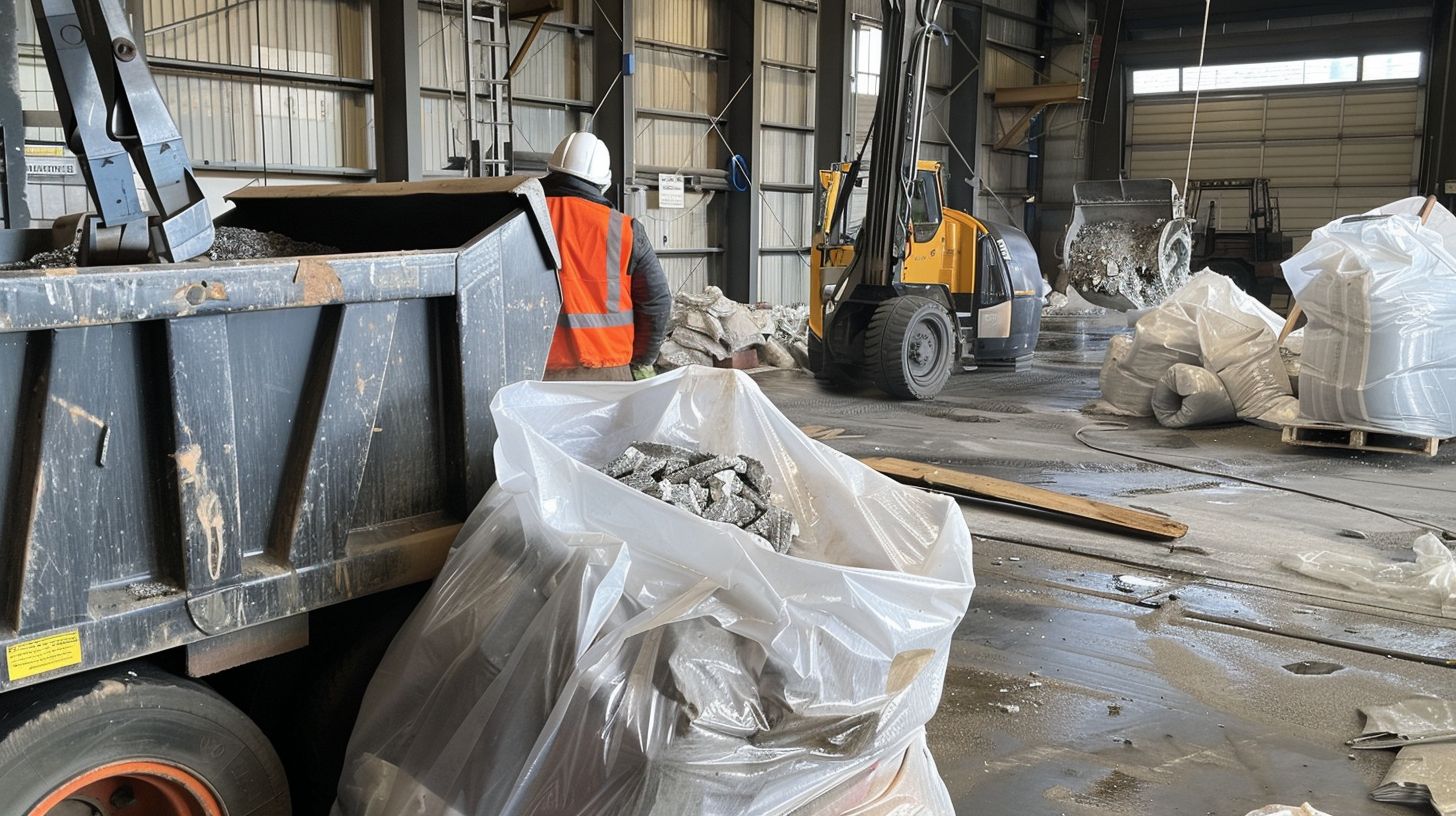
Packaging Asbestos Waste Correctly
Before asbestos waste leaves the site, it must be packaged to a specific standard. All asbestos waste must be:
- Double-bagged in heavy-duty polythene bags (minimum 1,000 gauge)
- Clearly labelled with the hazardous waste asbestos warning label
- Rigid ACMs — such as corrugated cement sheets — wrapped in heavy-duty polythene sheeting and sealed securely with tape
Bags and wrappings must not be overfilled. If packaging splits during handling or transport, you have a contamination incident on your hands — and a potential enforcement action to deal with alongside it.
Where Can Asbestos Waste Be Disposed of?
Asbestos waste can only be disposed of at sites that are licensed to accept it. The main options in the UK are:
- Licensed hazardous waste landfill sites — The primary route for asbestos disposal. These sites have designated asbestos cells with specific containment and burial procedures designed to prevent fibre release over time.
- Hazardous waste transfer stations — Licensed facilities that accept, consolidate, and transfer hazardous waste to disposal sites. They do not carry out final disposal themselves.
- Local authority household waste recycling centres (HWRCs) — Some council-run sites accept small quantities of asbestos from householders. This varies considerably by local authority, so always check before arriving with asbestos waste.
The Environment Agency (EA) in England and Wales, the Scottish Environment Protection Agency (SEPA), and the Northern Ireland Environment Agency (NIEA) maintain registers of sites licensed to accept asbestos waste. Checking these registers before arranging disposal is straightforward and takes only a few minutes.
Hazardous Waste Consignment Notes
Every movement of asbestos waste must be accompanied by a hazardous waste consignment note. This document records the type and quantity of asbestos waste, the point of origin, the carrier’s details, and the receiving facility.
Consignment notes must be retained by all parties for a minimum of three years. This paper trail is a legal requirement — it allows regulators to trace asbestos waste from the point of removal to its final resting place. There are no shortcuts here.
Transporting Asbestos Waste
Asbestos waste must be transported by a registered waste carrier. Vehicles used must be appropriate for hazardous waste, and drivers must carry the consignment note with them throughout the journey.
Using an unregistered carrier to remove asbestos waste is a criminal offence — both for the carrier and the person commissioning the removal. Always verify that your contractor holds a valid waste carrier registration before any waste leaves your site.
Your Legal Obligations as a Duty Holder
If you are responsible for a non-domestic building — as owner, landlord, or managing agent — the Control of Asbestos Regulations places specific legal duties on you. These include:
- Identifying and assessing ACMs in your premises, or presuming their presence in buildings constructed before 2000
- Maintaining an up-to-date asbestos register
- Producing and implementing an asbestos management plan
- Informing contractors and workers about the location and condition of ACMs before they start work
- Arranging re-inspection surveys at regular intervals to monitor known ACMs
Failure to comply can result in enforcement action, improvement or prohibition notices, unlimited fines, and — in serious cases — imprisonment. HSE guidance, including HSG264, sets out the standards expected of duty holders and those carrying out survey and removal work.
For domestic landlords, obligations vary depending on property type and tenancy arrangement, but the duty to manage your premises safely and commission appropriate surveys before refurbishment or demolition applies equally.
What Happens If Asbestos Is Disposed of Illegally?
Illegal disposal of asbestos — whether through fly-tipping, using unlicensed carriers, or dumping waste at sites not approved to receive it — is treated seriously by regulators. Prosecutions have resulted in significant fines and custodial sentences for individuals and companies found responsible.
Beyond the legal consequences, illegal disposal creates a genuine public health risk. Asbestos fibres released into the environment do not degrade. Once in the soil or air, they remain a hazard to anyone who disturbs the area in future — including residents, workers, and emergency services.
The reputational damage to businesses caught disposing of asbestos illegally is also considerable. Enforcement actions are a matter of public record, and the HSE and Environment Agency publish details of prosecutions.
When to Call in the Professionals
The honest answer is: almost always, unless you are a trained professional yourself. For any ACM in poor condition, any friable material, or any work that will disturb asbestos-containing materials, you need a licensed contractor. For surveys and identification, you need a qualified surveyor. For sample analysis, you need an accredited laboratory.
Non-domestic premises frequently require a fire risk assessment alongside asbestos management — particularly where removal or refurbishment work is planned. Both obligations sit with the duty holder, and both carry enforcement consequences if neglected.
Attempting to manage asbestos removal and disposal without professional support is rarely the cost-saving exercise it appears to be. The regulatory requirements, documentation obligations, and health risks involved make professional involvement not just advisable, but in most cases legally required.
Frequently Asked Questions
How is asbestos disposed of legally in the UK?
Asbestos waste must be double-bagged in heavy-duty polythene, clearly labelled as hazardous waste, and transported by a registered waste carrier to a licensed hazardous waste landfill site or transfer station. Every movement must be accompanied by a hazardous waste consignment note, which all parties must retain for a minimum of three years. Disposal at unlicensed sites or fly-tipping asbestos is a criminal offence.
Can I dispose of asbestos at my local tip?
Some local authority household waste recycling centres (HWRCs) accept small quantities of asbestos waste from householders, but this varies significantly between councils. Always contact your local authority before turning up with asbestos waste. Commercial quantities of asbestos must be disposed of at a licensed hazardous waste facility — a local tip is not an appropriate route for business or landlord disposal.
Do I need a licensed contractor to remove asbestos?
It depends on the type of asbestos and the nature of the work. High-risk materials such as asbestos insulation, asbestos insulating board (AIB), and sprayed coatings must only be removed by a contractor holding an HSE licence. Some lower-risk tasks fall under notifiable non-licensed work (NNLW), which requires notification but not a licence. Only a small category of work with intact, non-friable materials can be carried out without a licence or notification. A professional survey report will confirm which category applies to your situation.
What is a hazardous waste consignment note and do I need one?
A hazardous waste consignment note is a legally required document that must accompany every movement of asbestos waste. It records the type and quantity of waste, where it came from, who is carrying it, and where it is going. All parties — the producer of the waste, the carrier, and the receiving facility — must retain copies for at least three years. Using an unregistered carrier or failing to complete consignment notes correctly is a criminal offence.
How do I know if my building contains asbestos?
The only reliable way to confirm whether asbestos is present is through a professional asbestos survey carried out by a qualified surveyor, followed by laboratory analysis of any suspect samples. Any building constructed before 2000 should be treated as potentially containing asbestos until a survey proves otherwise. Supernova Asbestos Surveys offers management, refurbishment, and demolition surveys across the UK, as well as testing kits for initial sample collection.
Talk to Supernova Asbestos Surveys
Supernova Asbestos Surveys has completed over 50,000 surveys across the UK. Whether you need a survey to identify what is present, support with arranging licensed removal, or guidance on your legal obligations as a duty holder, our team is ready to help.
Call us on 020 4586 0680 or visit asbestos-surveys.org.uk to find out more about our full range of services.