One missing survey, one outdated register, or one contractor drilling into the wrong panel can turn asbestos compliance from a paperwork issue into a legal and safety problem overnight. If you manage a non-domestic property, school, office, warehouse, shop, or mixed-use building, the duty to manage asbestos is not optional and it does not disappear because the material is hidden.
Across the UK, asbestos compliance sits at the centre of property risk management. Duty holders are expected to know where asbestos-containing materials may be, assess their condition, control the risk, and make sure anyone who could disturb them has the right information before work starts. That means surveys, registers, management plans, re-inspections, training, and clear communication all need to work together.
For many property managers, the challenge is not understanding that asbestos matters. It is knowing what practical steps to take, when to take them, and how regulators are likely to judge whether your arrangements are good enough. That is where a clear, structured approach makes all the difference.
What asbestos compliance means in practice
At its simplest, asbestos compliance means meeting your legal duties to identify, manage, and control asbestos risk in premises where asbestos may be present. In the UK, that duty is shaped primarily by the Control of Asbestos Regulations, supported by HSE guidance and survey standards set out in HSG264.
For duty holders, compliance is not just about finding asbestos and filing a report. It is about proving that you have taken reasonable steps to prevent exposure. Regulators will look at what you knew, what you should have known, and what systems you had in place to manage the risk.
In practical terms, asbestos compliance usually involves:
- Identifying whether asbestos-containing materials are present
- Assessing the condition and risk of those materials
- Keeping an up-to-date asbestos register
- Creating and implementing an asbestos management plan
- Sharing asbestos information with contractors and maintenance staff
- Arranging re-inspections and updates when conditions change
- Using competent specialists for surveying, testing, and removal
If any one of those steps is missing, your asbestos compliance position can quickly weaken.
Who is responsible for asbestos compliance?
The legal duty usually falls on the person or organisation with responsibility for maintenance or repair of non-domestic premises. That may be the building owner, landlord, facilities manager, managing agent, employer, or another party with contractual control over the property.
Sometimes responsibility is shared. A landlord may control the structure and common parts, while a tenant controls internal repair obligations. In those cases, asbestos compliance depends on everyone understanding exactly where their duties begin and end.
Typical duty holders include:
- Commercial landlords
- Managing agents
- Facilities management companies
- Employers occupying office or industrial space
- Schools, academies, and education trusts
- NHS and healthcare estate managers
- Retail and hospitality operators
- Public sector property teams
If you are unsure whether you are the duty holder, start by reviewing lease terms, maintenance agreements, and repair responsibilities. Do not assume someone else is dealing with asbestos compliance unless that responsibility is clearly defined and evidenced.
The legal framework behind asbestos compliance
The Control of Asbestos Regulations set the main legal duties for managing asbestos in Great Britain. These regulations require duty holders to take reasonable steps to find out if asbestos is present, presume materials contain asbestos unless there is evidence to the contrary, assess risk, and put a plan in place to manage that risk.

Survey work should follow the approach set out in HSG264, which explains how asbestos surveys should be carried out, what they are designed to achieve, and how findings should be reported. HSE guidance also sets expectations around training, risk assessment, licensed work, notifiable work, and safe working methods.
Property managers should be careful not to treat compliance as a one-off event. The duty to manage is ongoing. If occupancy changes, refurbishment is planned, damage occurs, or previous survey information becomes unreliable, your asbestos compliance arrangements may need updating.
What inspectors expect to see
When the HSE or another enforcing authority reviews your arrangements, they are likely to look for evidence that your system is active and current. That includes:
- A suitable asbestos survey for the building and planned activity
- An accessible asbestos register
- A written asbestos management plan
- Evidence of regular review and re-inspection
- Records showing contractors were informed before starting work
- Training records for relevant staff
- Appropriate action where asbestos has been damaged or disturbed
If your documents are outdated, incomplete, or disconnected from what is happening on site, that can undermine your asbestos compliance even if asbestos was identified years ago.
Why surveys are the foundation of asbestos compliance
You cannot manage asbestos properly if you do not know where it is, what condition it is in, or whether planned works could disturb it. That is why surveying sits at the heart of asbestos compliance.
The right survey depends on how the building is being used and what work is planned. Choosing the wrong type of survey is a common and avoidable mistake.
Management surveys
A management survey is designed to locate, as far as reasonably practicable, asbestos-containing materials that could be disturbed during normal occupation, routine maintenance, or minor installation works. It supports the asbestos register and management plan.
If you are responsible for a non-domestic building built before 2000 and you do not have a current management survey, your asbestos compliance position is likely to be weak. The same applies if the survey is old, the building has changed significantly, or areas were previously inaccessible and have not been reviewed.
Refurbishment and demolition surveys
Before intrusive works begin, a standard management survey is not enough. You need a survey that specifically targets the areas affected by the planned works.
For properties due to major strip-out or structural removal, a demolition survey is essential. This type of survey is intrusive and may involve destructive inspection to locate asbestos hidden within the building fabric.
Starting refurbishment or demolition without the correct survey is one of the clearest ways to fail asbestos compliance. It puts workers at risk and leaves the duty holder exposed to enforcement action if asbestos is discovered mid-project.
Re-inspection surveys
Known asbestos-containing materials need to be monitored. Their condition can change through age, vibration, water ingress, accidental impact, or maintenance activity.
A re-inspection survey checks previously identified materials, updates condition assessments, and helps keep the asbestos register accurate. If your current register relies on findings from many years ago with no follow-up, that is not strong asbestos compliance.
Asbestos testing and sample analysis
Not every suspect material can be identified by sight alone. Ceiling tiles, textured coatings, insulation boards, floor tiles, bitumen products, and cement sheets can all be misjudged without proper analysis.
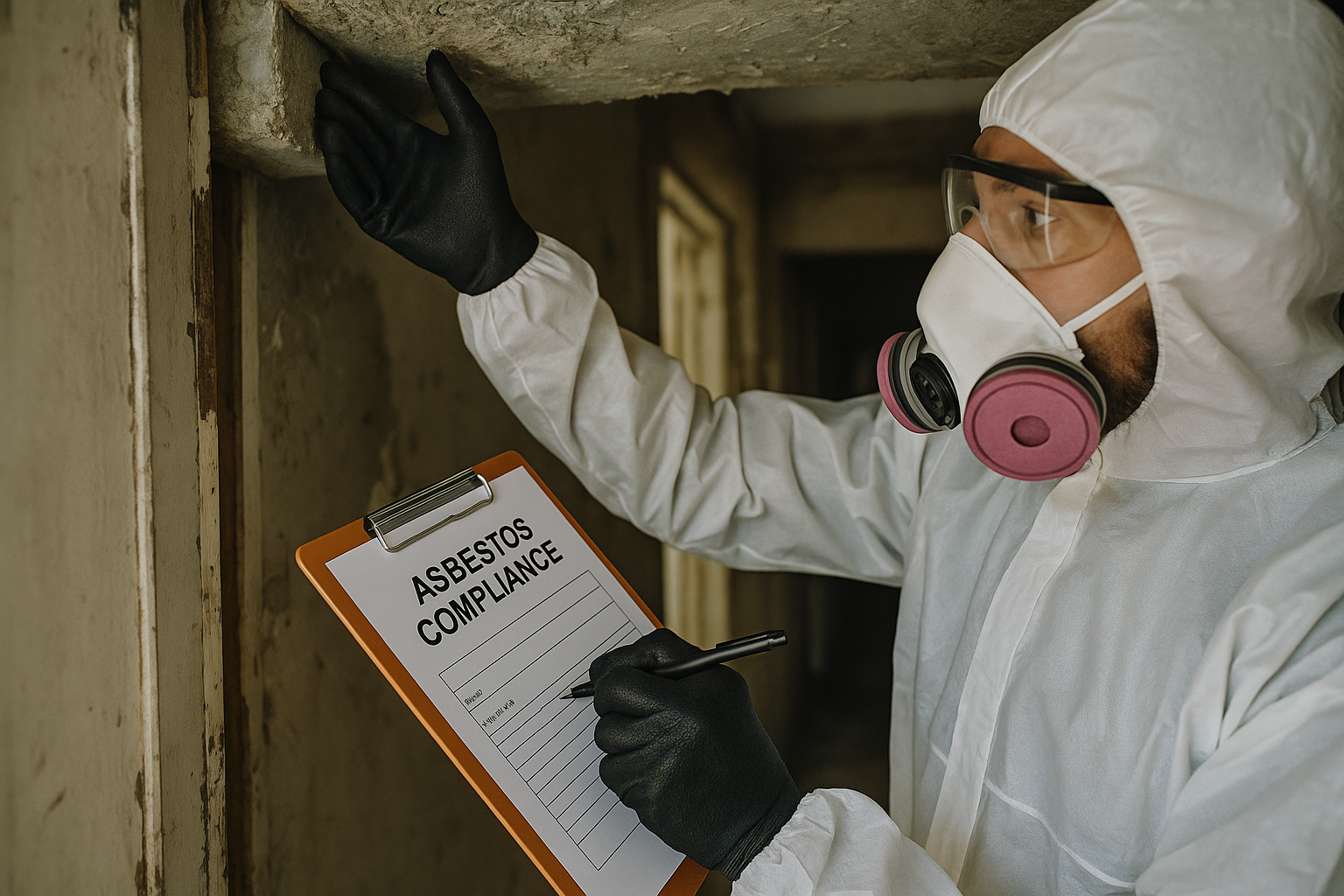
Where there is uncertainty, asbestos testing provides a more reliable basis for decision-making. Sampling should be carried out safely and analysed by a competent laboratory process.
For isolated materials or smaller investigations, sample analysis can be a practical option when you need formal confirmation of whether a material contains asbestos. The key point for asbestos compliance is simple: assumptions are risky. If you cannot confirm a material is asbestos-free, it should be managed cautiously until proven otherwise.
Where property managers need local support, services such as asbestos testing can help speed up decisions before maintenance or fit-out work begins.
How to build a workable asbestos management plan
An asbestos management plan should do more than repeat survey findings. It needs to explain how asbestos risks will be controlled in the real world, by real people, across daily operations.
Good asbestos compliance depends on the plan being practical, accessible, and reviewed regularly.
Your plan should include:
- The location of known or presumed asbestos-containing materials
- The condition of those materials and the level of risk
- Responsibilities for managing asbestos information
- Procedures for contractor control and permit systems
- Arrangements for re-inspection and review
- Emergency actions if asbestos is accidentally disturbed
- Rules for labelling, monitoring, encapsulation, or removal where required
Make sure the asbestos register and management plan are easy to access. If a contractor needs to ask three different people for the latest asbestos information, the system is too weak.
Practical steps for property managers
- Keep one current asbestos register for each property or clearly defined site.
- Check that survey reports match the building layout and current use.
- Flag inaccessible areas and arrange access when possible.
- Brief contractors before work starts, not after they arrive on site.
- Record when asbestos information has been shared and acknowledged.
- Review the plan after alterations, damage, tenant churn, or incidents.
- Schedule re-inspections rather than waiting for problems to appear.
These are the habits that strengthen asbestos compliance and reduce the chance of unpleasant surprises during routine works.
Training, communication, and contractor control
Even the best survey will not protect people if the information stays in a folder and never reaches those doing the work. One of the most common failures in asbestos compliance is poor communication between the duty holder, site team, and contractors.
Anyone liable to disturb asbestos-containing materials should have suitable asbestos awareness training. That often includes electricians, plumbers, joiners, decorators, data installers, general maintenance teams, and supervisors.
Training should help workers understand:
- What asbestos is and why it is dangerous
- Where it may be found in buildings
- How to avoid disturbing suspect materials
- What site rules apply before drilling, cutting, or accessing voids
- What to do if damage or accidental disturbance occurs
Training alone is not enough. Contractors also need site-specific asbestos information before they start work. A generic induction does not replace a proper review of the asbestos register and relevant survey data.
For stronger asbestos compliance, use a simple contractor control process:
- Define the work area and task.
- Check whether existing survey information covers that area.
- Arrange further survey or testing if information is incomplete.
- Share the relevant asbestos information with the contractor.
- Get written confirmation that it has been received and understood.
- Monitor the work if there is any risk of disturbing suspect materials.
Enforcement: how asbestos compliance is monitored
The HSE is the main enforcing authority for asbestos law in many workplaces, and inspectors have broad powers. They can enter premises, review records, inspect work areas, speak to staff, and take samples where necessary.
Enforcement does not only happen after a serious incident. It can follow routine inspections, refurbishment projects, complaints, unsafe working practices, or accidental disturbance reports.
Common triggers for enforcement action
- No suitable asbestos survey on file
- Outdated or incomplete asbestos register
- Failure to inform contractors about asbestos risks
- Intrusive works starting without the correct survey
- Poor control of asbestos-containing materials in damaged condition
- Inadequate training records
- Unsafe removal or clean-up attempts by unqualified persons
If inspectors identify material breaches, they may issue improvement notices or prohibition notices, and they may recover costs through Fee for Intervention. In more serious cases, prosecution is possible, with penalties that can include unlimited fines and, for individuals in the most serious circumstances, imprisonment.
From a property management perspective, strong asbestos compliance is not just about avoiding fines. It protects occupiers, contractors, business continuity, and reputation.
When asbestos removal is necessary
Not all asbestos-containing materials need to be removed immediately. If a material is in good condition, unlikely to be disturbed, and can be managed safely in place, that may be the right approach.
Removal becomes more likely where materials are damaged, deteriorating, difficult to protect, or located in areas affected by planned works. In those cases, using a competent specialist is essential.
If removal is required, arrange professional asbestos removal rather than relying on general contractors. Some higher-risk asbestos work must be carried out by licensed contractors, while other tasks may fall under non-licensed or notifiable non-licensed categories depending on the material and method.
Before removal work starts, make sure you understand:
- Whether the work is licensed, non-licensed, or notifiable
- What plan of work will be followed
- How the area will be isolated and cleaned
- What air monitoring or clearance procedures are needed
- How waste will be packaged, transported, and disposed of lawfully
This is a key part of asbestos compliance because appointing the wrong contractor or misunderstanding the work category can create fresh legal problems.
What to do if asbestos is accidentally disturbed
Accidental disturbance is one of the most stressful situations a property manager can face. Quick, calm action matters.
If suspect asbestos has been drilled, cut, broken, or otherwise disturbed:
- Stop work immediately.
- Keep people out of the area.
- Prevent further spread by isolating the space where possible.
- Do not sweep, vacuum, or attempt a casual clean-up.
- Contact a competent asbestos specialist for assessment.
- Review how the incident happened and whether survey information was missing or ignored.
Depending on the circumstances, further reporting obligations may arise. HSE guidance should be followed carefully, and any remediation should be handled by competent professionals.
Incidents like this often expose gaps in asbestos compliance, especially where works began without the right survey, register review, or contractor briefing.
Asbestos compliance across different locations and portfolios
Large property portfolios often struggle because asbestos information is spread across multiple systems, consultants, and site teams. One building may have a current register while another relies on outdated PDFs and old handover files.
Standardising your approach makes compliance easier to maintain. Whether you manage assets in the capital or across regional sites, the same principles apply: identify, assess, record, communicate, review.
If you need local support, Supernova provides services including asbestos survey London, asbestos survey Manchester, and asbestos survey Birmingham. For multi-site owners and managing agents, using a consistent surveying and reporting approach can make asbestos compliance far easier to oversee.
Common asbestos compliance mistakes to avoid
Most failures are not caused by obscure legal technicalities. They come from routine oversights, poor coordination, or assumptions that turn out to be wrong.
- Relying on an old survey without checking whether it is still suitable
- Assuming a management survey covers refurbishment work
- Failing to re-inspect known asbestos-containing materials
- Not sharing asbestos information with contractors before work starts
- Keeping an asbestos register that nobody on site can access easily
- Letting damaged materials remain in place without action
- Using unqualified contractors to sample, remove, or clean up asbestos debris
- Assuming domestic areas are always outside the scope of concern in mixed-use premises
If you recognise any of these issues in your own estate, act before the next maintenance job, fit-out, or inspection exposes the gap.
How to stay ahead of asbestos compliance
The most effective approach is proactive rather than reactive. Do not wait until a contractor asks for asbestos information on the morning work is due to start.
Use this simple checklist:
- Identify which buildings may contain asbestos.
- Check that each property has the correct and current survey information.
- Maintain an accurate asbestos register and management plan.
- Set review dates for re-inspections and document updates.
- Train relevant staff and brief contractors properly.
- Arrange testing where materials are uncertain.
- Escalate damaged or high-risk materials for remedial action or removal.
That is what effective asbestos compliance looks like in day-to-day property management. It is organised, documented, and built around preventing exposure before work begins.
If you need help with surveys, testing, re-inspections, or removal planning, Supernova Asbestos Surveys can support you nationwide. We have completed more than 50,000 surveys across the UK and provide practical advice that helps duty holders stay in control. Call 020 4586 0680 or visit asbestos-surveys.org.uk to arrange the right service for your property.
Frequently Asked Questions
Who is responsible for asbestos compliance in a commercial building?
The duty usually sits with the person or organisation responsible for maintenance or repair of the premises. That may be the owner, landlord, managing agent, facilities manager, employer, or a combination of parties depending on lease and contract arrangements.
Do I need a new survey if I already have an asbestos report?
Possibly. If the report is old, incomplete, based on limited access, or does not cover the planned works, it may no longer be suitable. A management survey does not replace a refurbishment or demolition survey where intrusive works are planned.
How often should asbestos be re-inspected?
There is no single fixed period that suits every building. Re-inspection frequency should reflect the material, its condition, location, and likelihood of disturbance. Many duty holders use regular review cycles, but the right interval should be based on risk and documented in the management plan.
Can asbestos be left in place?
Yes, if it is in good condition, not likely to be disturbed, and managed properly. Removal is not always required. What matters is that the risk is assessed and controlled, with clear records and regular review.
What happens if asbestos is disturbed accidentally?
Work should stop immediately, the area should be secured, and a competent asbestos specialist should assess the situation. Do not attempt an informal clean-up. The incident should also trigger a review of your asbestos compliance procedures to identify what failed.