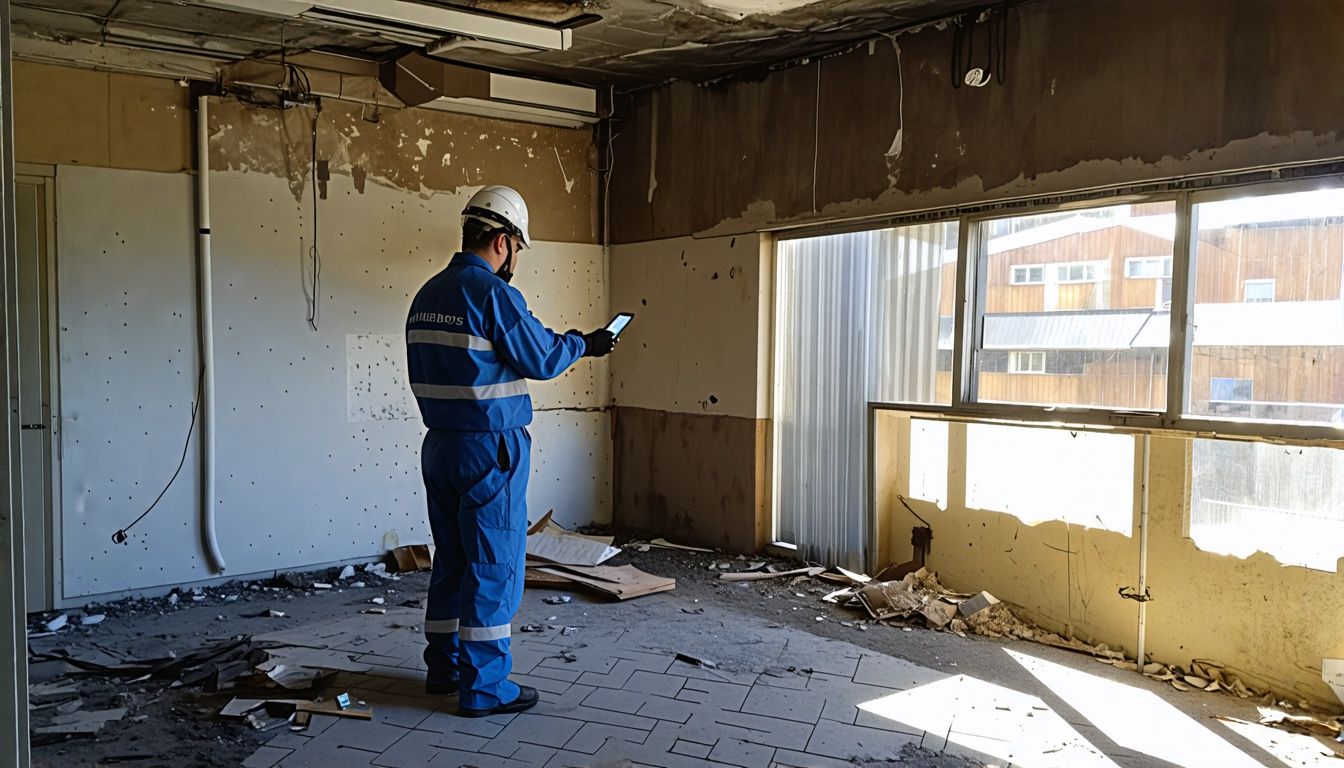
How Local Authorities Enforce Asbestos Compliance — And What It Means for Your Premises
If you manage or own a non-domestic property in the UK, local authority oversight is not a distant possibility — it is a practical reality. Environmental Health Officers carry genuine enforcement powers, and they use them regularly. Whether it arrives as a routine inspection, a reactive investigation following a complaint, or scrutiny of your documentation, the question is never if an inspector will take an interest in your premises — it is whether you will be ready when they do.
Many duty holders are uncertain about how local authorities fit into the wider regulatory picture, what they can actually do, and where the Health and Safety Executive (HSE) ends and local council enforcement begins. This post sets out exactly how the system works, what inspectors look for, and what you need to do to maintain asbestos compliance on your premises.
The Enforcement Split: Local Authorities and the HSE
Asbestos regulation in the UK is enforced by two bodies: the HSE and local authorities. Understanding which one oversees your premises is the starting point for everything else.
As a general rule, the HSE takes responsibility for higher-risk workplaces — construction sites, manufacturing facilities, and similar environments. Local authorities, specifically their Environmental Health departments, cover lower-risk premises: offices, retail units, hotels, catering establishments, GP surgeries, and many public buildings. This division is defined under the Health and Safety (Enforcing Authority) Regulations.
In practice, both bodies work closely together — sharing intelligence, coordinating joint inspections, and aligning enforcement approaches. The HSE provides technical guidance and support to local authority inspectors, particularly around asbestos, which requires specialist knowledge to assess correctly.
Who Is the “Local Authority” for Asbestos Purposes?
In England and Wales, this typically means district councils or London borough councils. In Scotland and Northern Ireland, equivalent functions are carried out by local councils under their respective legislative frameworks.
Environmental Health Officers (EHOs) are the frontline inspectors. They are the people who will attend your premises, review your documentation, and initiate enforcement action where your asbestos compliance falls short. They are trained professionals who know what good management looks like — and they know what poor management looks like too.
The Legislation Local Authorities Are Working With
Three pieces of legislation form the backbone of local authority asbestos enforcement. Each gives EHOs different tools and powers.
The Control of Asbestos Regulations
This is the primary legislation governing asbestos in the workplace. It sets out the duty to manage asbestos in non-domestic premises and governs how asbestos work must be planned, carried out, and recorded. The HSE’s HSG264 guidance document supports these regulations and provides practical direction for duty holders and surveyors alike.
Under these regulations, duty holders must:
- Identify asbestos-containing materials (ACMs) in their premises
- Assess the condition and risk of those materials
- Produce and maintain an asbestos management plan
- Ensure anyone liable to disturb ACMs is informed of their location
- Arrange for licensed contractors to carry out notifiable asbestos work
Local authorities check compliance with all of the above during inspections. Failing on any single point can trigger formal enforcement action.
The Health and Safety at Work etc. Act
This broader legislation underpins almost all workplace safety law in the UK. It places a duty on employers to protect employees and others who may be affected by their activities — including protection from asbestos exposure.
Local authorities can use powers under this Act when asbestos failings form part of a wider pattern of health and safety neglect, or where the specific asbestos regulations do not fully capture the nature of the breach.
The Environmental Protection Act
This gives local authorities the power to address asbestos as an environmental hazard. It is particularly relevant when asbestos waste has been fly-tipped, when contaminated land needs remediation, or when a property is creating a risk to neighbouring occupants.
Councils can issue notices requiring landowners to remediate contaminated sites and can prosecute for the illegal disposal of asbestos waste. Penalties under this route are significant, and the reputational consequences are serious.
What Local Authority Monitoring Actually Looks Like
Local authority oversight is not purely reactive. EHOs conduct proactive inspections of premises within their jurisdiction — and the visits are more structured than many duty holders expect.
Routine Premises Inspections
Environmental Health Officers visit commercial and public premises to check that asbestos management duties are being met. Priority is typically given to higher-risk premises: older buildings (pre-2000 construction is the key threshold), schools, care homes, and environments where vulnerable people are present or where refurbishment work is likely.
During a routine inspection, an EHO may:
- Ask to see your asbestos register and management plan
- Check that ACMs are correctly labelled and in an acceptable condition
- Review records of any asbestos surveys that have been carried out
- Verify that contractors working on site have been informed of asbestos locations
- Confirm that any recent disturbance work was carried out by appropriately licensed contractors
If your documentation is absent, incomplete, or out of date, that alone is sufficient to trigger an improvement notice. You do not need to have caused an incident for enforcement action to begin.
Reactive Investigations
Local authorities also respond to complaints and reported incidents. If a worker reports that asbestos has been disturbed without proper precautions, or a member of the public raises concerns about visibly deteriorating materials, EHOs will investigate — and these visits tend to be more thorough than routine inspections.
Reactive visits carry a significantly higher risk of enforcement action. Where the complaint is substantiated, the response is rarely just advisory.
Oversight of Asbestos Removal Projects
For notifiable asbestos removal work, contractors must notify the relevant enforcing authority at least 14 days in advance. In many cases, the local authority will conduct site visits during the works — checking that enclosures are properly constructed, that air monitoring is taking place, and that waste is being correctly bagged and disposed of.
Post-removal, they may require a four-stage clearance certificate before allowing re-occupation of the affected area. If you are commissioning asbestos removal work, understanding this notification requirement is part of your duty holder responsibility.
Enforcement Powers: What Local Authorities Can Actually Do
Local authorities have genuine enforcement teeth. The range of actions available reflects the seriousness with which asbestos risk is treated under UK law — and the consequences of non-compliance are not trivial.
Improvement Notices
An improvement notice is typically the first formal step. It sets out specifically what is wrong, what needs to be done, and gives a defined timeframe for compliance — usually at least 21 days. Improvement notices are a matter of public record.
Failure to comply with an improvement notice is a criminal offence in itself, regardless of whether the original asbestos failing has been addressed. Do not treat an improvement notice as a starting point for negotiation.
Prohibition Notices
Where there is an immediate risk of serious injury — for example, if friable asbestos is being actively disturbed without controls in place — a prohibition notice can be issued on the spot. This stops the activity immediately.
You cannot resume the work until the notice has been lifted, which requires demonstrating that the risk has been properly controlled. Prohibition notices can shut down a construction project or close a building with immediate effect.
Fines and Prosecution
Breaches of the Control of Asbestos Regulations and the Health and Safety at Work Act are criminal offences. In the magistrates’ court, unlimited fines can be imposed. In the Crown Court, fines are similarly unlimited and custodial sentences of up to two years are possible for the most serious cases.
Courts have made clear that profit-motivated disregard for asbestos regulations — cutting corners on a renovation to save money, for instance — will result in significantly higher penalties. Director-level individuals can face personal prosecution alongside the corporate entity.
Prosecution Without Prior Notice
Local authorities are not required to issue an improvement notice before prosecuting. Where the breach is serious or where there is evidence of deliberate non-compliance, they can proceed directly to prosecution. This is not a theoretical possibility — it happens.
Licensing: How Local Authorities Check Contractor Legitimacy
Only HSE-licensed contractors can carry out licensable asbestos work — this includes most work with sprayed coatings, insulation, insulating board, and any work liable to expose workers above the control limit. The HSE issues and manages these licences.
However, local authorities play a critical role at ground level. When overseeing removal projects within their jurisdiction, EHOs will check that the contractor on site holds a valid licence. Engaging an unlicensed contractor — even unknowingly — creates significant legal exposure for the duty holder commissioning the work.
You can verify a contractor’s licence status directly on the HSE’s public register of licensed asbestos contractors before any work begins. This is a straightforward check that every duty holder should carry out as standard practice.
Non-Licensed and Notifiable Non-Licensed Work
Not all asbestos work requires a licence. Some lower-risk tasks fall into “non-licensed” or “notifiable non-licensed work” (NNLW) categories. For NNLW, workers must still be trained, the employer must notify the relevant enforcing authority before work begins, and health records must be maintained.
Local authorities check compliance with these requirements during inspections and reactive visits. The lower-risk categorisation does not mean lower scrutiny.
Specific Contexts Where Local Authorities Are Particularly Active
Schools and Educational Buildings
Many schools — particularly those built between the 1950s and 1980s — contain asbestos. The Department for Education and the HSE have published specific guidance for the education sector, and local authority EHOs take a close interest in how schools manage their obligations.
Governing bodies and local authority-maintained schools carry the duty to manage, and failures in this context — given the presence of children — are treated with exceptional seriousness by enforcement bodies.
Houses in Multiple Occupation
Residential dwellings do not fall under the duty to manage in the same way as commercial premises, but Houses in Multiple Occupation (HMOs) sit in a grey area. Local authorities licence HMOs and can take action under housing legislation where asbestos poses a hazard to tenants.
This is a growing area of enforcement activity, and landlords of older HMO properties should not assume that residential use exempts them from scrutiny.
Demolition and Refurbishment Projects
Local authorities are closely involved in planning and building control processes. Prior to granting permission for demolition or significant refurbishment of older buildings, councils may require evidence that asbestos has been surveyed and appropriately managed.
Building control inspectors work alongside EHOs in these situations. If you are planning significant works on a pre-2000 building, a refurbishment and demolition survey is not optional — it is a prerequisite for safe and legally compliant project delivery.
Maintaining Asbestos Compliance: What You Need to Have in Place
The good news is that meeting your obligations is straightforward when you approach it systematically. The following checklist covers the core elements that any EHO will expect to see.
- A current asbestos survey — carried out by a qualified surveyor, appropriate to the type of premises and any planned works. Management surveys cover occupied premises; refurbishment and demolition surveys are required before intrusive work begins.
- An asbestos register — documenting the location, type, condition, and risk rating of all identified ACMs. This must be kept up to date as conditions change or materials are removed.
- An asbestos management plan — setting out how identified ACMs will be managed, monitored, and communicated to those who may disturb them.
- Contractor communication records — evidence that anyone working on your premises has been informed of ACM locations before starting work.
- Records of any asbestos work — including air monitoring results, waste transfer notes, and clearance certificates for any removal projects.
- Periodic re-inspection — ACMs in situ must be inspected regularly to check that their condition has not deteriorated. Annual re-inspection is standard practice for most premises.
If any of these elements are missing or out of date, you are exposed — both to enforcement action and to the genuine risk of harm to the people in your building.
Regional Enforcement: Local Authorities Across the UK
Enforcement activity is not uniform across the country, but the obligations on duty holders are consistent regardless of location. Whether your premises are in the capital or in a regional city, the same regulations apply and the same documentation is expected.
For duty holders in the capital, an asbestos survey London carried out by an accredited surveyor will ensure your documentation meets the standard that London borough Environmental Health Officers expect to see.
In the North West, premises managers should ensure their surveys and management plans are current. An asbestos survey Manchester from a UKAS-accredited provider gives you the evidential foundation to demonstrate compliance with confidence.
In the Midlands, where a significant proportion of the commercial building stock dates from the post-war decades, local authority scrutiny of asbestos management is well-established. An asbestos survey Birmingham ensures you have the documentation in place before an inspector asks for it.
What Happens If You Are Not Compliant When an Inspector Arrives
The most common outcome of an inspection where documentation is missing or inadequate is an improvement notice. This is manageable — but it creates a formal record, triggers follow-up visits, and places you under closer scrutiny going forward.
Where the situation is more serious — where ACMs are in poor condition and no management plan exists, or where unlicensed work has taken place — the response escalates quickly. Prohibition notices, prosecution referrals, and press releases are all tools that local authorities use and are not reluctant to deploy.
The most effective strategy is straightforward: get your survey done, maintain your documentation, keep your management plan current, and ensure that everyone who needs to know about asbestos on your premises does know. Enforcement action is almost always preceded by a period of non-compliance that could have been addressed at any point.
Frequently Asked Questions
Do local authorities have the power to enter my premises without notice to check asbestos compliance?
Yes. Environmental Health Officers have the right to enter premises at any reasonable time without prior notice under the Health and Safety at Work etc. Act. They can inspect your asbestos documentation, examine ACMs in situ, and take samples where necessary. Obstructing an inspector is itself a criminal offence.
My building was constructed after 2000 — do I still need to worry about asbestos compliance?
The use of asbestos in construction was banned in the UK in 1999, so buildings constructed after that point are very unlikely to contain asbestos-containing materials. However, if your building underwent any refurbishment using salvaged or imported materials, or if there is any uncertainty about its construction history, a survey is still advisable. The duty to manage applies wherever ACMs may be present.
What is the difference between a management survey and a refurbishment and demolition survey?
A management survey is designed for occupied premises and focuses on identifying ACMs that could be disturbed during normal use or routine maintenance. A refurbishment and demolition survey is more intrusive — it involves accessing all areas, including voids and structural elements — and is required before any significant building work begins. Using the wrong survey type for the situation is itself a compliance failing that EHOs will identify.
Can I be prosecuted personally as a director or manager for asbestos compliance failures?
Yes. Where a compliance failure is attributable to the consent, connivance, or neglect of a director or senior manager, that individual can be prosecuted personally alongside the corporate entity. Courts have imposed custodial sentences in serious cases. Personal liability is a real consequence, not a theoretical one.
How often should I have my asbestos register and management plan reviewed?
There is no fixed statutory interval, but HSE guidance and established good practice indicate that ACMs in situ should be re-inspected at least annually, and the management plan should be reviewed whenever there is a change in the condition of materials, a change in the use of the building, or following any asbestos work. Many duty holders commission an annual review as a matter of routine to ensure continuous asbestos compliance.
Get Your Asbestos Compliance in Order — Speak to Supernova
Supernova Asbestos Surveys has completed over 50,000 surveys across the UK for property managers, landlords, local authorities, and commercial operators of every kind. Our surveyors are fully qualified and work to HSG264 standards, providing the documentation you need to demonstrate compliance with confidence.
Whether you need a management survey, a refurbishment and demolition survey, or advice on what your existing documentation is missing, our team can help. Call us on 020 4586 0680 or visit asbestos-surveys.org.uk to arrange a survey or speak to one of our advisors.