The Control of Asbestos Regulations 2012: What Every Dutyholder Must Know
Asbestos exposure remains the single largest cause of work-related deaths in Britain. Despite a complete ban on its use, the material is still present in hundreds of thousands of buildings across the country — and the legal framework governing how it must be managed, removed, and disposed of is uncompromising. The Control of Asbestos Regulations 2012 sit at the heart of that framework, placing clear legal duties on building owners, employers, and anyone with control over non-domestic premises.
If you manage a building, commission maintenance work, or oversee refurbishment projects, this legislation applies directly to you. Getting it wrong doesn’t just expose workers and occupants to serious health risks — it can result in criminal prosecution, unlimited fines, and imprisonment.
What the Control of Asbestos Regulations 2012 Actually Cover
The Control of Asbestos Regulations 2012 consolidated earlier asbestos legislation into a single, unified set of rules. They apply across England, Scotland, Wales, and Northern Ireland, and are enforced primarily by the Health and Safety Executive (HSE), with local authorities taking responsibility for certain lower-risk premises.
The regulations cover a broad range of obligations, including:
- Identifying and assessing asbestos-containing materials (ACMs) in non-domestic buildings
- Managing ACMs safely through a written asbestos management plan
- Controlling who can carry out asbestos work and under what conditions
- Training requirements for workers who may encounter asbestos
- Air monitoring and clearance testing after removal
- Proper disposal of asbestos waste as a hazardous material
The HSE’s technical guidance document HSG264 sets out in detail how surveys should be planned and carried out. Any surveyor or dutyholder working under the Control of Asbestos Regulations 2012 should be thoroughly familiar with it.
The Duty to Manage: The Core Legal Obligation
Regulation 4 of the Control of Asbestos Regulations 2012 establishes the duty to manage asbestos in non-domestic premises. It applies to offices, schools, hospitals, warehouses, factories, retail premises, and rented commercial buildings — whether or not you believe asbestos is actually present.
The duty doesn’t automatically mean you must remove asbestos. In many cases, managing it safely in place is the correct approach. What the regulation requires is that you take a structured, documented approach to identifying and controlling the risk.
What the Duty to Manage Requires
Under Regulation 4, dutyholders must:
- Commission an asbestos survey to identify whether ACMs are present
- Assess the condition of any ACMs found and the likelihood of fibre release
- Maintain an up-to-date asbestos register documenting the location, type, and condition of all ACMs
- Produce a written asbestos management plan outlining how risks will be controlled
- Share information about ACMs with anyone who could disturb them — contractors, maintenance staff, and emergency services
- Review and update the register and plan regularly, and whenever circumstances change
The asbestos register is not a one-time document. If refurbishment work has been carried out, or if an ACM’s condition has changed, the register must be updated to reflect reality.
Who Holds the Duty?
Responsibility typically falls to whoever has control of the premises through an ownership or tenancy agreement. For unoccupied premises, that’s usually the building owner. For premises in use, it’s often the employer or occupier.
In multi-tenancy buildings, leases often split responsibilities between landlord and tenant. Review your contractual obligations carefully — ignorance of who holds the duty is not a defence in enforcement proceedings.
Asbestos Surveys: The Starting Point for Compliance
You cannot manage what you haven’t identified. An asbestos survey is the first and most critical step in meeting your obligations under the Control of Asbestos Regulations 2012. The type of survey required depends on the nature of the work being undertaken and the current use of the building.
Management Surveys
A management survey is required for any non-domestic building that may contain asbestos. It’s designed to locate ACMs that could be disturbed during normal occupancy, routine maintenance, or minor repair works. The surveyor inspects accessible areas, takes samples where necessary, and produces a report that feeds directly into your asbestos register.
Refurbishment and Demolition Surveys
Before any refurbishment or demolition work begins — even something as minor as removing a partition wall — a refurbishment survey or demolition survey is legally required under the Control of Asbestos Regulations 2012. This is a far more intrusive inspection than a management survey, accessing voids, ceiling spaces, and areas behind fixtures.
Refurbishment work that disturbs unidentified asbestos is one of the most common causes of serious asbestos exposure incidents. This survey type is not optional — it’s a legal prerequisite.
Re-inspection Surveys
Where asbestos is being managed in place rather than removed, it must be regularly re-inspected to check its condition. A re-inspection survey documents the current state of known ACMs and allows your management plan to be updated accordingly. Annual re-inspections are typical for most managed asbestos, though the required frequency depends on the material type and risk level.
Licensed, Notifiable Non-Licensed, and Non-Licensed Work
The Control of Asbestos Regulations 2012 divide asbestos-related activities into three categories, each carrying different legal requirements. Understanding which category applies to a given task is essential before any work begins.
Licensed Work
The highest-risk asbestos removal work can only be carried out by contractors holding an HSE licence. Licensed work includes:
- Sprayed asbestos coatings (limpet asbestos)
- Asbestos lagging on pipes and boilers
- Loose-fill asbestos insulation
- Asbestos insulating board (AIB) — in most circumstances
- Any work where fibre release is likely to be high or prolonged
To obtain and maintain an HSE licence, contractors must demonstrate technical competence, employ trained and medically surveilled workers, operate appropriate decontamination facilities, and maintain a documented quality management system.
Never engage an unlicensed contractor for licensed work — the legal and financial consequences fall on you as the dutyholder, not just the contractor.
Notifiable Non-Licensed Work (NNLW)
Some lower-risk asbestos tasks don’t require a licence but must still be notified to the HSE before they begin. This category — Notifiable Non-Licensed Work (NNLW) — typically covers sporadic, short-duration tasks with a lower likelihood of significant fibre release. Examples include:
- Removing a single asbestos insulating board ceiling tile
- Drilling or cutting asbestos cement sheets in a controlled manner
- Encapsulating or sealing minor areas of damaged asbestos insulation
Employers must maintain health records for workers involved in NNLW for a minimum of 40 years, conduct a thorough risk assessment, provide appropriate PPE, and ensure workers have received task-specific training. Medical surveillance — with examinations every three years — is also required.
Non-Licensed Work
A limited range of low-risk activities can be carried out without a licence or notification requirement. This typically includes work with intact asbestos cement products, textured coatings such as Artex, and certain floor tiles — provided the work is done carefully, with appropriate precautions, and the material is in good condition.
Even non-licensed work requires a risk assessment, appropriate controls, and basic asbestos awareness training. The absence of a licence requirement doesn’t mean the absence of any obligation.
The Asbestos Removal Process: What It Involves
When asbestos must be removed — because it’s in poor condition, or because planned works make managing it in place impractical — the process must follow a strictly controlled procedure under the Control of Asbestos Regulations 2012.
Before Removal Begins
- A refurbishment or demolition survey must be completed to identify all ACMs in the affected area
- A licensed contractor must be engaged for any licensed work
- A site-specific risk assessment and method statement must be prepared
- The work area must be enclosed, clearly signed, and decontamination units set up on site
During Removal
- Workers must wear appropriate respiratory protective equipment (RPE) and disposable coveralls
- The work area must be kept under negative pressure using air extraction units with HEPA filtration
- Asbestos materials must be kept damp to suppress fibre release
- Access to the work area must be strictly controlled throughout
- Air monitoring must be conducted continuously during the removal process
For professionally managed asbestos removal, every stage of this process should be documented and verifiable. If an HSE inspector visits site, they will expect to see evidence of compliance at every step.
Clearance Testing After Removal
Once removal is complete, the area cannot simply be handed back for use. A four-stage clearance procedure is required:
- Visual inspection of the enclosure to confirm all visible asbestos has been removed
- Air testing inside the enclosure — fibre counts must fall below the clearance indicator level
- Dismantling of the enclosure
- A final air test confirming the area is safe for re-occupation
This clearance asbestos testing must be carried out by an independent body — not the contractor who carried out the removal. Supernova Asbestos Surveys provides independent testing and clearance certificates as a standalone service.
Asbestos Waste Disposal: Strict Rules Apply
Asbestos waste is classified as hazardous waste under UK environmental law. Disposing of it incorrectly is a criminal offence, and the penalties are significant. The Control of Asbestos Regulations 2012 work in conjunction with hazardous waste regulations to ensure proper handling throughout the disposal chain.
How Asbestos Waste Must Be Handled
- All asbestos waste must be double-bagged in heavy-duty polythene sacks, clearly labelled with the appropriate asbestos hazard warning
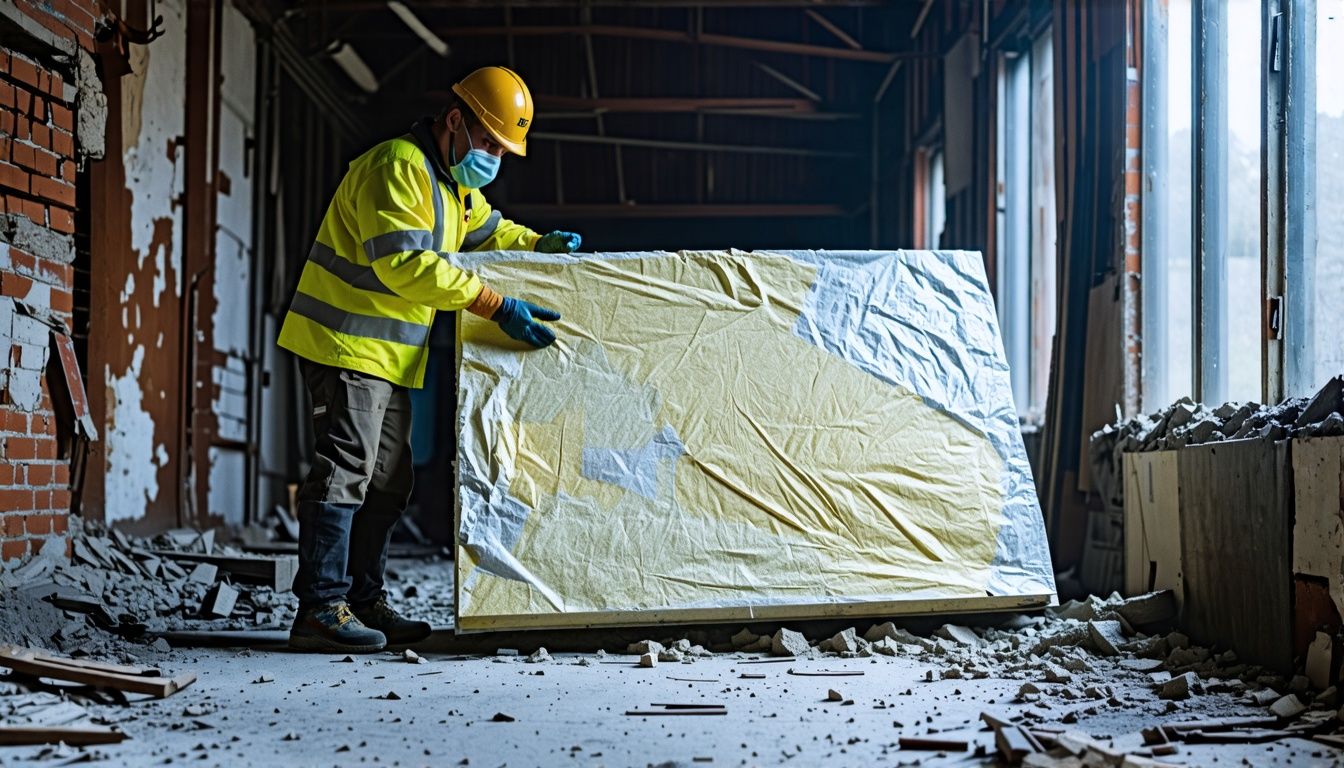
- Larger items such as asbestos cement sheets must be wrapped in heavy-duty polythene sheeting and sealed securely
- Waste must be transported in a sealed, clearly labelled vehicle by a carrier registered to handle hazardous waste
- Asbestos waste can only be deposited at a licensed hazardous waste disposal site — not a standard skip, household recycling centre, or general landfill
- A consignment note must accompany every load and be retained by both parties
Never allow asbestos waste to be left on site, disposed of in a general skip, or taken to an unlicensed facility. If an investigation is ever carried out, the paper trail for waste disposal will be scrutinised closely.
Enforcement: Who Oversees Compliance?
Responsibility for enforcing the Control of Asbestos Regulations 2012 is split between the HSE and local authority environmental health teams, depending on the type of premises. The Environment Agency — and its devolved equivalents, SEPA in Scotland and Natural Resources Wales — oversees compliance with hazardous waste regulations.
The HSE has wide-ranging enforcement powers. Inspectors can enter premises unannounced, issue improvement notices, issue prohibition notices that stop work immediately, and initiate criminal prosecutions. Courts can impose unlimited fines and custodial sentences for serious breaches.
Beyond regulatory consequences, dutyholders can also face civil claims from workers or occupants who develop asbestos-related illness. These diseases typically take 20 to 50 years to manifest — but that doesn’t limit liability. The legal exposure can follow a dutyholder for decades.
Where the Regulations Apply Across the UK
The Control of Asbestos Regulations 2012 apply uniformly across Great Britain. Whether you’re managing a commercial property in the capital, the North West, or the West Midlands, the same legal obligations apply.
Supernova Asbestos Surveys operates nationwide. If you need an asbestos survey in London, an asbestos survey in Manchester, or an asbestos survey in Birmingham, our UKAS-accredited surveyors can mobilise quickly and deliver reports that meet every requirement of the regulations.
Asbestos Awareness Training: A Requirement, Not an Option
One aspect of the Control of Asbestos Regulations 2012 that is sometimes overlooked is the training obligation. Anyone whose work could reasonably bring them into contact with asbestos — or who supervises such work — must receive appropriate asbestos awareness training.
This applies to a wide range of trades: electricians, plumbers, joiners, plasterers, painters, and general maintenance operatives. It also applies to their supervisors and managers. Training must be relevant to the type of work being carried out and must be refreshed regularly.
Providing adequate training is a legal requirement under the regulations — not a discretionary measure. Failure to train workers who are then exposed to asbestos is a serious breach that enforcement authorities treat accordingly.
Sampling and Laboratory Analysis: Confirming What You’re Dealing With
Visual identification of asbestos is not reliable. Many ACMs look identical to non-asbestos materials, and incorrect assumptions have led to serious exposure incidents. Where there is any doubt about whether a material contains asbestos, asbestos testing through bulk sample analysis is the only way to confirm its composition.
Samples must be taken by a competent person and analysed by a UKAS-accredited laboratory. The results will determine whether the material must be managed as an ACM and what category of work applies if it needs to be disturbed or removed.
Never assume a material is asbestos-free based on appearance alone. The cost of a laboratory analysis is negligible compared to the consequences of getting it wrong.
Common Compliance Failures — and How to Avoid Them
Despite the clarity of the Control of Asbestos Regulations 2012, certain compliance failures appear repeatedly in HSE enforcement actions. Being aware of them is the first step to avoiding them.
- No asbestos survey before refurbishment: Starting building work without a refurbishment or demolition survey is one of the most frequent and serious breaches. It puts workers at immediate risk and exposes the dutyholder to prosecution.
- Out-of-date asbestos registers: An asbestos register that hasn’t been reviewed or updated after building works or re-inspections is a compliance failure, even if the original survey was carried out correctly.
- Failing to share information with contractors: Dutyholders must actively provide contractors with information about known ACMs before any work begins. Relying on contractors to ask is not sufficient.
- Using unlicensed contractors for licensed work: This is a criminal offence. The dutyholder who commissioned the work bears responsibility alongside the contractor.
- Inadequate waste disposal: Disposing of asbestos waste in a general skip or through an unregistered carrier is a criminal offence under hazardous waste legislation.
- No training records: Employers must be able to demonstrate that workers have received appropriate training. Verbal assurances are not sufficient — records must be maintained.
How Supernova Asbestos Surveys Can Help
Supernova Asbestos Surveys has completed over 50,000 surveys across the UK. Our UKAS-accredited team provides the full range of services required to meet your obligations under the Control of Asbestos Regulations 2012 — from initial surveys and sampling through to re-inspections, clearance testing, and support with management plan documentation.
We work with property managers, facilities teams, local authorities, housing associations, schools, and commercial landlords. Our reports are clear, actionable, and produced to the standards required by HSG264.
Whether you need a first-time management survey for a building you’ve just taken on, a refurbishment survey before a fit-out project, or independent clearance testing after removal works, we’re ready to help.
Call us on 020 4586 0680 or visit asbestos-surveys.org.uk to get a quote or discuss your requirements.
Frequently Asked Questions
Who does the Control of Asbestos Regulations 2012 apply to?
The regulations apply to anyone who owns, occupies, or has control over non-domestic premises — including offices, schools, hospitals, warehouses, and rented commercial buildings. They also apply to employers and self-employed people whose work could disturb asbestos-containing materials. Domestic properties are largely outside the scope of the duty to manage, though other provisions still apply if asbestos work is carried out in a domestic setting.
Do the regulations require asbestos to be removed?
No. The Control of Asbestos Regulations 2012 do not require asbestos to be removed simply because it is present. In many cases, managing asbestos safely in place is the legally appropriate approach, provided it is in good condition and unlikely to be disturbed. Removal is required when the material is in poor condition, poses an unacceptable risk, or when refurbishment or demolition work makes managing it in place impractical.
What is the difference between licensed and non-licensed asbestos work?
Licensed work involves high-risk materials — such as sprayed coatings, pipe lagging, and asbestos insulating board — where fibre release is likely to be significant. This work can only be carried out by contractors holding a current HSE licence. Non-licensed work covers lower-risk tasks involving materials like intact asbestos cement or textured coatings. Notifiable Non-Licensed Work (NNLW) sits between the two categories — no licence is required, but the work must be notified to the HSE and health records must be maintained.
How often does an asbestos register need to be updated?
There is no fixed statutory interval for updating an asbestos register, but the Control of Asbestos Regulations 2012 require it to be kept current. In practice, this means reviewing and updating the register after any building works, after each re-inspection survey, and whenever the condition of a known ACM changes. Annual re-inspections are standard for most managed asbestos, and the register should be updated following each one.
What happens if asbestos regulations are breached?
The HSE has broad enforcement powers under the Control of Asbestos Regulations 2012. Inspectors can issue improvement notices, issue prohibition notices that halt work immediately, and bring criminal prosecutions. Courts can impose unlimited fines and custodial sentences for serious or repeated breaches. Dutyholders can also face civil liability claims from workers or building occupants who develop asbestos-related disease, sometimes decades after the original exposure.