
You cannot search a single national asbestos register for every building in the UK. That catches out plenty of property managers, landlords and facilities teams, especially when a contractor is due on site, a lease is being signed, or refurbishment is about to start. In practice, asbestos information is held building by building, and the duty to keep an asbestos register accurate and usable sits with the people responsible for the premises.
That matters more than many organisations realise. If your asbestos register is missing, buried in an old handover file, or based on a survey that no longer reflects the building, routine jobs can become risky very quickly. Contractors may disturb hidden materials, projects can stall, and your organisation may fall short of its duties under the Control of Asbestos Regulations.
For non-domestic premises and the common parts of some residential buildings, an asbestos register is not admin for admin’s sake. It is a live safety record that supports day-to-day management, helps protect anyone who may disturb the fabric of the building, and gives you a practical basis for decision-making.
Is there a national asbestos register in the UK?
No. There is no publicly searchable national asbestos register covering all UK buildings.
Instead, asbestos records are maintained locally by duty holders, owners, landlords, managing agents, employers and others with responsibility for maintenance and repair. Some large organisations keep estate-wide systems for their own properties, but there is no central platform where you can enter an address and instantly see whether asbestos is present.
The Health and Safety Executive provides guidance and enforcement, and certain asbestos work is notified through separate regulatory processes. That is not the same as a universal building database. If you manage a property, the safest assumption is that nobody else is maintaining your asbestos register for you.
What an asbestos register actually is
An asbestos register is a live record of known or presumed asbestos-containing materials in a building. It is usually created from the findings of an asbestos survey and then updated as materials are removed, repaired, encapsulated, damaged or re-assessed.
A good asbestos register does more than list materials. It tells the people using the building what is there, where it is, what condition it is in, and what needs to happen next to prevent accidental disturbance.
What should be included in an asbestos register?
A practical asbestos register will normally include:
- the location of each known or presumed asbestos-containing material
- the product type, such as asbestos insulating board, cement sheet, floor tile, textured coating or insulation
- the extent or amount of the material
- the condition of the material at the time of inspection
- material and priority risk assessments where applicable
- recommended actions, such as manage in situ, encapsulate, repair or remove
- inspection and re-inspection dates
- details of any areas that were not accessed during survey work
- references to supporting survey reports, plans, photographs and sample results
If your asbestos register cannot be understood by a contractor on site, it is not doing its job. The information has to be clear enough to support real decisions, not just detailed enough to sit in a compliance folder.
What an asbestos register is not
An asbestos register is not the same as the survey report, even though the two are closely linked. The survey provides the evidence and findings. The asbestos register is the working record used to manage risk over time.
It is also not a one-off document. Once asbestos has been identified, the asbestos register must be reviewed and updated whenever conditions change.
Who needs an asbestos register?
Under the Control of Asbestos Regulations, the duty to manage asbestos applies to non-domestic premises and the common parts of some domestic buildings. If you are the duty holder, you are likely to need an asbestos register.
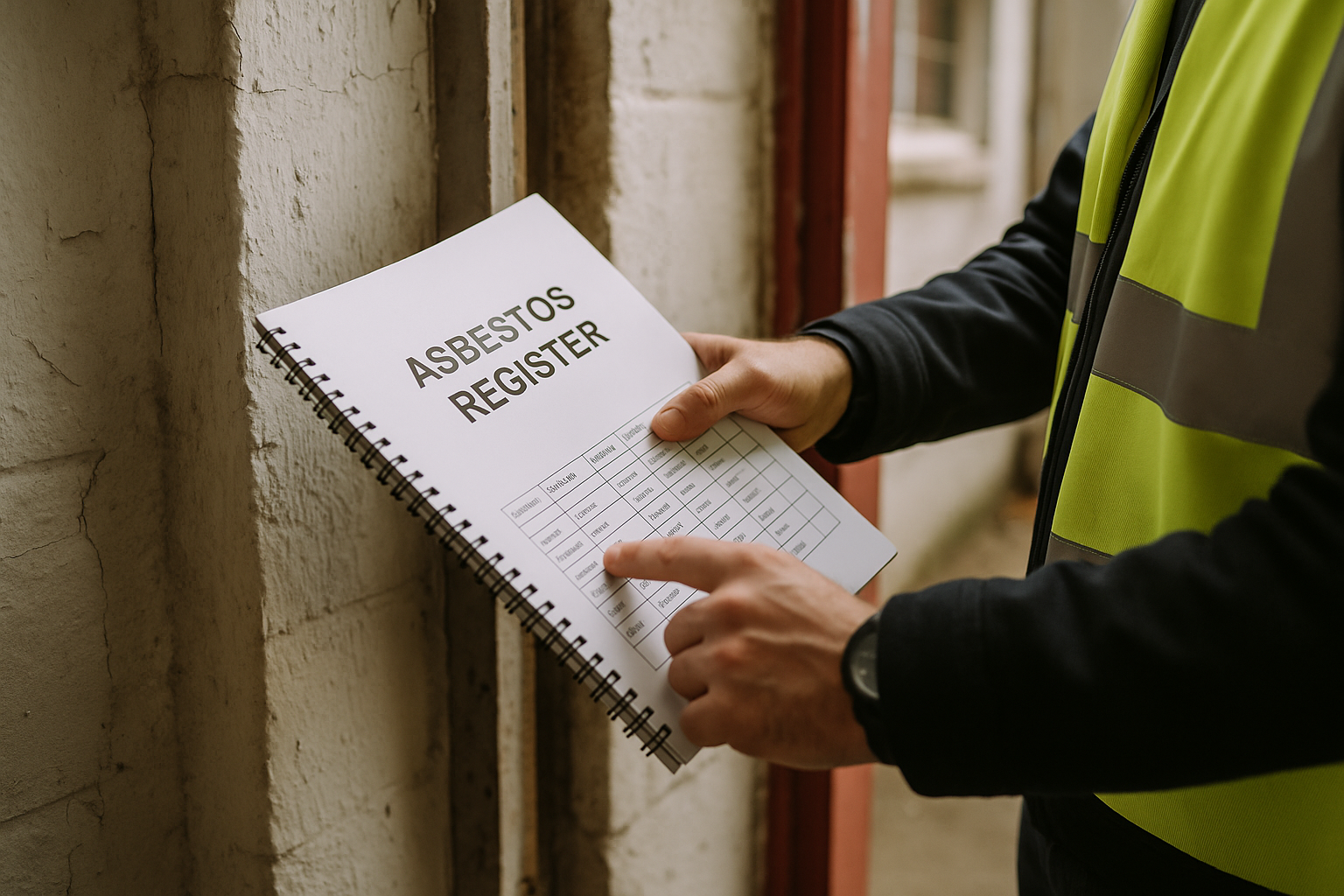
Duty holders commonly include:
- commercial landlords
- managing agents
- facilities managers
- employers occupying business premises
- local authorities
- NHS estate teams
- schools, colleges and universities
- housing providers responsible for communal areas
- retail, industrial and warehouse operators
Responsibility is based on control of maintenance and repair, not simply ownership. In leased premises, landlord and tenant duties can overlap, so the lease should be checked carefully and the practical arrangements agreed clearly.
If you manage a building constructed before the asbestos ban and there is no asbestos register in place, treat that as a compliance gap. Restrict intrusive work until you have reliable information.
How the asbestos register fits with UK regulations and guidance
The legal framework is clear. The Control of Asbestos Regulations require duty holders to determine whether asbestos is present, presume it is present where there is uncertainty, assess the risk, and manage that risk.
In practical terms, that means you need to:
- identify asbestos-containing materials, or presume their presence where necessary
- record their location and condition in an asbestos register
- assess the likelihood of disturbance
- prepare and implement an asbestos management plan
- keep the asbestos register and plan up to date
- provide information to anyone liable to disturb asbestos
Survey work should align with HSG264, which sets out how asbestos surveys should be planned, undertaken and reported. HSE guidance also makes it clear that asbestos information must be accessible to those who need it, particularly maintenance staff, contractors and anyone planning works.
This is where many organisations slip. They may have a survey report on file, but the asbestos register has not been updated, shared with contractors, or linked to permit-to-work procedures and maintenance controls.
Why there is no central asbestos register for UK buildings
The idea of one national database sounds sensible at first glance. In reality, the picture is more complicated because asbestos records are fragmented, building histories vary, and the quality of information is not always consistent.
Records are held in different places
Asbestos information has historically been kept by individual owners, landlords, public bodies and managing agents. Some records are digital, some are paper based, and some disappear during sales, lease changes or contractor handovers.
Data quality is uneven
Not every historic survey meets current expectations. Older reports may be limited in scope, unclear on exact locations, or missing supporting plans and photos. A national asbestos register would only be as reliable as the information uploaded to it.
Buildings do not stand still
Materials are removed, encapsulated, damaged, covered over or exposed during later works. An asbestos register has to be a live document. Any central system would need constant updating to remain useful.
Domestic properties add complexity
The duty to manage focuses mainly on non-domestic premises and common parts. Private homes can still contain asbestos, but they are not managed under the same framework, which makes a universal model harder to apply.
Access and security are practical issues
A searchable building-by-building database raises questions about confidentiality, data ownership and who should be able to view sensitive building information. None of that removes your duty to maintain your own asbestos register properly.
Why an accurate asbestos register matters in day-to-day property management
The lack of a national database is one thing. The bigger issue for most organisations is whether their own asbestos register is current, clear and actually used.
Routine maintenance becomes safer
Electricians, plumbers, cabling installers, decorators and general maintenance teams regularly disturb building fabric. Without an accurate asbestos register, they may drill, cut or remove materials blindly.
That is how accidental exposure happens in older premises. Contractors should be checking asbestos information before the job starts, not after dust has already been created.
Projects avoid last-minute delays
An asbestos register based on a standard management survey is not enough for intrusive works. If refurbishment is planned, you will usually need a targeted survey before work begins.
For occupied buildings, the starting point is often a management survey. If demolition is intended, the correct step is a demolition survey so hidden asbestos can be identified before the structure is disturbed.
Property transactions run more smoothly
During acquisitions, sales and leases, asbestos records are often incomplete or inconsistent. A current asbestos register reduces uncertainty and helps due diligence move faster.
If you are taking on a building, ask for:
- the latest survey report
- the current asbestos register
- the asbestos management plan
- records of re-inspections
- details of any removals, repairs or encapsulation works
If any of those are missing, budget for immediate action rather than assuming the building is clear.
Emergency response is more effective
After fire, flood, impact damage or structural failure, responders need to know whether asbestos may have been disturbed. A usable asbestos register helps teams make safer decisions during isolation, clean-up and remediation.
Many duty holders also coordinate asbestos controls with a suitable fire risk assessment so wider building safety information is managed in a joined-up way.
How an asbestos register is created
An asbestos register usually starts with the right survey. The survey type depends on what is happening in the building and how intrusive the planned work will be.
Management survey
For occupied non-domestic premises, a management survey is normally the baseline. It identifies asbestos-containing materials that could be disturbed during normal occupation, routine maintenance or foreseeable installation work.
The findings are then used to create or update the asbestos register and management plan. If you do not have a reliable baseline for an older building, this is usually the first step.
Refurbishment or demolition survey
If you are upgrading, stripping out or demolishing part or all of a building, you need a more intrusive survey in the affected areas before work starts. A standard asbestos register should never be relied on as the only source of information for this kind of work.
Refurbishment and demolition surveys are designed to locate asbestos hidden within the building fabric, including behind walls, above ceilings and inside service voids.
Re-inspection survey
Once asbestos-containing materials have been identified and left in place, they need regular review. A re-inspection survey checks whether known materials have deteriorated, been damaged or become more accessible.
This is one of the main ways an asbestos register is kept current. Many premises arrange re-inspection at regular intervals, often annually, but the timing should reflect the material, its condition and the likelihood of disturbance.
Testing and sample analysis
Sometimes the issue is more specific. You may have found a suspect board, tile, coating or insulation product and need confirmation before making decisions.
In that case, professional asbestos testing can confirm whether asbestos is present. Where a single suspect material needs laboratory confirmation, sample analysis provides the identification needed to support the asbestos register and management plan.
For clients looking for local testing support, Supernova also provides asbestos testing services for a wide range of property types. Sampling should always be carried out safely by competent people to avoid unnecessary fibre release.
What to do if your asbestos register is missing or out of date
This is common after lease changes, acquisitions, office moves or contractor turnover. The key is to act before work continues.
- Assume asbestos may be present. If the building predates the asbestos ban and records are missing, do not assume it is asbestos free.
- Pause intrusive work. Stop drilling, cutting, strip-out or demolition in affected areas until the risk is understood.
- Locate any existing records. Check handover packs, O&M files, estates systems, maintenance folders and previous survey reports.
- Review whether the information is still reliable. A survey from years ago may not reflect the current layout, access points or condition of materials.
- Arrange the right survey. For general occupation and maintenance, start with a survey suitable for management purposes. For intrusive works, arrange the correct pre-work survey.
- Create or rebuild the asbestos register. Make sure it is clear, accessible and linked to your management plan.
- Brief contractors and staff. Information only helps if the people doing the work actually receive it.
If there are gaps in access, damaged materials, or uncertainty about suspect products, deal with those issues before anyone starts work. A weak asbestos register is not better than none if it creates false confidence.
How to keep an asbestos register up to date
An asbestos register should be treated as a live operational document. It needs regular review and should change when the building changes.
Update the asbestos register when:
- asbestos-containing materials are removed
- materials are repaired or encapsulated
- damage is reported
- new areas are accessed for the first time
- further samples are taken
- layouts are altered during refurbishment
- re-inspection findings change the condition assessment
It also helps to build the asbestos register into your wider site controls. Practical steps include:
- linking it to permit-to-work systems
- making it part of contractor induction
- checking it before maintenance orders are issued
- storing it where site teams can access the latest version
- keeping old versions archived so changes can be tracked
If the register is held centrally but nobody on site can access it quickly, that is a problem. The right information needs to be available at the point of decision.
Common mistakes that make an asbestos register less useful
Most asbestos register problems come down to poor maintenance, unclear ownership or weak communication. The document exists, but it is not usable.
Common issues include:
- relying on an old survey after refurbishment or layout changes
- failing to record areas that were not accessed
- not updating the register after removal works
- keeping the register in a file that contractors never see
- confusing the survey report with the live asbestos register
- assuming a management survey is enough for intrusive works
- not arranging periodic re-inspection of known materials
If any of those sound familiar, your asbestos register probably needs review.
Can you check asbestos information when buying or managing property?
Yes, but you usually need to obtain it from the seller, landlord, managing agent or duty holder rather than a central database. During due diligence, ask direct questions and request evidence.
For buyers, tenants and portfolio managers, sensible checks include:
- asking for the current asbestos register and survey report
- checking whether a management plan exists
- reviewing re-inspection history
- checking whether removals or encapsulation works have been recorded
- confirming whether any areas were excluded from survey access
- identifying whether planned works will require a more intrusive survey
If you are managing property in specific regions, local support can speed things up. Supernova provides services including asbestos survey London, asbestos survey Manchester and asbestos survey Birmingham.
Best practice for sharing an asbestos register with contractors
An asbestos register only works if the right people see it before they start work. Handing over a report after the contractor has arrived on site is too late.
Good practice includes:
- review the job scope before works are authorised
- check the asbestos register for the relevant area
- highlight any known or presumed asbestos-containing materials nearby
- confirm whether the planned work is intrusive
- provide the register and relevant survey information to the contractor in advance
- record that the information has been received and understood
- stop work and reassess if the scope changes or suspect materials are uncovered
This approach is especially important for short-duration maintenance jobs, because those are often the tasks where assumptions creep in.
When an asbestos register is not enough on its own
Even a well-maintained asbestos register has limits. It reflects what is known or presumed at the time of survey and review. It does not guarantee that every hidden material in a building has been found.
That is why planned intrusive works need the right pre-work survey, and why site teams should be briefed to stop if suspect materials are uncovered unexpectedly. The asbestos register is a key control, but it has to sit within a wider management system.
If you are unsure whether your existing information is enough, get it reviewed before works begin. That is usually far cheaper and far less disruptive than dealing with an unexpected asbestos issue once contractors are already on site.
Frequently Asked Questions
Is an asbestos register a legal requirement?
For many non-domestic premises and the common parts of some domestic buildings, duty holders must identify and manage asbestos under the Control of Asbestos Regulations. In practice, that means keeping a record of known or presumed asbestos-containing materials, which is what an asbestos register does.
How often should an asbestos register be updated?
It should be updated whenever there is a change, such as removal, damage, encapsulation, new sampling or altered access. Known asbestos-containing materials should also be reviewed periodically through re-inspection, with the timing based on risk and condition.
Can a management survey be used for refurbishment works?
Not usually. A management survey supports normal occupation and routine maintenance. If refurbishment or demolition is planned, a more intrusive survey is normally required in the affected areas before work starts.
What if parts of the building were not accessed during the survey?
Those exclusions should be recorded clearly in the asbestos register and survey report. If work is later planned in those areas, further inspection or a targeted survey may be needed before anyone disturbs the fabric.
Who should have access to the asbestos register?
Anyone liable to disturb asbestos should have access to the relevant information. That usually includes facilities teams, maintenance staff, contractors, project managers and others planning or authorising works.
If your asbestos register is missing, outdated or difficult to use, Supernova Asbestos Surveys can help you put it right. We carry out surveys, re-inspections, testing and practical asbestos support for duty holders across the UK. Call 020 4586 0680 or visit asbestos-surveys.org.uk to arrange expert advice and fast nationwide service.