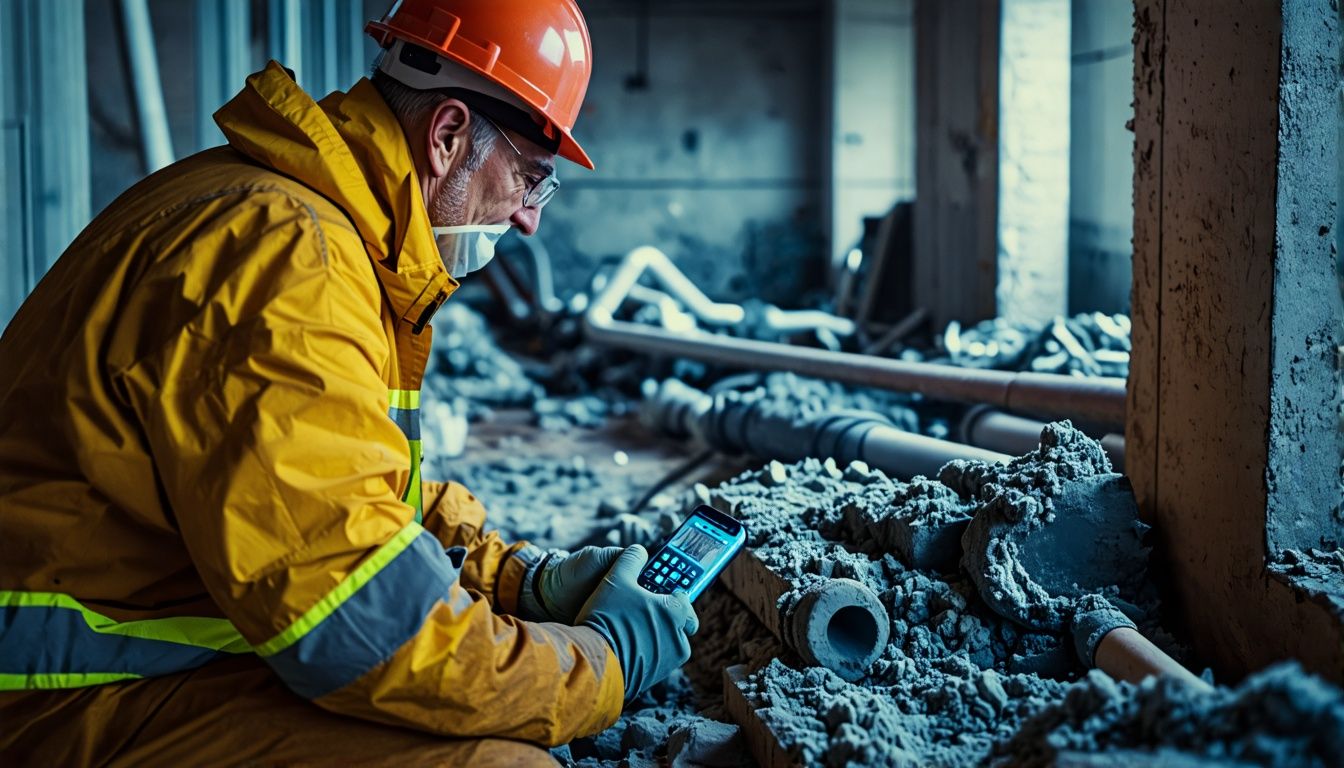
Asbestos Monitoring in the Workplace: What Every Duty Holder Must Know
Asbestos remains one of the most serious occupational health hazards in the UK. Despite a complete ban on its use and importation, asbestos-containing materials (ACMs) are still present in vast quantities across buildings constructed or refurbished before 2000 — and that makes asbestos monitoring far more than a best-practice recommendation.
It is a legal obligation that falls squarely on anyone responsible for a non-domestic premises. If you own, manage, or occupy a commercial building, understanding how asbestos is monitored and regulated could protect your workforce, your tenants, and yourself from serious consequences.
Here is what effective workplace asbestos management actually looks like in practice.
The Legal Framework Underpinning Asbestos Monitoring
The Control of Asbestos Regulations
The Control of Asbestos Regulations form the backbone of asbestos law in the UK. They apply to all non-domestic premises and place clear duties on employers, building owners, landlords, facilities managers, and anyone else responsible for maintaining or repairing a building.
Enforcement sits with the Health and Safety Executive (HSE) and, in certain workplaces, with local authorities. Non-compliance can result in improvement notices, prohibition notices, prosecution, and unlimited fines — and in the most serious cases, custodial sentences for individuals.
Who Counts as a Duty Holder?
A duty holder is anyone with responsibility for the maintenance or repair of non-domestic premises. In practice, that could be:
- A building owner
- An employer operating from the premises
- A facilities manager or managing agent
- A leaseholder, depending on the terms of the lease
Where responsibility is shared between multiple parties, duty holders must cooperate to ensure asbestos is properly managed. Gaps in responsibility are not a legal defence.
The Duty to Manage
At the heart of the regulations is the “duty to manage” asbestos. This requires duty holders to:
- Identify whether ACMs are present in their premises
- Assess the condition and risk of those materials
- Produce and maintain an asbestos management plan
- Keep an asbestos register — a written record of all ACMs identified
- Share information about ACMs with anyone who might disturb them
- Review and update all records regularly
Asbestos monitoring is an ongoing responsibility. It must be revisited whenever building work is planned, occupancy changes, or materials deteriorate — not just ticked off once and forgotten.
Why Visual Inspection Alone Is Never Enough
Asbestos fibres are microscopic. ACMs frequently look identical to non-asbestos alternatives, and there is no visual test that can confirm or rule out their presence. Textured coatings, floor tiles, ceiling tiles, pipe lagging, and insulation boards can all contain asbestos — and none of them are labelled.
The HSE’s position, set out in HSG264, is unambiguous: any material suspected of containing asbestos should be treated as though it does, until laboratory analysis proves otherwise. Assumption is not a management strategy.
Where ACMs Are Commonly Found
In buildings constructed or refurbished before 2000, ACMs can appear almost anywhere. The most common locations include:
- Sprayed coatings on ceilings, beams, and structural steelwork
- Pipe and boiler lagging
- Insulating boards used in partitions, ceiling tiles, and fire doors
- Textured decorative coatings such as Artex
- Vinyl and thermoplastic floor tiles
- Roofing felt and cement roof sheets
- Electrical switchgear and distribution boards
- Toilet cisterns and water storage tanks
- Gaskets and rope seals in boiler rooms
All three main types of asbestos — white (chrysotile), brown (amosite), and blue (crocidolite) — present health risks. Blue and brown asbestos are considered particularly hazardous and were among the earliest types to be banned in the UK.
Asbestos Surveys: The Foundation of Effective Asbestos Monitoring
Commissioning the right type of survey is essential. Using the wrong survey type — or skipping one entirely — can put workers at serious risk and leave you legally exposed. There are three main survey types, each serving a distinct purpose.
Management Survey
A management survey is the standard survey for occupied buildings. Its purpose is to locate ACMs that could be disturbed during normal occupation and routine maintenance activities.
A qualified surveyor will inspect all accessible areas, take samples from suspected materials, and produce a detailed report including an asbestos register and risk assessment. This is the survey that fulfils your duty to manage under the regulations — if you haven’t had one carried out, you are not compliant.
Refurbishment and Demolition Survey
Before any refurbishment, renovation, or demolition work begins, a demolition survey is required. This is a far more intrusive process, involving access to areas that would normally be sealed — voids, ceiling cavities, wall interiors — to identify all ACMs that could be disturbed during the planned works.
This survey must be completed before work starts, not during it. Discovering asbestos once contractors are already on site creates significant risk and can be extremely costly to manage retrospectively.
Re-Inspection Survey
If you already have an asbestos register, your duty doesn’t end there. ACMs left in situ must be periodically re-inspected to confirm their condition hasn’t deteriorated. A re-inspection survey assesses whether previously identified materials remain stable and updates your register accordingly.
The frequency of re-inspections depends on the risk rating of the materials involved. Higher-risk ACMs in poor condition may require more frequent checks — typically every six to twelve months.
Risk Assessment and the Asbestos Register
Carrying Out a Proper Risk Assessment
Once ACMs have been identified, each one must be assessed for risk. The key factors that determine risk include:
- Condition: Is the material intact, damaged, or actively deteriorating?
- Type of asbestos: Different fibre types carry different risk profiles
- Location: Is it in a high-traffic area where disturbance is likely?
- Accessibility: Could it be accidentally disturbed by maintenance workers or occupants?
- Friability: How easily could it release fibres if disturbed?
This assessment determines what action to take — whether to leave the material in place and monitor it, encapsulate it, or arrange for removal. Each decision must be documented and justified.
Maintaining the Asbestos Register
The asbestos register is the central document in your asbestos management system. It must record:
- The precise location of every ACM, by building, floor, room, and position
- The type, condition, and estimated quantity of each material
- The risk rating assigned to each ACM
- Control measures currently in place
- Dates of surveys, re-inspections, and any remedial work
- Photographic records where possible
This register must be kept up to date and made available to anyone who could disturb the materials — including contractors, maintenance staff, and emergency services. Keeping it locked in a filing cabinet that nobody knows about defeats the purpose entirely.
The Asbestos Management Plan
Alongside the register, you must have a written asbestos management plan. This sets out how ACMs in your building will be managed, who is responsible, how information will be shared with workers and contractors, and what will trigger a review.
The plan should be a living document — reviewed regularly and updated whenever there are significant changes to the building, its use, or the condition of identified materials.
Air Monitoring: Measuring Fibre Concentrations
Asbestos monitoring in the most literal sense — measuring airborne fibre concentrations — is a critical safety control during high-risk activities. During asbestos removal and certain other intrusive works, air monitoring is used to verify that fibre levels remain within safe limits.
Air samples are taken at the work area and analysed by an accredited laboratory. The results determine whether work can safely continue or whether additional controls are needed.
The Four-Stage Clearance Process
At the end of licensed asbestos removal work, a four-stage clearance procedure must be completed before an area can be reoccupied. This involves:
- A thorough visual inspection of the work area
- A thorough clean of all surfaces
- A background air test to establish baseline fibre levels
- A final air clearance test carried out by an independent analyst
Only once all four stages have been satisfactorily completed can the area be declared safe for reoccupancy. This process must be carried out by a body accredited to UKAS for asbestos air testing — it cannot be signed off by the removal contractor themselves.
Asbestos Removal: When It’s Necessary and Who Can Do It
A common misconception is that all asbestos must be removed immediately. That’s not the case. ACMs in good condition that are unlikely to be disturbed can often be safely left in place and managed through ongoing asbestos monitoring. Unnecessary removal can actually create more risk by releasing fibres that would otherwise remain stable.
Removal becomes necessary when materials are in poor condition, when they’re in a location where disturbance is unavoidable, or when refurbishment or demolition is planned. When removal is required, asbestos removal must be carried out by appropriately licensed and qualified contractors.
Licensed, Notifiable Non-Licensed, and Non-Licensed Work
The regulations distinguish between three categories of asbestos work:
- Licensed work: High-risk activities such as removing sprayed asbestos coatings, asbestos lagging, or asbestos insulating board (AIB). This must only be carried out by contractors holding an HSE licence, and the work must be notified to the HSE before it begins.
- Notifiable non-licensed work (NNLW): Lower-risk work with ACMs, such as minor maintenance on asbestos insulating board or removing small amounts of textured coating. No licence is required, but the work must be notified to the relevant enforcing authority at least 14 days in advance. Workers must be subject to health surveillance, and exposure records must be kept for at least 40 years.
- Non-licensed work: Short-duration, low-risk tasks involving materials such as asbestos cement or floor tiles in good condition. Notification is not required, but safe working practices must still be followed.
If you’re unsure which category applies to your situation, don’t guess. Seek professional guidance before any work begins.
Worker Protection During Asbestos Work
Respiratory Protective Equipment
For workers who may be exposed to asbestos fibres, appropriate personal protective equipment is essential. Respiratory protective equipment (RPE) is the most critical element — at a minimum, FFP3 disposable masks are required for most asbestos work. Powered air-purifying respirators or supplied-air systems may be required for licensed removal activities.
Disposable coveralls, gloves, and overshoes must also be worn to prevent fibres being carried out of the work area on clothing. PPE must be the correct type for the task, properly fitted, and used consistently throughout.
Face-Fit Testing
Any worker required to wear tight-fitting RPE must undergo face-fit testing. This verifies that the specific mask forms an adequate seal against that individual’s face — facial structure, facial hair, and the mask model all affect fit, and a mask that works for one person may be entirely unsuitable for another.
Face-fit testing must be carried out by a competent person using an approved method. It should be repeated if the worker’s face shape changes significantly or if a different mask model is introduced.
Decontamination and Waste Disposal
Asbestos waste is classified as hazardous waste and must be handled accordingly. All waste materials — including used PPE, sheeting, and debris — must be double-bagged in clearly labelled, UN-approved asbestos waste sacks before being removed from site.
Asbestos waste can only be disposed of at a licensed hazardous waste facility. It cannot be mixed with general construction waste or placed in standard skips. Failure to comply with hazardous waste regulations carries its own serious legal consequences, entirely separate from asbestos legislation.
Workers must also decontaminate themselves before leaving the work area — using a decontamination unit on larger projects, or at minimum removing and bagging disposable coveralls and washing hands and face thoroughly.
Asbestos Monitoring Across the UK
The duty to manage asbestos applies equally whether your premises are in a city centre or a rural location. The regulations make no geographical distinction, and the HSE enforces them nationwide.
If you are based in the capital and need an asbestos survey London professionals can rely on, Supernova operates across all London boroughs. For businesses in the North West, our asbestos survey Manchester service covers the full Greater Manchester area. And for property managers and duty holders in the Midlands, our asbestos survey Birmingham team is on hand to help you meet your obligations.
Wherever you are in the UK, the standards are the same — and so is our approach to delivering accurate, actionable survey results.
Common Mistakes That Put Duty Holders at Risk
Even well-intentioned duty holders can fall into traps that leave them non-compliant. The most common errors include:
- Assuming a building is asbestos-free because it looks modern or has been recently decorated — cosmetic refurbishment does not remove ACMs buried within the structure
- Commissioning the wrong survey type — a management survey is not sufficient before demolition or major refurbishment
- Failing to share the asbestos register with contractors before they begin work on site
- Not updating the register after remedial work, re-inspections, or changes to the building
- Treating the asbestos management plan as a one-off document rather than a living record that requires regular review
- Allowing unlicensed contractors to carry out work that legally requires an HSE licence
Each of these mistakes can result in enforcement action, and more importantly, can put real people at risk of exposure to one of the most dangerous substances ever used in construction.
Frequently Asked Questions
What is asbestos monitoring and why is it required?
Asbestos monitoring refers to the ongoing process of identifying, assessing, and tracking asbestos-containing materials (ACMs) within a building, as well as measuring airborne fibre concentrations during high-risk work. It is required under the Control of Asbestos Regulations for all non-domestic premises. The duty to manage asbestos means that building owners and managers must not only identify ACMs but actively monitor their condition over time and take action when risks change.
How often does an asbestos re-inspection need to take place?
The frequency depends on the risk rating of the materials identified. ACMs in good condition in low-disturbance areas may only need checking annually, while materials in poor condition or in high-traffic areas may require inspection every six months or more frequently. Your asbestos management plan should specify the re-inspection schedule for each material, and this should be reviewed whenever the building’s use or condition changes.
Can asbestos be left in place rather than removed?
Yes — in many cases, leaving ACMs in place and managing them through ongoing asbestos monitoring is the safest approach. Removing asbestos unnecessarily can disturb stable materials and release fibres that would otherwise pose no immediate risk. Removal is required when materials are in poor condition, are likely to be disturbed, or when refurbishment or demolition is planned. The decision must be based on a proper risk assessment, not assumptions.
Who can carry out asbestos air monitoring?
Air monitoring during and after asbestos removal must be carried out by a body accredited to UKAS for asbestos air testing. Critically, the final air clearance test after licensed removal work must be conducted by an independent analyst — it cannot be carried out by the removal contractor themselves. This independence is a legal requirement, not a recommendation, and is designed to ensure that clearance results are objective and reliable.
What happens if I don’t comply with asbestos monitoring regulations?
The consequences of non-compliance can be severe. The HSE has powers to issue improvement notices, prohibition notices, and to prosecute duty holders. Fines are unlimited, and in the most serious cases — particularly where non-compliance leads to exposure — individuals can face custodial sentences. Beyond the legal penalties, the health consequences for workers exposed to asbestos fibres can be fatal, with diseases such as mesothelioma typically not appearing until decades after exposure.
Get Your Asbestos Monitoring in Order with Supernova
Supernova Asbestos Surveys has completed over 50,000 surveys across the UK, helping duty holders in every sector meet their legal obligations with confidence. Whether you need a first-time management survey, a pre-demolition inspection, or a periodic re-inspection of existing ACMs, our UKAS-accredited surveyors deliver accurate, detailed reports that stand up to scrutiny.
Don’t wait until a contractor uncovers something on site or an HSE inspector comes knocking. Get your asbestos monitoring programme in place now.
Call us on 020 4586 0680 or visit asbestos-surveys.org.uk to book a survey or speak to one of our team.