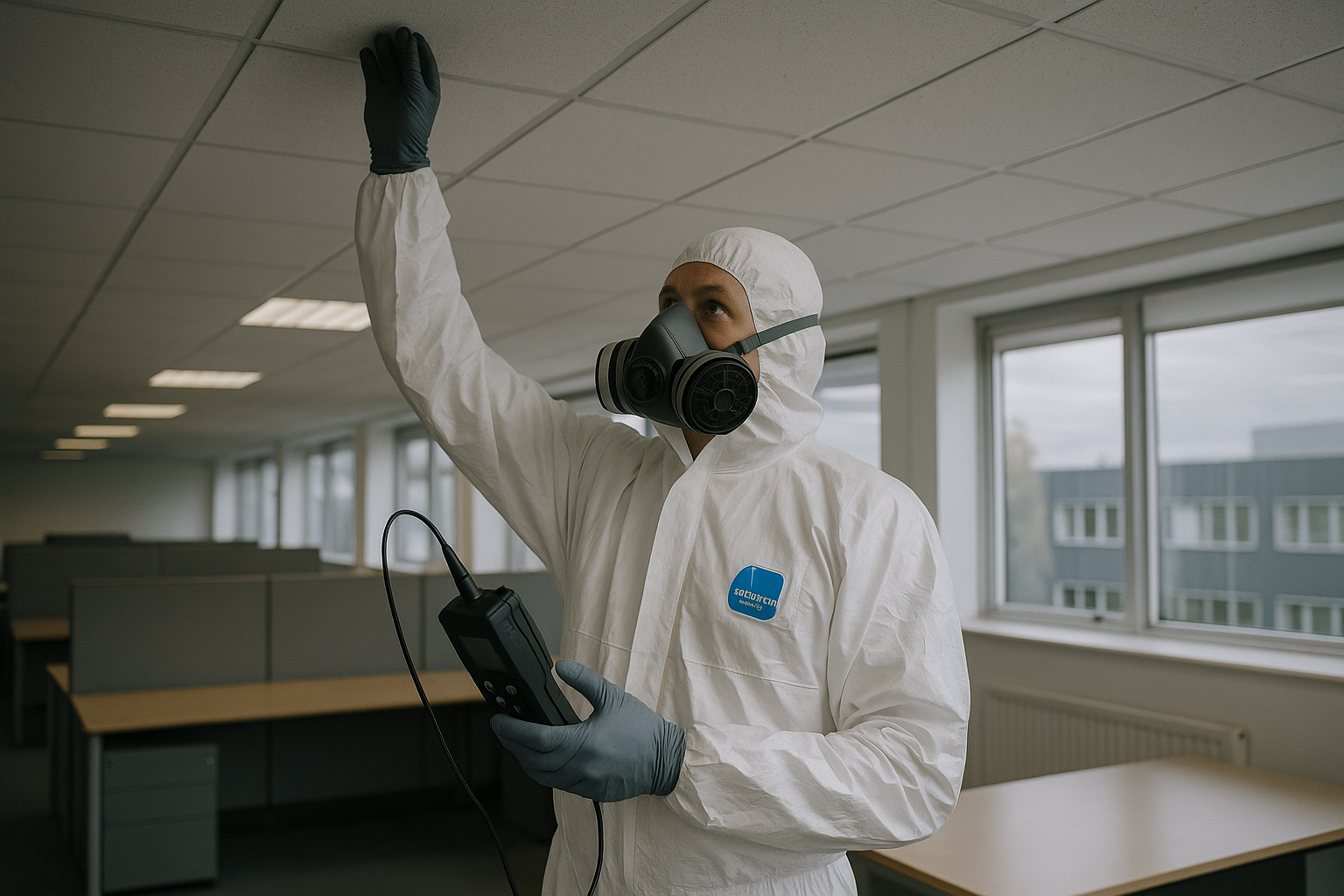
Warning Signs of Asbestos in a Building — And What to Do Next
Asbestos does not announce itself. It sits quietly inside partitions, ceiling tiles, pipe lagging and floor coverings — often indistinguishable from any other building material — until something disturbs it. The moment fibres become airborne is the moment a manageable situation becomes a serious health risk and a compliance emergency.
For property managers, landlords and dutyholders, the critical distinction is this: suspected asbestos does not automatically mean immediate removal, but it always means immediate control. Getting that right is what separates a well-managed property from a serious incident waiting to happen.
When Does Asbestos Require Urgent Action?
Under the Control of Asbestos Regulations, the legal duty is to identify asbestos-containing materials, assess the risk they present, and manage them appropriately. In many cases, asbestos in good condition can remain safely in place and be monitored over time.
Urgent action becomes necessary when asbestos is damaged, friable, exposed, or located somewhere that maintenance, refurbishment or everyday use could disturb it. That might mean restricting access immediately, arranging professional sampling, updating the asbestos register, and bringing in a competent surveyor or licensed contractor without delay.
Warning Signs That Should Trigger Immediate Attention
If you observe any of the following, stop work and prevent further disturbance before doing anything else:
- Visible damage — cracks, breaks, abrasion, delamination or crumbling edges on boards, tiles or insulation
- Dust or debris near insulation, lagging, ceiling void materials or service risers
- Water damage affecting asbestos insulating board, ceiling tiles or pipe insulation
- Recent building work where walls, ceilings, risers or service ducts were opened without prior asbestos checks
- Exposed insulation around pipes, boilers, ducts or plant equipment
- Deteriorating textured coatings or floor coverings in high-traffic areas
- Loose fragments in plant rooms, lofts, basements or service cupboards
- Unknown materials in a pre-2000 building that are about to be drilled, cut, sanded or removed
That first step — stopping work and preventing disturbance — matters more than anything else. Many avoidable asbestos exposures begin with someone attempting to tidy up broken material before proper advice is sought.
What Asbestos Looks Like in Real Buildings
One of the most persistent mistakes in asbestos management is assuming the material can be identified by appearance alone. Some products are more suspicious than others, but visual inspection only goes so far — laboratory analysis is required to confirm whether asbestos is actually present.
That said, there are common building products and locations where asbestos turns up repeatedly in UK properties built or refurbished before 2000.
Common Asbestos-Containing Materials
- Asbestos insulating board (AIB) — used in partitions, ceiling tiles, fire breaks, riser panels and soffits
- Pipe lagging — wrapped around heating systems and service runs throughout older buildings
- Sprayed coatings — applied to structural steel, ceilings and walls for insulation or fire protection
- Asbestos cement — found in garage roofs, wall panels, gutters, flues and downpipes
- Textured coatings — on ceilings and walls in residential and commercial premises alike
- Vinyl floor tiles and bitumen adhesive — common in older commercial and educational buildings
- Boiler and plant insulation — including rope seals, gaskets and lagged pipework
- Ceiling tiles and backing boards — frequently found in older offices, schools and retail units
Higher-risk materials are those that are more friable — meaning they release fibres more readily when disturbed. Pipe lagging, sprayed coatings and loose fill insulation sit at the top of that risk scale. Asbestos cement is generally lower risk when intact, but it still requires careful management and should never be drilled or broken without proper controls in place.
Which Buildings Are Most Likely to Contain Asbestos?
Any non-domestic building constructed before 2000 should be treated as potentially containing asbestos unless there is clear, documented evidence to the contrary. The same applies to many domestic communal areas and some residential properties, particularly where older materials remain undisturbed.
In practice, asbestos is regularly found in:
- Schools and colleges
- Hospitals and care settings
- Office buildings and business parks
- Factories and warehouses
- Retail units and shopping centres
- Churches and community buildings
- Blocks of flats, particularly in communal areas, plant rooms and roof voids
- Service risers, basements and maintenance areas
If you manage an older property portfolio, asbestos should feature in routine compliance planning — not surface as a last-minute concern when contractors arrive on site ready to start work. Supernova carries out surveys across the country, including asbestos survey London commissions, asbestos survey Manchester projects, and asbestos survey Birmingham instructions — so wherever your property is located, professional support is close at hand.
Should Asbestos Always Be Removed Immediately?
No — and this is where practical judgement is essential. The presence of asbestos does not automatically make removal the safest or legally correct response. Removing asbestos can generate more risk than leaving it in place if the material is in good condition and unlikely to be disturbed.
The correct question is not simply, “Is there asbestos?” It is: “What is the risk today, and what is likely to happen to this material in the near future?”
When Managing Asbestos in Place Is Appropriate
Leaving asbestos in place can be entirely acceptable where:
- The material is in good, undamaged condition
- It is sealed, enclosed or otherwise protected from accidental contact
- It is not likely to be disturbed during normal occupation or maintenance
- Its location is clearly recorded in the asbestos register
- It is inspected regularly as part of a live asbestos management plan
This is why many dutyholders arrange an asbestos management survey to identify materials that could be disturbed during normal occupancy, including foreseeable maintenance work. Having that information recorded properly is the foundation of compliant asbestos management.
When Removal Becomes the Better Option
Removal is often the more appropriate route where:
- The material is already damaged or visibly deteriorating
- It is in a vulnerable or frequently accessed location
- Refurbishment or demolition is being planned
- Accidental disturbance during routine use is a realistic risk
- Encapsulation would not provide reliable long-term control
Where refurbishment or demolition is planned, a management survey alone is not sufficient. A demolition survey is required before any intrusive work starts, because asbestos concealed within walls, ceilings, floors and voids can easily be missed otherwise.
Immediate Steps to Take If You Suspect Asbestos
If you encounter a suspicious material that may contain asbestos, the priority is to stop exposure, preserve the area and get competent advice. Speed matters, but so does staying calm and methodical.
- Stop work immediately. Do not drill, cut, scrape, sweep or attempt to remove anything.
- Keep people away. Restrict access to the room or affected area straight away.
- Do not clean up debris yourself. Sweeping or vacuuming can spread fibres unless specialist equipment and procedures are used.
- Check your asbestos register. If the building has one, confirm whether the material has already been identified and assessed.
- Arrange a survey or sampling. Use a competent asbestos surveyor to inspect and assess the material properly.
- Record the incident. Note the location, condition of the material, and any work that was underway at the time.
- Inform relevant contractors and staff. Anyone who may need to enter the area must understand the risk before they do so.
These steps are straightforward, but following them consistently prevents a significant number of avoidable exposures every year.
High-Risk Asbestos Materials That Demand Extra Caution
Not all asbestos-containing materials carry the same level of risk. Some are far more likely to release fibres than others, and these deserve particular attention — especially when damaged.
Pipe Lagging
Often found in older heating systems and plant rooms, pipe lagging can be highly friable. Even minor damage can release fibres into the surrounding air, and repair or removal typically requires licensed contractors working under strict controls.
Sprayed Coatings
Used for thermal insulation and fire protection on structural steel and ceilings, sprayed coatings are among the highest-risk asbestos materials in any building. If exposed or damaged, the affected area may need to be isolated immediately and specialist advice sought before anyone re-enters.
Asbestos Insulating Board
AIB was widely used in fire protection and partitioning throughout commercial and public buildings. It is less friable than lagging or sprayed coatings, but still significantly higher risk than asbestos cement. Broken edges, drilled panels and damaged access hatches are the most common problem areas.
Loose Fill Insulation
This is one of the most hazardous forms of asbestos because it can release fibres with minimal disturbance. If loose fill insulation is suspected — particularly in roof voids or cavity walls — do not enter or disturb the area further until specialist advice has been obtained.
Lower-Risk Materials Still Need Proper Management
Lower risk does not mean no risk. Asbestos cement sheets, roof panels, gutters, flues and some floor tiles are generally more tightly bound, but they still require proper management and careful handling. Problems commonly arise when people assume these materials are safe to handle casually.
Breaking cement sheets, power-washing asbestos roofs, lifting old floor tiles aggressively or sanding adhesive residues can all create unnecessary fibre release. Practical precautions include:
- Never using power tools on suspected asbestos materials without prior assessment
- Avoiding dry sweeping or brushing of any debris near suspect materials
- Labelling and recording the location of all known asbestos-containing materials clearly
- Checking the asbestos register before any maintenance work is carried out
- Using trained, competent contractors for any remedial or removal work
What to Do After Accidental Disturbance
Accidental disturbance happens more often than many property managers realise. A contractor drills into a riser panel. A ceiling tile breaks during electrical work. Old boxing is opened during plumbing repairs. The response in the first few minutes is critical.
- Stop the activity at once and evacuate or isolate the immediate area
- Prevent re-entry using signage or physical barriers
- Consider switching off ventilation if appropriate and safe — this can help limit fibre spread in some situations, though not all
- Call a competent asbestos professional for advice on sampling, air testing where appropriate, and safe clean-up
- Document who was present and keep a clear record of the event and any potential exposure
- Do not ask cleaners, caretakers or maintenance staff to clear up the area without specialist guidance
If workers may have been exposed, this should be reported and recorded. HSE guidance sets out the obligations around reporting and exposure records, and these should be followed carefully.
Why Surveys Matter Before Any Work Begins
Asbestos management starts with knowing what you have. Without a suitable survey, decisions are based on guesswork — and guesswork is where costly mistakes, contractor disputes and unsafe work practices take root.
For occupied buildings, a properly conducted asbestos management survey helps dutyholders locate, as far as is reasonably practicable, the presence and condition of asbestos-containing materials that could be disturbed during normal occupancy. The survey produces a written record — the asbestos register — which forms the basis of the asbestos management plan and informs anyone working on or in the building.
HSG264, the HSE’s guidance on asbestos surveys, sets out the standards surveyors must meet and the information a survey report should contain. A reputable surveyor will work to these standards and provide a report that is genuinely useful — not just a document produced to tick a box.
What a Survey Report Should Tell You
A well-produced asbestos survey report will identify:
- The location and extent of all suspected asbestos-containing materials
- The type of material and its likely asbestos content, confirmed by laboratory analysis where samples are taken
- The condition of each material and the risk it presents
- Recommendations for management, encapsulation or removal
- A clear asbestos register that can be shared with contractors and maintenance teams
Armed with this information, a dutyholder can make properly informed decisions — including whether any materials need urgent attention or whether a planned programme of management and monitoring is the right approach.
Your Legal Duties as a Dutyholder
The Control of Asbestos Regulations place clear duties on those responsible for non-domestic premises. The duty to manage asbestos applies to anyone who has responsibility for maintenance or repair of non-domestic premises — whether that is a building owner, a managing agent, a facilities manager or a tenant with repairing obligations.
The key obligations are:
- Take reasonable steps to find out whether asbestos is present and, if so, its location and condition
- Presume materials contain asbestos unless there is strong evidence they do not
- Make and keep up-to-date a written record of the location and condition of asbestos
- Assess the risk from the asbestos identified
- Prepare a written plan to manage that risk
- Put the plan into effect, monitor it and review it regularly
- Provide information on the location and condition of asbestos to anyone who may disturb it
Failure to meet these duties is not just a regulatory matter — it can result in enforcement action, improvement notices, prohibition notices and, in serious cases, prosecution. More importantly, it puts people at risk of a disease that has no cure.
Frequently Asked Questions
How do I know if a material in my building contains asbestos?
You cannot tell by looking. Visual inspection can help identify suspicious materials — particularly in buildings constructed or refurbished before 2000 — but the only way to confirm whether asbestos is present is through laboratory analysis of a sample taken by a competent surveyor. Do not attempt to take samples yourself, as disturbing the material without proper controls can create a risk where none previously existed.
Does all asbestos need to be removed straight away?
No. Under the Control of Asbestos Regulations, asbestos in good condition that is unlikely to be disturbed can remain in place and be managed through a written asbestos management plan. Removal is not always the safest option — disturbing intact asbestos to remove it can generate greater fibre release than leaving it undisturbed. The decision should be based on the material’s condition, location and the likelihood of future disturbance.
What is the difference between a management survey and a demolition survey?
A management survey is designed for occupied buildings undergoing normal use. It locates asbestos-containing materials that could be disturbed during everyday occupancy and maintenance. A demolition survey — also known as a refurbishment and demolition survey — is required before any intrusive refurbishment or demolition work begins. It involves a more thorough, often destructive inspection to locate all asbestos before work starts, including materials hidden within the building fabric.
What should I do if a contractor disturbs asbestos during building work?
Stop work immediately and evacuate the affected area. Prevent re-entry and do not attempt to clean up debris without specialist guidance. Contact a competent asbestos professional to assess the situation, carry out air testing if appropriate, and advise on safe clean-up procedures. Record who was present and document the incident in full. If workers may have been exposed, follow HSE guidance on reporting and exposure records.
Am I legally required to have an asbestos survey?
If you are a dutyholder for a non-domestic property, the Control of Asbestos Regulations require you to take reasonable steps to identify whether asbestos is present. In practice, commissioning a survey from a competent surveyor is the standard way to meet this obligation. Without a survey, you cannot demonstrate compliance, and you cannot provide contractors with the information they need to work safely. For domestic properties, the duty to manage does not apply in the same way, but asbestos can still be present and still poses a risk if disturbed.
Get Professional Asbestos Support From Supernova
Supernova Asbestos Surveys has completed over 50,000 surveys across the UK, working with property managers, landlords, facilities teams and contractors to identify, assess and manage asbestos safely and in full compliance with the Control of Asbestos Regulations.
Whether you need an initial survey for a newly acquired building, an updated register ahead of planned refurbishment, or urgent advice following a suspected disturbance, our team is ready to help. We cover the whole of the UK, with specialist teams operating in London, Manchester, Birmingham and beyond.
Call us on 020 4586 0680 or visit asbestos-surveys.org.uk to book a survey or speak to one of our team about your specific requirements.