One weak asbestos removal plan can turn a controlled job into a contamination incident. When asbestos-containing materials are disturbed without the right survey, site controls and clearance process, fibres can spread through a building without any obvious warning. For property managers, landlords and dutyholders, the risk is not just to health. It can also mean delays, extra cost, complaints from occupants and difficult questions about compliance.
A proper asbestos removal plan is not a generic template sitting in a folder. It is the working document that connects survey findings, risk assessment, notification, containment, removal methods, decontamination, waste disposal and final handover. If a building was constructed before 2000, asbestos should be presumed present unless suitable information shows otherwise. Under the Control of Asbestos Regulations, asbestos work must be properly assessed and managed, and survey work should align with HSG264 and current HSE guidance.
If you are arranging work in an occupied office, a school, a retail unit or a residential block, the quality of the asbestos removal plan often decides whether the job runs smoothly or becomes a problem. The plan needs to be specific to the site, the material and the work. Anything vague usually causes trouble later.
Why an asbestos removal plan matters
Asbestos is dangerous when fibres are released and inhaled. You cannot assess that risk by eye once work starts, which is why planning matters so much. A strong asbestos removal plan tells everyone involved exactly how the material will be removed, how exposure will be controlled and what evidence will be provided at the end.
For dutyholders, the plan is also a practical management tool. It helps you check whether the contractor has understood the building, chosen the right work category and thought through access, occupancy, waste routes and emergencies.
A fit-for-purpose asbestos removal plan should do all of the following:
- Identify the asbestos-containing materials to be removed
- State where they are located and how far they extend
- Describe their condition and likely fibre release risk
- Confirm whether the work is licensable, notifiable non-licensed or non-licensed
- Set out the sequence of work in practical detail
- Explain containment, access control and transit arrangements
- Specify PPE and respiratory protective equipment
- Cover decontamination of the work area and equipment
- Explain waste packaging, transport and disposal
- Set out air monitoring, clearance and certification arrangements
- Include emergency procedures and responsibilities
If those points are missing, copied from another site or described in generic language, the asbestos removal plan is not doing its job.
Start with the right survey before writing an asbestos removal plan
No reliable asbestos removal plan starts with guesswork. It starts with a survey that matches both the building and the work you intend to carry out. Without accurate survey information, no contractor can prepare a safe and lawful plan of work.
The survey should identify what is present, where it is, what condition it is in and whether the planned work will disturb it. That sounds basic, but many projects still run into trouble because someone relies on old records, partial sampling or a survey for the wrong purpose.
Management survey
If the premises are occupied and the aim is routine management during normal use, a management survey is usually the starting point. This helps identify asbestos-containing materials that could be damaged or disturbed during occupation, maintenance or minor works.
It is useful for day-to-day control, but it is not enough for intrusive works. A management survey should not be treated as the basis for refurbishment strip-out or demolition planning unless it specifically covers those intrusive areas, which it usually will not.
Refurbishment survey
If you are altering part of a building, opening up walls, replacing services or carrying out strip-out works, you will normally need a refurbishment survey. This is intrusive by design and focuses on the exact areas affected by the proposed works.
That detail is critical when preparing an asbestos removal plan. If hidden asbestos is missed because the wrong survey was used, the removal strategy may be unsafe from the start.
Demolition survey
Where a building or structure is due to be taken down, a demolition survey is required. This is the most intrusive survey type and aims to identify, so far as reasonably practicable, all asbestos-containing materials before demolition begins.
Demolition can disturb materials that would never be touched during normal occupation. That is why the survey is such an important foundation for the asbestos removal plan.
Practical survey checks before removal is planned
- Check the survey type matches the planned work
- Confirm the survey covers the exact areas being disturbed
- Review sample results and material assessments carefully
- Make sure the report is recent enough to reflect current site conditions
- Do not rely on verbal assurances from contractors or previous occupiers
- Pause the project if there are gaps in asbestos information
If you are managing sites across different regions, local support can speed up the process. Supernova can help with an asbestos survey London instruction for time-sensitive works, as well as regional support through our asbestos survey Manchester and asbestos survey Birmingham teams.
When should asbestos be removed?
Not every asbestos-containing material needs immediate removal. In many buildings, asbestos can remain in place and be managed safely if it is in good condition, sealed, protected from disturbance and properly recorded. The decision to remove should be based on risk, planned works and whether the material can realistically remain undisturbed.
That said, there are clear situations where removal is the right option and the asbestos removal plan becomes essential.
Common reasons for removal of asbestos materials
- The material is damaged, deteriorating or friable
- Refurbishment or demolition will disturb it
- It is in a location where accidental damage is likely
- Encapsulation or management in place is no longer reliable
- Maintenance access means repeated disturbance is likely
- Occupants or contractors cannot be adequately protected while it remains
Higher-risk materials such as pipe lagging, sprayed coatings and some asbestos insulating board often require more urgent attention because they can release fibres more readily if disturbed. Lower-risk materials such as asbestos cement may sometimes remain in place if they are sound and unlikely to be damaged, but that still needs proper assessment.
Questions to ask before deciding on removal
- What product contains the asbestos?
- What condition is it in right now?
- Will planned works disturb it directly or indirectly?
- Can it be safely managed in place instead?
- Who could be exposed if it is left where it is?
- What category of asbestos work applies?
If the answer to those questions points towards disturbance, deterioration or uncertainty, removal is usually the safer route. The key is to make that decision on evidence, not convenience.
What your asbestos removal plan should contain
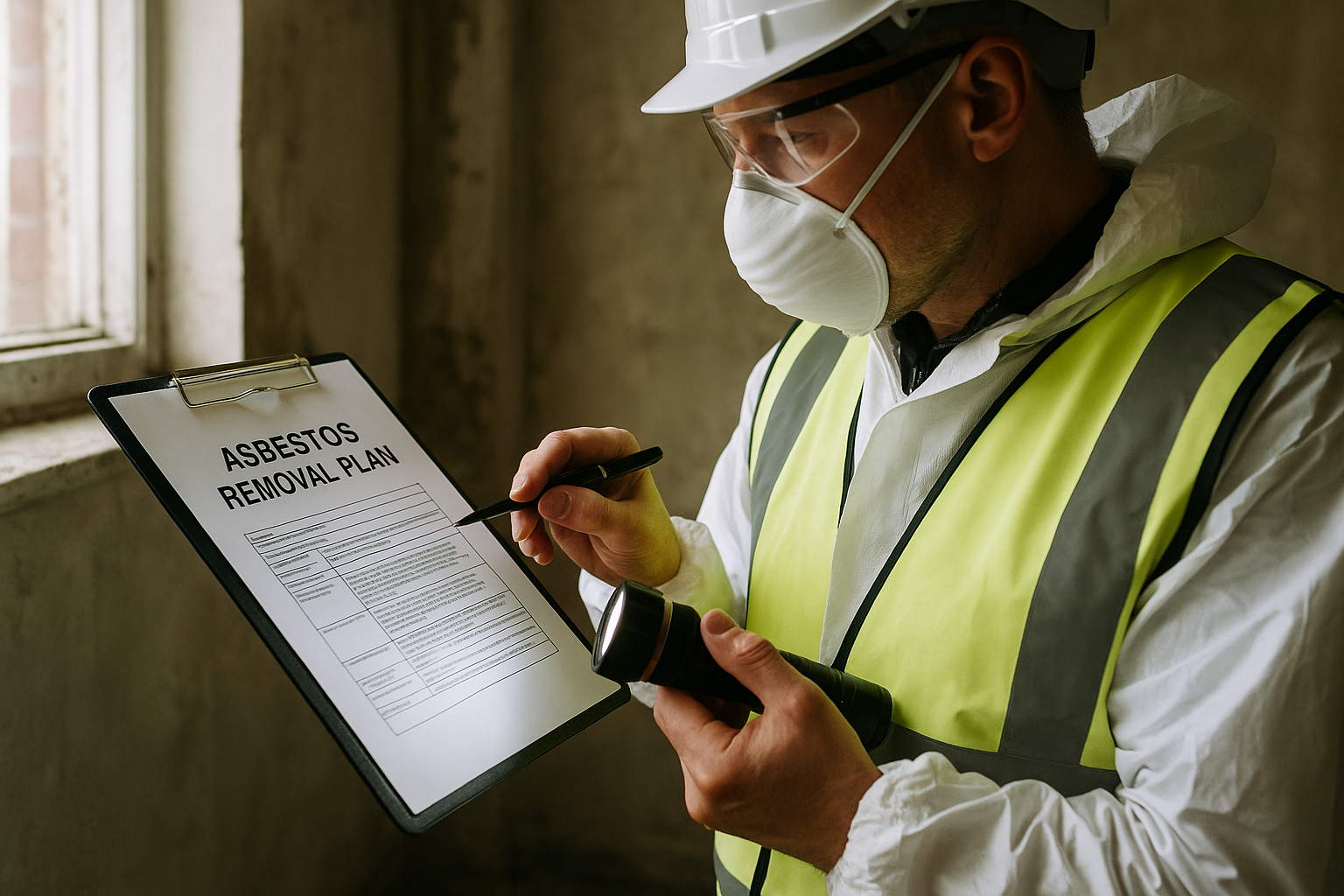
A strong asbestos removal plan is detailed, site-specific and written in plain operational language. It should not rely on broad statements such as remove asbestos safely using suitable controls. That wording tells you almost nothing about how the work will actually be done.
The plan should explain the job from start to finish. Anyone reading it should understand what is being removed, how the area will be controlled, how workers will decontaminate and what happens before the space is handed back.
Core information your plan should include
- Site address and exact work location
- Survey reference and asbestos register details where relevant
- Description of each asbestos-containing material
- Extent, condition and accessibility of the material
- Work category: licensable, notifiable non-licensed or non-licensed
- Risk assessment findings
- Step-by-step sequence of work
- Removal techniques and tools to be used
- Dust suppression and fibre control measures
- Containment and enclosure arrangements
- Negative pressure arrangements where required
- Access, egress and transit routes
- Location of decontamination facilities
- PPE and RPE requirements
- Supervision arrangements and named responsibilities
- Air monitoring and analytical arrangements
- Waste packaging, temporary storage and disposal routes
- Emergency procedures for accidental disturbance or enclosure failure
- Handover arrangements and clearance requirements
A good asbestos removal plan also reflects the wider site. It should account for nearby offices, residents, shared corridors, service risers, ventilation systems, fire routes and other contractors. If those practical issues are ignored, even technically competent removal work can create avoidable disruption.
What poor planning usually looks like
- Generic wording copied from another project
- No clear distinction between clean and dirty routes
- No detail on how waste leaves the enclosure
- Missing emergency arrangements
- Survey references that do not match the work area
- No explanation of how occupants will be protected
- Unclear responsibilities between contractor, analyst and client
If you spot those weaknesses early, ask for the asbestos removal plan to be revised before work starts. That is much easier than trying to fix a poor plan once the site has been set up.
Notification and legal duties
Notification is one of the areas where dutyholders and property managers often get caught out. Not all asbestos work is treated the same way. The category of work depends on the material, its condition, how it will be handled and the likely level of fibre release.
Some work is licensable and must be carried out by a contractor holding the appropriate licence. Some work is notifiable non-licensed work. Other tasks may be non-licensed. The asbestos removal plan must match the correct category. If the wrong category is assumed, the whole project can be delayed or challenged.
What notification should cover
For work that requires notification, the contractor must follow the relevant requirements under the Control of Asbestos Regulations. The notification process is not just an administrative step. It helps confirm that the work has been properly considered, categorised and scheduled.
Your planning checks should include:
- Whether the identified material makes the work licensable
- Whether notification is required before work begins
- Who is responsible for submitting the notification
- Whether the programme allows for the required lead time
- Whether the plan of work matches the notified scope
Questions to ask the contractor
- How have you categorised this asbestos work?
- What survey evidence supports that decision?
- Who prepared the risk assessment and plan of work?
- Has the required notification been made?
- What documentation will you provide before mobilisation?
A competent contractor should be able to answer those questions clearly. If the explanation is vague, treat that as a warning sign.
Setup of work area and containment
The setup phase is where the written asbestos removal plan becomes visible on site. Good containment protects workers, occupants and adjoining areas from fibre spread. The exact arrangement depends on the material and risk level, but the principle is always the same: isolate the work and stop contamination escaping.
For higher-risk removal, this may involve a full enclosure, airlocks, a bag lock, a decontamination unit and negative pressure equipment. For lower-risk tasks, the controls may be simpler, but the area still needs to be clearly segregated and managed.
Key elements of work area setup
- Barriers and warning signage to restrict access
- Isolation of services where appropriate
- Protection of nearby surfaces and common parts
- Construction of enclosures using suitable sheeting and sealed joints
- Negative pressure units where required to reduce escape risk
- Airlocks for personnel entry and exit
- Bag locks or controlled waste transfer points
- Clearly defined clean and dirty routes
- Placement of the decontamination unit in a practical location
- Checks on enclosure integrity, including smoke testing where appropriate
From a property manager’s perspective, this is the moment to ask practical questions. Where will the skip go? How will occupants be diverted? Will lifts, corridors or fire routes be affected? How will deliveries and other contractors be managed while the asbestos work is underway?
Containment problems to watch for
- Work starting before the enclosure is complete
- Damaged or poorly sealed sheeting
- No clear separation between waste route and clean route
- Ventilation systems left running when they should be isolated
- Signage that is missing or unclear
- Transit routes passing through busy occupied areas without proper controls
If the site setup does not match the asbestos removal plan, stop and query it. Changes should be justified, recorded and communicated before work continues.
Removal of asbestos materials: methods, PPE and site discipline
The actual removal of asbestos materials must follow the method set out in the asbestos removal plan. The aim is to minimise fibre release, control exposure and remove the material in the safest practical way. That means using the right tools, the right sequence and the right level of supervision.
PPE and respiratory protective equipment
Workers need suitable personal protective equipment and respiratory protective equipment for the task. This often includes disposable coveralls, gloves and suitable footwear, along with correctly selected RPE. The exact specification depends on the material and method.
RPE must be suitable for the wearer as well as the job. Face-fit issues, poor maintenance and incorrect use can undermine protection. This should never be treated as a box-ticking exercise.
Removal methods
Different asbestos products require different techniques. A competent asbestos removal plan should reflect that rather than applying one generic method to everything.
- Pipe lagging and thermal insulation: usually high risk and often requires licensed removal with tightly controlled methods
- Sprayed coatings: typically high risk and demanding in terms of containment and control
- Asbestos insulating board: often requires careful controlled removal to reduce breakage and dust release
- Asbestos cement: may sometimes be removed intact using lower-risk methods if condition and access allow
- Floor tiles and textured coatings: need task-specific assessment rather than assumptions
Power tools that generate dust are generally avoided unless there is a specific controlled reason to use them. Unnecessary breakage is poor practice. Removing materials intact where possible is usually the safer approach.
Site discipline during removal
Even a well-written asbestos removal plan can fail if site discipline slips. Supervision matters throughout the job, not just at the start.
Useful checks during the works include:
- Are operatives following the planned entry and exit procedures?
- Are waste bags being sealed and labelled correctly?
- Are tools being cleaned or disposed of as planned?
- Is the enclosure still intact?
- Have site conditions changed since work began?
- Are nearby occupants still properly protected?
If anything changes on site, the method may need to be reviewed before the work continues.
Decontamination of the work area and equipment
Decontamination is a central part of any asbestos removal plan. Removing the asbestos is only part of the job. The area, equipment and personnel all need to be decontaminated in a controlled way to prevent fibres being carried into clean areas.
This is where poor practice can undo otherwise competent removal work. If tools, footwear, waste routes or surfaces are left contaminated, the risk continues after the visible work has finished.
What decontamination should cover
- Worker decontamination when leaving the enclosure
- Use of the decontamination unit where required
- Cleaning of tools and equipment before removal from the work area
- Controlled cleaning of the enclosure and surrounding surfaces
- Inspection for visible debris and residue
- Management of contaminated consumables and disposable PPE
The exact process depends on the type of work, but the principle is consistent. Nothing contaminated should move into a clean area without the correct procedure being followed first.
Practical points for clients to check
- Is there a clear route from enclosure to decontamination facilities?
- Has the contractor allowed enough space for safe decontamination?
- How will larger equipment be cleaned before removal?
- Who checks the area before analyst attendance?
- How will shared corridors or access points be protected during demobilisation?
If these points are not considered in the asbestos removal plan, ask for clarity before the job starts.
Waste packaging and disposal
Asbestos waste must be handled with the same care as the removal itself. A weak approach to packaging or disposal can spread contamination beyond the work area and create legal problems for the dutyholder as well as the contractor.
The asbestos removal plan should explain exactly how waste will be packaged, moved, stored temporarily and taken off site. That includes the route through the building, not just the final disposal point.
What good waste planning looks like
- Waste is packaged promptly at the point of removal where appropriate
- Suitable asbestos waste bags or wrapping are used
- Packages are sealed and labelled correctly
- Sharp or awkward items are wrapped in a way that prevents puncture
- Waste routes are planned to avoid unnecessary contact with occupied areas
- Temporary storage is secure and clearly designated
- Transport and disposal arrangements are made in advance
Clients should also ask what happens if access is restricted, lifts are unavailable or waste has to move through common parts. Those details often get overlooked until the day of the job.
Common waste handling mistakes
- Overfilled or damaged bags
- Waste left unsealed inside the enclosure
- Poorly planned routes through occupied buildings
- No secure holding area for wrapped materials
- Unclear responsibility for consignment records and disposal evidence
Waste handling should never be treated as an afterthought. It is a core part of the asbestos removal plan.
Documentation and record-keeping
Paperwork matters because asbestos work needs an evidence trail. If there is a question later about what was removed, how the work was categorised or whether the area was safe to reoccupy, your records need to answer it quickly.
A well-managed asbestos removal plan sits within a larger set of documents. Together, they show that the job was planned, carried out and completed properly.
Documents you should expect to retain
- Relevant asbestos survey report
- Risk assessment
- Plan of work or method statement
- Notification records where required
- Training and competence records where relevant
- Site logs and supervisor records
- Air monitoring and analytical results
- Waste consignment documentation
- Clearance documentation and certificate where applicable
- Updated asbestos register or management records after removal
For dutyholders, one of the most useful habits is to check that records are updated promptly after the work. If asbestos has been removed, your building records should reflect that. If some material remains, that should also be clearly recorded so future contractors are not working from outdated information.
Record-keeping tips for property managers
- Keep survey reports and removal records linked to the exact area of the building
- Store digital copies in a place facilities teams can access easily
- Update the asbestos register after removal or reinspection
- Cross-check handover documents before signing off the job
- Make sure maintenance teams know what remains in place
Good record-keeping reduces confusion on future projects and helps demonstrate compliance if your decisions are ever questioned.
Air monitoring, issue of a clearance certificate and handover
One of the most important stages in the whole process comes after the visible removal work appears to be finished. The area may look clean, but asbestos work is not complete until the required checks, monitoring and clearance steps have been carried out.
The asbestos removal plan should make clear what analytical involvement is needed, who is responsible for arranging it and what evidence will be provided before the area is handed back.
Air monitoring
Air monitoring may be used at different stages depending on the job. This can include background monitoring, leak monitoring, reassurance monitoring or clearance-related testing where applicable. The exact approach depends on the work type and risk profile.
From a client perspective, the key point is that analytical arrangements should not be vague. You should know when monitoring will happen, what it is intended to show and how the results will be communicated.
Issue of a clearance certificate
For work that requires formal clearance procedures, the area must pass the necessary stages before a clearance certificate is issued. This certificate is a key part of the handover process because it provides evidence that the area has met the required standard for reoccupation following the relevant clearance procedure.
The certificate should not be treated as a routine administrative attachment. It is one of the main documents confirming that the controlled work area can be handed back.
Before you accept handover
- Check that the scope of removal matches the original plan
- Confirm any required analytical work has been completed
- Obtain the relevant clearance documentation
- Review waste paperwork and disposal evidence
- Update building records to reflect what has been removed
- Confirm whether any asbestos remains elsewhere nearby
If the contractor cannot provide clear handover documents, do not assume the process is complete just because the enclosure has come down.
Choosing competent support for surveys and asbestos removal
The best asbestos removal plan is built on accurate survey information and delivered by competent professionals. That means choosing the right survey type, making sure the scope is correct and appointing contractors who can explain their methods clearly.
If you need help with surveys before intrusive works, Supernova can arrange the right inspection for your building and project. If removal is required, our asbestos removal service helps clients move from identification to safe, controlled action with the right documentation and support.
Practical checklist before asbestos removal starts
If you want a simple way to pressure-test an asbestos removal plan, run through this checklist before mobilisation:
- Do we have the correct survey for the planned work?
- Does the plan identify the exact asbestos materials and locations?
- Has the work been categorised correctly?
- Has any required notification been dealt with?
- Are containment and transit routes practical for this building?
- How will occupants and neighbouring areas be protected?
- What is the decontamination process for workers and equipment?
- How will asbestos waste be packaged and removed from site?
- What records will be provided at handover?
- Will a clearance certificate be issued where required?
If you cannot answer those questions confidently, the planning stage is not finished.
Need help with an asbestos removal plan?
If you are planning works in a commercial, residential or public-sector property, Supernova Asbestos Surveys can help you get the process right from the start. We carry out the surveys that underpin a safe asbestos removal plan, and we support clients nationwide with practical advice, fast reporting and reliable asbestos services.
To arrange a survey or discuss removal requirements, call 020 4586 0680 or visit asbestos-surveys.org.uk. If you already have survey information and need help turning it into a workable, compliant next step, speak to Supernova today.
Frequently Asked Questions
What is an asbestos removal plan?
An asbestos removal plan is a site-specific document that explains how asbestos-containing materials will be removed safely and in line with legal requirements. It should include survey references, risk assessment findings, work methods, containment, decontamination, waste disposal and handover arrangements.
When should asbestos be removed rather than managed in place?
Asbestos should usually be removed when it is damaged, likely to be disturbed by planned works, difficult to protect in place or located where accidental damage is likely. If it is in good condition and unlikely to be disturbed, management in place may be appropriate, but that decision should be based on proper assessment.
Does every asbestos job need notification?
No. The need for notification depends on the type of material, its condition and the work involved. Some asbestos work is licensable, some is notifiable non-licensed, and some is non-licensed. The work must be categorised correctly under the Control of Asbestos Regulations.
What documents should I receive after asbestos removal?
You should normally receive the relevant survey information, the plan of work, waste documentation, any analytical results and clearance documentation where applicable. Your asbestos register or management records should also be updated after the work.
What is a clearance certificate in asbestos work?
A clearance certificate is issued after the required clearance procedure has been completed for relevant asbestos work and the area has met the standard for handover. It is an important record showing that the controlled work area can be reoccupied following the necessary checks.