Buying an asbestos test kit can seem like the fastest way to settle a nagging question about a ceiling, floor tile, garage roof or old boxed-in pipework. The problem is that speed and certainty are not the same thing. A lab can accurately analyse a sample, but the real risk often sits in the moment you disturb a suspect material to take that sample.
That is why an asbestos test kit needs to be viewed for what it is: a limited tool, not a substitute for proper asbestos management. If you own, let, manage or work on property, the better question is not simply whether a kit works, but whether it is the right approach for the material, the building and the job in front of you.
How an asbestos test kit works
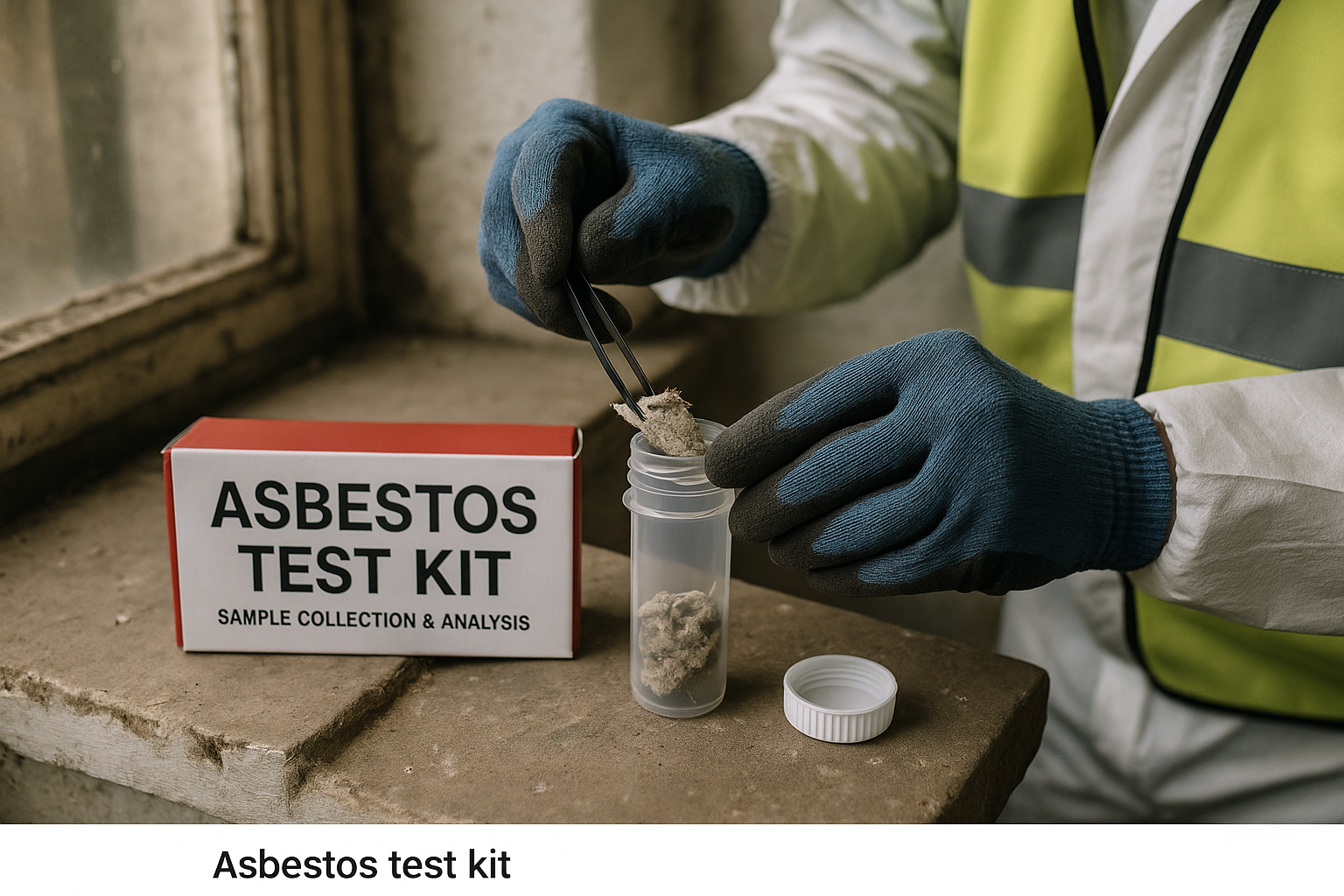
Most products sold as an asbestos test kit are postal sampling services. You receive packaging and instructions, collect a small piece of suspect material, then send it to a laboratory for identification.
The laboratory element can be perfectly reliable when carried out by a competent lab. What the kit cannot control is whether you sampled the right material, took a representative piece, or created unnecessary fibre release while collecting it.
What is usually included
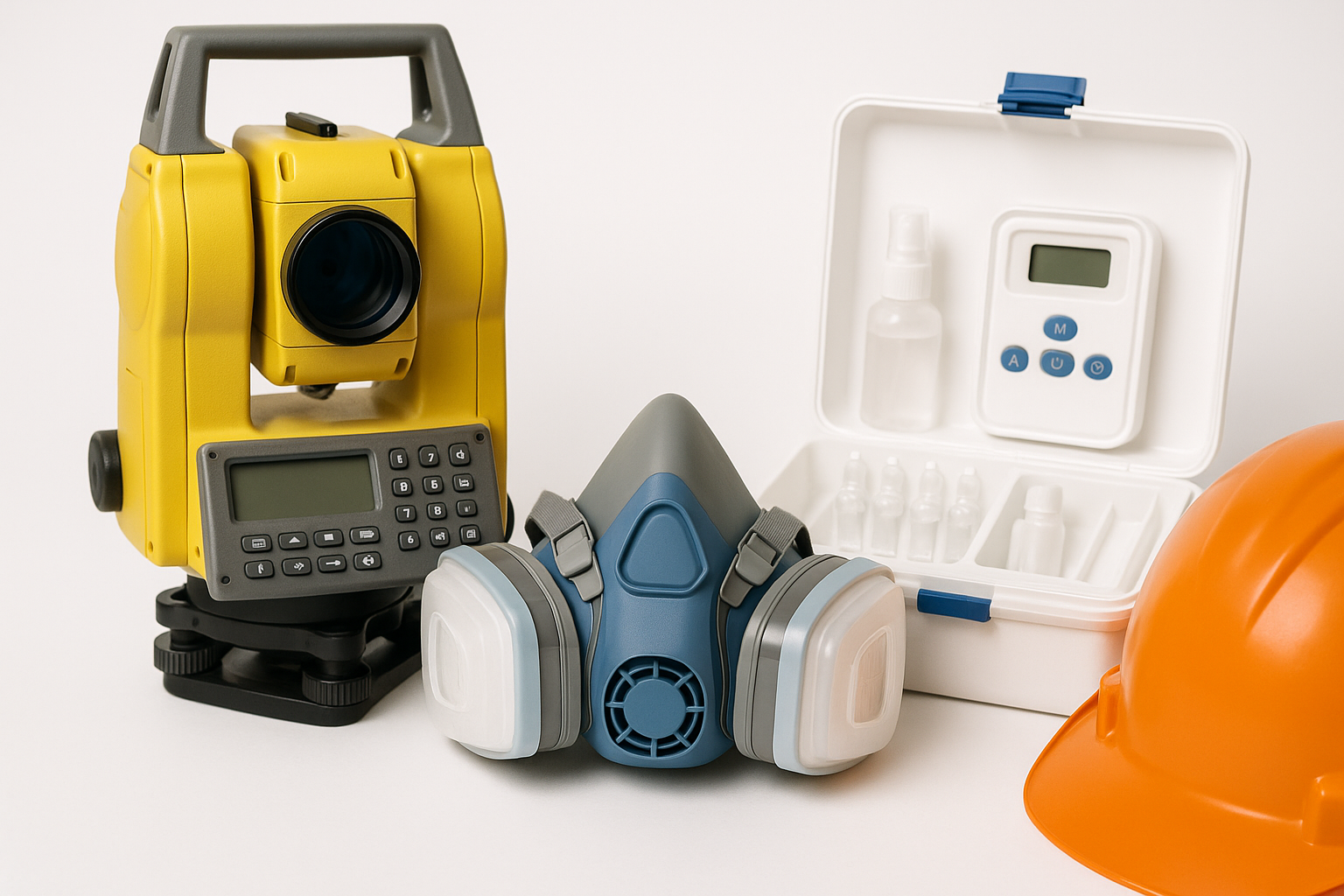
The contents vary, but a typical asbestos test kit may include:
- Sample bags or pots
- Labels and submission paperwork
- Written sampling instructions
- Return packaging
- Disposable gloves
- A simple collection tool
- Sometimes a mask or basic protective clothing
Some suppliers strip this back and only offer lab processing. If you already have a safely collected specimen, a dedicated sample analysis service may be all you need. If you are still deciding what to cut, scrape or remove, that is where risk starts to rise.
Can an asbestos test kit be reliable?
Yes, but only in a narrow sense. An asbestos test kit can reliably confirm whether the specific sample submitted contains asbestos.
What it cannot do is confirm that the sample was taken safely, that it represents all similar materials nearby, or that the rest of the property is free from asbestos-containing materials. It also does not assess condition, damage, accessibility or the likelihood of future disturbance.
Where reliability breaks down
DIY sampling commonly goes wrong in four ways:
- The wrong material is sampled. People often focus on obvious items and miss less visible asbestos-containing materials such as insulating board, bitumen adhesive, gaskets or debris in service areas.
- The sample is not representative. Some products do not contain asbestos evenly across the whole material.
- The sample is taken unsafely. Breaking, drilling or scraping can release fibres.
- The result is over-interpreted. One negative result is wrongly treated as proof that an entire room or building is asbestos-free.
So the honest answer is simple: the lab result may be sound, but the overall outcome of an asbestos test kit is only as good as the decisions behind the sample.
What an asbestos test kit can and cannot tell you
An asbestos test kit answers one limited question: does this sample contain asbestos? That can be useful, but it leaves several important gaps.
What it can tell you
- Whether asbestos is present in the submitted sample
- The type of asbestos identified, where applicable
- Whether a suspect material needs further professional attention
What it cannot tell you
- Whether other materials in the same area also contain asbestos
- Whether the material is in good or poor condition
- Whether fibres are likely to be released during normal occupation
- What should go into an asbestos register
- Whether refurbishment or demolition work can proceed safely
- Whether you have met your duties under the Control of Asbestos Regulations
That distinction matters. For a homeowner checking one clearly accessible item, an asbestos test kit may have a place. For a landlord, facilities manager or dutyholder, it is rarely enough on its own.
When using an asbestos test kit may be appropriate
There are situations where an asbestos test kit can be a practical option. The key is keeping the use case narrow and realistic.
It may be suitable when:
- You have one small, accessible suspect material
- The material can be sampled with minimal disturbance
- You only need confirmation of asbestos content
- You are not planning refurbishment or demolition
- You understand that the result applies only to that sample
If you want a postal option, a purpose-made asbestos testing kit is generally clearer than buying separate items and guessing your way through the process.
Good examples of limited use
A single old floor tile in a utility room. A small piece of cement sheet from a detached garage. A textured coating sample from one ceiling where no work is planned yet.
Even then, the sample should only be taken if it can be done without creating avoidable dust or damage. If there is any doubt, stop and get professional help.
When an asbestos test kit is the wrong choice
An asbestos test kit is often bought when what is really needed is a survey, not a lab certificate. This is especially true in workplaces, communal areas and buildings where maintenance or refurbishment is planned.
DIY sampling is usually the wrong route when:
- You manage non-domestic premises
- You are responsible for communal areas in residential blocks
- Refurbishment or demolition is planned
- You are unsure what the material is
- The material is damaged, friable or already shedding debris
- There are multiple suspect materials across the property
- You need records that support ongoing management
For occupied premises, a professional management survey is often the correct starting point. It is designed to locate, as far as reasonably practicable, asbestos-containing materials that could be disturbed during normal occupation, maintenance or installation work.
Different types of asbestos test kit on the market
Not every asbestos test kit is the same. Understanding the differences helps you avoid paying for the wrong service.
1. Analysis-only services
This is the simplest version. You send in a sample that has already been collected, and the lab analyses it.
This can be sensible where a competent person has already obtained the sample. It is much less sensible if the service quietly assumes you will collect it yourself with no real support.
2. Kits with packaging and instructions
These are the standard postal products most people mean when they say asbestos test kit. They usually include sample containers, forms and return packaging.
They are convenient, but convenience does not remove the need for care. You still carry the risk of disturbing the material.
3. Kits with PPE and RPE
Some products include gloves, coveralls and a mask. That is better than no protection at all, but it should not be mistaken for competence.
Protective equipment can reduce exposure. It does not teach correct sampling technique, identify hidden asbestos or turn unsuitable sampling into a safe task.
4. Multi-sample kits
These are sold for properties with several suspect materials. They can be cost-effective if you genuinely have a few separate, low-risk items to check.
The danger is assuming that more sample slots equal a survey. They do not. Multiple lab results still do not provide a material assessment, management plan or register.
If you are considering a postal testing kit, read exactly what is included and what is not. Many buyers assume they are purchasing certainty when they are really only buying lab identification for whatever they happen to send.
How many samples do you actually need?
This is one of the most misunderstood parts of using an asbestos test kit. The right number of samples depends on the variety of suspect materials, not just the size of the building.
As a practical rule, think about different materials in different locations. If the appearance, texture, age, use or product type changes, it may need to be treated as a separate sampling area.
You may need separate samples for:
- Different textured coatings in different rooms
- More than one type of floor tile or adhesive
- Different cement sheet products around outbuildings
- Insulating board in cupboards, risers and ceiling voids
- Pipe insulation or debris in more than one area
One sample only tells you about one sample. That is the core limitation of any asbestos test kit.
Where asbestos is commonly found in UK properties
People often buy an asbestos test kit for the obvious suspects, such as garage roofs or pipe lagging. In reality, asbestos was used in a wide range of building materials, and many are less obvious than people expect.
Common locations include:
- Textured coatings on walls and ceilings
- Floor tiles and bitumen adhesives
- Soffits, fascias and cement panels
- Garage and shed roofs
- Asbestos insulating board in partitions, risers and service cupboards
- Ceiling tiles and boxing around services
- Pipe insulation, boiler insulation and rope seals
- Toilet cisterns, bath panels and window boards
- Roofing felt, mastics and some sealants
Some of these materials are low risk when in good condition and left undisturbed. Others can release fibres more readily if damaged or worked on. That difference is exactly why identification alone is not the whole story.
Why professional asbestos testing is safer and more useful
Professional sampling is not just about sending a piece of material to a lab. It is about making sure the right material is identified, sampled in a controlled way and reported in a form that supports real decisions.
With professional asbestos testing, the process usually includes:
- Inspection of the suspect material in context
- Selection of representative sample points
- Controlled disturbance methods to reduce fibre release
- Correct sealing, labelling and documentation
- Clear reporting on location, product type and findings
That is far more useful than a loose certificate with no context. If you are trying to manage a building properly, context matters as much as identification.
Testing versus surveying
Testing answers whether a sample contains asbestos. Surveying identifies suspect materials across an area and records their location, extent and condition in line with HSG264 expectations.
If you are responsible for occupied premises, a proper asbestos management survey is often the better investment than relying on an asbestos test kit. It gives you information you can act on, not just a single result.
Legal and practical limits of DIY asbestos testing
The Control of Asbestos Regulations place duties on those who manage non-domestic premises. Those duties go beyond confirming whether one sample is positive or negative. They involve identifying asbestos-containing materials, assessing the risk and managing them properly.
An asbestos test kit does not by itself meet those wider duties. It does not create an asbestos register, assess condition across the premises or provide the management information needed for contractors, maintenance teams and occupiers.
HSG264 sets out the expected standard for asbestos surveys. That matters because survey work is not just about spotting likely asbestos. It is about planning, inspection, sampling strategy, recording and reporting in a way that supports safe management.
From a practical point of view, if you are a dutyholder, landlord with communal areas, facilities manager or contractor planning intrusive work, treating an asbestos test kit as a compliance shortcut is risky. It can leave key materials unidentified and key records missing.
Safety advice if you are considering an asbestos test kit
The safest advice is simple: do not disturb suspect asbestos unless there is a clear need and you are confident the sampling can be done without creating avoidable risk. If you are still thinking about using an asbestos test kit, keep these precautions in mind.
- Do not drill, sand, saw or break suspect materials unnecessarily.
- Do not sample damaged insulation, lagging or loose debris yourself.
- Keep other people away from the area while sampling.
- Use appropriate disposable gloves and suitable respiratory protection if specified.
- Dampen the sampling point lightly where appropriate to reduce dust.
- Take the smallest sample needed.
- Double bag waste and clean the area carefully using damp wiping methods.
- Do not use a domestic vacuum cleaner on suspect asbestos dust.
If any step feels uncertain, that is usually the point to stop and arrange professional asbestos testing instead.
For property managers, landlords and contractors: choose the right service
If you manage property professionally, an asbestos test kit is rarely the complete answer. The right service depends on what you are trying to achieve.
Choose testing when:
- You need a suspect material identified
- The sample can be taken safely by a competent person
- You need quick confirmation before deciding next steps
Choose a management survey when:
- You manage an occupied non-domestic property
- You need an asbestos register
- You need to understand location, extent and condition of accessible materials
Choose a refurbishment or demolition approach when:
- Works will disturb the fabric of the building
- Hidden materials may be present behind finishes or within voids
- You need to avoid exposing trades to unknown asbestos-containing materials
If your portfolio includes multiple sites, consistency matters. A patchwork of DIY certificates is much harder to manage than a proper survey record.
Local support for surveys and testing
For buildings that need more than a simple asbestos test kit, local surveying support makes a real difference. If you are managing premises in the capital, booking an asbestos survey London service can be the quickest route to clear, site-specific advice.
The same applies in the North West and Midlands. If your property is in the region, an asbestos survey Manchester service or an asbestos survey Birmingham visit will usually give you more useful information than relying on an asbestos test kit alone.
Should you buy an asbestos test kit or book a professional?
If you only need to identify one accessible material and you understand the limits, an asbestos test kit may be enough. If you need confidence about a wider area, want to protect contractors, or have any legal management duty, professional help is usually the smarter option.
The real cost is not just the price of the kit. It is the risk of sampling the wrong material, missing other asbestos-containing products, or ending up with a result that does not actually answer the question you needed to solve.
Supernova Asbestos Surveys provides professional surveys, sampling and testing across the UK. If you are unsure whether an asbestos test kit is suitable, speak to our team for practical advice and the right service for your property. Call 020 4586 0680 or visit asbestos-surveys.org.uk.
Frequently Asked Questions
Are asbestos test kits accurate?
An asbestos test kit can be accurate for the sample analysed by the laboratory. The limitation is that the result only applies to that specific sample, and accuracy depends on whether the correct material was collected safely and representatively.
Does an asbestos test kit replace an asbestos survey?
No. An asbestos test kit only identifies the submitted sample. It does not assess condition, extent, accessibility or management requirements, and it does not replace a survey carried out in line with HSG264 expectations.
Can landlords or property managers rely on an asbestos test kit?
In most cases, no. If you manage non-domestic premises or communal areas, you may need broader asbestos information to support compliance under the Control of Asbestos Regulations. A survey is often more appropriate than a DIY kit.
Is it safe to take your own asbestos sample?
Not always. Disturbing suspect asbestos can release fibres, especially if the material is damaged or friable. If you are unsure what the material is or how to sample it safely, arrange professional testing instead of using an asbestos test kit yourself.
What should I do if an asbestos test kit comes back positive?
Do not disturb the material further. Record the location, prevent unnecessary access or work nearby, and get professional advice on whether the material should be managed in place, sealed, monitored or removed by a competent contractor.