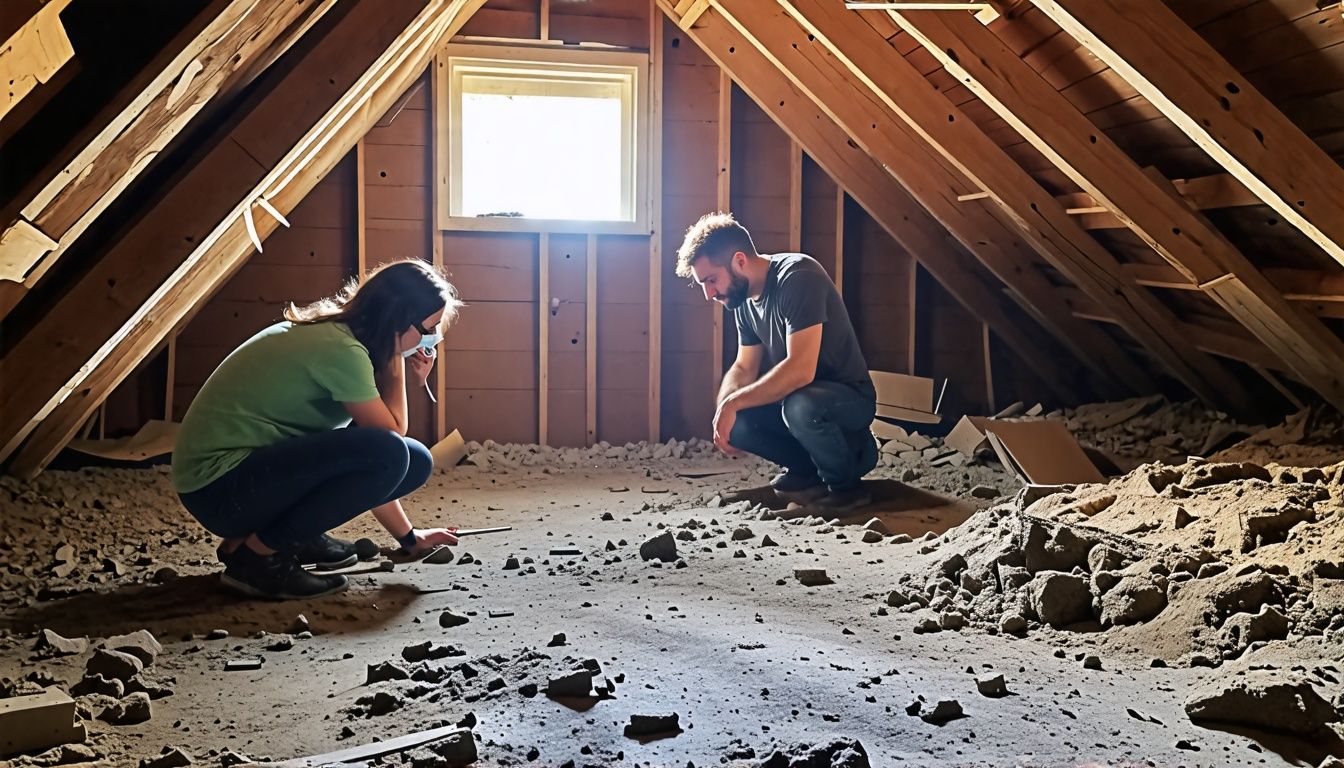
What Happens If You Have Asbestos in Your House?
Finding asbestos in your home is not an automatic emergency — but it absolutely demands the right response. Understanding what happens if you have asbestos in your house, and what you should and shouldn’t do about it, is the difference between managing a situation calmly and making it significantly worse.
The material itself is not inherently dangerous. What determines the risk is whether it has been disturbed, how it was disturbed, and what you do next.
Why Asbestos Is Dangerous in the First Place
Asbestos is a naturally occurring fibrous mineral that was used extensively in UK construction from the 1950s through to the late 1990s. Valued for its heat resistance, durability, and versatility, it found its way into dozens of building products. It was banned in the UK in 1999, but any property built or significantly refurbished before that date may still contain it.
The danger is not the material sitting undisturbed behind your plasterboard or beneath your floor tiles. The danger is the microscopic fibres it releases when cut, drilled, sanded, scraped, or broken. Once airborne, those fibres can be inhaled deep into the lungs — and the body cannot expel them.
Over time, those trapped fibres cause serious, irreversible disease. The conditions linked to asbestos exposure include:
- Mesothelioma — an aggressive cancer affecting the lining of the lungs, chest wall, or abdomen. Almost exclusively caused by asbestos exposure and currently incurable.
- Asbestosis — chronic scarring of the lung tissue caused by prolonged fibre inhalation, leading to progressive breathlessness.
- Asbestos-related lung cancer — risk increases significantly with asbestos exposure, particularly in smokers.
- Pleural thickening — scarring of the membrane surrounding the lungs, causing chest pain and breathing difficulties.
What makes these diseases particularly serious is the latency period. Symptoms rarely appear until decades after exposure — often 20 to 50 years later. By the time a diagnosis is made, the disease is typically advanced. This is why getting the response right matters so much.
Does Simply Having Asbestos in Your Home Put You at Risk?
Here is the key point that many homeowners miss: asbestos in good condition, left undisturbed, poses very little risk. Simply being in the same room as intact asbestos-containing materials is not a health hazard.
If you are visually checking the condition of your artex ceiling, examining old pipe lagging, or looking at floor tiles — you are not releasing fibres. You are not at risk. The problems begin when people attempt to take samples without proper training, or start renovation work without first establishing whether asbestos is present.
So the first rule when you suspect asbestos in your home is straightforward: do not disturb it.
Where Is Asbestos Commonly Found in UK Homes?
Any property built or significantly renovated before 2000 could contain asbestos. Knowing where to look helps you avoid accidental disturbance. Common locations include:
- Artex and textured coatings — stippled or swirled ceiling and wall finishes applied before the late 1990s frequently contain chrysotile (white asbestos).
- Pipe lagging and boiler insulation — the insulation wrapped around older heating pipes may contain amosite (brown asbestos), one of the higher-risk types.
- Floor tiles and adhesives — vinyl floor tiles from the 1960s through to the 1980s, and the black bitumen adhesive used to fix them, often contain asbestos.
- Roof and soffit boards — asbestos cement was used extensively in corrugated roofing, guttering, and flat garage roofs.
- Ceiling tiles — particularly in properties with suspended ceiling systems from the 1960s and 1970s.
- Partition walls and board linings — asbestos insulation board (AIB) was commonly used as fireproofing in airing cupboards, around storage heaters, and in lift shafts.
- Loose-fill loft insulation — used in some loft spaces, particularly in council-built housing.
- Sprayed coatings — sprayed asbestos was applied to structural steelwork as fireproofing in larger buildings.
If your property was built before 2000 and you are unsure what it contains, the safest assumption is that asbestos-containing materials may be present until a survey proves otherwise.
What Should You Do If You Find Asbestos in Your House?
The appropriate response depends on the condition of the material and what you are planning to do with the property. Here is a practical breakdown.
If the Material Is Intact and Undamaged
Leave it alone. Asbestos in good condition — not crumbling, not damaged, not being worked on — is best managed in place. The standard guidance from the Health and Safety Executive (HSE) is to monitor it regularly and record its condition.
You should arrange a management survey to formally identify and assess all asbestos-containing materials in the property. This gives you a clear record of what is present, where it is, and what condition it is in — so you can manage it safely over time and ensure no one accidentally disturbs it.
If You Are Planning Renovation or Building Work
Do not start any intrusive work until a refurbishment survey has been completed. This type of survey is specifically designed to identify all asbestos-containing materials in areas that will be disturbed by planned works.
Sending builders or tradespeople into a property without this information puts them at risk and could expose you to legal liability. Contractors have every right to refuse to work on a property where asbestos has not been assessed.
If the Property Is Being Demolished
A full demolition survey is legally required before any demolition work begins. This is a fully intrusive inspection that locates all asbestos-containing materials throughout the entire structure, including areas that are not normally accessible.
If the Material Is Damaged or Crumbling
This is the scenario that requires immediate professional attention. Damaged or friable asbestos is actively releasing fibres into the air. Do not attempt to clean it up, bag it, or remove it yourself.
Limit access to the area, keep other people away — especially children — and contact a licensed asbestos contractor as quickly as possible.
The Highest-Risk DIY Scenarios
Most residential asbestos exposures in the UK occur during home improvement work — not through passive living in a property. These are the situations that consistently put homeowners at risk.
Sanding or Scraping Artex Ceilings
Artex is one of the most common asbestos-containing materials found in UK homes. Dry-sanding, dry-scraping, or cutting artex can release significant concentrations of fibres. Even a small area disturbed in an unventilated room can result in substantial exposure.
If you are planning to skim over artex or have it removed, get it tested first. It is a simple, inexpensive step that could prevent a serious health risk.
Removing Old Floor Tiles
Vinyl floor tiles installed before the mid-1980s should always be treated with caution. The tiles themselves may contain asbestos, but so might the adhesive beneath them. Chiselling, grinding, or power-sanding these materials without testing is a significant risk.
Drilling Into Garage Roofs or Outbuildings
Asbestos cement sheets were used extensively in garage roofs, garden sheds, and outbuildings. These are classed as a lower-risk product when intact, but drilling, cutting, or breaking them generates high concentrations of dust. Never cut asbestos cement with power tools.
Disturbing Pipe Lagging or Insulation Board
Asbestos insulation board (AIB) and pipe lagging are among the highest-risk asbestos materials. They are more friable — meaning they break apart easily — and release fibres at much higher concentrations than asbestos cement. Any work involving these materials must be carried out by a licensed asbestos contractor.
How to Get Asbestos Tested
Visual inspection alone cannot confirm whether a material contains asbestos. The only way to know for certain is laboratory analysis. You have two main options for asbestos testing.
Professional Survey and Sampling
A qualified asbestos surveyor visits the property, takes samples under controlled conditions using correct PPE and containment procedures, and sends them to an accredited laboratory for analysis. This is the recommended approach for any significant survey work, for properties with multiple suspect materials, or where renovation is planned.
Supernova’s asbestos testing service covers the full process — from site visit to laboratory results — carried out by qualified surveyors with samples analysed by a UKAS-accredited laboratory.
DIY Testing Kit
For a quick check on a single material that is in good condition and undamaged, an asbestos testing kit allows you to take a sample yourself and send it to an accredited laboratory for analysis.
If you use one of these, follow the instructions precisely. Use the gloves and bag provided. Dampen the material slightly before sampling to reduce fibre release. Avoid creating dust. Seal the sample securely. This option is suitable for a straightforward check on a single, accessible material — not for widespread survey work.
Your Legal Responsibilities as a UK Homeowner
The legal framework around asbestos in the UK is set out in the Control of Asbestos Regulations. Domestic homeowners are not subject to the same duty-to-manage requirements as commercial landlords and employers — but responsibilities still exist.
If You Are a Landlord
If you let a property, you have a legal duty to manage asbestos. This includes arranging a survey, maintaining an asbestos register, and ensuring that any contractors working on the property are made aware of any known or suspected asbestos-containing materials before work begins.
If You Hire Contractors
Even as a private homeowner, if you hire contractors to work on your property, you must inform them of any known or suspected asbestos before work starts. Sending workers into a building without this information puts them at risk and could result in legal liability for you.
Licensed Removal Requirements
Certain types of asbestos removal — particularly involving AIB, pipe lagging, or sprayed coatings — must only be carried out by a contractor licensed by the HSE. Unlicensed removal of these materials is illegal.
Asbestos waste must also be disposed of correctly as hazardous waste. It cannot go in a standard skip or household bin.
How to Minimise Risk While Waiting for Professional Help
If you have identified a suspect material and are waiting for a professional assessment, follow these principles:
- Do not disturb the material. If it is intact and undamaged, leave it alone.
- Do not drill, sand, scrape, or cut any surface you suspect might contain asbestos.
- Limit access to the area. Keep other people — especially children — away from the space.
- If you must handle suspect material, wear disposable coveralls, nitrile gloves, and a correctly fitted FFP3 respirator. A standard dust mask is not sufficient.
- Dampen materials slightly before any contact to suppress dust.
- Clean up with a damp cloth, not a dry brush or standard vacuum cleaner. Only a HEPA-filtered vacuum should be used near potential asbestos.
- Bag and seal any potentially contaminated materials — including disposable PPE — and label them clearly as potential asbestos waste.
- Document everything. Note the location, condition, and approximate area of any suspect materials.
When You Need Professional Asbestos Removal
There are situations where asbestos cannot simply be left in place or managed — it needs to be removed by a licensed contractor. You should arrange professional asbestos removal if:
- The material is damaged, crumbling, or actively releasing fibres
- Planned renovation or demolition work will disturb the material
- The material is in a location where accidental damage is likely
- You are selling the property and want to resolve any asbestos issues before sale
- The material has been identified as high-risk — particularly AIB, pipe lagging, or sprayed coatings
A licensed contractor will carry out the removal under controlled conditions, using enclosures, negative pressure units, and full PPE. The removed material is then disposed of as hazardous waste in accordance with current regulations.
Does Asbestos Affect Your Property Value or Sale?
The presence of asbestos does not automatically prevent a property from being sold or mortgaged. Many UK homes contain asbestos-containing materials that are in good condition and being managed appropriately. Buyers and lenders are generally more concerned with whether the asbestos has been identified, assessed, and is being managed — rather than simply whether it is present.
Having a formal management survey and asbestos register in place is actually a positive step. It demonstrates that you have taken the issue seriously and that the materials are being monitored. Undisclosed asbestos that comes to light during a buyer’s survey is far more likely to cause problems than asbestos that has been professionally assessed and documented.
If you are selling a property and suspect asbestos is present, arranging a survey before listing is the most straightforward approach. It removes uncertainty for buyers and avoids last-minute complications during conveyancing.
Asbestos Surveys Across the UK
Supernova Asbestos Surveys operates nationwide, with local teams covering every region. Whether you need an asbestos survey in London or an asbestos survey in Manchester, our qualified surveyors can visit your property, assess what is present, and provide you with a clear, actionable report.
With over 50,000 surveys completed across the UK, we have the experience to handle everything from a single domestic property to large commercial portfolios. All sampling is analysed by a UKAS-accredited laboratory, and our surveyors hold recognised industry qualifications.
Get Professional Advice From Supernova Asbestos Surveys
If you have found — or suspect — asbestos in your home, the right next step is a professional assessment. Do not guess, and do not disturb anything until you know what you are dealing with.
Supernova Asbestos Surveys provides management surveys, refurbishment surveys, demolition surveys, testing, and removal services across the UK. Our team is ready to help you understand exactly what is in your property and what needs to happen next.
Call us on 020 4586 0680 or visit asbestos-surveys.org.uk to book a survey or speak to one of our surveyors today.
Frequently Asked Questions
What happens if you have asbestos in your house and leave it alone?
If the asbestos-containing material is in good condition and undisturbed, it poses very little risk. The HSE guidance is to leave intact asbestos in place, monitor its condition regularly, and ensure no one accidentally disturbs it. The risk arises when materials are damaged, drilled, sanded, or broken — releasing fibres into the air.
Do I have to tell buyers if my house has asbestos?
You are expected to disclose any known material defects or hazards when selling a property. If you are aware of asbestos-containing materials, failing to disclose this could create legal problems after the sale. Having a professional survey and asbestos register in place is the most straightforward way to handle this — it shows the issue has been assessed and is being managed appropriately.
Can I remove asbestos myself from my home?
Some lower-risk asbestos-containing materials — such as small amounts of asbestos cement in good condition — can be removed by a non-licensed contractor following specific HSE guidelines. However, higher-risk materials including asbestos insulation board, pipe lagging, and sprayed coatings must only be removed by an HSE-licensed contractor. Attempting to remove these materials yourself is illegal and extremely dangerous.
How much does an asbestos survey cost for a house?
The cost of a domestic asbestos survey depends on the size of the property and the type of survey required. A management survey for a standard residential property is generally the most affordable option. Refurbishment and demolition surveys are more involved and priced accordingly. Contact Supernova Asbestos Surveys on 020 4586 0680 for a no-obligation quote tailored to your property.
Is asbestos in artex dangerous?
Artex and other textured coatings applied before the late 1990s frequently contain chrysotile (white asbestos). When left intact and unpainted, the risk is low. The danger arises when artex is dry-sanded, scraped, or cut — activities that release fibres into the air. Before any work on artex, always arrange testing to establish whether asbestos is present. If it is, the work must be carried out using appropriate controls or by a specialist contractor.