Identifying Asbestos: Should You Do It Yourself or Call a Professional?
If you own or manage a property built before 2000, identifying asbestos is not something you can treat as an afterthought. Whether you’re planning a renovation, taking on a new rental property, or noticing a suspicious ceiling coating, knowing what’s actually in your building matters — and getting it wrong has serious consequences.
The temptation to investigate yourself is understandable. You can see the old Artex, look it up online, maybe order a kit. Job done, or so it seems. The reality is considerably more complicated, and in some cases the DIY approach can actively make things worse.
Where Asbestos Hides in UK Properties
Asbestos was used extensively in UK construction right up until it was fully banned in 1999. If your property was built or significantly refurbished before that date, asbestos-containing materials (ACMs) could be present almost anywhere. The older the building, the higher the likelihood — but even properties from the 1980s and 1990s can contain ACMs, particularly in textured coatings and floor tiles.
Common locations include:
- Artex and textured wall and ceiling coatings — probably the most widespread source in UK homes, applied from the 1960s through to the 1990s
- Floor tiles and vinyl sheet flooring — particularly thermoplastic tiles laid between the 1950s and 1980s, including the adhesive used to fix them
- Pipe lagging and boiler insulation — common in properties with older heating systems
- Asbestos cement roofing sheets and guttering — widely used in garages, outbuildings, and extensions
- Ceiling tiles and wall panels — particularly in 1970s and 1980s construction
- Asbestos insulating board (AIB) — found around fireplaces, in airing cupboards, and as partition boards; one of the more hazardous forms
- Rope seals and gaskets — around old storage heaters, boiler doors, and flues
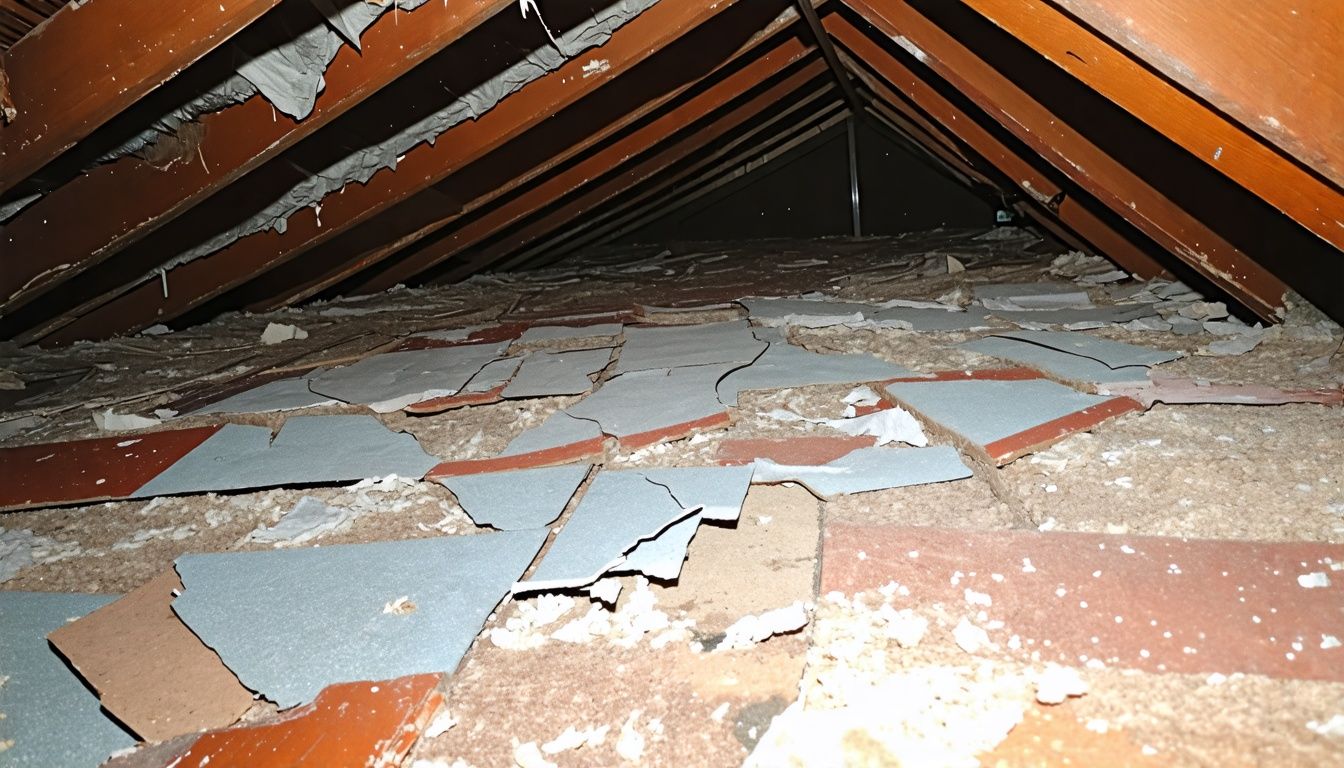
- Loose-fill insulation — occasionally found in roof spaces and wall cavities; particularly dangerous because of its friable nature
This is far from an exhaustive list. Asbestos was incorporated into over 3,000 different products precisely because it was so versatile and effective as a building material. If you’re not sure whether a material contains it, that uncertainty alone is reason enough to get professional advice.
The Three Main Types of Asbestos — and Why the Differences Matter
Not all asbestos is the same. Understanding the main types is part of identifying asbestos correctly — though it’s worth stating clearly that no type is safe, and all must be treated as hazardous.
Chrysotile (White Asbestos)
The most commonly encountered type in residential properties. Found in Artex, floor tiles, cement products, and insulation. Its curly fibres are considered less biopersistent than other types, but it remains a Group 1 carcinogen and must be handled accordingly.
Amosite (Brown Asbestos)
Frequently used in insulating board and ceiling tiles. Its straight, needle-like fibres are more easily inhaled deep into lung tissue, making it significantly more dangerous than chrysotile. Commonly found around fireplaces, in airing cupboards, and in commercial buildings converted to residential use.
Crocidolite (Blue Asbestos)
The most hazardous of all commercially used asbestos types. Its thin, rigid fibres penetrate lung tissue deeply and are strongly associated with mesothelioma. Found in spray-applied insulation and some pipe lagging — less common in homes, but not unheard of.
Here’s the critical point that underpins everything else: you cannot identify the type of asbestos — or whether a material contains asbestos at all — simply by looking at it. The fibres are microscopic. Visual inspection alone tells you nothing definitive. This is not a matter of experience or expertise; it is a physical limitation that applies to everyone.
Why DIY Identification Creates More Problems Than It Solves
The appeal of sorting it yourself is obvious. You can see the old ceiling coating, read a few articles, and feel like you have a reasonable handle on the situation. But there are two serious problems with this approach.
You Risk Releasing Fibres
Asbestos is most dangerous when disturbed. Intact, well-bonded ACMs that are left undisturbed pose a relatively low risk. The moment you start prodding, scraping, drilling, or sanding — even gently — you can release fibres into the air that will remain suspended for hours.
Inhaled asbestos fibres cause irreversible damage. The diseases associated with exposure — asbestosis, lung cancer, and mesothelioma — typically develop 20 to 40 years after initial exposure. There are no early warning signs. By the time symptoms appear, the damage is already done.
DIY Assessment Is Unreliable
Even if you use a home asbestos testing kit and send off a sample, the reliability of the result depends entirely on how the sample was collected. Improper sampling — disturbing too much material, contaminating the sample, or not collecting from the right area — can produce false negatives and, more dangerously, can release fibres in the process.
A home kit will only test the specific material you sample. It won’t give you a whole-property picture. A professional surveyor assesses the entire property systematically, identifying materials you might never have considered. The scope of a professional survey is incomparably broader than anything a homeowner can realistically achieve alone.
What Professional Asbestos Surveying Actually Involves
A professional asbestos survey is not simply a more thorough version of looking around. It’s a structured, regulated process conducted by trained specialists working in line with HSE guidance, including HSG264. There are several types of survey, and the right one depends on your circumstances.
Management Survey
A management survey is the standard survey for occupied properties. The surveyor identifies all reasonably accessible ACMs, assesses their condition, and produces a written report with a risk register. This is what most homeowners and landlords need to establish a baseline picture of their property.
Refurbishment Survey
A refurbishment survey is required before any significant renovation work begins. It’s a more intrusive process — surveyors access areas behind walls, above ceilings, and beneath floors to locate all ACMs before work starts. If you’re planning anything more than minor decorating, this survey is not optional.
Demolition Survey
A demolition survey must be completed before any structure is torn down. It involves a thorough, often destructive inspection to locate every ACM in the building. Without it, demolition work risks exposing workers and the surrounding area to asbestos fibres.
Re-Inspection Survey
Where ACMs are being managed in place rather than removed, a periodic re-inspection survey is essential. It confirms whether the condition of known materials has changed and whether the management plan needs updating. For many duty holders, this is an ongoing legal obligation — not a one-off task.
What the Survey Process Looks Like
- Initial site assessment — the surveyor conducts a systematic visual inspection of the whole property
- Material sampling — small samples are taken from suspected ACMs using correct techniques that minimise fibre release, with the area sealed and cleaned afterwards
- Laboratory analysis — samples are analysed under polarised light microscopy (PLM) to confirm the presence and type of asbestos
- Risk assessment — the condition, accessibility, and likelihood of disturbance of each ACM is assessed
- Written report — a detailed document outlining findings, the location and condition of all ACMs, and recommended actions
- Management plan — the surveyor advises on whether materials should be managed in place, encapsulated, or removed
This is the only process that gives you legally defensible, actionable information about asbestos in your property.
Your Legal Obligations Around Asbestos
The Control of Asbestos Regulations place clear duties on those responsible for non-domestic premises — including landlords of residential properties where others live or work. If you fall into that category, you have a legal duty to manage any asbestos present.
Key obligations include:
- Identifying whether ACMs are present and assessing their condition
- Maintaining an up-to-date asbestos register
- Sharing asbestos information with anyone who may disturb the material, including tradespeople
- Monitoring the condition of known ACMs over time through regular re-inspections
For homeowners in purely owner-occupied domestic properties, the legal duty to manage doesn’t apply in the same way — but the health risk absolutely does. And the moment a contractor comes in to carry out any work, they need to know what they might be disturbing. Providing that information is both a legal and a moral responsibility.
Unlicensed asbestos disturbance and failure to comply with regulations can result in substantial fines and, in serious cases, criminal prosecution. The Health and Safety Executive takes asbestos enforcement seriously — and rightly so, given that asbestos-related disease remains the single largest cause of work-related deaths in the UK.
When Should You Commission a Survey?
You don’t necessarily need to commission a survey simply because your property was built before 2000. Undisturbed, well-maintained ACMs in good condition are generally considered lower risk than damaged or friable materials. That said, you should seek professional assessment if:
- You are planning any building, renovation, or refurbishment work
- You are a landlord and do not have an asbestos register for your property
- You have discovered a material you suspect may contain asbestos, particularly if it is damaged or deteriorating
- You are selling or buying an older property and need clarity on what’s present
- A contractor has raised concerns before starting work
- You simply want peace of mind — which is a perfectly valid reason
What to Do If You Suspect Asbestos Right Now
If you’ve already disturbed something and you’re concerned, stop work immediately. Leave the area and keep others out. Don’t vacuum the debris — standard vacuum cleaners will spread fibres further. Don’t use compressed air.
Open windows to ventilate if it’s safe to do so, then call a professional. Do not attempt to clean up or assess the situation yourself. If you need asbestos removal following a disturbance, this must be carried out by a licensed contractor — not a general builder and certainly not a homeowner with a dust mask.
If you’ve identified a material you’re suspicious about but haven’t disturbed it, treat it as potentially containing asbestos until proven otherwise. Leave it alone, and arrange professional asbestos testing or a full survey.
A Sensible Role for Home Testing Kits
There are situations where a home testing kit can play a useful role — particularly if you want to test a single, easily accessible material that you haven’t disturbed and can sample carefully. Used correctly, with instructions followed precisely, a reputable kit can provide useful preliminary information.
What a home kit cannot do is replace a professional survey. It will only test what you sample. It won’t assess the condition of materials across the whole property, flag materials you hadn’t considered, or produce the kind of documented risk register that satisfies a legal duty of care.
Think of it as a starting point, not an endpoint — and only use one if you’re confident you can take a sample without creating a disturbance. If there’s any doubt, leave it to a professional to carry out asbestos testing properly.
Don’t Overlook Fire Safety While You’re at It
If you’re commissioning an asbestos survey for a commercial or residential rental property, it’s worth considering whether your fire risk assessment is also up to date. Both are legal obligations for many property types, and addressing them together is simply good property management.
A fire risk assessment identifies hazards, evaluates risks to occupants, and recommends control measures. Like asbestos management, it’s not a one-off exercise — it needs to be reviewed regularly and updated whenever there are significant changes to the building or its use.
The Bottom Line on Identifying Asbestos Safely
Identifying asbestos is not a task that lends itself to guesswork or good intentions. The fibres that cause life-limiting disease are invisible to the naked eye. The materials that contain them can look identical to those that don’t. And the act of investigating incorrectly can itself create the very exposure you’re trying to avoid.
The sensible approach is straightforward: if your property was built before 2000 and you have any reason to suspect ACMs are present, get a professional survey. Don’t wait until you’re mid-renovation. Don’t rely on a visual check. Don’t assume that because a material looks intact it’s safe to disturb.
Professional asbestos surveying exists precisely because this is a job that requires training, equipment, and regulated processes — not a ladder and a torch.
Frequently Asked Questions
Can I identify asbestos just by looking at it?
No. Asbestos fibres are microscopic and cannot be seen with the naked eye. You cannot determine whether a material contains asbestos — or which type — through visual inspection alone. Even experienced surveyors take physical samples for laboratory analysis to confirm the presence of asbestos. Any claim that you can visually identify asbestos with certainty is simply not accurate.
Is it safe to take a sample myself using a home testing kit?
It can be, provided you follow the instructions precisely, the material is easily accessible, and you can take a small sample without causing significant disturbance. However, improper sampling can release fibres and produce unreliable results. A home kit tests only the specific material you sample — it won’t give you a picture of the whole property. If there’s any doubt about your ability to sample safely, arrange professional testing instead.
Do I legally need an asbestos survey for my property?
For non-domestic premises and residential properties where others live or work, the Control of Asbestos Regulations place a legal duty on those responsible to manage asbestos. This includes identifying whether ACMs are present. For owner-occupied domestic homes, there is no equivalent legal duty — but if any contractor carries out work, you have a responsibility to inform them of any known or suspected ACMs. Before any refurbishment or demolition, a survey is legally required regardless of property type.
What should I do if I’ve accidentally disturbed a material that might contain asbestos?
Stop work immediately and leave the area. Keep others out and avoid vacuuming or sweeping — this spreads fibres further. Ventilate the space if you can do so without further disturbance, and then contact a professional asbestos contractor. Do not attempt to clean up yourself. If removal is required, it must be carried out by a licensed contractor under the Control of Asbestos Regulations.
How often should a property’s asbestos be re-inspected?
Where ACMs are being managed in place rather than removed, they should be re-inspected periodically — typically at least annually, though the frequency may vary depending on the condition and location of the materials. The purpose is to check whether the condition of known ACMs has deteriorated and whether the management plan needs updating. For duty holders, maintaining an up-to-date asbestos register through regular re-inspections is a legal requirement under the Control of Asbestos Regulations.
Talk to Supernova Asbestos Surveys
Supernova Asbestos Surveys has completed over 50,000 surveys across the UK. Whether you need a management survey for a rental property, a refurbishment survey ahead of building work, or simply want to understand what’s in your building, our qualified surveyors will give you a clear, accurate, and legally compliant answer.
Call us on 020 4586 0680 or visit asbestos-surveys.org.uk to book your survey or find out more about our services.