How to Test for Asbestos: A Practical Guide for UK Homeowners and Landlords
If your property was built or refurbished before 2000, there is a realistic chance it contains asbestos-containing materials (ACMs). Knowing how to test for asbestos — and doing it safely — is one of the most important steps you can take to protect yourself, your family, and anyone who works on your property.
This is not about causing alarm. Asbestos in good condition and left undisturbed is generally low risk. But the moment you start investigating, renovating, or disturbing materials, the rules change entirely.
Here is everything you need to know: where asbestos hides, how to stay safe during testing, what the law requires, and when to bring in a qualified professional.
Where Asbestos Hides in UK Properties
Asbestos was not used in one or two places — it was used extensively across residential and commercial construction because it was cheap, fireproof, and durable. If your property dates from before the millennium, it could be present in more locations than you might expect.
Common Locations to Check
- Textured coatings — Artex and similar decorative finishes on ceilings and walls frequently contain chrysotile (white) asbestos
- Floor tiles and adhesives — Vinyl floor tiles, particularly 9-inch square tiles, and the bitumen adhesive beneath them
- Pipe and boiler lagging — Insulation wrapped around hot water pipes and heating systems
- Insulating board — Used in partition walls, ceiling tiles, fire doors, and around boilers
- Roof and soffit sheets — Corrugated asbestos cement sheets on garages, outbuildings, and flat roofs
- Guttering and downpipes — Older properties sometimes used asbestos cement for external drainage
- Spray coatings — Found on structural steelwork or beneath floor joists for fire protection
- Electrical panels and fuse boxes — Some older consumer units used asbestos board as a backing material
- Bath panels and window surrounds — Particularly in properties fitted out between the 1960s and 1980s
The critical point here is that you cannot identify asbestos by looking at it. Visual inspection can help you spot materials that are likely suspects based on age, appearance, and location — but confirmation always requires laboratory analysis of a physical sample.
The Golden Rule Before You Test for Asbestos
Before anything else, one principle must be stated clearly: if you suspect a material contains asbestos, do not disturb it unnecessarily. Asbestos fibres only become dangerous when they are released into the air and inhaled.
Intact, well-bonded materials — such as undamaged floor tiles or solid cement sheets — pose a very low risk. The danger comes from cutting, drilling, sanding, breaking, or aggressively handling these materials.
If you are unsure whether something contains asbestos, treat it as though it does until you have professional confirmation.
Your Options: How to Test for Asbestos
There are two main routes available to property owners who need to test for asbestos. Understanding the difference between them will help you choose the right approach for your situation.
Option 1: DIY Sample Collection with Laboratory Analysis
If you want to test a specific material without commissioning a full survey, you can collect a small sample yourself and send it to an accredited laboratory for analysis. Supernova Asbestos Surveys offers an asbestos testing kit that you can order directly from our website, giving you everything you need to collect and submit a sample safely.
Once collected, the sample is sent for sample analysis by accredited analysts who will confirm whether asbestos fibres are present and, if so, which type. Results are typically returned quickly, and the process is straightforward if you follow the correct safety procedures.
This route is suitable for testing a single suspect material — for example, a ceiling tile or a section of floor adhesive — where you want confirmation before deciding on next steps.
Option 2: Professional Asbestos Survey
For a thorough, documented assessment of your property, a professional survey is the appropriate route. A qualified surveyor will systematically inspect accessible areas, take samples where ACMs are suspected, and produce a written report with a risk assessment and management recommendations.
Professional asbestos testing carried out as part of a survey gives you far greater certainty than a single DIY sample, particularly if you are a landlord, planning building work, or buying or selling a property.
PPE: What You Need Before You Collect a Sample
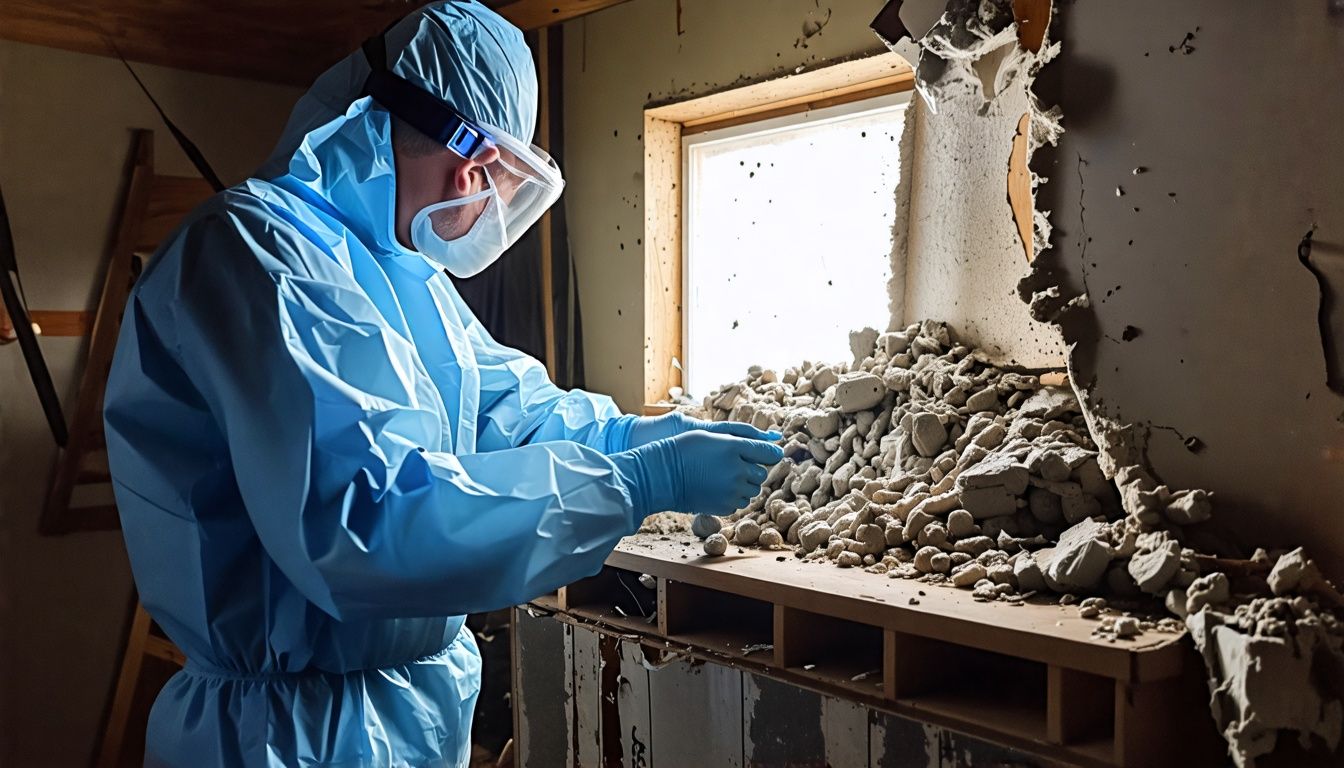
If you are conducting a visual inspection without touching or disturbing materials, the risk is low. But if you are collecting samples — even carefully — you must use appropriate personal protective equipment (PPE). There are no shortcuts here.
Respiratory Protection
This is non-negotiable. Use a disposable FFP3 respirator or a half-face respirator fitted with P3 filters. Standard dust masks and surgical masks offer no meaningful protection against asbestos fibres — they are too fine to be filtered by anything less than P3-rated filtration.
Make sure the mask is correctly fitted and face-checked before you enter the area.
Full PPE for Sampling
- Disposable coveralls (Type 5/6) — Full-body, hooded coveralls prevent fibres settling on your clothing
- Nitrile gloves — Disposable, chemical-resistant, and properly fitted at the wrist
- Disposable boot covers — Prevent tracking fibres through the rest of your property
- FFP3 or P3-filtered respirator — Correctly fitted and face-checked before entering the area
- Safety goggles — If there is any risk of material falling or spraying
All disposable PPE must be double-bagged in heavy-duty polythene bags, sealed, and disposed of as asbestos waste — not in your household bin. Asbestos waste is classified as hazardous waste in the UK and must go to a licensed hazardous waste disposal facility.
Step-by-Step: How to Safely Collect a Sample for Testing
We would always recommend having sampling carried out by a professional surveyor. But if you choose to use a testing kit and collect a sample yourself, follow this process carefully.
Before You Start
- Clear the room of other people and pets
- Turn off any ventilation, fans, or air conditioning that could spread fibres
- Lay plastic sheeting on the floor beneath the area you are working on
- Put on your full PPE before entering the area
Taking the Sample
- Lightly dampen the material using a water spray — this suppresses fibre release
- Use a sharp implement such as a knife or chisel to take a small sample — no larger than a 50p coin
- Work slowly and avoid breaking, crumbling, or crushing the material
- Immediately seal the sample in a resealable plastic bag, then place that bag inside a second bag
- Label the outer bag clearly: “Asbestos — Suspect Sample”
After Sampling
- Carefully seal any disturbed area with a small piece of duct tape or specialist sealant
- Remove your PPE carefully — peel off coveralls from the outside in, rolling them downward
- Dispose of all used PPE as asbestos waste
- Wash your hands and face thoroughly
- Clean the area using damp wipes — never a standard vacuum cleaner, which will spread fibres through the air
What the Law Says About Asbestos Testing in UK Properties
Many homeowners do not realise that asbestos legislation can apply to them — not just commercial landlords and large businesses. Understanding your legal position before you test for asbestos is essential.
The Duty to Manage
The Control of Asbestos Regulations place a legal duty on those responsible for non-domestic premises to manage asbestos. For private homeowners living in their own home, this specific duty does not apply in the same way.
However, the moment you employ someone to work on your property, they have a right to know about any known asbestos hazards. Failing to disclose this puts both you and them at legal risk.
Landlords and Rental Properties
If you rent out a property, the duty to manage asbestos applies to you as the dutyholder. You are legally required to have a management survey carried out, maintain an asbestos register, and ensure that contractors are made aware of ACMs before any work begins.
This is not optional — it is a legal obligation under the Control of Asbestos Regulations.
Licensed vs Non-Licensed Work
Not all asbestos work requires a licensed contractor, but some does. Work on higher-risk materials — such as pipe lagging, sprayed coatings, and insulating board — must be carried out by an HSE-licensed contractor.
Lower-risk, non-licensed work — such as removing intact cement sheets with the correct precautions — can be carried out without a licence but must still follow strict safety procedures set out in HSE guidance. If you are unsure which category your situation falls into, seek professional advice before proceeding.
Choosing the Right Type of Professional Survey
When a professional survey is the right route, it is worth understanding the different types available so you commission the one that matches your circumstances.
Management Survey
A management survey is the standard starting point for most homeowners and landlords. It covers all normally accessible areas of a property and is designed to locate ACMs that could be disturbed during normal occupation or routine maintenance. The output is a written report with a risk assessment and management recommendations.
Refurbishment Survey
If you are planning significant building work, a refurbishment survey goes further. It involves destructive inspection of areas that will be affected by the works, to ensure nothing is missed before contractors move in. This type of survey is required by law before any refurbishment work begins.
Demolition Survey
Before any structure is demolished, a demolition survey must be carried out. This is the most thorough type of survey, involving intrusive inspection of the entire structure to locate all ACMs before demolition work commences.
Re-Inspection Survey
If ACMs have been identified and are being managed in place rather than removed, a periodic re-inspection survey is required — typically on an annual basis — to check for deterioration and ensure the management plan remains effective.
Choosing a Qualified Asbestos Surveyor
Not all surveyors are equal. When selecting someone to carry out professional asbestos testing or a survey, check the following before booking.
- The surveyor should hold a BOHS P402 qualification (or recognised equivalent)
- The company should be UKAS-accredited for asbestos surveying
- Surveyors should work to the standards set out in HSG264, the HSE’s guidance document on asbestos surveys
- Ask to see evidence of qualifications and accreditation — a reputable company will provide this without hesitation
If you are based in the capital and need qualified local expertise, our asbestos survey London service is available across all London boroughs, carried out by fully qualified surveyors working to HSG264 standards.
Managing Asbestos in Place: When Removal Is Not the Answer
Once you have tested for asbestos and confirmed its presence, removal is not always the right response. In many cases, ACMs in good condition are better left in place and managed, rather than removed.
Removal itself carries risk — disturbing intact asbestos to remove it can create more of a hazard than simply monitoring it over time. An effective management plan includes:
- A written record of where ACMs are located, their condition, and their risk rating
- Regular re-inspection — typically annually — to check for deterioration
- Clear communication to anyone working in the property, including tradespeople, contractors, and tenants
- Action protocols if materials become damaged or disturbed
Supernova Asbestos Surveys provides re-inspection surveys to help property owners keep their asbestos management plans current and remain compliant with their legal obligations.
The Health Risks: Real, but Manageable
Asbestos-related diseases — including mesothelioma, asbestosis, and asbestos-related lung cancer — are serious and irreversible. They develop after prolonged or significant exposure to airborne asbestos fibres, typically following repeated disturbance of ACMs without adequate protection.
For most homeowners who are not carrying out building work, the risk from undisturbed ACMs in good condition is very low. The risk increases sharply the moment materials are disturbed without proper precautions in place.
This is precisely why knowing how to test for asbestos correctly — and when to hand over to a professional — matters so much. Getting it right from the start avoids creating a hazard that did not previously exist.
When to Call a Professional Instead of Testing Yourself
DIY sample collection is a legitimate option in some circumstances, but there are situations where you should not attempt it yourself and should call a qualified surveyor directly.
- The suspected material is damaged, friable, or already crumbling
- The material is in a confined space or difficult-to-access area
- You are a landlord with a legal duty to manage asbestos across a rental property
- You are about to commence refurbishment or demolition work
- You have already disturbed a material and are concerned about exposure
- You need a legally defensible survey report for a property transaction
In any of these situations, a professional survey is not just the safer option — it is often the legally required one.
Frequently Asked Questions
Can I test for asbestos myself at home?
Yes, in some circumstances. If you want to test a single suspect material, you can use a dedicated testing kit to collect a small sample and send it to an accredited laboratory for analysis. However, you must use the correct PPE, follow safe sampling procedures, and dispose of all waste as hazardous material. For comprehensive assessments, planning building work, or landlord compliance, a professional survey is the appropriate route.
How much does asbestos testing cost in the UK?
The cost varies depending on the route you take. A DIY testing kit with laboratory analysis is the most affordable option for testing a single material. A professional survey will cost more but provides a full written report, risk assessment, and legal compliance documentation. Contact Supernova Asbestos Surveys on 020 4586 0680 for a quote tailored to your property.
What types of asbestos are found in UK homes?
The three most commonly encountered types in UK residential properties are chrysotile (white asbestos), amosite (brown asbestos), and crocidolite (blue asbestos). All three are hazardous when fibres are inhaled, though they vary in risk level. Chrysotile was the most widely used and is found in textured coatings, floor tiles, and cement products. Amosite and crocidolite were used in insulation and insulating board and are considered higher risk.
Do I have to remove asbestos if it is found in my property?
Not necessarily. ACMs in good condition and unlikely to be disturbed are often best left in place and managed rather than removed. Removal itself disturbs the material and can increase risk if not handled correctly by a licensed contractor. A professional surveyor will assess the condition and risk of any ACMs found and recommend whether management or removal is the appropriate course of action.
How long does it take to get asbestos test results back?
Turnaround times vary depending on the laboratory and the service level selected. Standard analysis through an accredited laboratory typically takes a few working days. Some services offer faster turnaround for urgent situations. When you use Supernova’s sample analysis service, you will be advised of expected timescales at the point of submission.
Get Professional Asbestos Testing from Supernova
Supernova Asbestos Surveys has completed over 50,000 surveys across the UK. Our fully qualified surveyors hold BOHS P402 qualifications, operate under UKAS accreditation, and work to HSG264 standards on every job.
Whether you need a DIY testing kit, a professional management survey, or a full refurbishment or demolition survey before building work begins, we have the expertise and accreditation to help.
Call us on 020 4586 0680 or visit asbestos-surveys.org.uk to book your survey or order a testing kit today.