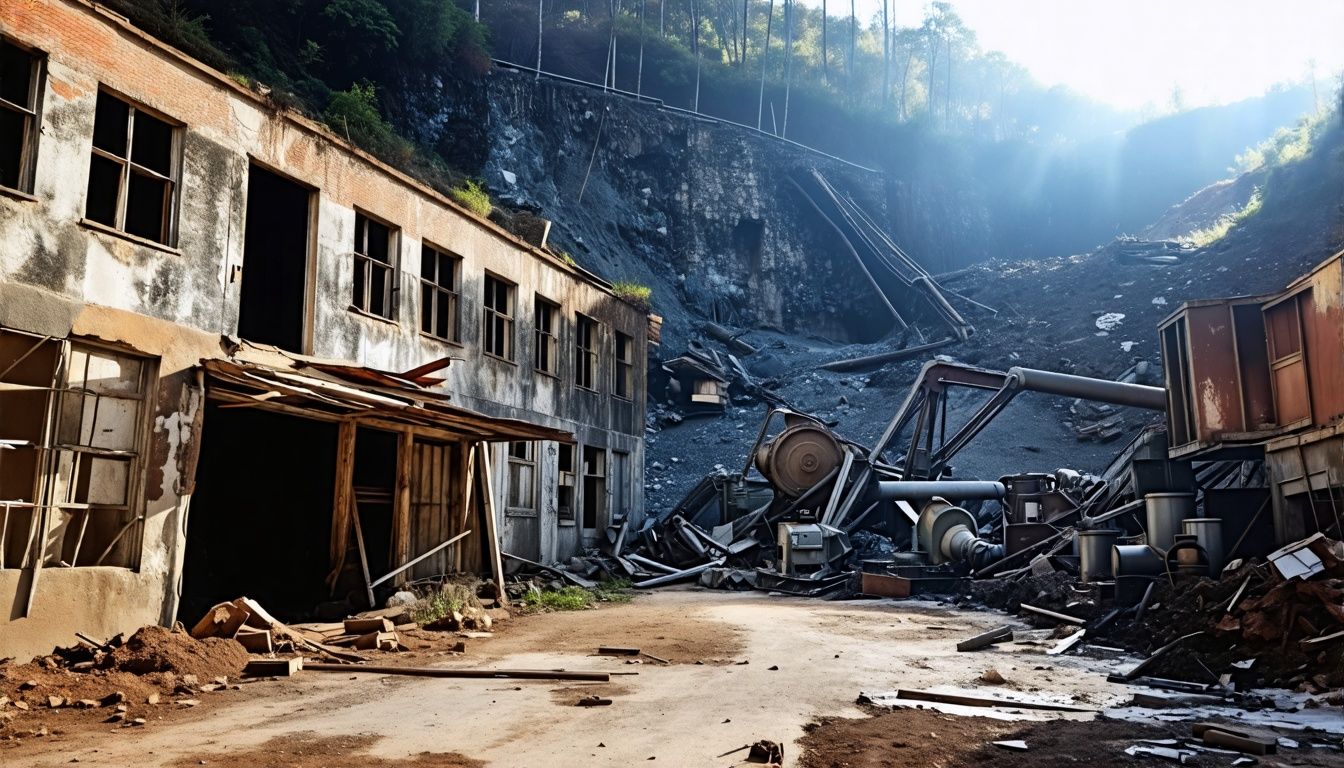
Asbestos Mining in Zimbabwe: History, Colonial Exploitation, and the Health Effects That Followed
Asbestos didn’t spread across the globe by accident. The story of asbestos mining in Zimbabwe — its history, the colonial systems that drove it, and the devastating health effects on workers and communities — is one of the clearest examples of how industrial profit was built on the backs of those least able to refuse. This history matters not just as a record of past injustice, but because the asbestos mined in what was then Rhodesia is still embedded in British buildings today, still posing risks to workers and occupants decades later.
Zimbabwe’s Place in the Global Asbestos Story
Zimbabwe — known as Rhodesia under British colonial rule — was one of the world’s most significant asbestos-producing nations throughout the 20th century. The country’s deposits, found primarily in the Mashava and Zvishavane districts, were rich in chrysotile (white asbestos), the most widely used commercial variety.
At its peak, Zimbabwe ranked among the top five asbestos exporters globally. These mining operations weren’t a minor footnote in asbestos history — they were central to supplying the industrial demand of Britain, Europe, and beyond, particularly during the post-war construction boom that embedded asbestos-containing materials into buildings across the UK.
The Geography of Colonial Asbestos Mining
The world’s major asbestos deposits were not found in Western Europe’s industrial heartlands. They were found in colonial territories. Canada’s Quebec province, South Africa’s Northern Cape, and Zimbabwe were among the most heavily exploited regions.
This geography was not coincidental. Colonial infrastructure, built to extract and export natural resources, made the large-scale asbestos trade possible and profitable for imperial powers. In Zimbabwe, British commercial interests identified the asbestos deposits in the late 19th century. Mining operations expanded rapidly through the early 20th century, driven by insatiable demand from British industry for a material that was cheap, fire-resistant, and seemingly miraculous in its versatility.
How Colonialism Shaped Asbestos Mining in Zimbabwe
The economic logic of colonial asbestos extraction was straightforward: mine as much as possible, at the lowest possible cost, and export it to meet demand elsewhere. What made this viable was the systematic exploitation of local labour under conditions that would have been considered unacceptable — and increasingly illegal — in Britain itself.
Workers in Zimbabwe’s asbestos mines were predominantly Black Africans operating under the racial and legal structures of colonial Rhodesia. Wages were minimal. Trade union rights were absent or severely restricted. Protective equipment was essentially non-existent. Asbestos dust — the very substance that causes mesothelioma, asbestosis, and lung cancer — filled the air of mines and processing facilities day after day.
Working Conditions in the Mines
The conditions in Zimbabwe’s asbestos mines were brutal by any measure. Workers handled raw asbestos fibre with bare hands, often in enclosed processing sheds where dust concentrations were dangerously high. There was no respiratory protection, no dust suppression, and no medical monitoring.
Families lived in mining compounds adjacent to the operations. Women and children were exposed to asbestos fibre carried home on workers’ clothing and drifting from open stockpiles. The community surrounding each mine was, in effect, an unprotected exposure zone — a pattern seen across colonial asbestos operations worldwide.
The Suppression of Health Information
Medical literature linking asbestos exposure to serious lung disease existed from the early 20th century. By the 1930s, credible scientific evidence of the dangers was available to company management and colonial administrators. Yet this information was systematically suppressed.
In colonial territories like Rhodesia, the suppression was particularly effective. Workers had no access to independent medical information. Colonial governments, whose economic interests were aligned with maintaining output, had no incentive to publicise findings that might undermine production. The result was that generations of Zimbabwean miners were exposed to lethal concentrations of asbestos fibre without any understanding of what it was doing to their lungs.
The Health Effects of Asbestos Mining in Zimbabwe’s Communities
The health consequences of asbestos mining in Zimbabwe were severe and long-lasting. The diseases caused by asbestos exposure have latency periods of 20 to 50 years. By the time illness appeared in mining communities, the operations responsible had often closed or changed ownership, making legal accountability virtually impossible to establish.
Mesothelioma
Mesothelioma is a cancer of the lining of the lungs, abdomen, or heart, caused almost exclusively by asbestos exposure. It is invariably fatal, typically within 12 to 18 months of diagnosis. Workers in Zimbabwe’s asbestos mines faced significant mesothelioma risk, as did their family members exposed through secondary contamination.
The disease has no safe threshold of exposure. Even relatively brief contact with asbestos fibre can cause it decades later — a fact that was known to industry long before it was acted upon.
Asbestosis
Asbestosis is a chronic, progressive scarring of the lung tissue caused by the inhalation of asbestos fibres. It causes breathlessness, reduced lung function, and a significantly shortened life expectancy. For workers who spent years in Zimbabwe’s dusty mine shafts and processing facilities, asbestosis was an occupational inevitability rather than a risk to be managed.
Lung Cancer and Other Respiratory Diseases
Asbestos exposure significantly increases the risk of lung cancer, particularly in combination with smoking. Pleural plaques and pleural thickening — while not cancerous themselves — are markers of significant asbestos exposure and can cause lasting respiratory impairment.
Communities around Zimbabwe’s mining districts experienced elevated rates of all these conditions, often without access to the specialist medical care needed to diagnose or manage them. The full scale of the health burden was never properly documented under the colonial administration, and that data gap remains a significant injustice in itself.
The Post-Colonial Legacy of Zimbabwe’s Asbestos Industry
Zimbabwe’s asbestos mining continued after independence in 1980, though the industry declined significantly through the 1990s and 2000s. The Shabanie Mine and the Gaths Mine were among the last operational sites. By the early 2000s, most large-scale asbestos mining in Zimbabwe had effectively ceased, driven by a combination of falling global demand, international pressure, and the country’s wider economic difficulties.
However, the legacy of decades of mining remained. Contaminated sites, legacy waste, and communities still living near former operations continued to pose ongoing health risks. The infrastructure of the colonial mining era — the compounds, the processing facilities, the stockpiles — left behind a landscape of residual hazard that has never been fully remediated.
The Global Shift in Asbestos Production
As health evidence mounted and Western nations began introducing asbestos bans — the UK prohibited blue and brown asbestos in 1985 and all forms of asbestos by 1999 — production shifted rather than stopped. Russia, China, Kazakhstan, and India became the dominant producers and consumers.
The pattern is recognisable: the health burden of asbestos use continued to fall on those with the least political and economic power to refuse it. The colonial dynamic changed its geography but not its essential character.
What Asbestos Mining in Zimbabwe Means for UK Buildings Today
For UK property managers, building owners, and duty holders, the history of asbestos mining in Zimbabwe has a very direct practical dimension. The chrysotile mined in Rhodesia was exported to Britain and incorporated into buildings throughout the mid-20th century. It is present today in ceiling tiles, pipe lagging, floor tiles, textured coatings, insulating boards, and roofing materials across the UK’s building stock.
Any building constructed or refurbished before the year 2000 may contain asbestos-containing materials. The Control of Asbestos Regulations place a legal duty on those responsible for non-domestic premises to manage the risk — knowing where asbestos is, what condition it is in, and having a management plan in place.
Ignoring that duty isn’t just a legal risk. It is a continuation, in a very real sense, of the same disregard for human health that defined the colonial asbestos trade in the first place.
Your Legal Obligations Under the Control of Asbestos Regulations
The duty to manage asbestos is not optional. It applies to anyone who has responsibility for the maintenance or repair of non-domestic premises. Failing to meet these obligations is a criminal offence, and the HSE takes enforcement seriously.
In practical terms, compliance involves the following:
- A management survey is required for occupied buildings to identify and assess the condition of asbestos-containing materials that may be disturbed during normal use or routine maintenance.
- A refurbishment survey is required before any intrusive work begins — a more thorough investigation involving sampling of materials likely to be disturbed.
- A demolition survey is required before a building is demolished, ensuring all asbestos-containing materials are identified and safely removed before structural work starts.
- A re-inspection survey is needed at regular intervals to monitor the condition of known asbestos-containing materials and update the asbestos register accordingly.
- An asbestos register must be maintained and made available to any contractor or worker before they carry out work on the building.
HSG264, the HSE’s guidance on asbestos surveys, provides the technical framework that accredited surveyors follow. Ensuring your surveyor works to this standard is a basic requirement of due diligence.
Testing and Sampling Options for Suspect Materials
If you suspect materials in your building may contain asbestos but have not yet had a full survey, asbestos testing can provide an important first step. Samples taken from suspect materials are analysed under polarised light microscopy to confirm the presence or absence of asbestos fibres and identify the type.
Our UKAS-accredited laboratory offers rapid sample analysis for materials you need to assess quickly. Turnaround times are fast, and results are clear and actionable.
For situations where you want to check a specific material before deciding whether to commission a full survey, our asbestos testing kit allows you to take a sample safely and send it for professional analysis. It’s a practical option for landlords, facilities managers, and property owners who need a quick answer on a specific material.
If you’re based in or around the capital and need fast, professional support, our team carries out asbestos survey London work across all boroughs, typically with short lead times and no unnecessary delays.
The Ethical Dimension: Then and Now
The history of asbestos mining in Zimbabwe, and the broader colonial asbestos trade, raises questions that go beyond legal compliance. The industries and governments that profited from asbestos did so by externalising the cost — onto workers, onto communities, and onto future generations.
Mesothelioma deaths occurring in the UK today are a direct consequence of decisions made decades ago by people who either didn’t know or chose not to act on what they did know. The asbestos that remains in UK buildings is a legacy of that history.
How it is managed — whether responsibly or recklessly — is a choice that today’s duty holders make every time they commission a refurbishment, bring in a contractor, or decide whether to invest in a proper survey. Responsible asbestos management is not bureaucratic box-ticking. It is the practical, modern expression of a principle that should have been applied from the beginning: the people who work in and around buildings containing asbestos deserve to know about the risk, and those responsible for those buildings have an obligation to protect them.
The workers in Zimbabwe’s mines had no such protection. The workers in your building can.
Frequently Asked Questions
What type of asbestos was mined in Zimbabwe?
Zimbabwe’s mines produced primarily chrysotile, also known as white asbestos. This was the most commercially widespread variety and was exported in large quantities to Britain and other industrialised nations throughout the 20th century. Chrysotile was used in a wide range of building materials, including ceiling tiles, pipe lagging, insulating boards, and roofing products.
When did asbestos mining in Zimbabwe end?
Large-scale asbestos mining in Zimbabwe had effectively wound down by the early 2000s. The decline was driven by falling global demand, growing international pressure to phase out asbestos use, and Zimbabwe’s broader economic difficulties during that period. The Shabanie and Gaths mines were among the last major operational sites before closure.
What are the main health effects of asbestos exposure from mining?
The principal diseases associated with asbestos exposure are mesothelioma (a cancer of the lining of the lungs, abdomen, or heart), asbestosis (progressive scarring of lung tissue), and lung cancer. Pleural plaques and pleural thickening are also common markers of significant exposure. All of these conditions have latency periods of 20 to 50 years, meaning illness often appears long after the original exposure occurred.
Does asbestos from Zimbabwe’s mines still pose a risk in UK buildings?
Yes. Chrysotile exported from Rhodesia was incorporated into UK buildings throughout the mid-20th century. It remains present in a wide range of materials in buildings constructed or refurbished before 2000. Under the Control of Asbestos Regulations, duty holders are legally required to identify, assess, and manage asbestos-containing materials in non-domestic premises.
How do I find out if my building contains asbestos?
The most reliable way is to commission an accredited asbestos survey from a qualified surveyor working to HSG264 standards. Depending on the circumstances, this may be a management survey for an occupied building, or a refurbishment or demolition survey if intrusive work is planned. If you need to check a specific material quickly, a professional asbestos testing service or a testing kit can provide an initial answer while you arrange a full survey.
Speak to Supernova Asbestos Surveys
Supernova Asbestos Surveys has completed over 50,000 surveys across the UK. Our accredited surveyors work to HSG264 standards and provide clear, actionable reports that help duty holders meet their obligations under the Control of Asbestos Regulations.
Whether you need a management survey for an occupied building, a refurbishment or demolition survey before works begin, or rapid sample analysis for a suspect material, we can help. Call us on 020 4586 0680 or visit asbestos-surveys.org.uk to find out more or book a survey.