A cheap asbestos test kit can feel like the quickest way to settle an awkward question about a garage roof, artex ceiling or old service panel. Sometimes it is a sensible first step. Just as often, it gives you one lab result without answering the bigger questions about risk, legal duties and what should happen next.
That distinction matters. A single sample can tell you whether one material contains asbestos, but it cannot confirm the condition of materials across a building, assess how likely fibres are to be released, or replace a formal inspection where the law or the works demand one. For a homeowner with one accessible material, an asbestos test kit may be useful. For landlords, managing agents, dutyholders and anyone planning works, professional advice is usually the safer route.
At Supernova Asbestos Surveys, we have completed more than 50,000 surveys nationwide. We regularly hear from clients who bought an asbestos test kit, received a result, and then realised they still needed a survey, clearer advice or formal reporting before they could make a proper decision.
What an asbestos test kit actually does
An asbestos test kit is not a detector that scans a room and gives an instant answer. In most cases, it is a sampling and submission pack. You take a small piece of suspect material, seal it, send it to a laboratory, and receive a result showing whether asbestos is present.
The usual process looks simple enough:
- Identify a suspect material.
- Take a small sample using the instructions provided.
- Seal and label the sample.
- Send it for laboratory analysis.
- Receive a result stating whether asbestos is present and, in many cases, the asbestos type.
The value is not really the pack itself. It is the quality of the laboratory analysis, the clarity of the reporting and the advice available afterwards. If you need dependable results rather than a basic retail product, it makes sense to use a provider offering professional asbestos testing with proper support.
What is usually included in an asbestos test kit
The contents of an asbestos test kit vary quite a bit. Some packs are little more than a bag and a submission form. Better kits include practical safety items and clearer instructions to help reduce disturbance during sampling.
A typical kit may include:
- Sample bags or pots
- Labels and submission paperwork
- Step-by-step instructions
- Return packaging
- Cleaning wipes
- Disposable gloves
- Basic protective equipment
Some suppliers go further and include disposable coveralls and respiratory protection. Others leave that to you. If you are comparing options, do not focus only on price. A very cheap asbestos test kit with poor instructions and no proper protective equipment can create more risk during sampling than it solves.
If you want a ready-made option, Supernova offers an asbestos testing kit designed to make the process clearer and more practical.
When an asbestos test kit is useful
An asbestos test kit works best when the question is narrow and the material can be sampled with very little disturbance. That usually means one clearly defined item, in reasonable condition, that is easy to access.
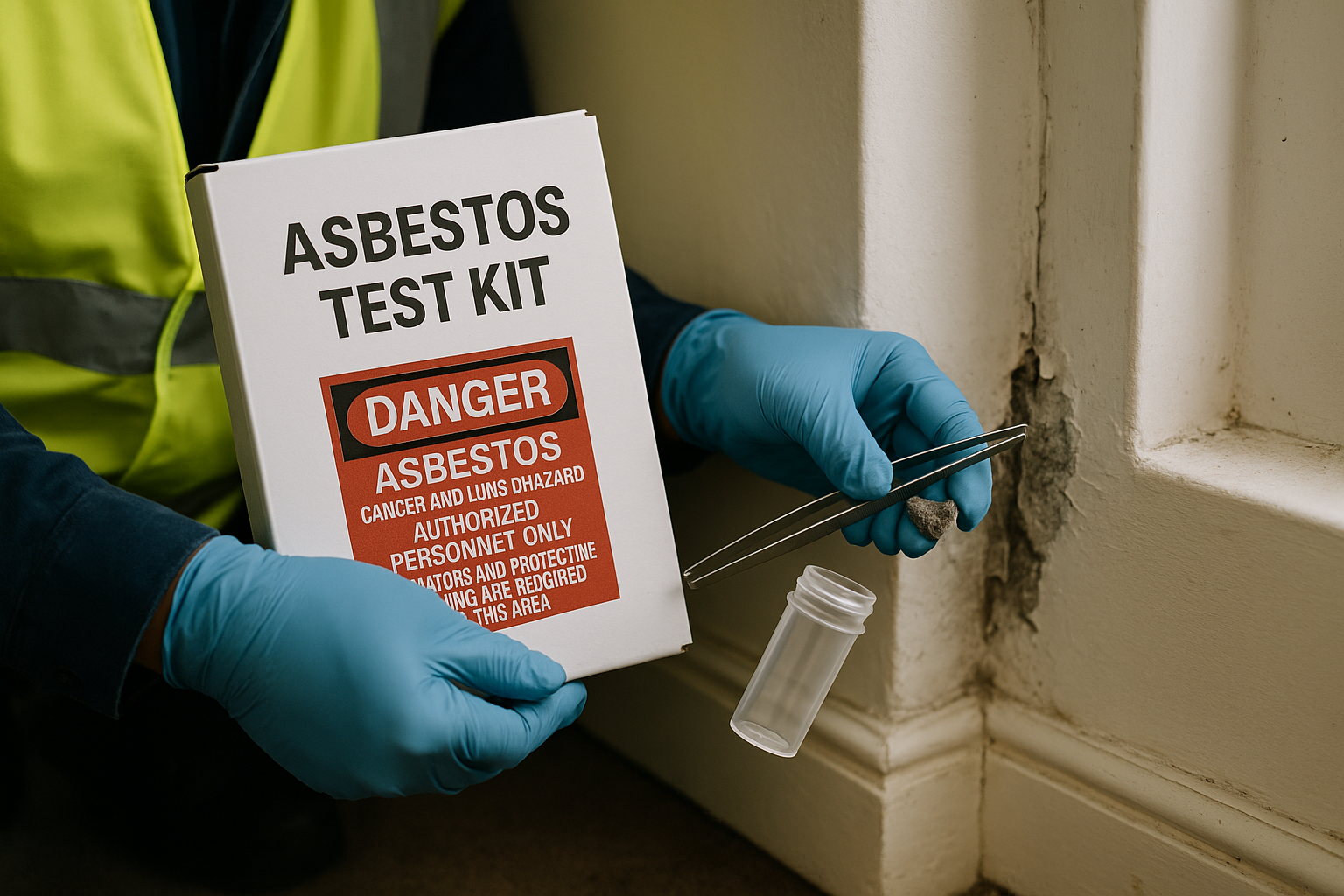
Good situations for a kit
- A homeowner checking one suspect cement sheet in a garage
- A private occupier wanting an initial answer on one textured coating
- A single board or panel that can be sampled without breaking up the area
- An accessible material where only a tiny piece is needed
In those situations, an asbestos test kit can be a practical way to confirm whether asbestos is present before deciding what to do next.
When a kit is not enough
The limitations become obvious once the property is larger, the materials are varied or there is a legal duty to manage asbestos. A lab result from one sample does not tell you whether similar-looking materials elsewhere are the same, whether the material is damaged, or whether contractors can start work safely.
Skip the DIY route and call a surveyor if you are dealing with:
- Commercial or industrial property
- Communal areas in residential blocks
- Schools, offices, shops or healthcare premises
- Planned refurbishment, strip-out or demolition
- Multiple suspect materials across a site
- Damaged or friable materials
- Any situation where formal records are needed for compliance
For occupied non-domestic premises, the Control of Asbestos Regulations place duties on those responsible for maintenance and repair. In many cases, the right starting point is a professional management survey. If intrusive works are planned, a refurbishment survey is normally required before work begins.
An asbestos test kit can answer a narrow identification question. It cannot replace a survey carried out in line with HSG264 and current HSE guidance.
Different types of asbestos test kit
Not every asbestos test kit is the same. The right option depends on whether you only need lab analysis, whether you need safety equipment included, and whether there is any technical reason for extra testing.
1. Sample analysis only
This is the most basic format. You get the packaging and paperwork needed to submit a sample, but little or no PPE. It can suit someone who already has suitable protective equipment and understands how to take a very small sample safely.
It is usually best where:
- You already have the correct PPE and RPE
- You only need one or two samples analysed
- You are confident the material can be sampled with minimal disturbance
- You know how to seal, label and return samples properly
If you already have a sample and only need the laboratory element, Supernova provides dedicated sample analysis without unnecessary extras.
2. A fuller kit with PPE and RPE included
This is often the more sensible choice for domestic users. A more complete asbestos test kit may include gloves, disposable coveralls, a suitable respirator and clearer instructions on how to dampen the area and take the smallest practical sample.
When comparing kits, look for:
- Clear step-by-step instructions
- Proper respiratory protection rather than a basic nuisance dust mask
- Disposable gloves
- Disposable coveralls where appropriate
- Sealable waste bags for used PPE
- Clear return instructions
- Understandable reporting once results are ready
The point of an asbestos test kit is not just to get a certificate. It is to get an answer while keeping disturbance to an absolute minimum.
3. Kits with additional tests
Some suppliers advertise upgrades or extra analysis. In practice, standard bulk sample analysis is enough for most situations. Extra testing is usually only helpful when there is a clear technical reason for it.
Additional analysis may be useful where:
- The first result is inconclusive
- The material is layered or mixed
- The sample is contaminated
- There is a dispute or insurance issue
- A surveyor or analyst recommends more detailed examination
Before paying for upgrades, ask three practical questions:
- Was the first sample suitable and representative?
- Has the laboratory explained why extra analysis is needed?
- Will the extra result change the decision you need to make?
If the answer to the last question is no, the extra cost may add very little value.
4. Standalone PPE and RPE packs
Some suppliers separate the protective equipment from the lab service and sell a standalone testing kit or PPE pack. That can help if you already have access to sample submission but need disposable safety items before collecting a sample.
A sensible pack should include:
- Disposable gloves
- Suitable respirator
- Disposable coveralls
- Waste bag for contaminated items
- Basic instructions on fitting and removal
How many samples do you actually need?
One of the biggest misunderstandings around an asbestos test kit is the idea that one result proves everything that looks similar is identical. It often does not. Materials in different rooms, extensions or phases of construction may have different compositions even if they look the same.
The right number of samples depends on:
- The type of material
- How consistent it looks
- How many locations it appears in
- Whether it is likely to come from one installation or several
- The level of certainty required
For example, one sample from a single garage roof sheet may be enough to identify that roof covering. Textured coatings across several rooms are different. They may have been applied at different times, by different trades or during separate refurbishments, so more than one sample is often needed.
Practical rules on sample numbers
- Treat visibly different materials as separate items
- Treat materials in different building phases as separate items
- Sample patched or repaired areas separately
- Do not assume one positive or negative result applies everywhere
- Do not keep taking extra samples if the material is becoming damaged
If you are unsure how many samples are appropriate, stop before you over-disturb the area. A professional asbestos testing service can advise on representative sampling without guesswork.
How to use an asbestos test kit more safely
If you are going to use an asbestos test kit, technique matters more than speed. The aim is to take the smallest practical sample while releasing as little dust as possible.
Before you start
- Keep other people away from the area
- Turn off fans or ventilation that could move dust
- Prepare labels, tools and sample bags in advance
- Lay down disposable sheeting if appropriate
- Wear the PPE and RPE provided or sourced separately
Taking the sample
- Lightly dampen the surface if suitable for the material.
- Take a very small piece from an inconspicuous point.
- Place it straight into the sample bag or pot.
- Seal the sample immediately.
- Wipe down the surrounding area with damp wipes if appropriate.
- Bag used wipes and disposable PPE as waste.
Do not drill, sand or break up large sections. If the material starts to crumble, release visible debris or feels friable, stop. That is no longer a sensible situation for a DIY asbestos test kit.
After sampling
- Label the sample clearly with location and material description
- Wash hands and any exposed skin
- Keep submission paperwork accurate
- Do not leave debris behind
- Wait for the result before carrying out work
A negative result for one material does not mean the building is asbestos-free. It only applies to the sample tested.
Common mistakes people make with an asbestos test kit
Most problems do not come from the laboratory. They happen during sampling or when people assume the result answers more than it really does.
Common mistakes include:
- Taking a sample from the wrong material
- Assuming one sample covers the whole property
- Using poor-quality or unsuitable PPE
- Breaking off too much material
- Sampling damaged or friable materials that should be left alone
- Starting refurbishment work before results are back
- Thinking a negative result on one item means all works can proceed
If there is any doubt about the material, the extent of asbestos in the building or the legal position, a professional survey is usually the more efficient answer.
What happens after the result comes back?
A positive result from an asbestos test kit does not automatically mean panic, removal or major cost. The next step depends on the type of material, its condition, where it is located and whether it is going to be disturbed.
After a positive result, ask:
- Is the material in good condition?
- Is it likely to be damaged or disturbed?
- Is the property domestic or non-domestic?
- Are any works planned nearby?
- Do you need a formal asbestos register or survey report?
In many cases, asbestos-containing materials can remain in place if they are in good condition and managed properly. In other cases, encapsulation, repair or removal may be needed. The result tells you what the material is. It does not, by itself, tell you the full management strategy.
If the result is negative, that is useful, but only for that sample. It does not rule out asbestos elsewhere in the building.
Asbestos test kit or asbestos survey: which should you choose?
This is the real decision for many property owners and managers. A DIY asbestos test kit can be a sensible tool where the question is small and specific. A survey is the right answer where the building, the legal duty or the planned works are wider.
Choose a test kit if:
- You are a homeowner with one suspect item
- The material is accessible and in reasonable condition
- You only need to know whether that one item contains asbestos
- No refurbishment or demolition work is planned
Choose a survey if:
- You are responsible for non-domestic premises
- You need to comply with the duty to manage
- There are several suspect materials
- Works are planned that will disturb the fabric of the building
- You need formal documentation for contractors, tenants or records
For dutyholders and commercial clients, a survey is often the only route that properly addresses compliance under the Control of Asbestos Regulations. HSG264 sets out how asbestos surveys should be carried out, and HSE guidance makes clear that the right survey type depends on how the building is being used and what work is planned.
Practical advice for landlords, agents and property managers
If you manage property professionally, treat an asbestos test kit as a limited tool rather than a full solution. It may help answer a narrow question, but it rarely replaces the need for structured asbestos management.
A sensible approach is to:
- Identify whether the premises are domestic, communal or non-domestic.
- Check whether there is already an asbestos survey or register.
- Review whether any maintenance or refurbishment works are planned.
- Avoid disturbing suspect materials before the right inspection is arranged.
- Use testing or surveying services that provide clear reporting and follow-up advice.
If you need local support, Supernova provides services including asbestos survey London, asbestos survey Manchester and asbestos survey Birmingham.
How to choose the best asbestos test kit
The best asbestos test kit is not always the cheapest. It is the one that matches your situation, gives clear instructions, uses proper laboratory analysis and does not encourage unsafe sampling.
Before buying, check:
- Whether the kit includes PPE and RPE
- How many samples are included in the price
- How samples should be packaged and returned
- What turnaround information is provided
- Whether the reporting is clear and usable
- Whether there is expert support if the result is positive
If a supplier is vague about the lab process, the protective equipment or what happens after the result, that is a warning sign. A good asbestos test kit should make the process clearer, not leave you guessing.
Frequently Asked Questions
Is an asbestos test kit accurate?
An asbestos test kit can be accurate if the sample is taken correctly and analysed by a competent laboratory. The main weakness is usually the sampling stage, not the lab. If the wrong material is sampled or the sample is not representative, the result will not answer the right question.
Can an asbestos test kit replace an asbestos survey?
No. An asbestos test kit only identifies whether a submitted sample contains asbestos. It does not assess the wider building, the condition of materials, the risk of disturbance or compliance duties. For non-domestic premises and planned refurbishment works, a professional survey is usually required.
Is it safe to take my own asbestos sample?
Only in limited situations. If the material is accessible, in reasonable condition and can be sampled with minimal disturbance, a small sample may be possible using proper PPE and careful technique. If the material is damaged, friable or likely to release dust, do not sample it yourself.
What should I do if the test result is positive?
Do not disturb the material further. The next step depends on its condition, location and whether any work is planned. In some cases it can be managed in place. In others, you may need a survey, risk assessment, encapsulation or removal advice.
How quickly should I arrange help if I am unsure?
Immediately, if the material is damaged or works are planned. Do not let contractors start until the asbestos position is clear. Early advice is usually cheaper and safer than dealing with contamination after the fact.
If you are unsure whether an asbestos test kit is enough, speak to Supernova Asbestos Surveys. We can advise on testing, sample analysis and the right survey for your property. Call 020 4586 0680 or visit asbestos-surveys.org.uk to book a service or get expert guidance.