Why Certified Asbestos Testing Is One of the Most Important Decisions You’ll Make as a Building Owner
If your building was constructed before 2000, there is a reasonable chance it contains asbestos-containing materials (ACMs). That is not a reason to panic — but it is absolutely a reason to get the facts from a certified asbestos professional. The wrong company can leave you exposed, both physically and legally.
The right one gives you accurate, defensible results and a clear path forward. Here is everything you need to know about choosing a qualified asbestos testing company in the UK — what accreditation really means, what the process looks like, what it costs, and why cutting corners almost always ends up costing far more.
Why Certified Asbestos Testing Is a Legal Necessity, Not an Option
Asbestos fibres are invisible to the naked eye. You cannot identify an ACM by looking at it, touching it, or smelling it. The only way to know for certain is laboratory analysis — and that analysis must be carried out by a UKAS-accredited facility to be credible and legally defensible.
Under the Control of Asbestos Regulations, duty holders — landlords, employers, building managers — have a legal obligation to manage asbestos in non-domestic premises. That obligation begins with knowing what is present in your building.
Professional certified asbestos testing gives you:
- Confirmed identification of ACMs, including type, location, and condition
- Results that will withstand regulatory scrutiny from the HSE and local authorities
- Documentation suitable for insurance, property transactions, and compliance records
- A solid foundation for an asbestos management plan
Without this, you are making decisions about your building — and the safety of the people inside it — based on guesswork. That is not a position any responsible duty holder should accept.
What Accreditation Actually Means for a Certified Asbestos Company
When comparing asbestos testing companies, accreditation is the single most important factor to verify. There are two bodies you need to know about.
UKAS Laboratory Accreditation
The United Kingdom Accreditation Service (UKAS) is the national body that accredits laboratories against internationally recognised standards. A UKAS-accredited laboratory for asbestos fibre identification has been independently assessed for competence, impartiality, and consistency.
If a company sends your samples to a non-UKAS lab, those results may not be accepted by the HSE, local authorities, or your insurers. Always ask which laboratory a company uses and verify that it holds current UKAS accreditation before you commit.
UKAS Accreditation as an Inspection Body
Beyond the laboratory, the surveying organisation itself should ideally hold UKAS accreditation as an inspection body — typically to ISO 17020. This covers the quality of the survey process itself: how samples are collected, how findings are recorded, and how reports are compiled.
A certified asbestos company with ISO 17020 accreditation has had its entire operation independently audited, not just its lab results. That distinction matters enormously when your compliance record is on the line.
Individual Surveyor Qualifications
Individual surveyors should hold qualifications recognised by the industry. The British Occupational Hygiene Society (BOHS) P402 certificate is the benchmark for asbestos surveying and sampling.
Ask any company whether their surveyors hold this or an equivalent qualification. If they cannot give you a straight answer, look elsewhere — this is not an area where vague reassurances are acceptable.
What Services Should a Certified Asbestos Company Offer?
A reputable certified asbestos company offers far more than a basic sample test. Depending on your situation, you may need one or more of the following services.
Management Survey
The standard survey for occupied buildings, a management survey locates and assesses ACMs that could be disturbed during day-to-day use or routine maintenance. It is the starting point for any asbestos management plan and a legal requirement for most non-domestic properties.
Refurbishment Survey
Before any refurbishment work begins, a more intrusive survey is required. A refurbishment survey identifies all ACMs in the areas affected by the planned work — including materials that would normally be left undisturbed. It is a legal requirement before contractors are appointed and work commences.
Demolition Survey
If a building or part of a building is to be demolished, a demolition survey is required. This is the most intrusive type of survey, designed to locate all ACMs throughout the structure before any demolition work begins, as required under HSE guidance.
Re-Inspection Survey
If you already have an asbestos management plan in place, the condition of known ACMs needs to be reviewed periodically. A re-inspection survey checks whether materials have deteriorated, been disturbed, or require remediation — keeping your management plan current and your compliance intact.
Asbestos Testing
If you have a specific material you are concerned about — a ceiling tile, a section of pipe lagging, a floor adhesive — asbestos testing gives you a definitive answer without commissioning a full survey. Supernova also offers a postal asbestos testing kit, allowing you to submit a sample safely for UKAS-accredited laboratory analysis.
Asbestos Removal
Some certified asbestos companies also provide licensed removal services. Working with one provider for both survey and removal simplifies the process significantly.
For licensable work — which covers the most hazardous asbestos types and higher-risk tasks — the contractor must hold a licence issued by the HSE. Supernova’s asbestos removal service is available alongside our full survey offering.
How Certified Asbestos Testing Actually Works
Understanding the process helps you evaluate whether a company is doing things properly — or cutting corners. Every reputable certified asbestos provider follows the same core steps.
Step 1: Site Survey and Sample Collection
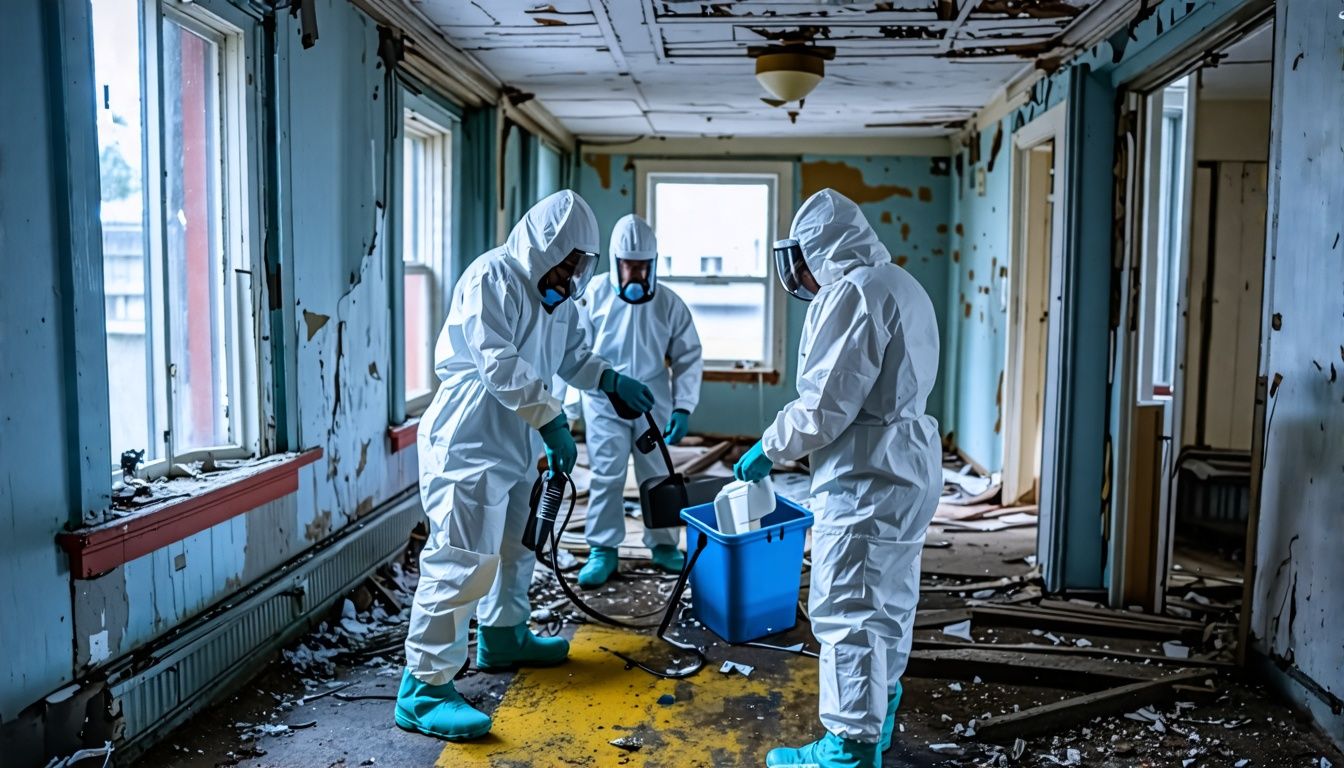
A qualified surveyor visits the property and systematically inspects accessible areas for materials that may contain asbestos. Where ACMs are suspected, small bulk samples are carefully extracted using appropriate PPE and containment procedures to avoid releasing fibres.
Samples are sealed in airtight containers, labelled with location data and reference numbers, and dispatched to an accredited laboratory. The surveyor should minimise disturbance throughout — poor sampling technique can create the very risk you are trying to assess.
Step 2: Laboratory Analysis
Bulk samples are analysed using polarised light microscopy (PLM), which identifies the type and concentration of asbestos fibres present. Air monitoring samples — taken to assess airborne fibre concentrations — are typically analysed by phase contrast microscopy (PCM) or transmission electron microscopy (TEM) for greater sensitivity.
A UKAS-accredited lab follows strict quality control procedures and participates in proficiency testing schemes to ensure its results are reliable and reproducible. This is what separates credible sample analysis from a result you simply cannot rely on.
Step 3: Reporting
The final report should clearly set out:
- Which materials were sampled and where
- Whether asbestos was identified and what type
- The condition and risk rating of any ACMs found
- Recommended actions — removal, encapsulation, or ongoing monitoring
A good report includes photographs and floor plans to support the findings. It should be written in plain English — you should finish reading it with a clear picture of what, if anything, needs to happen next.
The Real Risks of DIY Asbestos Testing
DIY testing kits are available online and from some hardware retailers. They are cheap, and that is essentially the only thing in their favour.
Exposure Risk
Collecting a sample from an ACM without training or proper PPE can disturb asbestos fibres and release them into the air. Asbestos-related diseases — including mesothelioma, lung cancer, and asbestosis — are caused by inhaling these fibres, and there is no known safe level of exposure.
Even careful handling carries a significant risk of cross-contamination, spreading fibres to other areas of the property, clothing, or vehicles. The effects of exposure may not appear for decades, which is precisely why taking shortcuts with sampling is so dangerous.
Unreliable Results
The quality of a DIY result depends entirely on how the sample was collected and whether it is representative of the material. Untrained individuals frequently collect insufficient material, contaminated samples, or samples from the wrong part of a suspect material.
This leads to false negatives — the most dangerous outcome, because it creates a false sense of security about materials that may still pose a risk. A false negative from an unaccredited test is not a clean bill of health; it is a liability waiting to surface.
Legal and Commercial Consequences
Results from non-UKAS-accredited testing are not legally defensible. If you rely on a DIY result to make decisions about refurbishment work or a property transaction, you could face serious consequences if ACMs are subsequently discovered.
For duty holders under the Control of Asbestos Regulations, using inadequate testing methods does not satisfy your legal obligations — regardless of what the test result said. Insurers are unlikely to accept a claim that relied on unaccredited testing.
What Does Certified Asbestos Testing Cost in the UK?
Costs vary depending on the size of the property, the type of survey, the number of samples required, and the location. As a general guide:
- Single bulk sample analysis — typically £25–£50 per sample through a postal testing kit
- Management survey (small residential property) — from around £200–£300
- Management survey (commercial property) — from £300 upwards, depending on size and complexity
- Refurbishment or demolition survey — typically higher, reflecting the more intrusive nature of the work
Be cautious of very low quotes. Cutting costs on a certified asbestos survey almost always means fewer samples, a less thorough inspection, or analysis by a non-accredited laboratory. Any of those compromises can leave you with an inaccurate picture of your building — and that is a liability, not a saving.
Questions to Ask Before Appointing a Certified Asbestos Testing Company
Before you commit, ask any prospective company the following questions:
- Do you hold UKAS accreditation as an inspection body?
- Which laboratory do you use, and is it UKAS-accredited for asbestos analysis?
- What qualifications do your surveyors hold? (Look for BOHS P402 or equivalent)
- Will the report include photographs, sample locations, and a risk assessment?
- What is the turnaround time for results?
- Do you offer removal services if ACMs are found?
A reputable certified asbestos company will answer these questions without hesitation. Vague responses or reluctance to confirm accreditation details are clear warning signs — treat them as such.
Asbestos in Residential Properties: What Homeowners Need to Know
The Control of Asbestos Regulations primarily applies to non-domestic premises, but homeowners are not entirely off the hook. If you are planning renovation work on a property built before 2000, contractors have a legal duty to assess whether ACMs are present before work begins.
As a homeowner, you have a practical obligation to your family and the tradespeople working in your home. Common locations for ACMs in residential properties include:
- Artex and textured coatings on ceilings and walls
- Floor tiles and the adhesive beneath them
- Pipe lagging and boiler insulation
- Roof and soffit boards, particularly in pre-1980s properties
- Garage and outbuilding roofs — corrugated asbestos cement sheets are common
- Insulating board around fireplaces and in airing cupboards
If you are buying or selling a property, a clear asbestos report from a certified asbestos surveyor can add transparency to the transaction and protect all parties. Buyers increasingly request this information, and having it prepared in advance demonstrates responsible ownership.
For homeowners who want to check a specific material before calling in a full survey, a testing kit with UKAS-accredited laboratory analysis offers a cost-effective starting point — provided the sample is collected correctly and safely.
How HSG264 Shapes the Certified Asbestos Survey Process
HSG264 is the HSE’s guidance document for asbestos surveys. It sets out the standards that certified asbestos surveyors are expected to follow, covering everything from survey planning and sample collection to report writing and risk assessment.
A surveyor who follows HSG264 will plan the survey to ensure adequate coverage of the building, take sufficient samples to characterise materials properly, and produce a report that meets the expectations of the HSE and other regulatory bodies.
When you ask a company whether their surveys comply with HSG264, a competent provider will confirm this immediately. If there is any hesitation, or if the surveyor is unfamiliar with the guidance, that is a significant red flag. HSG264 compliance is not optional for credible certified asbestos work — it is the baseline.
Managing Asbestos After the Survey: Your Ongoing Obligations
A certified asbestos survey is not a one-off exercise. Once ACMs have been identified, the duty holder’s obligations continue. The Control of Asbestos Regulations requires that a written asbestos management plan is produced and kept up to date.
That plan must record the location and condition of all known ACMs, set out how they will be managed — whether through encapsulation, labelling, monitoring, or removal — and be communicated to anyone who might disturb those materials. Contractors, maintenance teams, and emergency services all need to know what is present and where.
The condition of ACMs can change over time. Damage, deterioration, or building works can alter the risk profile of a material that was previously considered low risk. This is why periodic re-inspection is not just good practice — it is a legal expectation under the regulations. Keeping your asbestos register current is an ongoing duty, not a box you tick once and forget.
If you need support with asbestos testing as part of your ongoing management obligations, Supernova’s team can advise on the most appropriate approach for your property and circumstances.
Get Certified Asbestos Testing From a Company You Can Trust
Supernova Asbestos Surveys has completed over 50,000 surveys across the UK. Our surveyors are fully qualified, our laboratory partners hold UKAS accreditation, and every survey we carry out follows HSG264 guidance and the requirements of the Control of Asbestos Regulations.
Whether you need a management survey for a commercial property, a refurbishment survey ahead of building works, or a simple postal sample analysis for a single suspect material, we can help. We also offer licensed asbestos removal where remediation is required — meaning you can manage the entire process through one trusted provider.
Call us on 020 4586 0680 or visit asbestos-surveys.org.uk to request a quote or speak to one of our team. Getting the right certified asbestos advice now is always less costly than dealing with the consequences of getting it wrong.
Frequently Asked Questions
What does certified asbestos testing involve?
Certified asbestos testing involves a qualified surveyor collecting bulk samples from suspect materials, which are then sent to a UKAS-accredited laboratory for analysis. The lab identifies whether asbestos fibres are present and, if so, which type. A written report is produced setting out the findings, risk ratings, and recommended actions. The entire process must follow HSG264 guidance to be credible and legally defensible.
How do I know if an asbestos company is properly accredited?
Ask the company directly whether they hold UKAS accreditation as an inspection body (to ISO 17020) and which UKAS-accredited laboratory they use for sample analysis. You can verify UKAS accreditation independently through the UKAS website. Also confirm that individual surveyors hold a recognised qualification such as the BOHS P402 certificate. A legitimate certified asbestos company will provide this information readily.
Is asbestos testing required by law?
Under the Control of Asbestos Regulations, duty holders in non-domestic premises are legally required to manage asbestos — and that begins with identifying whether ACMs are present. For refurbishment or demolition work, a survey is a legal requirement before work commences. While homeowners are not subject to the same duties, contractors working in domestic properties are still required to assess for asbestos before starting work that could disturb building materials.
Can I use a DIY kit instead of a certified asbestos surveyor?
DIY kits carry significant risks. Without proper training and PPE, collecting a sample can disturb asbestos fibres and create an exposure risk. Results from unaccredited testing are also not legally defensible and will not satisfy your obligations under the Control of Asbestos Regulations. For any formal compliance purpose — surveys, management plans, property transactions — you need a certified asbestos professional. Supernova’s postal testing kit is a safer option for homeowners checking a specific material, as it includes proper guidance and UKAS-accredited laboratory analysis.
How much does a certified asbestos survey cost?
Costs depend on the property size, survey type, and number of samples required. A management survey for a small property typically starts from around £200–£300, while commercial properties and more intrusive refurbishment or demolition surveys will cost more. Single sample analysis through a postal kit is generally £25–£50 per sample. Be wary of unusually low quotes — they often reflect fewer samples, less thorough inspections, or non-accredited laboratory analysis, all of which undermine the value of the survey.