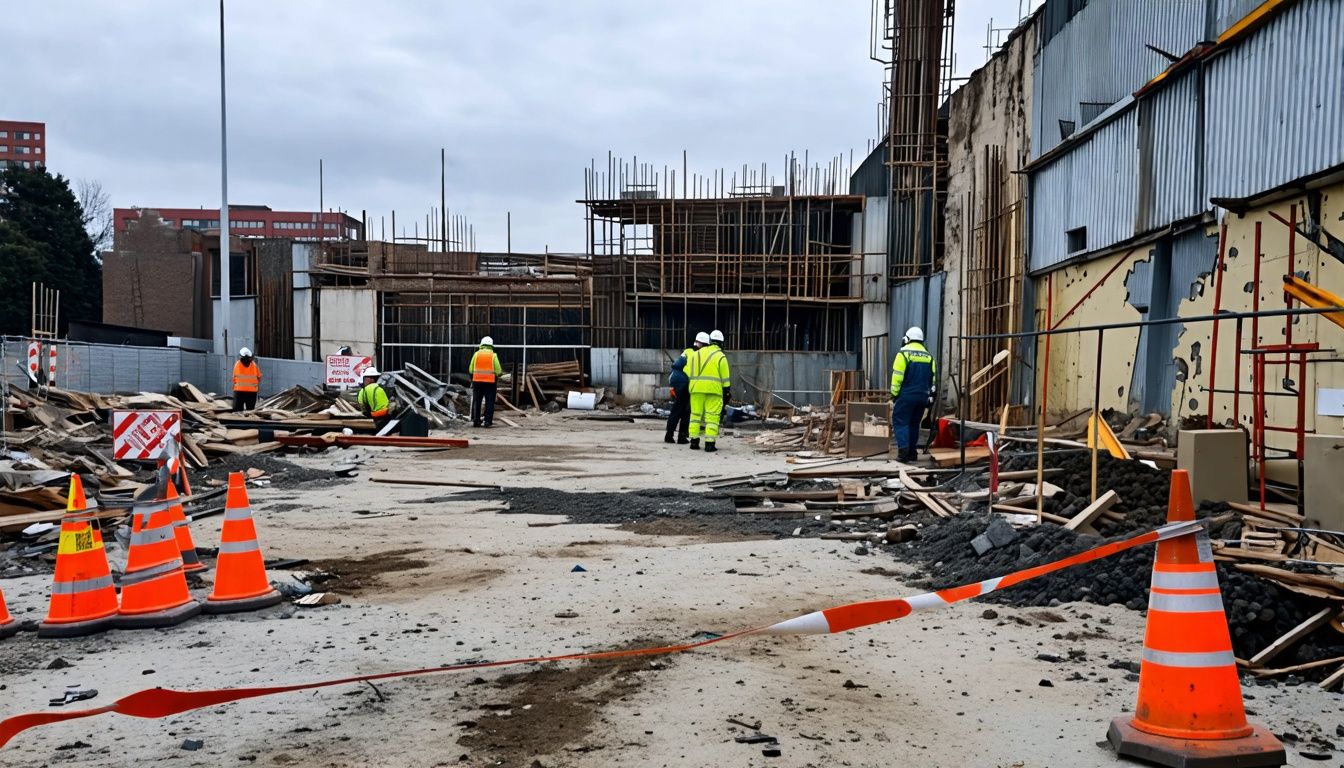
Asbestos Hazards in Construction: What Every Contractor and Site Manager Needs to Know
Asbestos remains one of the most serious occupational health hazards facing the UK construction industry. Despite a complete ban on its use and importation, it persists in hundreds of thousands of buildings across the country — and construction workers disturb it every single day. If you manage sites, commission refurbishment work, or employ tradespeople working in pre-2000 buildings, understanding asbestos hazards in construction is not optional. It is a legal and moral responsibility.
Why Construction Workers Face the Greatest Risk
The Health and Safety Executive consistently identifies construction and maintenance workers as among those most at risk from asbestos exposure. The reason is straightforward: their work involves physically disturbing buildings — drilling, cutting, demolishing, stripping out — which are precisely the activities that release asbestos fibres into the air.
Unlike office workers who may share a building with undisturbed asbestos-containing materials (ACMs), construction workers are regularly breaking into walls, lifting floors, and removing ceilings where ACMs may be hidden. The exposure risk is direct, repeated, and cumulative.
Common Exposure Scenarios on Site
Asbestos exposure in construction rarely stems from a single dramatic incident. It tends to accumulate gradually through repeated low-level contact over the course of a career.
Typical scenarios include:
- Drilling into walls or ceilings containing asbestos insulating board (AIB)
- Removing old pipe lagging or boiler insulation during a heating system upgrade
- Lifting vinyl floor tiles bonded with asbestos-containing adhesive
- Cutting or breaking asbestos cement roofing sheets
- Stripping textured coatings such as Artex from older ceilings
- Demolishing pre-2000 structures without a prior asbestos survey
Each of these activities, if carried out without proper identification and controls in place, can release respirable fibres that lodge permanently in lung tissue.
Where Asbestos Hides in Buildings
Asbestos was incorporated into an enormous range of construction products throughout the twentieth century. Its appeal was entirely practical — it is fire-resistant, thermally insulating, chemically stable, and was cheap to produce at scale. That versatility is exactly why it ended up almost everywhere.
Insulation and Fireproofing
Thermal insulation was one of asbestos’s primary applications. You will find it lagging around heating pipes, hot water cylinders, and boilers in commercial and industrial buildings from the 1950s through to the late 1980s.
Spray-applied asbestos insulation — used on structural steelwork for fireproofing — is among the most dangerous forms, as it is loosely bound and fibre release can be significant even with minimal disturbance.
Asbestos Insulating Board (AIB)
AIB was used extensively as a lower-cost alternative to asbestos lagging. It appears in ceiling tiles, partition walls, door panels, soffits, and fire-break boards. AIB is classified as an intermediate-risk material — more fragile than asbestos cement but less friable than sprayed coatings.
Drilling or cutting it without controls creates a serious exposure risk. Any work involving AIB in refurbishment scenarios must be properly planned and, in most cases, carried out by a licensed contractor.
Asbestos Cement Products
Corrugated roofing sheets, guttering, downpipes, flue pipes, and exterior cladding panels were routinely manufactured from asbestos cement. These products are still commonplace on agricultural buildings, industrial units, and pre-1980s commercial properties.
When intact, they are considered lower risk — but weathering, breakage, or cutting during refurbishment changes that picture significantly. Never cut asbestos cement with power tools without appropriate controls in place.
Floor and Ceiling Products
Vinyl floor tiles, thermoplastic tiles, and the bitumen-based adhesives used to bond them frequently contained asbestos. As tiles age and degrade, or when they are removed during renovation, fibres can be released.
Textured decorative coatings applied to ceilings — particularly popular from the 1960s through to the 1990s — also commonly contained chrysotile (white asbestos). Never sand or dry-scrape these coatings without first establishing whether they contain asbestos.
Other Materials to Be Aware Of
- Rope seals and gaskets around boilers and ovens
- Bituminous felt used in roofing and damp-proof courses
- Toilet cisterns and window sills in older commercial buildings
- Textured mastics and sealants
- Lift shaft linings and fire door cores
In any structure built before 2000, asbestos could be almost anywhere. Never assume its absence without professional confirmation.
The Health Consequences of Asbestos Hazards in Construction
Asbestos fibres are microscopic and, once inhaled, cannot be expelled by the body. They accumulate in the lungs and surrounding tissue, causing progressive damage over years and decades. There is no safe level of exposure.
Mesothelioma
Mesothelioma is a cancer of the mesothelial lining — most commonly the pleura (lining of the lungs) or the peritoneum (lining of the abdomen). It is almost exclusively caused by asbestos exposure.
The latency period between first exposure and diagnosis is typically between 20 and 50 years, which means workers exposed during the 1970s and 1980s are still being diagnosed today. It is incurable, and prognosis remains poor.
Asbestosis
Asbestosis is a chronic fibrotic lung disease caused by prolonged inhalation of asbestos fibres. The fibres trigger scarring of the lung tissue, progressively reducing lung capacity and causing breathlessness, persistent cough, and fatigue.
It is not curable, though symptoms can be managed. It also significantly increases the risk of developing lung cancer.
Lung Cancer
Asbestos is an established cause of lung cancer, particularly in workers who have experienced sustained occupational exposure. The risk is compounded significantly in those who also smoke.
Asbestos-related lung cancer can be difficult to distinguish from lung cancer caused by other factors, which means its true prevalence linked to occupational exposure is likely underreported.
Pleural Disease
Non-malignant pleural plaques, pleural thickening, and pleural effusions are also associated with asbestos exposure. While pleural plaques themselves are not directly harmful, they indicate past exposure and signal increased risk for more serious conditions.
For construction workers and their employers, the critical point is this: symptoms from asbestos-related diseases can take decades to appear. Prevention is the only effective strategy.
Legal Duties Under the Control of Asbestos Regulations
The Control of Asbestos Regulations set out clear legal duties for everyone involved in work that might disturb asbestos. This legislation applies to employers, self-employed workers, and those with responsibility for non-domestic premises.
The Duty to Manage
Owners and managers of non-domestic premises have a legal duty to manage asbestos. This means identifying whether ACMs are present, assessing their condition and risk, and putting a management plan in place.
The starting point for meeting this duty is commissioning a professional management survey, which provides a baseline assessment of all accessible ACMs and their current condition. Without this, you are operating blind.
Before Refurbishment or Demolition
Before any significant refurbishment or demolition work begins, a refurbishment and demolition survey is legally required for the areas affected. This is a more intrusive survey than a management survey — it involves accessing voids, lifting floor coverings, and taking samples to identify all ACMs that could be disturbed by the planned works.
If you are planning to tear down or significantly alter a building, a demolition survey must be completed before work commences. Work must not proceed until survey results are known and ACMs have been appropriately managed or removed.
Licensing Requirements for Removal
Not all asbestos removal work requires a licensed contractor, but much of it does. Work on high-risk materials — including sprayed coatings, AIB, and pipe lagging — must be carried out by a contractor licensed by the HSE.
Even for lower-risk or short-duration work that falls below the licensing threshold, notification requirements and specific control measures still apply. Using an unlicensed contractor for licensable work is a criminal offence.
Employer Responsibilities
Under the Control of Asbestos Regulations, employers have a duty to:
- Identify asbestos risks before work begins and communicate that information to workers
- Ensure workers receive appropriate asbestos awareness training
- Provide suitable personal protective equipment (PPE) and respiratory protective equipment (RPE)
- Establish safe systems of work and emergency procedures
- Maintain health surveillance records for workers engaged in licensed asbestos work
- Ensure asbestos waste is correctly classified, packaged, transported, and disposed of at a licensed facility
The HSE takes asbestos regulation seriously and has the power to issue improvement notices, prohibition notices, and prosecute duty holders. Fines and custodial sentences have been handed down in cases of serious non-compliance.
Practical Steps for Managing Asbestos Hazards in Construction Projects
Understanding the risk is one thing. Managing it operationally across a live project is another. Here is how asbestos risk should be handled throughout a construction project lifecycle.
Step 1: Survey Before You Start
Any refurbishment or demolition project on a pre-2000 building should begin with a professional asbestos survey. A refurbishment and demolition survey identifies ACMs in the areas to be worked on — not just visible surfaces, but within the fabric of the building.
This is how you find out what your workers are about to encounter before they encounter it. Skipping this step is not a cost saving — it is a liability.
Step 2: Assess and Plan
Once ACMs are identified, a decision must be made for each one: can it be left in place safely, managed in situ, or does it need to be removed prior to work? High-risk materials in areas to be disturbed should be removed by a licensed contractor before other trades move in.
Document every decision and make the survey findings available to all relevant parties on site. Under HSG264, this is not optional — it is part of your duty of care.
Step 3: Use Licensed Contractors Where Required
For licensable work, appoint an HSE-licensed asbestos removal contractor and verify that their licence is current. Ensure notification has been submitted to the relevant enforcing authority at least 14 days before licensable work begins.
For professional asbestos removal that meets all regulatory requirements, this step is non-negotiable.
Step 4: Control, Contain, and Clear
During removal, ACMs must be kept wet to suppress fibre release, contained within a sealed enclosure where necessary, and removed section by section using hand tools rather than power tools wherever possible.
A four-stage clearance procedure — including air testing by an independent analyst — is required before a licensed enclosure can be signed off as safe. Do not allow other trades back into the area until clearance has been formally issued.
Step 5: Dispose Correctly
Asbestos waste is classified as hazardous waste under UK regulations. It must be double-bagged, clearly labelled, transported under a waste carrier licence, and deposited at a site licensed to accept asbestos waste.
Fly-tipping asbestos carries serious criminal penalties and creates ongoing risks for anyone who subsequently encounters it. There are no shortcuts here.
Step 6: Keep Records
Maintain records of all surveys, removals, air monitoring results, waste transfer notes, and training. These records protect your business if questions arise later and form part of the updated asbestos register that must be passed on when a building changes hands or tenancy.
Asbestos Awareness Training for Construction Workers
Every construction worker who might encounter asbestos — even those who will never work directly with it — should complete Category A asbestos awareness training. This does not qualify them to disturb or remove asbestos; it teaches them to recognise potential ACMs and understand what to do if they encounter one unexpectedly.
The HSE guidance phrase “stop, get out, don’t go back in” exists for a reason. A worker who recognises the signs of asbestos and stops work immediately can prevent serious harm. A worker who carries on regardless can expose themselves and colleagues to fibres that will cause irreversible damage decades later.
Training should be refreshed regularly and records kept. For workers carrying out non-licensed notifiable work, Category B training is required. For those working under a licence, full licensed contractor training applies.
Asbestos Hazards in Construction Across the UK
Asbestos hazards in construction are not confined to any one region. The UK’s industrial heritage means that pre-2000 buildings are spread across every city and county — from post-war social housing to Victorian commercial premises to 1970s industrial estates.
In London, the density of older commercial and residential stock means that refurbishment projects regularly encounter ACMs. Supernova provides asbestos survey London services to support contractors and property managers working across the capital.
In the North West, the region’s manufacturing and industrial legacy means significant volumes of older stock remain in active use. Our asbestos survey Manchester team works across the city and surrounding areas to provide fast, accurate survey results before work begins.
In the Midlands, commercial and industrial properties built during the postwar boom frequently contain multiple ACM types. Supernova’s asbestos survey Birmingham service covers the full range of survey types required under the Control of Asbestos Regulations.
Wherever your project is located, the same legal duties apply and the same risks are present. Local knowledge matters when it comes to surveying efficiently and accurately.
What Happens When Things Go Wrong
The consequences of failing to manage asbestos hazards in construction fall into two categories: immediate regulatory consequences and long-term human consequences.
On the regulatory side, the HSE can issue prohibition notices that shut down a site immediately, improvement notices requiring remedial action within a set timeframe, and prosecutions that result in unlimited fines or custodial sentences for individuals. Principal contractors, employers, and individual site managers have all faced prosecution for asbestos-related failures.
On the human side, the consequences are far graver. Workers who are unknowingly exposed to asbestos fibres today may develop mesothelioma or asbestosis two or three decades from now. By that point, no amount of regulatory compliance after the fact will undo the harm.
The duty to manage asbestos hazards in construction is ultimately about protecting people — the workers on your sites, the occupants of the buildings you work in, and the families who depend on those workers remaining healthy.
Frequently Asked Questions
Do I need an asbestos survey before starting refurbishment work on a pre-2000 building?
Yes. Under the Control of Asbestos Regulations, a refurbishment and demolition survey is legally required before any work that could disturb the fabric of a pre-2000 building. This applies to both commercial and domestic properties where the work is being carried out as part of a business activity. The survey must be completed before work begins — not during it.
What is the difference between a management survey and a refurbishment and demolition survey?
A management survey is designed to locate and assess ACMs that could be disturbed during normal occupancy and routine maintenance. It is non-intrusive. A refurbishment and demolition survey is more invasive — it accesses voids, removes floor coverings, and samples materials that will be disturbed by the planned works. If you are carrying out significant building work, you need the latter, not the former.
Can any contractor remove asbestos, or does it have to be a licensed firm?
It depends on the material and the nature of the work. High-risk materials — including sprayed asbestos, AIB, and pipe lagging — must be removed by an HSE-licensed contractor. Some lower-risk, short-duration work may fall below the licensing threshold, but notification requirements and strict control measures still apply. If in doubt, always use a licensed contractor. Using an unlicensed contractor for licensable work is a criminal offence.
How long does asbestos exposure take to cause disease?
The latency period for asbestos-related diseases is typically long — often between 20 and 50 years from first exposure. This means that construction workers exposed today may not develop symptoms until well into the future. It also means that workers from earlier decades are still being diagnosed with mesothelioma and asbestosis now. There is no safe level of exposure, and no cure once disease develops.
What should a worker do if they suspect they have disturbed asbestos on site?
Stop work immediately. Leave the area and do not re-enter. Inform the site manager or principal contractor. The area should be treated as potentially contaminated until a competent person has assessed it and, if necessary, air testing has been carried out. The HSE’s guidance is clear: stop, get out, and do not go back in. Continuing to work in an area where asbestos may have been disturbed significantly increases the risk of exposure.
Get Expert Help Today
If you need professional advice on asbestos in your property, our team of qualified surveyors is ready to help. With over 50,000 surveys completed across the UK, Supernova Asbestos Surveys delivers clear, actionable reports you can rely on.
Call us on 020 4586 0680 or visit asbestos-surveys.org.uk for a free, no-obligation quote.