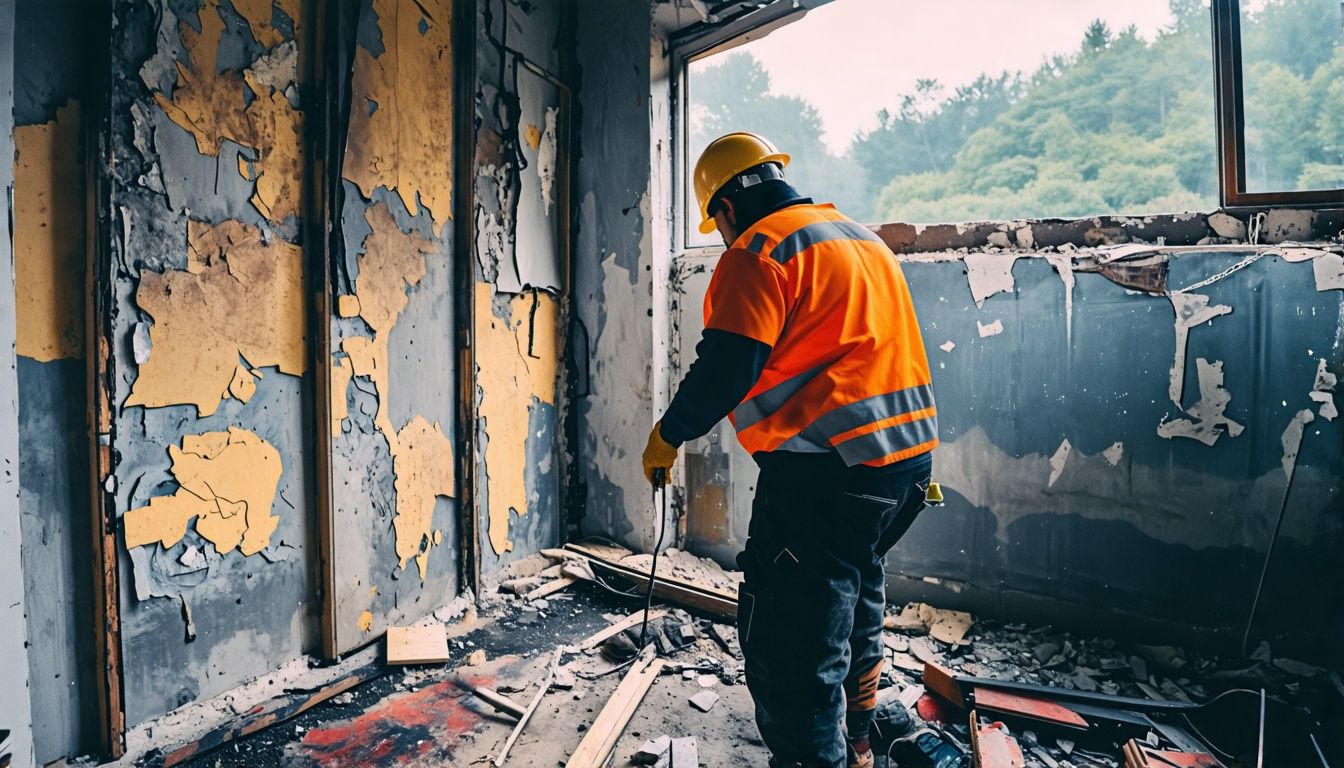
What Is the Protocol for Asbestos Exposure in the Workplace?
Asbestos is the single greatest cause of work-related deaths in the UK. Every year, thousands of people die from mesothelioma, asbestosis, and asbestos-related lung cancer — diseases that take decades to develop but trace directly back to fibre exposure at work.
Understanding what is the protocol for asbestos exposure is not a box-ticking exercise. It is a legal duty and, more fundamentally, a matter of life and death.
The difficulty is that asbestos does not announce itself. It hides in ceiling tiles, pipe lagging, floor adhesives, and roof sheets — often in buildings that look entirely ordinary. The moment those materials are disturbed, microscopic fibres become airborne. You cannot see them, smell them, or taste them. But they can kill.
This post covers the full protocol — from identifying risk, through legal duties, daily management, emergency procedures, and health surveillance — so you can protect the people in your building with confidence.
Where Asbestos Is Likely to Be Found in the Workplace
Any non-domestic building constructed or refurbished before 2000 could contain asbestos-containing materials (ACMs). The full ban on asbestos use in the UK only came into effect in 1999, so the risk is not limited to Victorian warehouses or 1960s office blocks.
A 1980s commercial unit, a 1990s school extension, a warehouse refitted in the mid-nineties — all could contain ACMs. Never assume a building is clear simply because it looks modern or well-maintained.
Common locations where ACMs are found include:
- Pipe and boiler lagging
- Ceiling tiles, particularly suspended tile systems
- Floor tiles and the adhesive beneath them
- Roof sheets, soffits, and guttering (often asbestos cement)
- Partition walls and fireproofing panels
- Textured coatings such as Artex-style finishes
- Spray-applied insulation on structural steelwork
- Gaskets, rope seals, and insulating boards around boilers and plant rooms
- Decorative plaster and certain construction adhesives
The age of a building matters, but so does its history. A newer fit-out does not guarantee a clean bill of health if the underlying structure pre-dates 2000. Never assume — always verify.
Your Legal Duties Under the Control of Asbestos Regulations
The Control of Asbestos Regulations place a clear legal duty on anyone who manages or has responsibility for non-domestic premises. This is known as the duty to manage, and it applies to building owners, employers, and anyone with control over maintenance or repair activities.
The duty to manage requires you to:
- Identify whether ACMs are present in the premises
- Assess the condition and risk level of any ACMs found
- Produce and maintain a written asbestos management plan
- Share that information with anyone likely to disturb those materials — contractors, maintenance staff, and tradespeople
- Regularly review and update the management plan
The Health and Safety Executive (HSE) can and does prosecute dutyholders who fail to comply. Fines can be substantial, but the greater consequence is putting lives at risk.
There are also specific regulations governing licensed, notifiable non-licensed, and non-licensed asbestos work — each with different requirements for training, notification, and supervision. If you are uncertain which category applies to a task your team is undertaking, get professional advice before the work begins.
Step One: Commission the Right Type of Asbestos Survey
Before any maintenance, renovation, or demolition work begins in a pre-2000 building, a professional asbestos survey is required. This is not optional — it is a legal requirement and a basic duty of care to your workforce and any contractors on site.
There are three main survey types, each suited to different circumstances.
Management Survey
The standard survey for buildings in normal occupation. A management survey identifies the location, type, and condition of ACMs that could be disturbed during routine maintenance. It forms the basis of your asbestos management plan and should be revisited regularly, particularly if the building changes use or undergoes any works.
Refurbishment Survey
Required before any refurbishment, fit-out, or intrusive maintenance work. A refurbishment survey is more invasive than a management survey and locates all ACMs in the areas to be disturbed. It cannot be carried out while the area is occupied.
Demolition Survey
Required before any demolition project. A demolition survey is the most thorough survey type, designed to identify every ACM in the structure so that all asbestos can be safely removed before demolition commences.
At Supernova Asbestos Surveys, we carry out all three survey types across the UK. Our surveyors are qualified, accredited, and experienced in commercial, industrial, and residential settings — whether you need an asbestos survey in London or an asbestos survey in Manchester.
The Day-to-Day Protocol for Managing Asbestos in the Workplace
Having a survey in place is the foundation. But day-to-day management is where prevention actually happens. Here is what a robust asbestos management protocol looks like in practice.
1. Maintain an Up-to-Date Asbestos Register
Your asbestos register is the live record of all known ACMs in the building — their location, type, condition, and risk rating. It must be accessible to anyone who could disturb those materials, including contractors and maintenance staff.
A register is not a one-off document. It needs to be updated whenever inspections take place, whenever ACMs are removed, and whenever new information comes to light.
2. Schedule Regular Re-Inspection Surveys
ACMs that are in good condition and left undisturbed are generally safe to manage in place. But condition can change. Damage, water ingress, physical impact, and natural deterioration can all cause previously stable materials to become friable and release fibres.
The HSE recommends regular monitoring of known ACMs — typically annually, though higher-risk materials may require more frequent checks. A re-inspection survey by a qualified surveyor gives you documented evidence that materials are being properly monitored and that your management plan remains current.
3. Use a Permit-to-Work System
Any maintenance or building work in premises with known or suspected ACMs should operate under a permit-to-work system. This ensures that before anyone picks up a drill or a saw, they have checked the asbestos register, understood what is in the area, and confirmed it is safe to proceed.
This is particularly important for contractors who are unfamiliar with your building. They have a legal right to see your asbestos information before starting work, and you have a duty to provide it.
4. Never Disturb Suspect Materials Without Testing First
If you are unsure whether a material contains asbestos, treat it as though it does until you know otherwise. Do not drill into it, sand it, cut it, or break it open.
Arrange for a sample to be taken and analysed by an accredited laboratory. Supernova offers professional on-site asbestos testing with UKAS-accredited laboratory analysis. If you prefer to collect a sample yourself, you can order an asbestos testing kit directly from our website — a straightforward and cost-effective way to get certainty before any work begins.
5. Ensure Only Trained, Competent People Handle ACMs
Some asbestos work can be carried out by non-licensed contractors — but only with the right training and controls in place. Licensed asbestos work, which includes most removal of sprayed coatings, lagging, and heavily damaged materials, must only be carried out by a contractor holding an HSE asbestos licence.
Always verify your contractor’s credentials. Ask for their licence number and check it against the HSE’s licensed contractor register. Do not allow unlicensed workers to handle materials they are not qualified to touch.
PPE and Workplace Controls: The Last Line of Defence
Personal protective equipment is the last line of defence, not the first. Engineering controls — encapsulation, enclosure, or removal — should always be considered before relying on PPE.
That said, appropriate PPE is essential when working in or near areas with ACMs. Minimum PPE requirements for asbestos work typically include:
- A correctly fitted FFP3 disposable respirator or a half-face mask with a P3 filter, fit-tested for the individual wearing it
- Disposable Type 5 coveralls, disposed of after each use
- Nitrile gloves
- Sealed disposal bags for contaminated PPE and waste
Standard dust masks offer no meaningful protection against asbestos fibres. If a worker is handed a standard surgical or DIY dust mask before entering an area with asbestos, that is not adequate protection — it is a red flag.
Workplace controls should also include:
- Wetting techniques to suppress fibre release during any disturbance
- HEPA-filtered vacuum equipment — not standard vacuum cleaners, which will spread fibres
- Clear demarcation and signage around areas where ACMs are present or work is taking place
- Decontamination procedures for workers and equipment leaving the work area
Asbestos Awareness Training: Who Needs It and What It Must Cover
Under the Control of Asbestos Regulations, employers must ensure that anyone liable to disturb asbestos during their work — or who supervises such work — receives adequate information, instruction, and training. This is not just for specialist asbestos contractors.
Awareness training is required for a wide range of workers, including electricians, plumbers, plasterers, painters, joiners, HVAC engineers, and general maintenance staff. Anyone who might encounter asbestos in the course of their work needs to know how to recognise it and what to do.
Awareness training should cover:
- What asbestos is and why it is dangerous
- The types of asbestos and where they are likely to be found
- How to recognise suspect materials
- The legal framework and both employer and employee responsibilities
- The correct actions to take if asbestos is encountered unexpectedly
- How to use and dispose of PPE correctly
Training should be refreshed regularly — the HSE recommends annually for workers in higher-risk occupations. Records of training should be kept and made available for inspection if required.
What Is the Protocol for Asbestos Exposure in an Emergency?
Even with robust management systems in place, accidental disturbances can happen. Every workplace where ACMs are present should have a documented emergency procedure, and all relevant staff should know it before an incident occurs.
If asbestos is accidentally disturbed, follow these steps immediately:
- Stop all work immediately. Do not continue to work in the area under any circumstances.
- Evacuate the area without delay. Move all personnel away from the affected zone.
- Do not attempt to clean up. Leave the area as it is and do not touch anything.
- Prevent others from entering. Cordon off the area and display clear warning notices.
- Notify your health and safety manager or appointed competent person. They will coordinate the response.
- Arrange for a licensed contractor to carry out decontamination and air monitoring. Only trained personnel with HEPA-filtered equipment should be involved in the clean-up.
- Record the incident and review how it occurred. Update your management plan and procedures accordingly.
Do not attempt to clean up disturbed asbestos with a standard vacuum cleaner or brush. This will spread fibres further and significantly increase the risk of exposure. Only HEPA-filtered equipment operated by trained personnel should be used.
Workers who may have been exposed should be advised to seek a medical assessment promptly. Depending on the nature and extent of the disturbance, there may also be a requirement to notify the HSE under RIDDOR (Reporting of Injuries, Diseases and Dangerous Occurrences Regulations).
Health Surveillance for Workers at Risk
Workers who regularly carry out notifiable non-licensed work (NNLW) or licensed asbestos work are required by law to undergo health surveillance. This must be carried out by a doctor appointed by the HSE.
Health surveillance for asbestos workers typically includes:
- An initial medical examination before work with asbestos begins
- Regular follow-up examinations — typically every three years
- A medical record that is kept for a minimum of 40 years
The long latency period of asbestos-related diseases — often 20 to 40 years between exposure and diagnosis — is precisely why long-term record-keeping matters so much. Health surveillance does not prevent disease, but it does create a documented history that can be critical for workers who develop symptoms later in life.
Employers must not allow workers to carry out notifiable asbestos work without the appropriate medical clearance in place. This applies to your own employees and to any contractors you engage.
Keeping Your Asbestos Management Plan Current
An asbestos management plan is only as useful as it is current. A survey carried out five years ago on a building that has since been partially refurbished, had maintenance work carried out, or changed its use is not a reliable basis for managing risk today.
Your management plan should be reviewed:
- At least annually as a matter of routine
- After any building works, even minor ones
- Following any incident or near-miss involving suspect materials
- When the building changes use or occupancy
- When new ACMs are identified or existing ones are removed
If your survey is out of date or you have never had one carried out, that is the first thing to address. You cannot manage what you do not know is there. Professional asbestos testing and surveying gives you the baseline information on which every other part of your management protocol depends.
Frequently Asked Questions
What is the protocol for asbestos exposure at work?
The protocol covers several layers: commissioning a professional asbestos survey for any pre-2000 building, maintaining an up-to-date asbestos register, using a permit-to-work system for any maintenance activities, ensuring workers have appropriate training and PPE, and having a documented emergency procedure for accidental disturbances. If exposure does occur, the area must be evacuated immediately, cordoned off, and a licensed contractor engaged for decontamination. Affected workers should seek medical assessment promptly.
Am I legally required to have an asbestos survey?
If you manage or are responsible for a non-domestic building constructed or refurbished before 2000, you have a legal duty under the Control of Asbestos Regulations to identify whether ACMs are present and manage the risk accordingly. A professional asbestos survey is the standard and recommended method for fulfilling that duty. Failure to comply can result in prosecution by the HSE.
What should I do if a worker accidentally disturbs asbestos?
Stop work immediately and evacuate the area. Do not attempt to clean up — leave everything in place. Cordon off the zone and prevent anyone else from entering. Contact your health and safety manager or competent person, then arrange for a licensed asbestos contractor to carry out decontamination and air monitoring. Record the incident and notify the HSE under RIDDOR if required. Review your management plan to prevent recurrence.
What type of asbestos survey do I need before refurbishment?
Before any refurbishment, fit-out, or intrusive maintenance work, you need a refurbishment survey. This is more invasive than a standard management survey and is designed to locate all ACMs in the areas that will be disturbed. It must be carried out before work begins and cannot take place while the area is occupied. For full demolition projects, a demolition survey is required instead.
How do I know if a material contains asbestos without disturbing it?
Visual inspection alone cannot confirm whether a material contains asbestos. The only reliable way to identify asbestos is through laboratory analysis of a sample. Supernova Asbestos Surveys offers professional on-site sampling and UKAS-accredited laboratory testing. Alternatively, if you need to collect a sample yourself, a testing kit is available from our website. Until a material is confirmed clear, always treat it as though it contains asbestos.
Talk to Supernova Asbestos Surveys
With over 50,000 surveys completed nationwide, Supernova Asbestos Surveys is the UK’s leading asbestos surveying company. Our fully accredited surveyors work across commercial, industrial, and residential properties — delivering fast, accurate results you can rely on.
Whether you need a management survey, refurbishment survey, demolition survey, or professional asbestos testing, we are ready to help. Call us on 020 4586 0680 or visit asbestos-surveys.org.uk to get a quote or book a survey today.