That dated stippled finish might seem like a decorating problem, but a popcorn ceiling asbestos test can quickly turn it into a health, legal and cost issue if you get it wrong. Scraping, drilling or sanding a textured ceiling before it has been checked can release asbestos fibres, disrupt works and create avoidable risk for occupants and trades.
Across older UK homes, offices, schools and mixed-use buildings, textured coatings were widely used on ceilings and sometimes walls. Some contain asbestos, some do not, and the finish alone will not tell you which is which. If you are planning maintenance, refurbishment or removal, testing first is the sensible step.
Why a popcorn ceiling asbestos test matters
Asbestos is most dangerous when fibres become airborne and are inhaled. That usually happens when asbestos-containing materials are damaged, drilled, sanded, cut or removed. A textured ceiling can sit undisturbed for years, but once work starts, the risk profile changes.
A popcorn ceiling asbestos test gives you evidence rather than guesswork. Instead of relying on age, appearance or what a contractor thinks it might be, you get a laboratory result that helps you decide whether the ceiling should be left alone, managed in place, sealed or removed by a competent contractor.
For non-domestic premises, the Control of Asbestos Regulations require dutyholders to manage asbestos risk. HSE guidance and HSG264 Asbestos: The Survey Guide set out expectations for identifying suspect materials, surveying, sampling and reporting. If you manage a property portfolio, school, office, shop or common parts of residential buildings, a proper assessment is not optional.
How common is asbestos in popcorn ceilings?
It is common enough that older textured ceilings should not be dismissed without checking. Textured coatings were used extensively in the UK and some products included chrysotile asbestos to add strength and improve application characteristics.
Not every popcorn or stippled ceiling contains asbestos. That is the point. Two ceilings can look almost identical while only one contains asbestos, so visual inspection alone is unreliable.
When suspicion should be higher
You should treat a textured ceiling as suspect if:
- the property is older and the ceiling appears original
- there is no survey report or previous lab result
- the ceiling has a stippled, swirled or heavily textured finish
- repairs, rewiring, lighting changes or redecoration are planned
- the surface is cracked, flaking, water-damaged or patched
In practice, textured ceilings are often overlooked because they feel ordinary. The problem is that ordinary jobs can disturb them. Fitting a smoke detector, moving a light fitting, chasing cables or repairing a leak may all affect the coating.
Why older records matter
If you already have asbestos records for the building, review them before any work starts. A previous survey may already identify textured coatings, although older reports sometimes group them broadly and do not always reflect later repairs or hidden layers.
If there is any doubt, arrange targeted asbestos testing rather than assuming the ceiling is safe.
How dangerous is asbestos in ceilings?
Textured coatings are generally considered lower risk than materials such as pipe insulation, sprayed coatings or asbestos insulating board. Lower risk does not mean no risk. The danger comes from disturbance and fibre release.
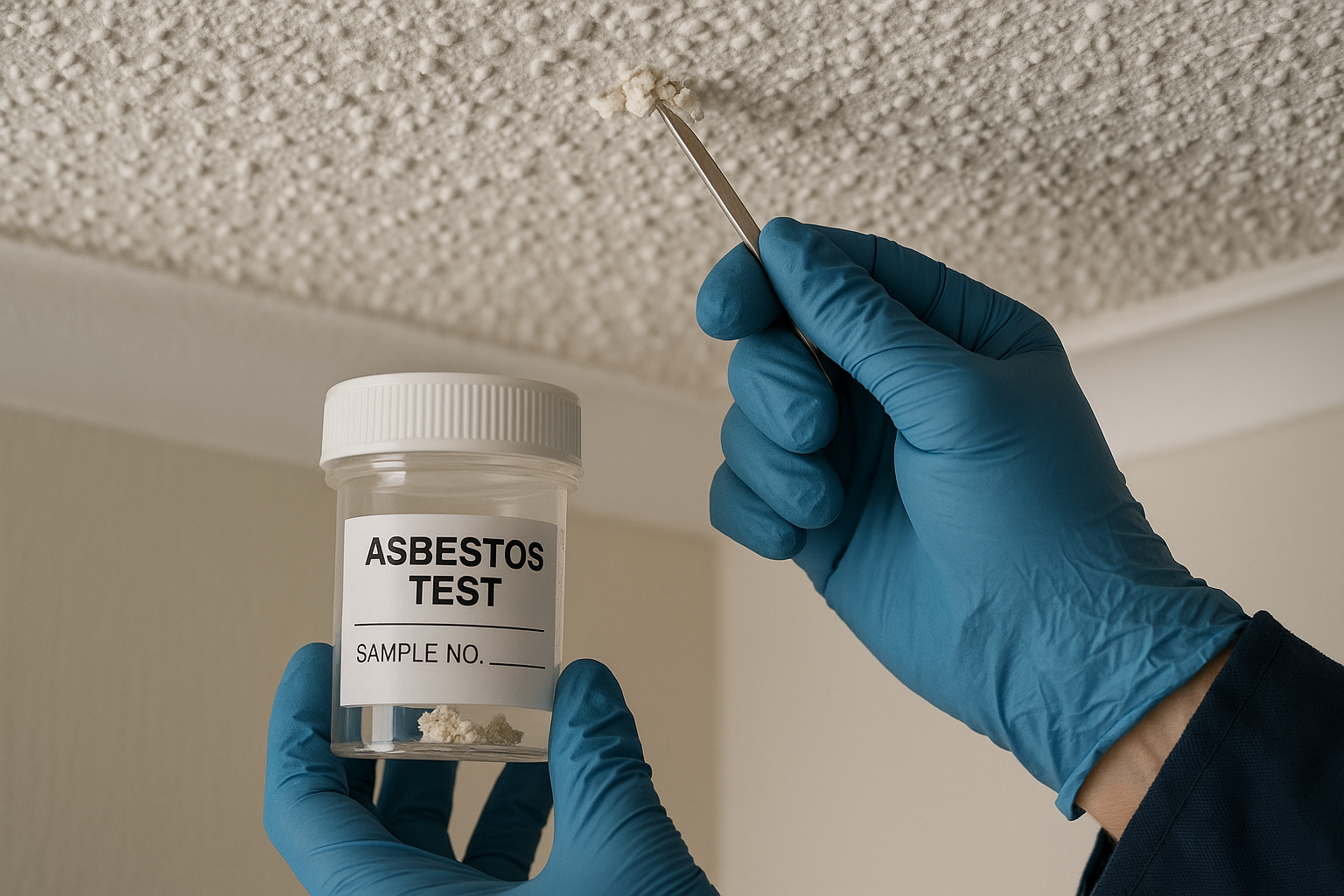
When a textured ceiling is intact and left alone, the immediate risk is usually low. When it is scraped, sanded, drilled or broken during works, fibres can be released into the air. Those fibres are microscopic, so you cannot see or smell them.
Exposure to asbestos fibres is associated with serious diseases including mesothelioma, asbestos-related lung cancer and asbestosis. That is why a popcorn ceiling asbestos test should happen before any intrusive work begins.
What affects the level of risk?
- the type and amount of asbestos within the coating
- the condition of the material
- whether it has been sealed or overpainted
- how the work is carried out
- the scale and duration of disturbance
- how many people may be exposed
- whether suitable controls are in place
A ceiling in good condition in a low-traffic room is one scenario. A damaged ceiling above a busy office being cut back for electrical works is another. The material may be similar, but the risk is not.
Situations where extra caution is needed
Arrange a popcorn ceiling asbestos test before any of the following:
- installing spotlights, speakers, alarms or CCTV
- moving or replacing light fittings
- repairing leaks or water damage
- skimming or flattening the ceiling
- removing loose sections
- major refurbishment
- demolition
If trades are due on site, do not rely on a visual opinion. Testing or surveying first is faster than stopping a project halfway through because suspect materials were disturbed.
How to identify and test for asbestos
You cannot confirm asbestos in a popcorn ceiling by sight. Colour, pattern, thickness and age may make a ceiling suspicious, but they do not prove anything. Only sample analysis can confirm whether asbestos is present.
That is why a popcorn ceiling asbestos test is so useful. It replaces assumptions with a clear result from a UKAS-accredited laboratory process.
Visual clues can only tell you a ceiling is suspect
A surveyor or experienced contractor may recognise a textured coating that should be treated with caution. That is helpful for deciding whether to stop work, but it is not the same as confirmation.
Paint layers, patch repairs, over-skimming and later decorative finishes often hide what is underneath. A ceiling that looks newer may still contain an older textured layer below.
Professional inspection and sampling
If you manage commercial premises, rental stock, schools, offices or common parts, professional attendance is usually the best route. A competent surveyor can inspect the ceiling in context, assess condition, identify other suspect materials and advise on the right level of survey.
For day-to-day occupation and routine maintenance planning, a management survey helps identify asbestos-containing materials that could be disturbed during normal use.
If planned works will disturb the ceiling or nearby structure, a refurbishment survey is normally required in the affected area. This is intrusive and designed to locate asbestos before work starts.
If the building is due to be taken down, a demolition survey is required before demolition begins. It is fully intrusive and aims to identify all asbestos-containing materials that must be dealt with beforehand.
Targeted testing for a single ceiling
If the issue is one suspect textured ceiling rather than a wider project, targeted testing may be enough. Supernova can arrange professional attendance for a specific sample, especially where access is awkward, the coating is damaged or there are several suspect areas.
For broader service information, see our asbestos testing page.
DIY sampling in domestic settings
In some homes, an owner may choose to submit a small sample for analysis before deciding what to do next. That can be practical if the ceiling is in reasonable condition and the aim is simply to confirm whether asbestos is present.
If you take that route, use a proper asbestos testing kit rather than improvising with household bags and tools. The correct packaging and instructions help reduce unnecessary disturbance.
If you already have a sample and only need laboratory confirmation, sample analysis may be the most direct option. Some householders prefer a straightforward testing kit for a one-room check, but if the ceiling is damaged, friable or above a frequently used area, professional sampling is the safer choice.
Practical precautions during sampling
Whether the sample is taken by a surveyor or, in a limited domestic setting, by the owner, the aim is to keep disturbance to an absolute minimum.
- keep the sample small
- lightly dampen the area first
- do not use power tools
- seal the sample immediately
- clean the area with damp wipes
- keep other people out of the room while sampling takes place
Never scrape, sand or break away large sections just to see what lies underneath. That creates avoidable exposure and may spread contamination beyond the immediate area.
What the test result means
Once the popcorn ceiling asbestos test result comes back, the next step is not panic. It is deciding how the material should be managed based on condition, location and planned works.
If the result is negative
A negative result means the sampled material did not contain asbestos. Keep the report with your property records and share it with contractors before work starts.
Be careful not to overinterpret one result. A negative sample from one room does not automatically clear every textured ceiling in the building. Different rooms may have been coated at different times using different products.
If the result is positive
A positive result means the coating contains asbestos and should be managed accordingly. That does not automatically mean urgent removal is required.
The right response depends on:
- the condition of the ceiling
- how likely it is to be disturbed
- how the room is used
- whether refurbishment is planned
- whether damage, leaks or repeated maintenance are expected
- whether other asbestos-containing materials may also be present nearby
In many cases, an intact ceiling can remain in place under a management plan. In others, sealing, enclosing or removal is more appropriate.
What to do if you find asbestos in your popcorn ceiling
A positive popcorn ceiling asbestos test should lead to a calm, structured response. The goal is to stop disturbance, assess risk properly and choose the right control measure.
- Stop any planned work immediately. Do not let decorators, electricians or general builders keep going.
- Prevent further disturbance. Keep people away from the area where possible.
- Assess the ceiling condition. Check for cracks, water damage, delamination or previous drilling.
- Review planned works. A ceiling that can stay untouched may be managed differently from one due for removal.
- Record the finding. For non-domestic premises, update the asbestos register and share the information with anyone who may work on site.
- Take professional advice. The correct option may be management in place, encapsulation, encasement or removal.
For domestic properties, keep the report with your maintenance records and show it to any contractor before future work starts. For commercial buildings and communal areas, make sure the finding feeds into wider asbestos management arrangements.
When leaving it in place is the best option
If the ceiling is sound and there is no reason to disturb it, leaving it alone is often the safest and most cost-effective approach. Many asbestos-containing materials are managed in place for years without incident.
That only works if the material stays in good condition and everyone involved in maintenance knows it is there. A hidden risk is still a risk if contractors are not informed.
Encapsulation
Encapsulation means applying a suitable protective coating or sealant over the asbestos-containing material to reduce the chance of fibre release. For some textured ceilings, this can be an effective option when the coating is in fair condition and removal is not necessary.
Encapsulation is not just a case of painting over the surface and hoping for the best. The product used, the condition of the ceiling and the likelihood of future disturbance all matter.
When encapsulation may be suitable
- the ceiling is largely intact
- there is no major refurbishment planned
- the room can be managed to avoid damage
- a competent person has confirmed the condition is appropriate
Encapsulation can help stabilise the surface and make accidental minor disturbance less likely to release fibres. It may also be useful where immediate removal would cause more disruption than benefit.
Limits of encapsulation
Encapsulation does not remove asbestos. The material remains in the building and still needs to be considered during future maintenance, refurbishments and surveys.
If the ceiling is already badly damaged, water-affected or likely to be disturbed repeatedly, encapsulation may not be the right answer. In those cases, other control options are usually better.
Encasement
Encasement is different from encapsulation. Instead of applying a sealant directly to the asbestos-containing surface, encasement creates a physical barrier around it. In ceiling situations, that may involve installing a new lining or suspended ceiling beneath the textured coating so the original material is enclosed and protected from disturbance.
Encasement can be practical where the existing ceiling is stable but unattractive, and where full removal would be unnecessarily disruptive. It can also reduce the chance of accidental contact during normal occupation.
When encasement may make sense
- the original ceiling is in reasonable condition
- the asbestos-containing coating can remain undisturbed
- access for future maintenance can be controlled
- the new design allows the asbestos material to stay protected
Encasement needs proper planning. If fixings, lighting or service penetrations disturb the original textured coating during installation, the benefit is lost. The work method has to be designed around the asbestos risk.
What to remember about encasement
Like encapsulation, encasement does not remove asbestos. The ceiling must still be recorded, labelled where appropriate and considered whenever future works are planned.
For property managers, this often comes down to long-term practicality. If the ceiling is likely to need repeated access above it for services, removal may ultimately be simpler than enclosing it.
Abatement: hire a professional to safely remove it
If the ceiling is damaged, if refurbishment is planned or if ongoing maintenance will keep disturbing it, removal may be the better option. This is where professional asbestos abatement matters.
Do not let general trades start scraping, sanding or soaking down a positive ceiling without proper assessment. Even where textured coating work is not always licensable, it still requires the correct controls, competent operatives, suitable equipment, waste handling and a safe method of work.
Why professional removal is the safer route
- the work area can be properly controlled
- disturbance is minimised using the right methods
- waste is packaged, transported and disposed of correctly
- the surrounding area can be cleaned appropriately
- records are created for compliance and future property files
Removal is not only about taking the material down. It is about preventing spread, protecting workers and occupants, and making sure the building is safe for the next stage of works.
Questions to ask before arranging removal
- Is the ceiling definitely asbestos-containing, based on analysis?
- Is the material damaged or likely to be disturbed?
- Will the planned works affect only the ceiling, or also walls, voids and services?
- Do you need a wider survey before removal starts?
- Who is responsible for the asbestos register and contractor communication?
If you are planning broader works, testing one ceiling may not be enough. Hidden materials nearby can still delay the job if they are discovered after contractors have started.
When you need a survey rather than a simple test
A popcorn ceiling asbestos test is ideal when you need to confirm whether a specific ceiling contains asbestos. It is not always enough on its own.
If the project involves wider intrusive works, the real question is often not just whether one ceiling is positive, but what else may be disturbed. Walls, service risers, floor finishes, boxing, soffits and hidden voids may also contain asbestos.
Use the right option for the job
- Testing when you need to identify a specific suspect material
- Management survey for routine occupation and standard maintenance planning
- Refurbishment survey before intrusive works
- Demolition survey before demolition
Getting the scope right at the start saves time and money later. It also prevents projects stopping halfway through because another asbestos-containing material is found after site mobilisation.
Practical advice for homeowners, landlords and property managers
For homeowners
If you are planning to redecorate, fit downlights or remove a dated finish, do not start by scraping. Arrange a popcorn ceiling asbestos test first and keep the result with your house records.
If the result is positive and the ceiling is in good condition, you may be able to leave it in place or discuss encapsulation or encasement with a competent professional. If you want it removed, use a specialist contractor rather than a general builder.
For landlords
Landlords should be especially careful in common parts and any areas where contractors may work. If maintenance is planned between tenancies, check suspect textured ceilings before the work order is issued.
Clear records reduce disputes, delays and unsafe decisions. If one flat has a positive textured coating, do not assume neighbouring units are identical without evidence.
For property managers
Textured ceilings are easy to miss in offices, retail units, schools and residential blocks because they blend into the background. Add them to your asbestos review whenever there are lighting upgrades, leak repairs, HVAC works or fit-outs planned.
If you operate in the capital, our asbestos survey London service can help with surveys and testing across a wide range of property types. For clients in the North West, our asbestos survey Manchester team can support local projects with the same practical approach.
Top Posts
If you are researching textured coatings, you are not alone. Property owners and managers often move on from a single popcorn ceiling asbestos test query to wider questions about surveys, removal planning and legal duties.
Popular related topics usually include:
- when a management survey is enough and when it is not
- how refurbishment surveys affect project timelines
- what happens after a positive asbestos sample
- whether textured coatings must always be removed
- how to prepare a property for asbestos sampling
The common thread is simple: test before you disturb, survey before you refurbish, and keep clear records throughout.
Frequently Asked Questions
Can you tell if a popcorn ceiling contains asbestos just by looking at it?
No. A textured finish can look suspicious, but appearance alone cannot confirm asbestos. A popcorn ceiling asbestos test using sample analysis is the only reliable way to know.
Should I remove an asbestos popcorn ceiling straight away?
Not always. If the ceiling is in good condition and will not be disturbed, it may be safer to leave it in place and manage it properly. Removal is usually considered when the material is damaged or planned works will disturb it.
What is the difference between encapsulation and encasement?
Encapsulation involves applying a protective sealant or coating directly to the asbestos-containing material. Encasement means enclosing it behind a physical barrier, such as a new ceiling lining, so it is protected from disturbance.
Do I need a survey or just a test?
If you only need to confirm whether one ceiling contains asbestos, targeted testing may be enough. If you are planning intrusive works, refurbishment or demolition, you will usually need the appropriate asbestos survey instead.
What should I do if a contractor has already disturbed a textured ceiling?
Stop work immediately, keep people out of the area and seek professional advice. The material may need to be assessed, sampled and managed before any further work continues.
Need help with a popcorn ceiling asbestos test?
If you need a popcorn ceiling asbestos test, a targeted sample, or a full survey before maintenance, refurbishment or demolition, Supernova Asbestos Surveys can help. We have completed more than 50,000 surveys nationwide and provide practical advice that keeps projects moving safely.
Call 020 4586 0680 or visit asbestos-surveys.org.uk to arrange testing, discuss your property, or book the right survey for your project.