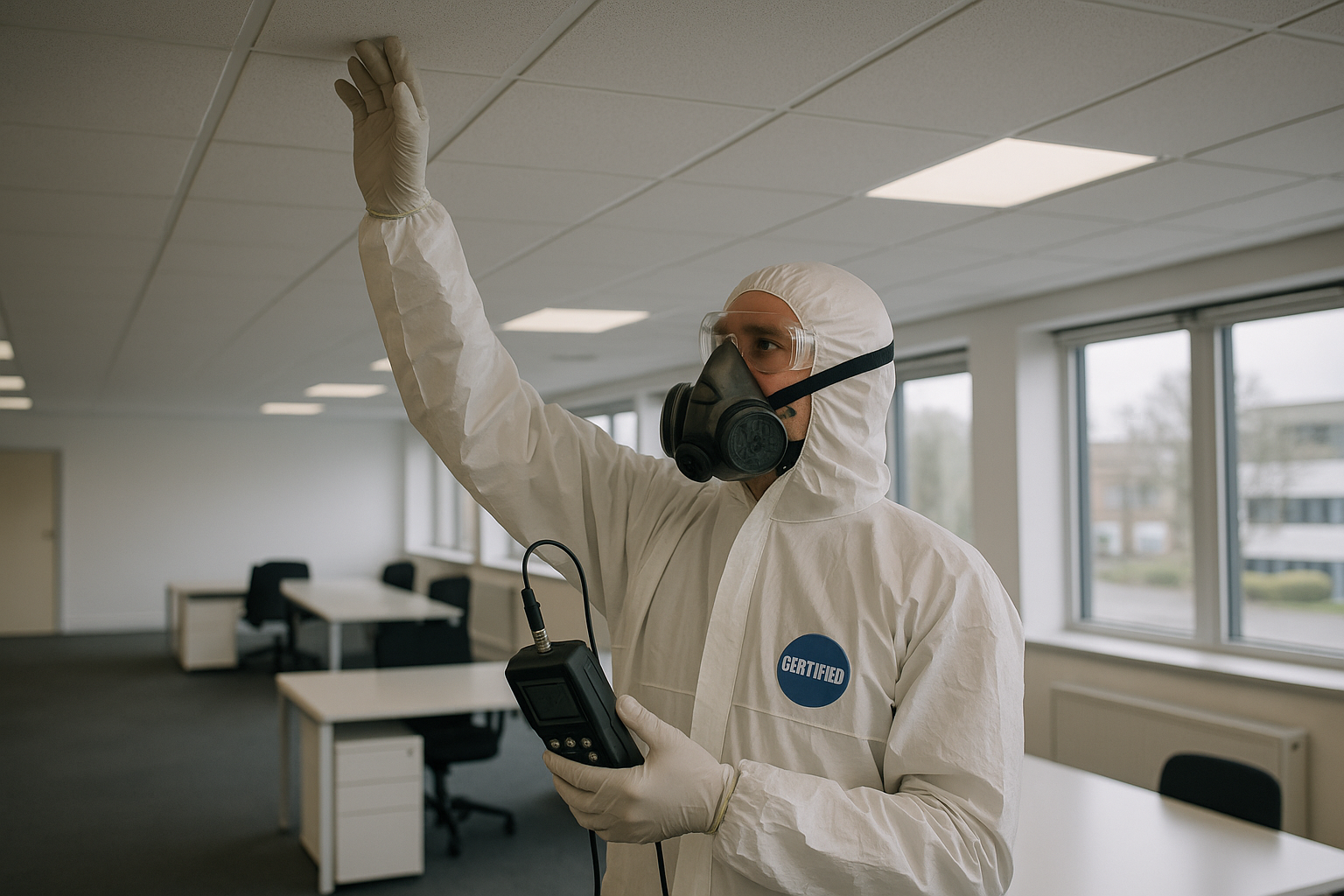
What Asbestos Monitoring Actually Means — And Why It Cannot Be an Afterthought
A survey tells you what is in a building. Asbestos monitoring tells you whether it is still safe, whether the risk has shifted, and whether your records still reflect the building your staff and contractors are working in today.
For duty holders, facilities managers, landlords and property teams, this is not optional. Under the Control of Asbestos Regulations, those responsible for non-domestic premises must manage asbestos actively — and that means keeping information current, not just collecting it once.
If asbestos is present and left in place, someone needs to keep checking it. If works are planned, someone needs to confirm the existing information is still adequate. If damage occurs, someone needs to assess the risk quickly and decide whether air testing, remedial action or asbestos removal is required. That is the practical job of asbestos monitoring.
The Two Main Types of Asbestos Monitoring
Asbestos monitoring generally falls into two distinct areas: monitoring the condition of known or presumed asbestos-containing materials, and monitoring the air where there is a risk of fibre release. They are connected, but they serve different purposes and are used in different circumstances.
Condition Monitoring
Condition monitoring is the day-to-day backbone of asbestos management. It focuses on whether materials remain stable, sealed and unlikely to be disturbed during normal occupation, routine maintenance or foreseeable use.
If asbestos-containing materials are in good condition and are not at risk of disturbance, they can often remain in place — but only if they are inspected regularly and the findings are properly recorded.
When carrying out condition-based asbestos monitoring, a competent person will typically look for:
- Cracks, chips, abrasion or broken edges
- Water damage, staining or damp that may accelerate deterioration
- Damaged encapsulation, missing seals or exposed surfaces
- Signs of drilling, cutting, impact or accidental disturbance
- Changes in access, occupancy or building use that increase risk
- Poor or missing labelling and barriers that no longer provide adequate control
Context matters here. A board in a locked electrical riser is not managed in the same way as a board in a busy service corridor. The material may be identical, but the exposure risk is not.
Air Monitoring
Air monitoring involves drawing a measured volume of air through a filter using calibrated equipment. The filter is then analysed by a competent laboratory or analyst using recognised methods.
This part of asbestos monitoring is not needed in every building where asbestos is present — it is used where there is a specific reason to check whether fibres are airborne under the conditions being assessed.
Typical situations where air monitoring is used include:
- After suspected or confirmed disturbance of asbestos-containing materials
- During certain licensed asbestos works
- As part of the four-stage clearance process after licensed removal work
- Where reassurance is needed in higher-risk areas
- When occupants or contractors raise concerns about possible fibre release
Air monitoring answers a narrow but important question: are asbestos fibres present in the air at the time of testing? It does not replace a survey, and it does not tell you where asbestos is located within the building.
Why Asbestos Monitoring Is a Legal Requirement, Not a Best Practice
The Control of Asbestos Regulations place a duty to manage asbestos on those responsible for non-domestic premises. That duty includes identifying asbestos-containing materials, assessing the risk, keeping an up-to-date record, preparing a management plan, and reviewing that plan regularly.
That final point is where asbestos monitoring becomes central to compliance. An asbestos register created years ago and never checked again does not satisfy the duty to manage. If materials deteriorate, become accessible, or are affected by works, your records and controls must change with the risk.
HSE guidance and HSG264 both support the same principle: asbestos information must be suitable, sufficient and kept up to date.
As a practical test, you should be able to answer these questions without hesitation:
- Where are the known or presumed asbestos-containing materials?
- What condition are they in right now?
- Who could disturb them?
- What controls are currently in place?
- When were they last checked?
- What action is due next?
If those answers are vague or out of date, your asbestos monitoring system needs tightening.
When Asbestos Monitoring Is Needed
Not every property needs the same inspection frequency. The right schedule depends on the type of material, its condition, its location, and the likelihood that someone will disturb it.
A sensible approach follows risk rather than routine — annual review is common, but some materials need more frequent checks and some situations require immediate action.
Known Asbestos Left in Place
If asbestos has been identified and is being managed rather than removed, it should be subject to regular review and re-inspection. The condition of the material, its location and the activities taking place nearby all determine how often that check should happen.
After Accidental Damage
If someone drills, cuts, breaks or impacts a suspect material, the area should be assessed quickly. Depending on the circumstances, air monitoring and asbestos testing may also be needed before the area is reoccupied.
Before, During or After Asbestos Works
Certain asbestos works require specialist testing and independent clearance procedures before an area can be handed back. This applies to licensed removal work and forms a formal part of the handover process.
In Higher-Risk Areas
Plant rooms, service risers, industrial spaces, ceiling voids and maintenance routes often need closer attention because disturbance is more likely. If contractors regularly access an area, the monitoring frequency should reflect that.
Where Building Use Changes
A low-risk area can become a higher-risk one if occupancy increases, access changes or refurbishment exposes previously hidden materials. The monitoring plan must reflect what is happening in the building now, not what was true when the first survey was carried out.
Re-Inspection Surveys: The Backbone of Ongoing Asbestos Monitoring
For most duty holders, the core of asbestos monitoring is a re-inspection survey. This revisits known or presumed asbestos-containing materials, reassesses their condition, and checks whether the asbestos register and management plan are still accurate.
It is not a paperwork exercise — it is the point where minor deterioration can be caught before it becomes a costly incident, a contractor exposure issue or a compliance failure.
During a re-inspection, a competent surveyor will typically review:
- The location and accessibility of each recorded item
- Its present condition and any signs of deterioration
- Whether seals, labels or encapsulation remain effective
- Whether nearby activities have increased the chance of disturbance
- Whether previous recommendations have been acted on
If a material has worsened, the next step may be tighter controls, repair, encapsulation, further testing or removal. If the building has changed significantly, a different survey type may be required rather than another routine re-check.
Choosing the Right Survey to Support Asbestos Monitoring
Strong asbestos monitoring depends on reliable underlying information. If the original survey was incomplete, unsuitable for the building use, or no longer reflects the property, your monitoring decisions will be weaker from the start.
Different surveys serve different purposes, and using the wrong one leaves gaps that monitoring alone cannot fill.
Management Surveys
A management survey is usually the starting point for occupied premises. It identifies asbestos-containing materials that could be disturbed during normal occupation, routine maintenance and foreseeable day-to-day activities.
Without a suitable management survey, asbestos monitoring becomes guesswork — you cannot monitor materials properly if they have not been identified, recorded and risk assessed in the first place.
Refurbishment Surveys
If you are planning works that will disturb the fabric of the building, you will usually need a refurbishment survey in the affected area before work starts. This is more intrusive than a management survey and is intended to locate asbestos that may be hidden behind finishes, inside voids or beneath fixed elements.
Asbestos monitoring is not only about watching known materials — it is also about making sure new risks are not introduced when planned works begin.
Demolition Surveys
Where a structure is due to be demolished, a demolition survey is required before demolition proceeds. This is the most intrusive survey type and aims to locate asbestos throughout the entire building so it can be dealt with safely beforehand.
Demolition without suitable asbestos identification is a serious control failure, and monitoring cannot compensate for the absence of the correct survey.
How Asbestos Air Monitoring Works in Practice
Airborne fibre measurement is a specialist part of asbestos monitoring. It is used to assess whether asbestos fibres are present in the air and whether the control measures in place are working as intended.
The process typically involves a pump drawing a measured volume of air through a membrane filter, which is then analysed by a competent laboratory or analyst. The result helps determine whether an area is suitable for occupation, whether further cleaning is needed, or whether additional controls are required.
Air monitoring should always be planned and interpreted by competent professionals. A clear result at one moment does not mean a material is safe indefinitely, and a poor result needs to be understood in context before decisions are made.
Clearance After Licensed Removal
After licensed asbestos work, an area cannot simply be handed back because the visible debris has been cleared. Formal clearance procedures are required, including independent air testing where applicable.
This stage of asbestos monitoring is critical because it provides verifiable evidence that the area has been cleaned properly and is safe for reoccupation. Skipping or shortcutting this process is not just a compliance failure — it is a direct risk to the people who will use that space.
Risk Factors That Should Shape Your Asbestos Monitoring Plan
Not all asbestos-containing materials present the same level of risk. A sensible asbestos monitoring plan prioritises the materials most likely to release fibres if they deteriorate or are disturbed.
When deciding inspection intervals and control measures, the following factors all carry weight:
- Material type: Some asbestos products are more friable and more likely to release fibres if damaged.
- Condition: Deteriorated materials need closer attention than stable, well-protected ones.
- Surface treatment: Encapsulated materials may present a lower immediate risk than bare or damaged surfaces.
- Location: Busy corridors, service areas and plant rooms carry a higher disturbance risk.
- Accessibility: If contractors can reach it easily, they can disturb it easily.
- Occupancy and use: Changes in footfall, maintenance activity or room function can alter the risk quickly.
A practical approach is to rank materials by priority. Higher-risk items may need more frequent checks, while low-risk materials in stable, protected areas may justify longer intervals. What matters is that the decision is reasoned, recorded and reviewed — and that the monitoring plan changes when the building use changes.
Testing, Sampling and Laboratory Analysis
Sampling and laboratory analysis support asbestos monitoring by confirming whether a material contains asbestos and, where relevant, what type is present. If a suspect material has not been formally identified, it should be treated as if it contains asbestos until proven otherwise — or sampled and tested to get a definitive answer.
For properties where the asbestos status of certain materials is still unknown, asbestos testing provides the factual basis needed to make sound monitoring and management decisions. Acting on assumptions is not a substitute for confirmed identification.
Bulk sampling — taking a small physical sample of the suspect material — is the standard approach. The sample is sent to an accredited laboratory for analysis, and the result confirms whether asbestos is present and identifies the fibre type. This information feeds directly into the asbestos register and shapes the monitoring plan going forward.
Asbestos Monitoring Across Different Locations and Property Types
The principles of asbestos monitoring apply across the country, but the practical challenges can vary considerably depending on the age, type and use of a building. Older commercial and industrial properties, schools, hospitals and public sector buildings all carry their own histories and their own risks.
If you manage property in a major urban centre, working with a surveying team that understands local building stock and has regional experience makes a practical difference. Our teams carry out asbestos survey London work across a wide range of commercial, industrial and residential properties, as well as asbestos survey Manchester and asbestos survey Birmingham services for clients across the Midlands and the North.
Wherever your property is located, the obligation to monitor asbestos properly is the same. The practical approach to meeting it should be tailored to the building, not applied as a one-size-fits-all process.
Common Mistakes That Undermine Asbestos Monitoring
Even duty holders who take asbestos seriously can find their monitoring programme falling short. These are the gaps that appear most often:
- Treating the asbestos register as a fixed document. It is a living record and needs to be updated when conditions change, works are carried out, or new materials are identified.
- Applying a blanket inspection interval to all materials. Risk-based scheduling means higher-risk materials are checked more frequently, not that everything is reviewed on the same annual cycle regardless of condition.
- Failing to inform contractors. Before any work begins, contractors must be made aware of the asbestos register and the location of relevant materials. This is a legal obligation, not a courtesy.
- Confusing a survey with ongoing monitoring. A survey — even a recent one — is a point-in-time assessment. Asbestos monitoring is what happens between surveys to ensure the picture remains accurate.
- Skipping re-inspections after incidents. If a material is damaged or disturbed, a re-inspection is not optional. The risk has changed, and the record must reflect that.
- Not acting on recommendations. Re-inspection reports and survey reports often include recommended actions. If those actions are not completed and recorded, the monitoring programme is incomplete.
Building an Asbestos Monitoring Programme That Actually Works
Effective asbestos monitoring is not a single task — it is a system. It connects the original survey data, the asbestos register, the management plan, the re-inspection schedule, contractor communication and any remedial actions into a coherent process that can be demonstrated to the HSE if required.
Getting that system right starts with having the correct information. If your existing survey is outdated, incomplete or unsuitable for the current use of the building, the monitoring built on top of it will be unreliable. Address the foundation first.
From there, a practical monitoring programme typically includes:
- A current, accurate asbestos register with condition ratings for each item
- A documented management plan with clear responsibilities and review dates
- A risk-based re-inspection schedule with records of each visit
- A process for reporting and responding to damage, disturbance or changes in building use
- A contractor briefing procedure that ensures relevant information is shared before work begins
- A record of completed actions and outstanding recommendations
If any of those elements are missing or out of date, the monitoring programme has a gap. The goal is not perfection on paper — it is a system that genuinely protects people and can be evidenced when it matters.
Frequently Asked Questions
What is asbestos monitoring and who is responsible for it?
Asbestos monitoring is the ongoing process of checking the condition of known or presumed asbestos-containing materials and, where relevant, measuring airborne fibre levels. Under the Control of Asbestos Regulations, the duty to manage asbestos — which includes monitoring — falls on the person or organisation responsible for maintaining non-domestic premises. This is typically the building owner, employer or managing agent, depending on the terms of any lease or management agreement.
How often should asbestos monitoring take place?
There is no single fixed interval that applies to every building or every material. The frequency of asbestos monitoring should be based on risk — taking into account the type of material, its condition, its location and the likelihood of disturbance. Annual re-inspection is a common starting point, but higher-risk materials or areas with frequent contractor access may need more regular checks. The schedule should be documented and reviewed whenever the building use changes.
Is air monitoring the same as an asbestos survey?
No. An asbestos survey identifies where asbestos-containing materials are located within a building. Air monitoring measures whether asbestos fibres are present in the air at a specific point in time. Both are forms of asbestos monitoring, but they answer different questions and are used in different circumstances. Air monitoring is typically carried out after disturbance, during licensed works, or as part of the clearance process following removal.
Do I need asbestos monitoring if no asbestos has been found in my building?
If a suitable survey has been carried out and no asbestos-containing materials were identified, a formal monitoring programme for those materials is not required. However, if any materials were recorded as presumed to contain asbestos rather than confirmed as asbestos-free, those should continue to be treated as if asbestos is present until they are formally tested. If the building pre-dates the year 2000, it is worth confirming that the original survey was thorough and appropriate for the building’s current use.
What happens if asbestos monitoring reveals deterioration?
If a re-inspection or condition check identifies that an asbestos-containing material has deteriorated, the response should be proportionate to the risk. Options include increased inspection frequency, repair, encapsulation, further air testing or removal. The findings and the action taken should be recorded and the asbestos register updated. If the deterioration is significant or the material has been disturbed, specialist advice should be sought promptly rather than waiting for the next scheduled review.
Talk to Supernova Asbestos Surveys
Supernova Asbestos Surveys has completed over 50,000 surveys across the UK. Our team works with duty holders, property managers, facilities teams and contractors to deliver accurate, reliable asbestos monitoring support — from initial surveys and re-inspections through to sampling, testing and clearance.
Whether you need to establish a monitoring programme from scratch, update an existing register, or respond to a specific incident, we can help. Call us on 020 4586 0680 or visit asbestos-surveys.org.uk to find out more.