What an Asbestos Management Survey Actually Does — and Why Getting It Right Matters
Miss asbestos in a live building and the consequences rarely stay contained. A proper asbestos management survey gives duty holders a clear picture of where asbestos-containing materials may be present, what condition they are in, and what action is needed to keep people safe and remain legally compliant.
If you manage non-domestic premises, communal areas in residential buildings, or older commercial property, this is not paperwork for a shelf. It is the foundation of your asbestos register, your management plan, your contractor controls, and your day-to-day obligations under the Control of Asbestos Regulations and HSE guidance, including HSG264.
What Is an Asbestos Management Survey?
An asbestos management survey is the standard survey type used for buildings that are occupied and in normal use. Its purpose is to locate, as far as reasonably practicable, any asbestos-containing materials that could be damaged or disturbed during everyday occupation, routine maintenance, or minor works.
It is not designed for major strip-out or intrusive construction work. It is a targeted inspection of accessible areas, with sampling where needed, so the duty holder can assess risk and manage asbestos safely in place where appropriate.
The Four Questions a Management Survey Should Answer
A well-conducted survey should give you clear answers to:
- Is asbestos likely to be present in this building?
- Exactly where is it located?
- What condition is it currently in?
- How likely is it to be disturbed during normal use or maintenance?
That information feeds directly into your asbestos register and management plan. Without it, contractors may drill, cut, lift, or disturb materials without any awareness of what they are dealing with.
When Do You Need an Asbestos Management Survey?
You usually need a management survey when you are responsible for a non-domestic building constructed before 2000, or for communal areas in residential premises such as corridors, risers, plant rooms, stairwells, and service cupboards.
If there is no reliable asbestos information already in place, arranging a survey should be near the top of your list. You may also need a fresh survey if the existing report is outdated, incomplete, poorly scoped, or does not reflect changes to the building.
Typical Situations Where a Management Survey Is Needed
- Buying or taking over management of an older property
- Reviewing compliance across a property portfolio
- Preparing an asbestos register for contractors and maintenance teams
- Checking communal areas in blocks of flats or mixed-use buildings
- Replacing a poor-quality or outdated survey report
- Responding to a gap identified during a compliance audit
A survey that misses extensions, roof voids, service ducts, or locked rooms can leave dangerous gaps in your asbestos records. Those gaps have real consequences when contractors start work without complete information.
What Happens During an Asbestos Management Survey on Site?
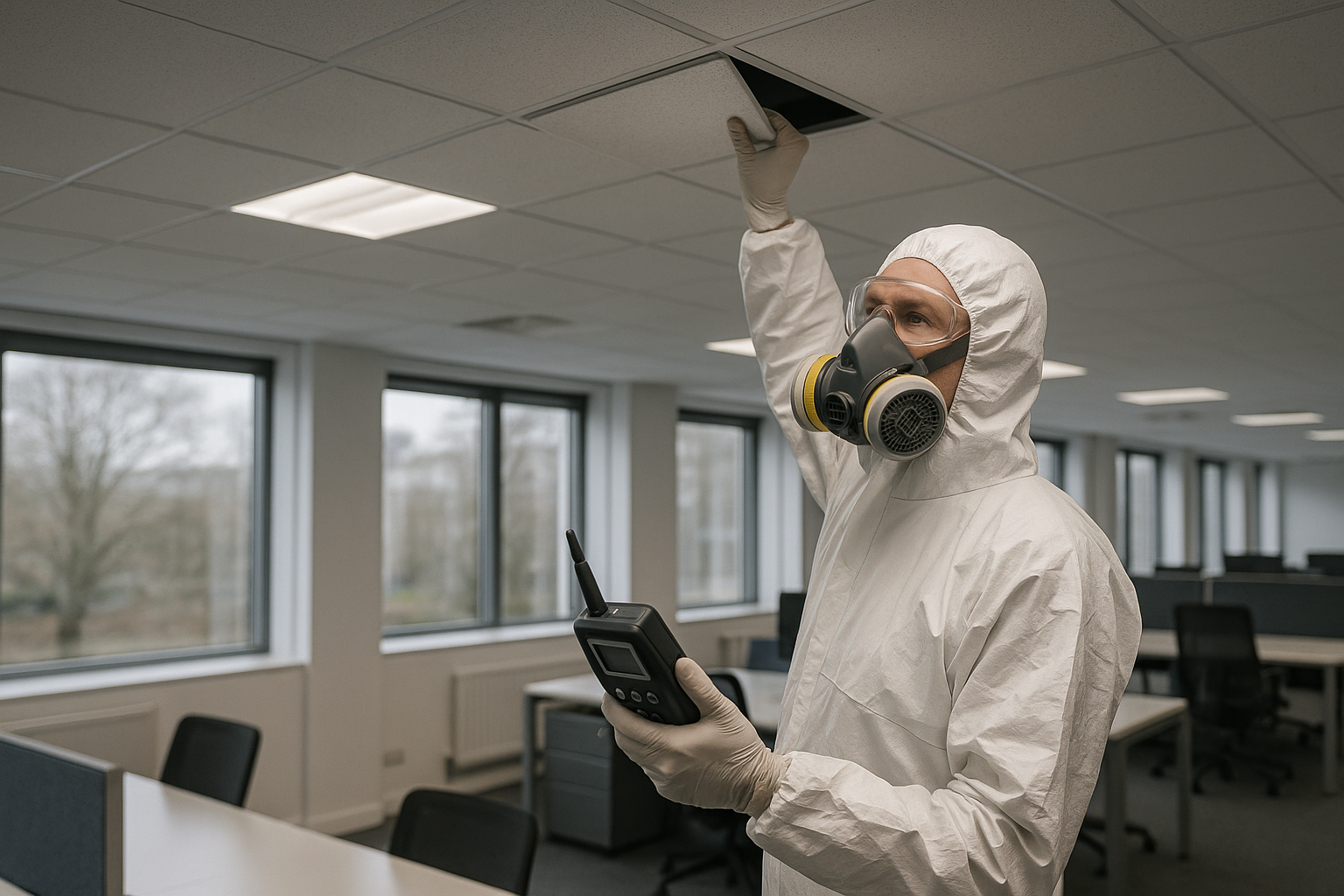
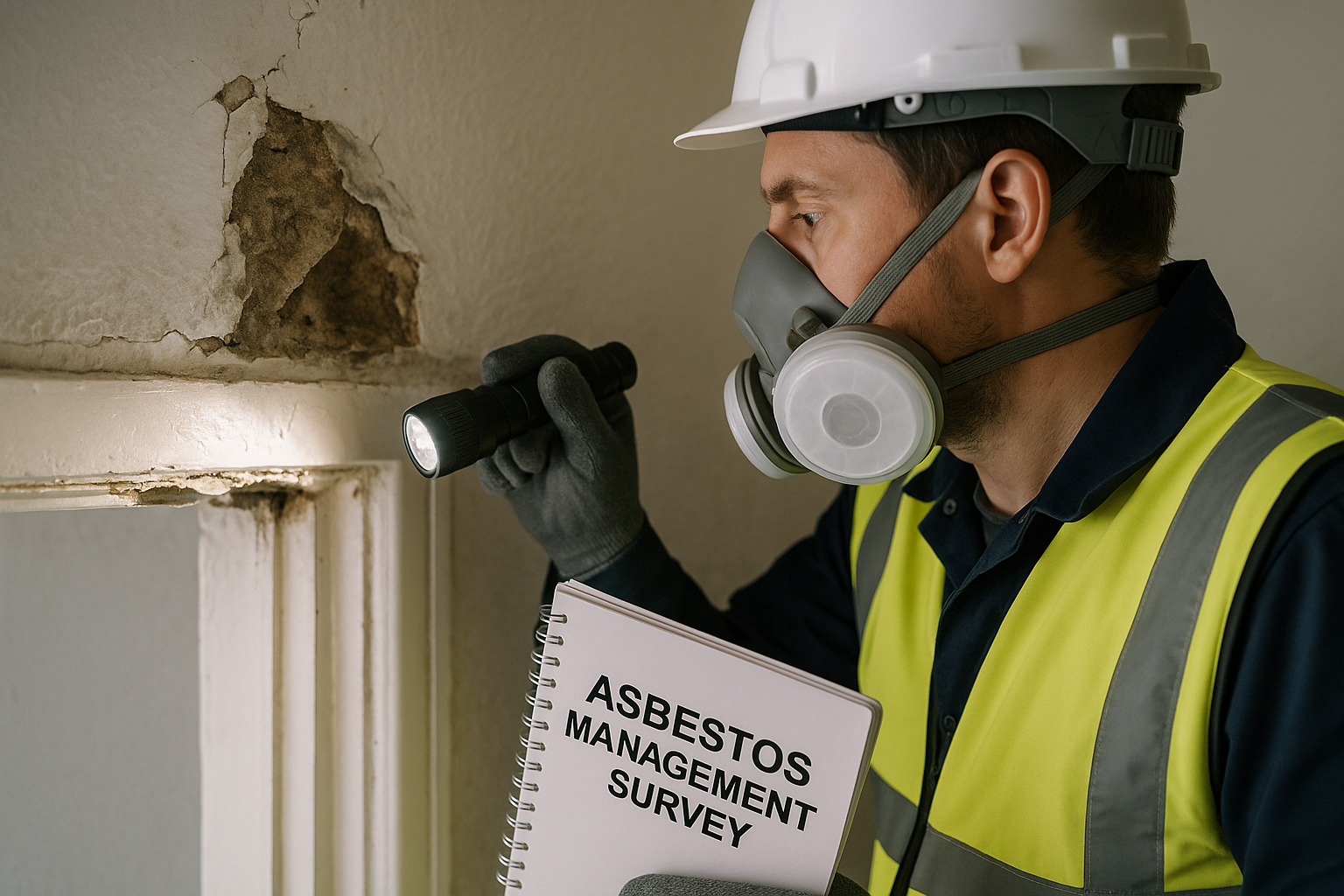
A management survey is primarily visual, but it is far more than a walk-through with a clipboard. The surveyor inspects accessible areas, identifies suspected asbestos-containing materials, assesses their condition, and takes samples where laboratory confirmation is needed.
The surveyor should also record inaccessible areas clearly. If a space cannot be inspected, it must not be ignored — it should be noted explicitly so the duty holder can manage that uncertainty until access is achieved.
Materials Commonly Identified During a Management Asbestos Survey
- Asbestos insulating board in partitions, ceiling tiles, fire breaks, and service risers
- Pipe lagging and thermal insulation in plant rooms and basements
- Textured coatings such as Artex on ceilings and walls
- Vinyl floor tiles and bitumen adhesives
- Asbestos cement sheets, soffits, gutters, and flues
- Sprayed coatings, insulation debris, gaskets, and rope seals
Each material identified should be described clearly, photographed, located on a plan, and assessed for condition and risk. Vague entries like “ceiling area” are not good enough when contractors need to work safely.
Arranging the Survey Properly
The quality of the result depends on the instructions, access, and competence behind it. HSE guidance is clear that surveys must be suitable, sufficient, and carried out by competent professionals.
- Define the scope clearly. Specify which buildings, floors, plant areas, outbuildings, roof spaces, and communal areas are included.
- Provide proper access. Unlock rooms, arrange permits, and make sure service areas, ceiling voids, and risers can be inspected where reasonably accessible.
- Choose a competent provider. Look for demonstrable experience, clear reporting, and work carried out in line with HSG264.
- Share the results. The report must feed into your asbestos register and be available to anyone liable to disturb materials.
Do not commission a management survey when you are actually planning intrusive works. That mismatch is one of the most common causes of asbestos being disturbed unexpectedly on site.
Sampling and Laboratory Analysis
Sampling and analysis is a key part of a reliable asbestos management survey. Visual inspection alone is not always sufficient, particularly where asbestos-containing products look similar to non-asbestos alternatives.
Samples should be taken carefully to minimise fibre release and sent for analysis by a UKAS-accredited laboratory. The result confirms whether asbestos is present and, where relevant, identifies the fibre type — which affects how the material should be managed.
Why Sampling Matters
- It reduces guesswork in the report and the register
- It helps prioritise risk accurately across the building
- It supports clear decisions on management, encapsulation, or removal
- It gives contractors better information before work begins
There are situations where a material is presumed to contain asbestos rather than sampled — usually because sampling would cause unnecessary damage or disturbance. If that approach is taken, the report must make it explicit, and the material must be managed as though asbestos is confirmed.
The Risk of Asbestos in Artex and Textured Coatings
Textured coatings applied to ceilings and walls in older properties may contain asbestos, usually in relatively small quantities, and they are still found regularly during a management survey. Artex and similar coatings are not always high risk if they are in good condition and left undisturbed.
The problem starts when ceilings are drilled for light fittings, scraped during redecoration, sanded, or damaged during repair works. That is when fibres can be released — often without anyone realising the material was hazardous.
Practical Advice for Textured Coatings
- Do not assume a textured ceiling is asbestos-free because it looks intact
- Do not scrape, sand, or drill it before survey confirmation or testing
- Inform electricians, decorators, and maintenance teams before any ceiling work starts
- Use the survey findings to decide whether the coating can be managed in place or requires specialist treatment
For many duty holders, textured coatings are exactly the kind of material an asbestos management survey is designed to identify before routine works turn into an exposure incident.
Checking the Accuracy of the Survey Report
A report is only useful if it is accurate, clear, and practical. Checking the report carefully should be part of your handover process, especially if you are responsible for contractor control across multiple sites.
Start by reading it as an end user would. Can a maintenance contractor easily understand where asbestos is, what it is, and what restrictions apply?
What to Check in the Report
- Correct building address, floor references, and room numbers
- Clear descriptions of each asbestos-containing material or presumed material
- Photographs and plans that match the actual site layout
- Material assessments and condition notes that are specific and usable
- A clear list of inaccessible areas and any survey limitations
- Recommendations that are proportionate and actionable
If something looks wrong or incomplete, query it immediately. A missing plant room, incorrect room label, or vague location reference can make the asbestos register far less useful when it matters most.
After the report is issued, keep it live. A periodic re-inspection survey confirms whether known materials remain in good condition and whether your register still accurately reflects the building as it stands.
When You Need a Refurbishment or Demolition Survey Instead
An asbestos management survey is not suitable for intrusive construction work. If you are upgrading toilets, replacing kitchens, opening walls, removing ceilings, rewiring, or altering services, a refurbishment survey is usually required in the affected area before work begins. It is intrusive by design and aims to identify asbestos before disturbance occurs.
If the whole building — or a significant part of it — is coming down, a demolition survey is required. This is more extensive and must identify all reasonably accessible asbestos-containing materials before demolition starts.
Choosing the Right Survey Type
- Management survey: Occupied building, normal use, routine maintenance
- Refurbishment survey: Intrusive works in a defined area before work begins
- Demolition survey: Full or partial demolition of a structure
Using the wrong survey type for the situation is not a technicality — it is a compliance failure that can put workers at risk. If asbestos is identified and removal is required before works proceed, asbestos removal by a licensed contractor must be arranged where the regulations require it.
Industries and Property Types That Commonly Require a Management Survey
Asbestos risk is not limited to heavy industry. Any older premises can contain asbestos-containing materials, and the duty to manage applies across a wide range of sectors and building types.
- Offices and commercial buildings
- Schools, colleges, and training centres
- Healthcare settings, GP surgeries, and dental practices
- Retail units, shopping parades, and warehouses
- Factories, workshops, and industrial estates
- Hotels, pubs, and leisure venues
- Blocks of flats and housing association communal areas
- Places of worship and community buildings
Different sectors bring different patterns of risk. A school may have repeated maintenance activity during holiday periods. A warehouse may experience frequent impact damage to panels and cladding. A block of flats may need clear asbestos information for communal refurbishments and visiting service contractors.
The asbestos management survey needs to reflect the specific building and how it is used — a generic approach rarely produces a report that is genuinely useful in practice.
Practical Steps After Your Asbestos Management Survey
Commissioning the survey is step one. Acting on it is where the legal duty actually sits. The Control of Asbestos Regulations require duty holders to manage asbestos — not simply to commission a report and file it away.
- Review the report for accuracy, completeness, and any limitations noted
- Create or update the asbestos register using the survey findings
- Prepare an asbestos management plan with clear responsibilities and review dates
- Share information with maintenance staff, contractors, and anyone likely to disturb materials
- Label or otherwise identify higher-risk areas where appropriate and practical
- Arrange remedial action, encapsulation, monitoring, or removal where the report recommends it
- Schedule future review and re-inspection activity based on the condition and risk of known materials
The register should be a live document, not a one-off exercise. As the building changes and materials age, the information needs to keep pace. Failing to maintain an up-to-date register is itself a breach of your duty to manage under the Control of Asbestos Regulations.
Regional Asbestos Management Survey Services
Supernova Asbestos Surveys operates across the UK, with surveyors experienced in commercial, residential, industrial, and public sector properties. Whether you need an asbestos survey London, an asbestos survey Manchester, or an asbestos survey Birmingham, our surveyors are familiar with the building stock, the sectors, and the compliance expectations in each area.
We have completed over 50,000 surveys nationwide and our reporting is designed to be genuinely usable — not just compliant on paper. Every survey is scoped correctly, carried out by competent professionals, and delivered in a format that supports real asbestos management rather than box-ticking.
If you are not sure which survey type you need, or if you want an honest assessment of whether an existing report is fit for purpose, speak to our team directly. We will give you a straight answer.
Call us on 020 4586 0680 or visit asbestos-surveys.org.uk to request a quote or discuss your requirements.
Frequently Asked Questions
What is the difference between an asbestos management survey and a refurbishment survey?
A management survey is designed for buildings in normal occupation and everyday use. It identifies asbestos-containing materials that could be disturbed during routine maintenance or minor works. A refurbishment survey is intrusive and required before any significant construction, alteration, or fit-out work takes place in a specific area. The two survey types serve different purposes and should not be used interchangeably.
Who is legally required to have an asbestos management survey?
Under the Control of Asbestos Regulations, the duty to manage asbestos applies to those who are responsible for non-domestic premises — including owners, landlords, facilities managers, and managing agents. This also extends to communal areas in residential buildings such as blocks of flats. If you have a duty to manage, you need to know whether asbestos is present, and an asbestos management survey is typically the starting point for fulfilling that obligation.
How long does an asbestos management survey take?
The duration depends on the size, complexity, and accessibility of the building. A small commercial unit may take a few hours. A large multi-floor office building, school, or industrial site may take a full day or more. Your surveyor should give you a realistic time estimate based on the scope before the survey begins. Laboratory results for samples typically take a few working days, after which the full report can be issued.
Can I rely on an old asbestos survey report?
Not always. Older reports may be incomplete, use outdated formats, or fail to cover areas that have since been altered or extended. HSE guidance requires that asbestos information is kept up to date and that the asbestos register reflects the current condition of the building. If your existing report is more than a few years old, has known gaps, or predates significant building works, it is worth having it reviewed or replaced with a current asbestos management survey.
What happens if asbestos is found during a management survey?
Finding asbestos does not automatically mean it needs to be removed. Many asbestos-containing materials can be safely managed in place, provided they are in good condition and not likely to be disturbed. The survey report will assess each material and recommend an appropriate course of action — whether that is monitoring, encapsulation, labelling, or referral for removal. Where removal is required, it must be carried out by a licensed contractor in accordance with the Control of Asbestos Regulations.