Safe Asbestos Removal: What Every Property Owner in the UK Needs to Know
Asbestos removal is one of the most tightly regulated activities in UK construction and property management — and the consequences of getting it wrong are severe. When asbestos-containing materials (ACMs) are disturbed incorrectly, microscopic fibres become airborne and can cause fatal diseases that may not surface for decades after exposure.
Whether you manage a commercial building, own a pre-2000 property, or are planning refurbishment work, this is a clear, practical breakdown of how safe asbestos removal works, when it is legally required, and what you need to do to protect yourself, your workers, and your occupants.
Why Asbestos Is Still a Problem in UK Buildings
Asbestos is a group of naturally occurring fibrous minerals that were used extensively in UK construction throughout most of the 20th century. It was valued for its fire resistance, durability, and insulating properties — and it was inexpensive to source and apply.
The UK banned brown and blue asbestos in 1985, with white asbestos following in 1999. But the legacy of decades of widespread use means asbestos remains present in millions of buildings across the country — particularly those built or refurbished before 2000.
The Health Risks You Cannot Afford to Ignore
When ACMs are damaged or disturbed, they release microscopic fibres that can be inhaled and become permanently lodged in lung tissue. The diseases linked to asbestos exposure include:
- Mesothelioma — an aggressive and incurable cancer of the lining of the lungs, abdomen, or heart
- Asbestos-related lung cancer — risk is significantly elevated in those who also smoke
- Asbestosis — a progressive scarring of lung tissue causing breathlessness and chronic cough
- Pleural thickening and pleural plaques — thickening or calcification of the lung lining, restricting breathing
The latency period for these diseases is typically 20 to 50 years. Someone exposed on a building site in the 1980s may only now be receiving a diagnosis. That long gap between exposure and illness is precisely why managing asbestos correctly — right now — matters so much.
When Does Asbestos Actually Need to Be Removed?
This is where many property owners get confused. Asbestos does not always need to be removed. In many cases, managing it in place is the safer and more practical option.
Under the Control of Asbestos Regulations, ACMs that are in good condition and unlikely to be disturbed can be left in place and managed through a documented asbestos management plan. Safe asbestos removal becomes necessary — or strongly advisable — in specific circumstances.
Situations That Typically Require Removal
- Damaged or deteriorating ACMs — materials in poor condition that are actively releasing fibres, or at risk of doing so, must be addressed promptly. Removal is usually the most appropriate solution.
- Refurbishment or demolition work — before any intrusive work begins, a demolition survey or refurbishment survey is legally required. Any ACMs in the work area must be removed by a licensed contractor before the main works start.
- Change of building use — converting an industrial unit to residential flats, for example, triggers a reassessment. What was acceptable to manage in situ in a commercial setting may not be appropriate where people will live.
- High-risk ACM types — sprayed coatings, pipe lagging, and loose-fill insulation are all considered high-risk due to their friable nature. These should be removed by a licensed contractor as a priority.
- Occupant concern or insurance requirements — sometimes removal provides the most straightforward long-term solution, particularly in buildings with changing tenants or complex management arrangements.
If you are unsure whether your ACMs need to be removed or managed in place, that decision should always be based on a professional asbestos survey — not a visual assessment or an assumption.
Getting the Right Survey Before Any Safe Asbestos Removal Work
No safe asbestos removal programme can be planned without first commissioning the correct type of survey. Using the wrong survey type is a common and potentially dangerous mistake.
Management Survey
A management survey is the standard survey for occupied, non-domestic buildings. It identifies the location, type, and condition of ACMs that could be disturbed during normal use and maintenance.
It forms the foundation of any asbestos management plan and is a legal requirement for duty holders managing non-domestic premises.
Refurbishment and Demolition Survey
This is a far more intrusive survey, required before any refurbishment or demolition work. It aims to locate all ACMs in the areas to be worked on — including those concealed within the building structure — so they can be removed before work begins.
This survey may cause some damage to the building fabric and is only carried out in areas that are unoccupied or can be safely cleared.
Re-Inspection Survey
If you have ACMs being managed in place, you also need regular condition monitoring. A re-inspection survey checks the condition of known ACMs against your asbestos register, flags any deterioration, and updates your management plan accordingly.
This is not optional — it is an ongoing legal duty for duty holders under the Control of Asbestos Regulations.
Asbestos Testing
Where the presence of asbestos in a specific material needs to be confirmed before decisions are made, asbestos testing provides laboratory-confirmed results. Samples are analysed by accredited laboratories and results inform whether removal, encapsulation, or management in place is the appropriate course of action.
For homeowners who want a straightforward first check on a suspect material, an asbestos testing kit allows you to collect a sample safely and send it to an accredited lab for analysis. However, a testing kit is not a substitute for a professional survey — it will not tell you about the condition of materials across your building or your legal obligations.
Can You Remove Asbestos Yourself?
No. In most cases involving licensable asbestos work, attempting to remove asbestos without an HSE licence is illegal. Even for non-licensable work — which covers a narrow range of lower-risk tasks — there are strict controls around personal protective equipment (PPE), waste disposal, and notification requirements.
Without proper training and equipment, you cannot carry out safe asbestos removal. The risks extend beyond the person doing the work — fibres can contaminate the wider building and affect anyone who enters the area.
If You Suspect Asbestos, Do This
- Do not touch, drill into, sand, cut, or otherwise disturb the suspected material
- Keep others away from the area
- Do not attempt to clean up any dust or debris with a domestic vacuum — ordinary hoovers spread fibres rather than contain them
- Contact an accredited asbestos surveyor to assess the situation
The Safe Asbestos Removal Process: Step by Step
Professional asbestos removal is a structured, regulated process. Here is what it looks like from start to finish.
Step 1: Survey and Risk Assessment
No removal work should be planned without first commissioning the appropriate survey. The survey report confirms which materials contain asbestos, their condition, and their risk rating.
This informs the scope of the removal work and the method statement the contractor will produce. Skipping this step is not just poor practice — it is a legal breach.
Step 2: Notification and Licensing
Most asbestos removal work in the UK requires a contractor licensed by the HSE. For licensable work, the contractor must notify the relevant enforcing authority at least 14 days before work begins — this is a legal requirement, not a formality.
Some lower-risk work falls into the category of non-licensed or notifiable non-licensed work (NNLW), which carries different — but still strict — requirements. Your contractor should be transparent about which category applies to your project.
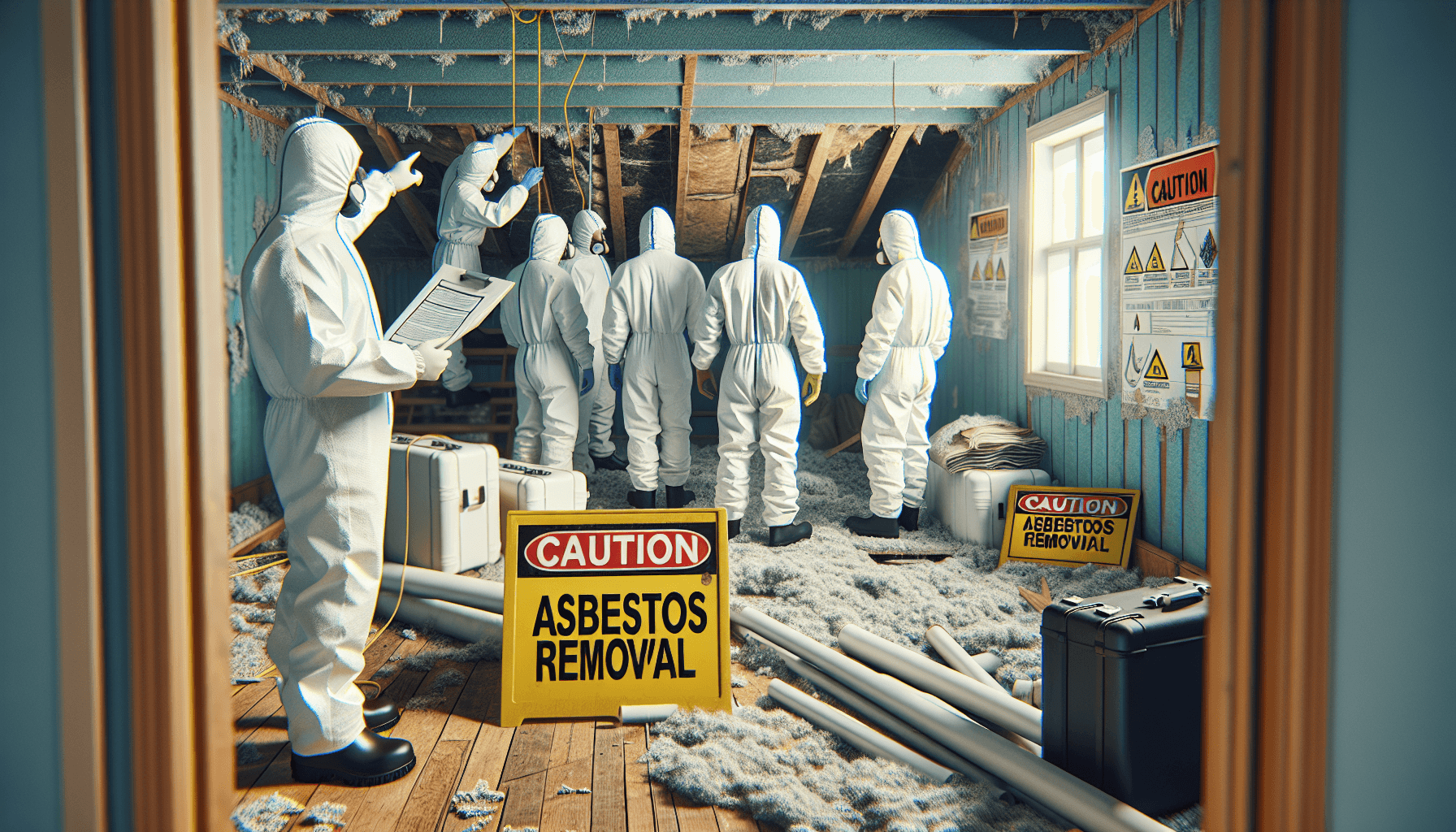
Step 3: Setting Up the Controlled Work Area
Before removal begins, the work area is fully isolated. This typically involves:
- Erecting an enclosure — a sealed, temporary structure around the work area to contain fibres
- Installing negative air pressure units with HEPA filtration to prevent contaminated air from escaping
- Establishing an airlock and decontamination unit for workers entering and leaving the enclosure
- Posting warning signs and barriers to prevent unauthorised access
Step 4: Removal of the Asbestos
Workers in full PPE — including type 5 disposable coveralls, gloves, and a correctly fitted respiratory protective device (RPD) — carefully remove the ACMs. Wet methods are used wherever possible to suppress fibre release.
Materials are double-bagged in clearly labelled, heavy-duty asbestos waste sacks as they are removed.
Step 5: Thorough Clean-Down
Once the material is removed, the enclosure is thoroughly cleaned using HEPA-filtered vacuum equipment and wet wiping. This is a critical step — any residual fibres left behind pose an ongoing risk to anyone who subsequently uses the area.
Step 6: Independent Air Clearance Testing
Before the enclosure is dismantled and the area handed back, an independent UKAS-accredited analyst carries out a four-stage clearance procedure. This includes a thorough visual inspection and air sampling.
The area is only released for use if clearance levels fall below the recommended threshold. This independent check is a vital safeguard — a responsible contractor will always insist upon it. For more detail on what this involves, you can find out more about asbestos testing procedures and clearance standards.
Step 7: Hazardous Waste Disposal
Asbestos waste is classified as hazardous waste under UK regulations. It must be transported by a registered waste carrier to a licensed disposal site, with the correct documentation — consignment notes — completed throughout the process.
Your contractor should provide copies of all waste transfer documentation as a matter of course. If they cannot, that is a serious red flag.
Choosing the Right Asbestos Removal Contractor
Not all contractors are equal. The asbestos industry has unfortunately seen its share of rogue operators who cut corners, put lives at risk, and leave clients with serious legal exposure. Here is how to separate the professionals from the cowboys.
Check the HSE Licence
For licensable work, the contractor must hold a current HSE asbestos licence. You can verify this directly on the HSE website. If a contractor cannot evidence their licence, do not engage them — full stop.
Look for Industry Accreditation
Membership of recognised industry bodies — such as the Asbestos Removal Contractors Association (ARCA) or the Asbestos Testing and Consultancy Association (ATaC) — indicates a commitment to professional standards and ongoing compliance.
Confirm Insurance
Ensure the contractor holds appropriate public liability and employers’ liability insurance. This protects you if something goes wrong during the removal work.
Demand a Written Method Statement
A professional contractor will provide a detailed method statement and risk assessment before work begins, along with a clear written quotation. Be wary of unusually low prices — cutting corners on safe asbestos removal puts lives at risk and can leave you legally liable.
Verify Waste Disposal Arrangements
Ask your contractor how the waste will be disposed of and request copies of all waste consignment notes. Illegal fly-tipping of asbestos waste does occur — you need certainty that your contractor handles disposal responsibly and in full compliance with the law.
Your Legal Obligations as a Duty Holder
If you are responsible for maintaining or managing a non-domestic building — as an owner, employer, or occupier — you have specific legal duties under the Control of Asbestos Regulations. These duties include:
- Assessing whether asbestos is present in the premises
- Maintaining a written asbestos management plan
- Keeping an up-to-date asbestos register
- Ensuring anyone who may disturb ACMs — tradespeople, maintenance staff, contractors — is made aware of their location and condition
- Monitoring the condition of ACMs at regular intervals
- Ensuring all work involving ACMs is carried out by appropriately licensed and competent contractors
Failure to meet these duties is not just a regulatory matter. If someone is harmed as a result of your failure to manage asbestos properly, you face potential criminal prosecution, unlimited fines, and civil liability.
If you manage buildings across multiple sites — including in the capital — our specialist asbestos survey London service covers the full range of survey types and can be coordinated across portfolios of any size.
Encapsulation vs Removal: Understanding Your Options
Safe asbestos removal is not always the only answer. In certain circumstances, encapsulation — sealing ACMs with a specialist coating to prevent fibre release — can be an appropriate alternative, particularly for materials that are in reasonable condition and not scheduled for disturbance.
Encapsulation is typically less disruptive and less costly than full removal. However, it is a management measure, not a permanent solution. Encapsulated materials still need to be recorded, monitored, and managed — and if the building is later refurbished or demolished, removal will still be required.
The decision between encapsulation and removal should always be made by a qualified asbestos professional, based on a current survey and risk assessment — not on cost alone.
What Happens After Removal: Ongoing Asbestos Management
Removing identified ACMs does not automatically mean your building is asbestos-free. In most pre-2000 buildings, it is common for some ACMs to remain — particularly in areas that were not within the scope of the removal works.
After any removal programme, your asbestos register must be updated to reflect what has been removed and what remains. Your management plan should be reviewed and revised accordingly. Any remaining ACMs still require regular re-inspection and condition monitoring.
Think of asbestos management as an ongoing responsibility, not a one-off event. The asbestos removal process is just one part of a broader duty of care that continues for as long as ACMs remain in a building.
Frequently Asked Questions
Do I always need a licensed contractor for asbestos removal?
Not always — but in the majority of cases, yes. Most asbestos removal work in the UK is classified as licensable work and must be carried out by an HSE-licensed contractor. A narrow category of lower-risk tasks falls under non-licensed or notifiable non-licensed work (NNLW), but these still carry strict legal requirements around training, PPE, and waste disposal. If you are unsure which category applies, seek professional advice before any work begins.
How do I know if my building contains asbestos?
If your building was constructed or refurbished before 2000, there is a reasonable possibility that asbestos-containing materials are present. The only reliable way to confirm this is through a professional asbestos survey carried out by an accredited surveyor. A visual inspection alone is not sufficient — many ACMs are not visually distinguishable from non-asbestos materials without laboratory analysis.
How long does asbestos removal take?
The duration depends on the quantity and type of ACMs being removed, the complexity of the building, and the access arrangements. A small domestic removal might be completed in a day or two; a large commercial project could take several weeks. Your contractor should provide a realistic programme as part of their method statement and quotation.
What does asbestos removal cost in the UK?
Costs vary significantly depending on the type and quantity of material, the level of licensing required, the location, and the complexity of the enclosure setup. It is always worth obtaining multiple quotes from licensed contractors — but be cautious of prices that appear unusually low. Cutting corners on safe asbestos removal carries serious legal and health consequences that far outweigh any short-term saving.
Can asbestos removal affect my property value?
Having a documented asbestos management plan and a clear record of any removal works can actually support your property’s value and saleability. Buyers, lenders, and insurers increasingly expect to see evidence of proper asbestos management in pre-2000 properties. Unmanaged or undocumented asbestos, by contrast, can complicate sales, delay transactions, and affect insurance cover.
Talk to Supernova Asbestos Surveys
Supernova Asbestos Surveys has completed over 50,000 surveys nationwide. Our UKAS-accredited surveyors provide the full range of survey types, asbestos testing, and specialist advice to help property owners and duty holders meet their legal obligations and protect the people in their buildings.
Whether you need a survey before planned works, an urgent assessment of a suspect material, or ongoing management support for a complex portfolio, we are here to help.
Call us on 020 4586 0680 or visit asbestos-surveys.org.uk to arrange a survey or speak to one of our team.