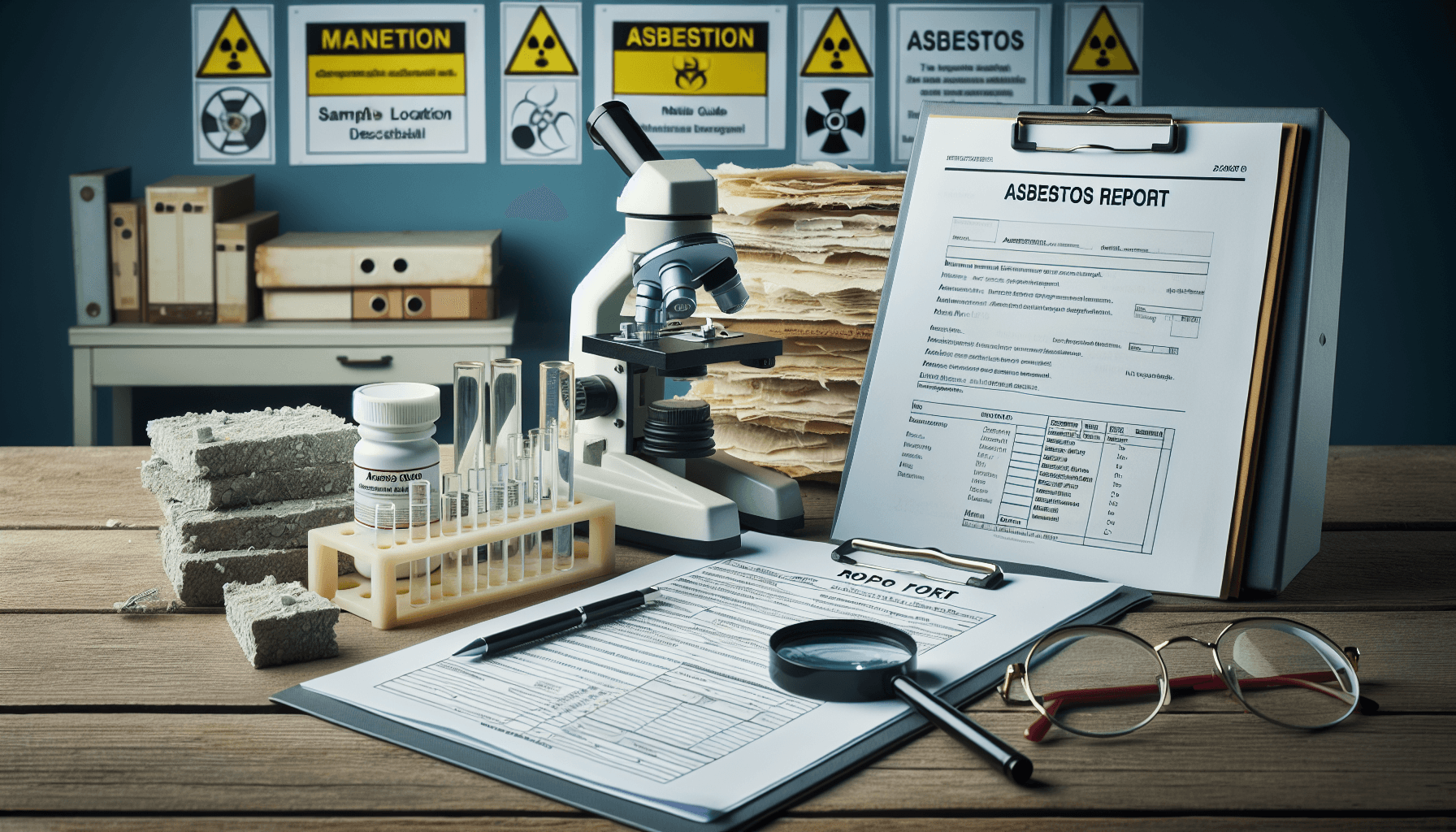
What Your Asbestos Report Must Actually Contain — And How to Tell a Good One From a Bad One
If you’ve commissioned an asbestos survey, you’ll receive a report when it’s done. But most duty holders never look beyond the first page — and that’s a problem. Understanding asbestos report requirements isn’t optional when you’re legally responsible for a building. A vague, incomplete, or poorly structured report can leave you exposed to serious liability, even if you genuinely believed you were doing the right thing.
This post covers everything you need to know: what a compliant report must contain, how surveys differ, what happens in the laboratory, and what your legal obligations are as a duty holder under the Control of Asbestos Regulations.
What Is an Asbestos Report?
An asbestos report is the formal document produced after a surveyor has inspected your premises for asbestos-containing materials (ACMs). It records what was found, where it was found, what condition it’s in, and what you should do about it.
Under the Control of Asbestos Regulations, duty holders — typically building owners and employers — are legally required to manage ACMs in non-domestic premises. A proper report is the foundation of that legal duty. Without one, you cannot produce a compliant asbestos management plan, and without a plan, you’re in breach of the regulations.
A report that’s vague, incomplete, or produced by an unqualified surveyor isn’t just unhelpful — it could expose you to criminal prosecution, significant fines, and the kind of liability that doesn’t go away.
The Different Types of Asbestos Survey — And the Reports They Produce
Asbestos report requirements vary depending on which type of survey was carried out. The survey type must be matched to the purpose — using the wrong one is a compliance failure in itself.
Management Survey
A management survey is the standard survey for buildings in normal use and occupation. Its purpose is to locate ACMs that could be disturbed during everyday activities — routine maintenance, minor repairs, cable runs — and to support the creation of an asbestos management plan.
The survey involves a thorough visual inspection with limited intrusion. Surveyors take samples of suspect materials where appropriate, but the work is designed to minimise disruption to occupants. Most commercial properties, schools, hospitals, and multi-tenancy buildings require this as a baseline.
Refurbishment Survey
A refurbishment survey is required before any significant refurbishment or remedial works take place. It’s far more intrusive than a management survey because it must locate all ACMs in the affected areas — including those hidden behind walls, above ceilings, and beneath floors.
Carrying out refurbishment without this survey is a potential breach of the Control of Asbestos Regulations. That’s not a technicality — it’s a serious legal risk that has resulted in prosecutions.
Demolition Survey
Before any structure is demolished, a demolition survey must be completed. This is the most intrusive survey type, requiring access to all areas of the building — including those that would be destroyed during the works. Every ACM must be identified and removed before demolition begins.
Re-Inspection Survey
Once ACMs are identified and recorded, they don’t disappear from your responsibilities. Any ACMs being managed in situ must be reinspected at least annually, or following any event that may have affected their condition.
A re-inspection survey allows duty holders to maintain a clear chronological record of how they’ve managed their legal obligations over time — which is exactly what the Health and Safety Executive will want to see if they ever investigate.
Core Asbestos Report Requirements: What Must Be Included
Regardless of which survey type was carried out, the final report must be clear, unambiguous, and immediately usable by the people responsible for the building. Here’s what the HSE’s guidance document HSG264 requires and what good practice demands.
Surveyor and Laboratory Details
- Full name and qualifications of the surveyor who carried out the inspection
- Name and UKAS accreditation details of the laboratory that analysed any samples
- Date of survey and a clear scope of areas covered
If any of these details are missing, treat the report with caution. A report without verifiable surveyor credentials or accredited laboratory details is not a compliant document.
Executive Summary
A brief overview of the key findings, overall conclusions, and immediate recommendations. This section is what most clients read first — it should give a clear picture of risk without requiring you to wade through pages of technical detail.
A good executive summary tells you immediately whether there are urgent actions required and what the overall risk profile of the building looks like.
Identified Asbestos-Containing Materials
This is the core of the report. Each suspected or confirmed ACM must be recorded with:
- Location — floor, room, specific area within the room
- Type of material and likely asbestos type (chrysotile, amosite, crocidolite, etc.)
- Quantity or extent of the material
- Current condition — good, fair, or poor
- Surface treatment — sealed, damaged, or exposed
- Accessibility to occupants and maintenance workers
- Photographs providing clear visual context
Photographs are non-negotiable. Without them, the report is significantly less useful to anyone who needs to locate or assess the material at a later date.
Priority Assessment Scores
Each identified ACM should be given a priority assessment score based on material condition, fibre type, location, and likelihood of disturbance. This scoring system helps duty holders understand which materials pose the greatest risk and need the most urgent attention.
Without priority scores, you’re left making subjective judgements about risk — which is precisely what the report should be doing for you.
The Asbestos Register
The asbestos register is a structured record of every ACM found in the building. It forms the backbone of your asbestos management plan and must be kept accessible to anyone who might work on the building — contractors, maintenance teams, and emergency services.
The register must be updated every time something changes: materials are disturbed, removed, or their condition deteriorates. An out-of-date register is almost as problematic as no register at all.
Laboratory Certificates and Sample Analysis Results
Where physical samples were taken, the report must include the laboratory certificates confirming what analysis was carried out and what was found. These certificates must come from a UKAS-accredited laboratory. Any report citing results from a non-accredited facility should be treated with serious scepticism.
You can arrange standalone sample analysis if you have suspect materials that weren’t included in a previous survey — this is a straightforward and cost-effective way to fill gaps in your records.
Recommendations
The report must clearly state what action is recommended for each identified ACM. Options typically include:
- Removal — where the material is in poor condition or at high risk of disturbance
- Encapsulation or sealing — where the material is stable but benefits from additional protection
- Management and monitoring — where the ACM is in good condition and in a low-disturbance location
Recommendations should be specific and actionable — not generic statements that leave you unsure what to do next.
Scope, Limitations, and Caveats
A reputable asbestos report will be honest about what the survey couldn’t assess — areas that were inaccessible, sealed voids, or sections excluded from the scope. These limitations must be clearly stated so you know exactly where knowledge gaps exist.
If a report makes no mention of limitations whatsoever, that’s actually a red flag, not a sign of a thorough survey. Every building has areas that can’t be fully assessed.
Sample Analysis: What Happens in the Laboratory
When a surveyor suspects a material contains asbestos, they take a physical sample for laboratory analysis. This is a controlled process with specific requirements at every stage — and it directly affects the reliability of your asbestos report.
How Samples Are Collected
Samples are collected carefully to minimise fibre release. The surveyor should use a HEPA-filtered vacuum and a water spray to suppress dust. The sample is immediately sealed in a labelled container recording the date, time, location, and site address.
The affected area must be decontaminated and cleared before reoccupation. Even a small sample — roughly the size of a two-pence piece — is sufficient for laboratory analysis.
Laboratory Analysis Techniques
Laboratory analysis follows a structured process using two primary techniques:
- Stereo Microscopy: The initial stage. Analysts examine the sample under a stereo microscope, assessing fibres by appearance and physical properties to determine the appropriate next steps.
- Polarised Light Microscopy (PLM) with Refractive Index Liquids: The definitive analysis stage. Analysts examine specific optical properties of each fibre — morphology, colour, pleochroism, extinction characteristics, and dispersion staining — to identify the type of asbestos present.
Where no visible fibres are present in the initial examination, analysts prepare at least two microscope slides from the sample before concluding analysis.
Laboratory Accreditation Requirements
All asbestos sample analysis in the UK must be carried out by a UKAS-accredited laboratory operating to ISO/IEC 17025. Analysts must hold the P401 qualification or an accepted equivalent. Samples must be retained by the laboratory for a minimum of six months after testing, after which they are disposed of as asbestos waste under controlled conditions.
The Asbestos Management Plan: What Comes After the Report
The asbestos report feeds directly into your asbestos management plan (AMP). You cannot produce a compliant AMP without a current, accurate report — and without a plan, you’re in breach of the Control of Asbestos Regulations as a non-domestic duty holder.
What the Plan Must Cover
- The asbestos register — kept current and accessible at all times
- Responsibility assignment — who is the named duty holder and who is the appointed Asbestos Responsible Person
- An action plan — what works are planned, what’s being monitored, and on what schedule
- Communication and training — who has been informed about ACMs and what training is in place for relevant staff and contractors
- Emergency and contingency arrangements — what happens if ACMs are accidentally disturbed
How Often to Review It
The plan should be reviewed at least annually. Your risk assessment should be revisited every six to twelve months, or sooner if there’s been any change in the condition of ACMs or works carried out on the building.
The plan needs to be usable by the people managing the building day to day — not a bureaucratic document gathering dust in a filing cabinet.
Surveyor Competence: Why It Matters for Report Quality
The quality of an asbestos report is only as good as the surveyor who produced it. Duty holders are responsible for ensuring they appoint a competent surveyor — and competence has a specific meaning here.
Qualified surveyors should hold the BOHS P402 qualification (Building Surveys and Bulk Sampling for Asbestos) as a minimum. Many will also hold the RSPH equivalent. Look for surveyors who are members of a recognised professional body such as BOHS (British Occupational Hygiene Society) or ARCA.
Using an unqualified surveyor to save money is a false economy. An incomplete or inaccurate survey leaves you exposed to liability and could put workers and occupants at genuine risk. The asbestos report requirements set out in HSG264 exist precisely because poor-quality reports have real consequences.
Your Legal Obligations as a Duty Holder
The Control of Asbestos Regulations set out clear legal duties for employers and building owners. Key obligations include:
- Identifying whether ACMs are present in non-domestic premises
- Assessing the risk from any ACMs found
- Creating, implementing, and maintaining an asbestos management plan
- Ensuring any work with asbestos is carried out by appropriately licensed contractors where required
- Providing information to anyone who might disturb ACMs during their work
- Ensuring staff who may encounter asbestos receive appropriate training
The exposure control limit for asbestos under the regulations is 0.1 fibres per cubic centimetre of air, averaged over a four-hour period. Employers must not allow workers to be exposed above this level and must take all reasonable steps to reduce exposure as far below this as possible.
Consequences of Non-Compliance
Non-compliance with the Control of Asbestos Regulations is a criminal offence. Penalties range from significant fines to imprisonment, depending on the severity of the breach. The HSE takes a robust approach to enforcement — particularly where workers have been put at risk.
Beyond the legal consequences, the human cost is real. Asbestos-related diseases — mesothelioma, asbestosis, asbestos-related lung cancer — kill thousands of people in the UK every year. The diseases typically take decades to develop after exposure, meaning decisions made today have consequences that last a lifetime.
When Should You Commission a Survey?
You should commission an asbestos survey in any of the following circumstances:
- You manage or own a non-domestic building constructed before 2000 and have no existing asbestos records
- You’re planning refurbishment, renovation, or demolition work
- Your existing asbestos register is out of date or incomplete
- You’ve purchased a commercial property and there’s no asbestos information available
- ACMs have been disturbed or damaged and you need an updated assessment
- You’re a landlord with responsibilities for communal areas in residential buildings
If you’re based in or around the capital, our asbestos survey London service covers the full range of survey types across all London boroughs. We also carry out surveys across the wider UK — our asbestos survey Manchester and asbestos survey Birmingham teams operate to exactly the same standards as our London-based surveyors.
Frequently Asked Questions
What are the legal requirements for an asbestos report in the UK?
Under the Control of Asbestos Regulations, duty holders of non-domestic premises must identify whether ACMs are present, assess the risk, and create an asbestos management plan. The asbestos report produced following a survey must include surveyor credentials, laboratory certificates from a UKAS-accredited facility, a full register of identified ACMs with condition assessments, priority scores, photographs, and clear recommendations. HSG264 sets out the detailed guidance on what a compliant survey and report must contain.
How long is an asbestos report valid for?
There is no fixed expiry date on an asbestos report, but it must remain accurate and current. If the condition of ACMs changes, works are carried out on the building, or materials are disturbed or removed, the report and register must be updated. ACMs being managed in situ must be reinspected at least annually. In practice, most duty holders commission re-inspection surveys every twelve months to ensure their records remain compliant.
Who can carry out an asbestos survey and produce a report?
Surveyors must be competent, which means holding appropriate qualifications — typically the BOHS P402 qualification as a minimum. Laboratory analysts examining samples must hold the P401 qualification and operate within a UKAS-accredited laboratory. Duty holders are responsible for ensuring they appoint competent surveyors. Using an unqualified individual to carry out a survey is a compliance failure, regardless of whether the report looks professional on paper.
Do I need an asbestos report for a domestic property?
The Control of Asbestos Regulations apply primarily to non-domestic premises. However, landlords have duties in relation to communal areas of residential buildings. Private homeowners are not subject to the same legal duties, but if you’re planning renovation or demolition work on a pre-2000 property, it’s strongly advisable to have a survey carried out before work begins — both to protect the workers involved and to avoid inadvertently creating a liability.
What should I do if my asbestos report identifies ACMs in poor condition?
ACMs recorded as being in poor condition should be treated as a priority. Your report’s recommendations will guide the appropriate action — this may be removal by a licensed asbestos contractor, encapsulation to stabilise the material, or increased monitoring frequency. Do not carry out any work on or near a material in poor condition without first seeking specialist advice. Poor-condition ACMs represent the highest risk of fibre release and must be managed accordingly.
Get a Compliant Asbestos Report From Supernova
Supernova Asbestos Surveys has completed over 50,000 surveys across the UK. Every survey is carried out by qualified, experienced surveyors operating to HSG264 standards, and every report meets the full asbestos report requirements set out under the Control of Asbestos Regulations.
Whether you need a management survey for an occupied building, a refurbishment or demolition survey ahead of planned works, or an annual re-inspection to keep your records current, we can help. We cover the whole of the UK, with dedicated teams across London, Manchester, Birmingham, and beyond.
Call us on 020 4586 0680 or visit asbestos-surveys.org.uk to get a quote or book a survey.